Bugcrowd domain subdomain takeover vulnerability
A Bugcrowd domain pointed to Fastly and was misconfigured or expired; a subdomain was linked to Pantheon. The author describes attempting takeover but gives no confirmed success.
 Published on blog.securitybreached.org
As I Frequently Visit bugcrowd.com The other domain bugcrowdtrafficcontrol.com was New for Me as I haven’t seen this domain I decided to Pay a Visit 😛 and I saw an error on the domain!
The full write-up lives on its author's site
It belongs to its author, so we link to it rather than copy it. The other two tabs are our own rewrites, checked against it.
Context
Bugcrowd runs a public bug bounty programme, and the researcher decided to test Bugcrowd itself. The asset involved is the domain bugcrowdtrafficcontrol.com, which sits alongside bugcrowd.com and is served through Cloudflare and Fastly. The behaviour at the centre of the write-up is the Fastly error page that appears when a hostname is pointed at Fastly but has not been added to any Fastly service:
Fastly error: unknown domain: bugcrowdtrafficcontrol.com. Please check that this domain has been added to a service.
Normally a Fastly customer adds their own domain to a service, and Fastly then serves that service's content for requests to the domain. If the DNS record still points at Fastly but nobody has claimed the hostname, anyone with a Fastly account can add it to a service of their own. The researcher's stated motivation was that people report this error on subdomains without actually claiming them, and that when you try to claim such a subdomain Fastly asks you to add the main domain instead. Here the affected name was the main domain itself.
Setup
The researcher used a reverse IP lookup, a WHOIS/DNS diagnostics view, and a Fastly account. A Pantheon account was also involved for the subdomain attempt, with a credit card required to subscribe to the Professional plan. No versions or further tooling are given in the report.
Finding it
While checking a reverse IP lookup for bugcrowd.com, the researcher got two results on the same IP address:
Reverse IP Lookup Results — 2 domains hosted on IP address [redacted]
    Domain  View Whois Record   Screenshots
1.  bugcrowd.com
2.  bugcrowdtrafficcontrol.com
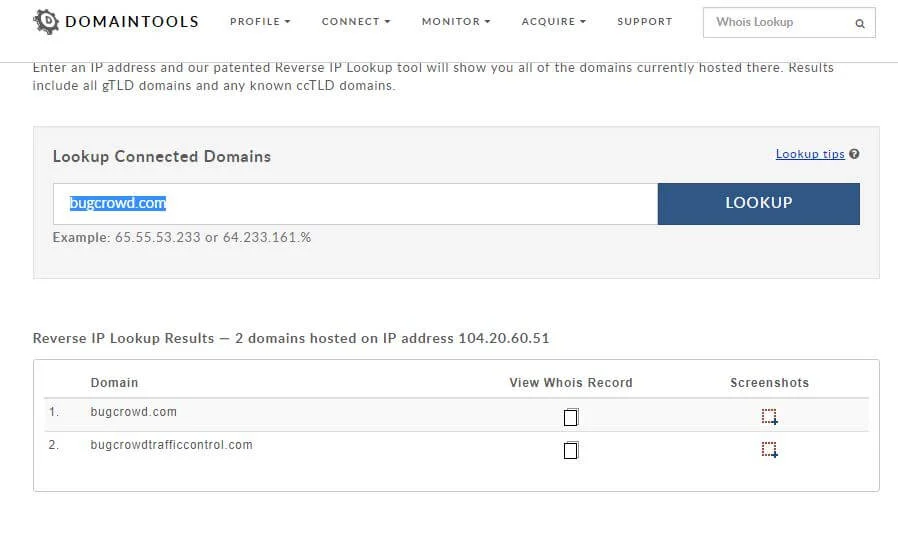
The second domain was unfamiliar, so the researcher visited it and was met with the Fastly unknown domain error.

That error is common on subdomains of bounty programmes, but here it was on what looked like a main domain. The researcher then pulled the DNS records for the domain:
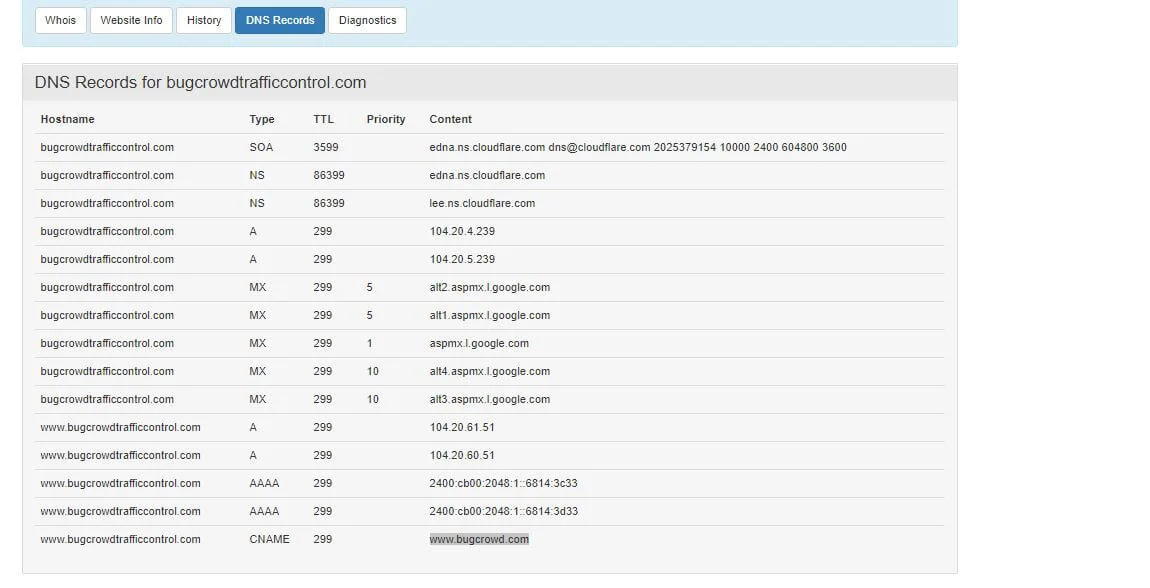
Diagnostics
DNS Records for bugcrowdtrafficcontrol.com
Hostname    Type    TTL Priority    Content
bugcrowdtrafficcontrol.com  SOA 1551        edna.ns.cloudflare.com [redacted] 2025379154 10000 2400 604800 3600
bugcrowdtrafficcontrol.com  NS  86399       edna.ns.cloudflare.com
bugcrowdtrafficcontrol.com  NS  86399       lee.ns.cloudflare.com
bugcrowdtrafficcontrol.com  A   299     [redacted]
bugcrowdtrafficcontrol.com  A   299     [redacted]
bugcrowdtrafficcontrol.com  MX  299 5   alt2.aspmx.l.google.com
bugcrowdtrafficcontrol.com  MX  299 5   alt1.aspmx.l.google.com
bugcrowdtrafficcontrol.com  MX  299 1   aspmx.l.google.com
bugcrowdtrafficcontrol.com  MX  299 10  alt4.aspmx.l.google.com
bugcrowdtrafficcontrol.com  MX  299 10  alt3.aspmx.l.google.com
www.bugcrowdtrafficcontrol.com  A   299     [redacted]
www.bugcrowdtrafficcontrol.com  A   299     [redacted]
www.bugcrowdtrafficcontrol.com  AAAA    299     [redacted]::6814:3c33
www.bugcrowdtrafficcontrol.com  AAAA    299     [redacted]::6814:3d33
www.bugcrowdtrafficcontrol.com  CNAME   299     www.bugcrowd.com
The apex has Cloudflare nameservers, Google Workspace MX records, and A records in Cloudflare's address space. The www host has A and AAAA records plus a CNAME to www.bugcrowd.com. For the researcher this was enough to confirm that the domain was owned by Bugcrowd.
Exploitation
Step 1: claim the apex domain on Fastly
The researcher opened a Fastly account and created a service named bugcrowdtrafficcontrol.com, using the IP of the domain. The service was created successfully:
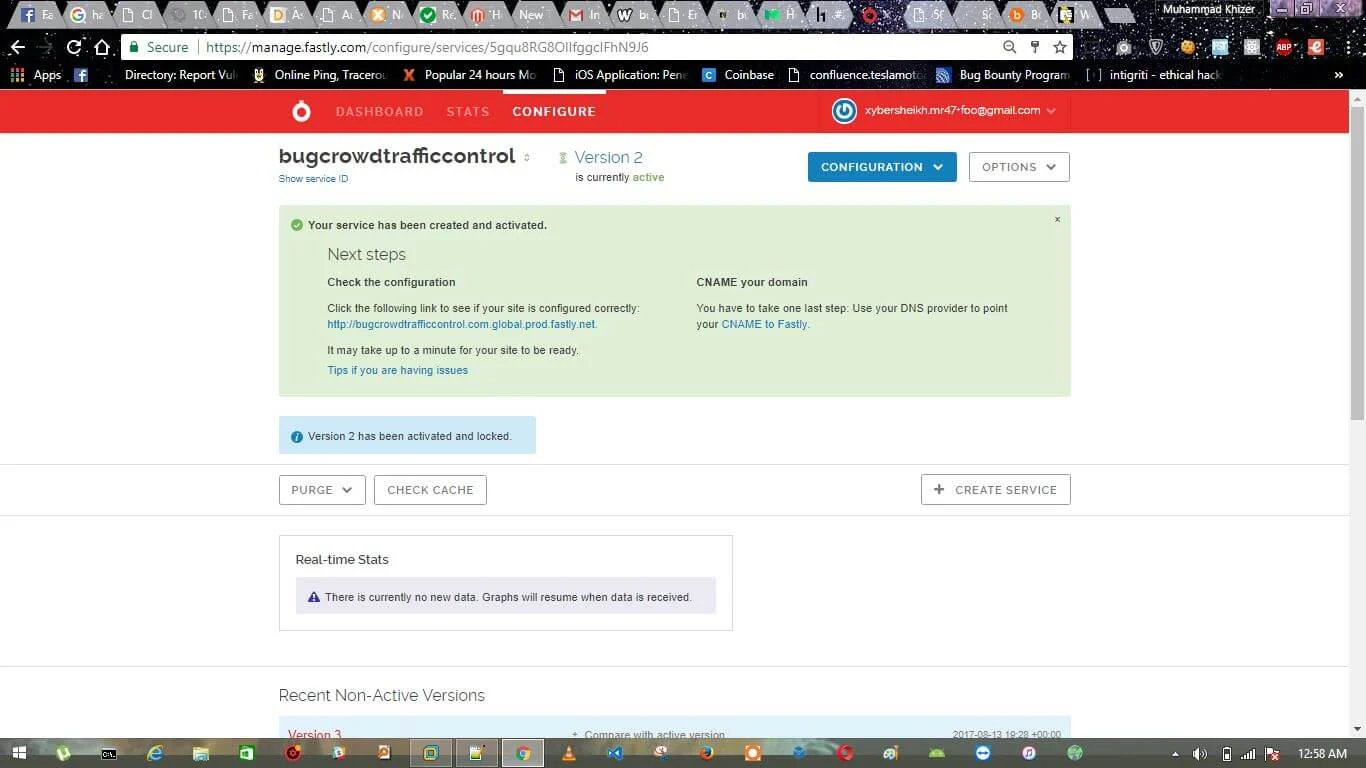
Your service has been created and activated. Domain 'bugcrowdtrafficcontrol.com' was created 2017-08-13 19:15 +00:00 by khizer
Click the following link to see if your site is configured correctly: http://bugcrowdtrafficcontrol.com.global.prod.fastly.net. It may take up to a minute for your site to be ready.
Because the hostname was not attached to any existing Fastly service, Fastly accepted it into the researcher's account. The message also gives the service's own hostname, bugcrowdtrafficcontrol.com.global.prod.fastly.net.
Step 2: observe the changed error
Visiting the domain again, the error had changed:
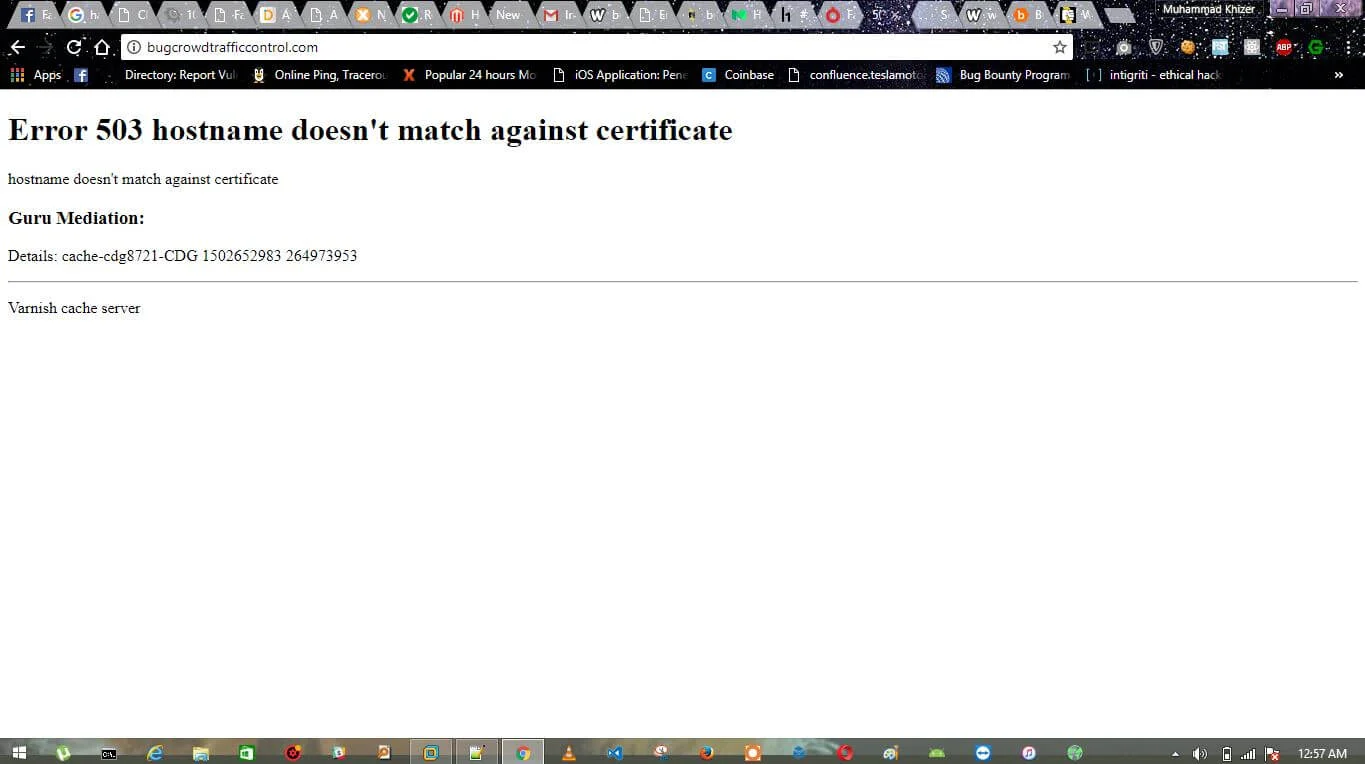
Error 503 hostname doesn't match against certificate hostname doesn't match against certificate Guru Mediation: Details: cache-cdg8721-CDG 1502652983 264973953 Varnish cache server
The researcher attributes this to a mistake: the same error appeared on the Fastly service URL http://bugcrowdtrafficcontrol.com.global.prod.fastly.net, and the researcher was not familiar with how to use these services. The important point is that the response was now coming from the researcher's own Fastly service rather than the unknown domain error.
Step 3: add the service through CloudFront
According to the researcher, this gives complete access to the domain.
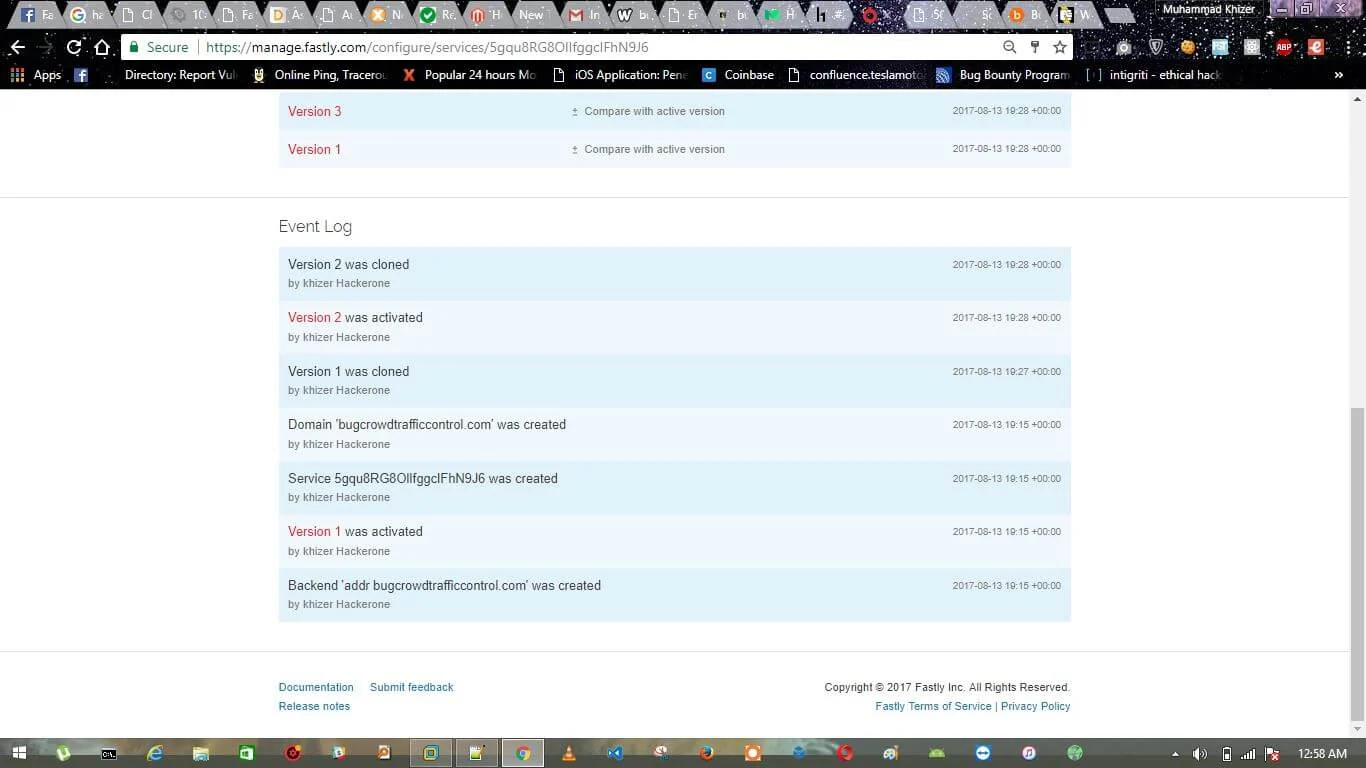
Step 4: the subdomain
The DNS records also showed www.bugcrowdtrafficcontrol.com, and visiting it produced an error of its own.
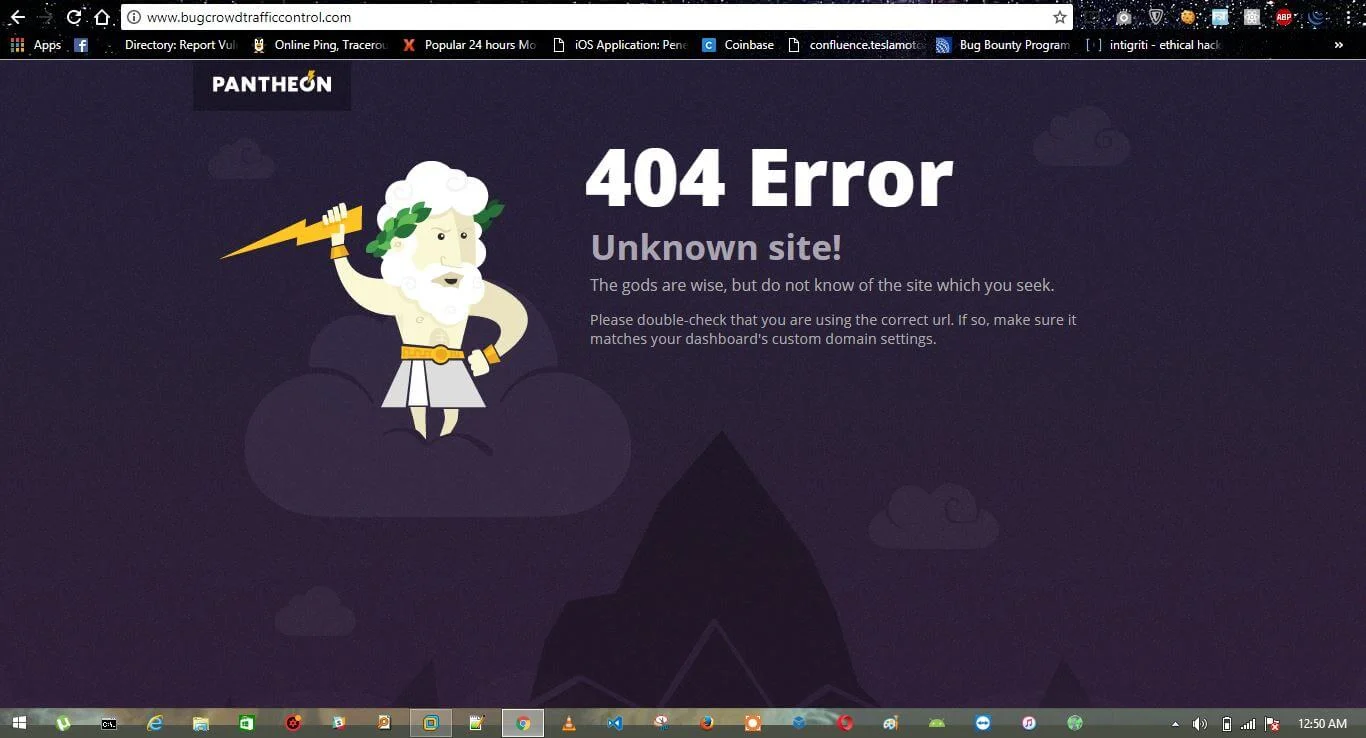
The researcher recalled a blog post about taking over a subdomain of DonaldJTrump's website with the same service and tried to follow those steps, but the card was declined while buying the services, so the subdomain was not taken over completely.
Step 5: the subdomain procedure
The report lists the steps that would have been used:
- Signed up as client in Pantheon service.
- Created a Sandboxed domain as WordPress or Drupal.
- Added a credit card, then subscribed as 'Professional' to setup the sandboxed domain.
- Used a feature called "custom domains" to add the vulnerable subdomain to my account.
- Waited for the verification and building process to be finish.
- Boom You will be the admin of the subdomain
Step 6: report and response
The researcher reported the issue to Bugcrowd, on the basis that both the domain and the subdomain were potentially owned by Bugcrowd. The report was closed as N/A, and the researcher still received 600 USD.
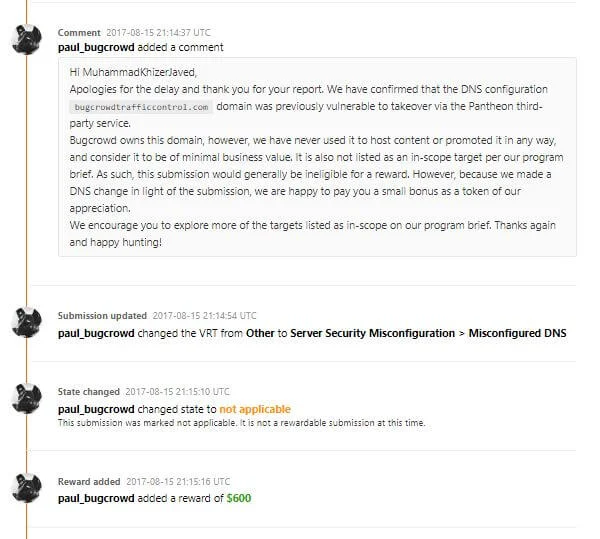
Root cause
A DNS record for bugcrowdtrafficcontrol.com still pointed at Fastly, but no Fastly service claimed the hostname. Fastly's model binds a hostname to whichever service adds it first, so an unclaimed hostname can be added by any account. The same applies to the www host, which the researcher attempted to take over through Pantheon's custom domains feature. The unknown domain error only signals that the hostname is unclaimed; it does not prevent claiming.
Impact
With the apex claimed on Fastly, the researcher states that access to the domain could be completed by adding the service to CloudFront on the Business plan. For the subdomain, the researcher states that completing the Pantheon steps would make the claimant the admin of the subdomain. Both outcomes depend on the claimant having a paid account and, in the subdomain case, a card that is not declined. The report does not describe what content or traffic the researcher actually served, and Bugcrowd closed the report as N/A.
Fix
The report does not say what was changed.
Variants to test
- Reverse IP lookups on a target's address space, looking for hostnames that resolve to a CDN or hosting provider but return an unclaimed-hostname error.
- DNS diagnostics on each discovered hostname, checking for CNAMEs to third-party platforms and for apex records pointing at CDN addresses. A positive result is a record whose target belongs to a provider the organisation may no longer use.
- Revisiting the hostname after claiming it and comparing the response with the provider's own service URL. A positive result is that the response now comes from your service rather than the unknown domain error.
- Checking
wwwand other subdomains of the same domain for the same condition, since the report found the apex andwwwaffected together. A positive result is the same unclaimed-hostname error on the subdomain.
What happened, in plain words
A security researcher decided to test Bugcrowd, a company that runs a public bug bounty programme. A bug bounty programme is a scheme where a company invites outside people to look for security mistakes in its systems and pays them for reporting what they find. The researcher found a domain name, bugcrowdtrafficcontrol.com, that belonged to Bugcrowd but was not properly claimed on a content delivery service called Fastly. Because nobody had claimed it, the researcher was able to add it to his own Fastly account. He then reported it to Bugcrowd, the report was closed as N/A (not applicable), and he still received 600 USD.
This article walks through the whole story from the beginning, explaining every term as it comes up, so that someone who has never done security testing can follow it.
Background concepts you need first
Before the story makes sense, here are a few ideas explained from zero.
What a domain name is
A domain name is the human-friendly address you type into a browser, like bugcrowd.com. Computers do not actually use names to find each other; they use numbers called IP addresses. A system called DNS (Domain Name System) translates the name into the number. Think of it like a phone book: you look up a name and get a number.
What a subdomain is
A subdomain is a name that sits under a main domain. In www.bugcrowd.com, the www part is the subdomain and bugcrowd.com is the main domain (sometimes called the apex or root domain). A company can have many subdomains: blog.example.com, shop.example.com, and so on.
What a CDN is
A CDN (Content Delivery Network) is a service that stores copies of a website's content on servers all over the world so that visitors get it faster. Fastly and CloudFront (Amazon's CDN) are two examples. When a website uses a CDN, the DNS records for the domain point at the CDN's servers instead of the website's own servers. The CDN then forwards the request to the real server behind the scenes.
What a DNS record is
A DNS record is one entry in the phone book. There are several types:
- A record: maps a name to an IPv4 address (a number like
[redacted]). - AAAA record: maps a name to an IPv6 address (a longer number format).
- CNAME record: says "this name is an alias for that other name".
- MX record: tells email systems where to deliver mail for the domain.
- NS record: says which nameservers are authoritative for the domain (the servers that hold the real records).
- SOA record: a "start of authority" record with administrative details about the domain.
What a nameserver is
A nameserver is a server that holds DNS records and answers questions about them. Cloudflare is a company that provides nameservers (and other services). If a domain's NS records point at Cloudflare, Cloudflare is the one answering DNS questions for that domain.
What a reverse IP lookup is
A normal DNS lookup goes from name to number. A reverse IP lookup goes the other way: you give it an IP address and it tells you which domain names are hosted there. It is useful for discovering domains you did not know about, because if a company's main domain and an unknown domain share the same IP address, they are probably related.
What WHOIS is
WHOIS is a public lookup service that shows registration information about a domain: who registered it, when, and which nameservers it uses. It is like looking up the owner of a phone number in a public directory.
What a subdomain takeover is
A subdomain takeover happens when a DNS record points at a third-party service (like a CDN or a hosting platform), but nobody has actually claimed that name on the service. Anyone who creates an account on that service can then claim the name and serve their own content at that address. The vulnerability class is called "subdomain takeover" because the attacker effectively takes control of the name.
What the Fastly error means
When a domain's DNS points at Fastly but the domain has not been added to any Fastly service, Fastly shows this error:
Fastly error: unknown domain: bugcrowdtrafficcontrol.com. Please check that this domain has been added to a service.
This message is Fastly saying: "I received a request for this name, but no customer of mine has claimed it." It is a signal, not a protection. It tells you the name is unclaimed, which is exactly the condition that makes a takeover possible.
Finding it
The researcher started by running a reverse IP lookup for bugcrowd.com. The result showed two domains on the same IP address:
Reverse IP Lookup Results — 2 domains hosted on IP address [redacted]
    Domain  View Whois Record   Screenshots
1.  bugcrowd.com
2.  bugcrowdtrafficcontrol.com
Line by line:
- The first line says the lookup found two domains sharing the IP address
[redacted]. - The table lists them:
bugcrowd.com(the known main domain) andbugcrowdtrafficcontrol.com(a name the researcher had not seen before).
The logic here is simple: if two names resolve to the same address, they are probably run by the same organisation. The second name was unfamiliar, so it was worth investigating.
The researcher visited bugcrowdtrafficcontrol.com in a browser and saw the Fastly unknown domain error.
That error is common on subdomains of bug bounty programmes, but here it appeared on what looked like a main domain. That difference mattered: normally, when you try to claim such a subdomain on Fastly, Fastly asks you to add the main domain instead. In this case, the affected name was the main domain itself, so that obstacle did not apply.
To confirm the domain really belonged to Bugcrowd, the researcher pulled its DNS records:
Diagnostics
DNS Records for bugcrowdtrafficcontrol.com
Hostname    Type    TTL Priority    Content
bugcrowdtrafficcontrol.com  SOA 1551        edna.ns.cloudflare.com [redacted] 2025379154 10000 2400 604800 3600
bugcrowdtrafficcontrol.com  NS  86399       edna.ns.cloudflare.com
bugcrowdtrafficcontrol.com  NS  86399       lee.ns.cloudflare.com
bugcrowdtrafficcontrol.com  A   299     [redacted]
bugcrowdtrafficcontrol.com  A   299     [redacted]
bugcrowdtrafficcontrol.com  MX  299 5   alt2.aspmx.l.google.com
bugcrowdtrafficcontrol.com  MX  299 5   alt1.aspmx.l.google.com
bugcrowdtrafficcontrol.com  MX  299 1   aspmx.l.google.com
bugcrowdtrafficcontrol.com  MX  299 10  alt4.aspmx.l.google.com
bugcrowdtrafficcontrol.com  MX  299 10  alt3.aspmx.l.google.com
www.bugcrowdtrafficcontrol.com  A   299     [redacted]
www.bugcrowdtrafficcontrol.com  A   299     [redacted]
www.bugcrowdtrafficcontrol.com  AAAA    299     [redacted]::6814:3c33
www.bugcrowdtrafficcontrol.com  AAAA    299     [redacted]::6814:3d33
www.bugcrowdtrafficcontrol.com  CNAME   299     www.bugcrowd.com
Line by line:
- The header says these are the DNS records for
bugcrowdtrafficcontrol.com. - The SOA record names
edna.ns.cloudflare.comas the authority and includes administrative numbers (serial, refresh, retry, expire, minimum). These are housekeeping values; the important part is that Cloudflare is in charge. - The two NS records confirm that Cloudflare's nameservers (
edna.ns.cloudflare.comandlee.ns.cloudflare.com) answer for this domain. - The two A records point the main domain at
[redacted]and[redacted], which are in Cloudflare's address space. - The five MX records point email at Google's mail servers (
aspmx.l.google.comand its alternates), which is typical for a company using Google Workspace for email. - The
wwwhost has two A records ([redacted]and[redacted]), two AAAA records (IPv6 addresses), and a CNAME pointing atwww.bugcrowd.com.
For the researcher, this was enough to confirm that the domain was owned by Bugcrowd: it uses Cloudflare nameservers, Google mail, and its www host is an alias for www.bugcrowd.com. All of that ties it to the same organisation.
Exploitation
Step 1: claim the main domain on Fastly
The researcher opened a Fastly account and created a service named bugcrowdtrafficcontrol.com, using the IP address of the domain. A "service" in Fastly is a configuration that tells Fastly what to do with requests for a particular hostname. The service was created successfully:
Your service has been created and activated. Domain 'bugcrowdtrafficcontrol.com' was created 2017-08-13 19:15 +00:00 by khizer
Click the following link to see if your site is configured correctly: http://bugcrowdtrafficcontrol.com.global.prod.fastly.net. It may take up to a minute for your site to be ready.
Line by line:
- The first line confirms that the service was created and activated, and that the domain
bugcrowdtrafficcontrol.comwas added to the researcher's account at the stated date and time. - The second line gives a link to the service's own hostname,
bugcrowdtrafficcontrol.com.global.prod.fastly.net, which is how Fastly addresses the service internally. It also warns that it may take up to a minute for the site to be ready.
Why did this work? Because the hostname was not attached to any existing Fastly service. Fastly's model is first-come, first-served: whoever adds a hostname to a service gets it. The unknown domain error was a sign that nobody had claimed it, and the researcher simply claimed it first.
Step 2: observe the changed error
Visiting the domain again, the error had changed:
Error 503 hostname doesn't match against certificate hostname doesn't match against certificate Guru Mediation: Details: cache-cdg8721-CDG 1502652983 264973953 Varnish cache server
Line by line:
Error 503means the server could not handle the request.hostname doesn't match against certificatemeans the TLS certificate (the digital certificate that proves a website's identity) presented by the server does not cover the name being requested. In plain terms, Fastly was now answering for the domain, but it did not have a certificate for that name.Guru Mediationis Fastly's playful name for its error page.- The rest is internal cache and server details.
The researcher attributes this to a mistake: the same error appeared on the Fastly service URL http://bugcrowdtrafficcontrol.com.global.prod.fastly.net, and the researcher was not familiar with how to use these services. The important point is that the response was now coming from the researcher's own Fastly service rather than the unknown domain error. In other words, the claim had worked; the configuration was just incomplete.
Step 3: add the service through CloudFront
According to the researcher, this gives complete access to the domain.
CloudFront is Amazon's CDN. The idea is that by putting the claimed service behind CloudFront on a paid plan, the researcher could serve content for the domain properly. The report does not describe exactly what content was served or what traffic was received.
Step 4: the subdomain
The DNS records also showed www.bugcrowdtrafficcontrol.com, and visiting it produced an error of its own.
The researcher recalled a blog post about taking over a subdomain of DonaldJTrump's website with the same service and tried to follow those steps, but the card was declined while buying the services, so the subdomain was not taken over completely. This is a practical reminder that some takeover techniques require a paid account, and a declined card can stop the attempt.
Step 5: the subdomain procedure
The report lists the steps that would have been used:
- Signed up as client in Pantheon service.
- Created a Sandboxed domain as WordPress or Drupal.
- Added a credit card, then subscribed as 'Professional' to setup the sandboxed domain.
- Used a feature called "custom domains" to add the vulnerable subdomain to my account.
- Waited for the verification and building process to be finish.
- Boom You will be the admin of the subdomain
What each step means:
- Pantheon is a hosting platform for websites. Signing up as a client creates an account.
- A sandboxed domain is a free trial site on Pantheon, built with WordPress or Drupal (two popular website-building systems).
- The Professional plan is a paid tier; a credit card is required to subscribe.
- "Custom domains" is a Pantheon feature that lets you attach your own domain name to a site. If the name is unclaimed on Pantheon, you can attach it.
- Pantheon verifies the domain and builds the site; you wait for that to finish.
- Once the process completes, you control what is served at that subdomain, which the report describes as being the admin of the subdomain.
Step 6: report and response
The researcher reported the issue to Bugcrowd, on the basis that both the domain and the subdomain were potentially owned by Bugcrowd. The report was closed as N/A, and the researcher still received 600 USD.
Why this happens (root cause)
A DNS record for bugcrowdtrafficcontrol.com still pointed at Fastly, but no Fastly service claimed the hostname. Fastly's model binds a hostname to whichever service adds it first, so an unclaimed hostname can be added by any account. The same applies to the www host, which the researcher attempted to take over through Pantheon's custom domains feature. The unknown domain error only signals that the hostname is unclaimed; it does not prevent claiming.
What the impact could be
With the main domain claimed on Fastly, the researcher states that access to the domain could be completed by adding the service to CloudFront on the Business plan. For the subdomain, the researcher states that completing the Pantheon steps would make the claimant the admin of the subdomain. Both outcomes depend on the claimant having a paid account and, in the subdomain case, a card that is not declined. The report does not describe what content or traffic the researcher actually served, and Bugcrowd closed the report as N/A.
How to fix it
Variants to test
- Run reverse IP lookups on a target's address space, looking for hostnames that resolve to a CDN or hosting provider but return an unclaimed-hostname error.
- Run DNS diagnostics on each discovered hostname, checking for CNAMEs to third-party platforms and for main-domain records pointing at CDN addresses. A positive result is a record whose target belongs to a provider the organisation may no longer use.
- Revisit the hostname after claiming it and compare the response with the provider's own service URL. A positive result is that the response now comes from your service rather than the unknown domain error.
- Check
wwwand other subdomains of the same domain for the same condition, since the report found the main domain andwwwaffected together. A positive result is the same unclaimed-hostname error on the subdomain.
Glossary
- A record: a DNS entry that maps a name to an IPv4 address.
- AAAA record: a DNS entry that maps a name to an IPv6 address.
- Apex domain: the main domain itself, without any subdomain prefix, such as
example.com. - Bug bounty programme: a scheme where a company pays outside researchers for reporting security problems.
- CDN (Content Delivery Network): a service that stores copies of website content on servers worldwide so visitors get it faster.
- CNAME record: a DNS entry that says one name is an alias for another name.
- Cloudflare: a company that provides nameservers and other web services.
- CloudFront: Amazon's content delivery network.
- DNS (Domain Name System): the system that translates domain names into IP addresses.
- DNS record: one entry in the DNS, such as an A, AAAA, CNAME, MX, NS or SOA record.
- Domain name: the human-friendly address of a website, like
example.com. - Fastly: a content delivery network whose services bind hostnames to configurations.
- Hostname: a name that identifies a machine or service on a network, such as
www.example.com. - IP address: the numeric address computers use to find each other.
- MX record: a DNS entry that tells email systems where to deliver mail for a domain.
- Nameserver: a server that holds DNS records and answers questions about them.
- NS record: a DNS entry that says which nameservers are authoritative for a domain.
- Pantheon: a hosting platform for websites, with a custom domains feature.
- Reverse IP lookup: a lookup that takes an IP address and returns the domain names hosted there.
- SOA record: a DNS entry with administrative details about a domain.
- Subdomain: a name under a main domain, such as
www.example.com. - Subdomain takeover: claiming a name on a third-party service when the DNS points there but nobody has claimed it.
- TLS certificate: a digital certificate that proves a website's identity and enables encrypted connections.
- WHOIS: a public lookup service showing registration information about a domain.
- WordPress / Drupal: two popular systems for building websites.