Modern Web Applications
The author describes several SSRF vulnerabilities found in different bug bounty programs, where features that fetch URLs could be abused to access internal services. In one case, an SSRF allowed access to AWS metadata and full cloud compromise; in others, internal SMTP and Redis services were reached.

It’s been over a year and a half since I’ve started my bug bounty journey as a hacker. With years of experience triaging reports and working in security, I’ve seen a plethora of bug types, attack vectors, and exploitation techniques.
The full write-up lives on its author's site
It belongs to its author, so we link to it rather than copy it. The other two tabs are our own rewrites, checked against it.
Context
This is a write-up about Server-Side Request Forgery (SSRF) as a bug class, built around five short stories of SSRF findings. The headline finding is against DuckDuckGo: a request to https://duckduckgo.com/iu with a query parameter named url that returns a page response when the parameter contains a URL whose domain is yimg.com. The endpoint returned a page response when the url parameter contained a URL with the domain yimg.com. The other stories cover a private CRUD-style program, a CMS asset on AWS, an authenticated signup flow, and an image upload feature in a financial analytics product.

Before the stories, the post sets out a working definition: SSRF is a vulnerability where an attacker can direct a system in a privileged network position to issue a request to another system with a privileged network position. The emphasis matters. A feature that lets an attacker direct a privileged service to make a request to a system in an unprivileged network position, such as a webhook pointed at a Burp Collaborator instance, is not a vulnerability. The author notes one exception from personal experience: being able to change the address to an attacker-controlled machine without a privileged network position once allowed reading the Authorization header and stealing credentials used on an internal API call, so the strict definition should be taken with a grain of salt.
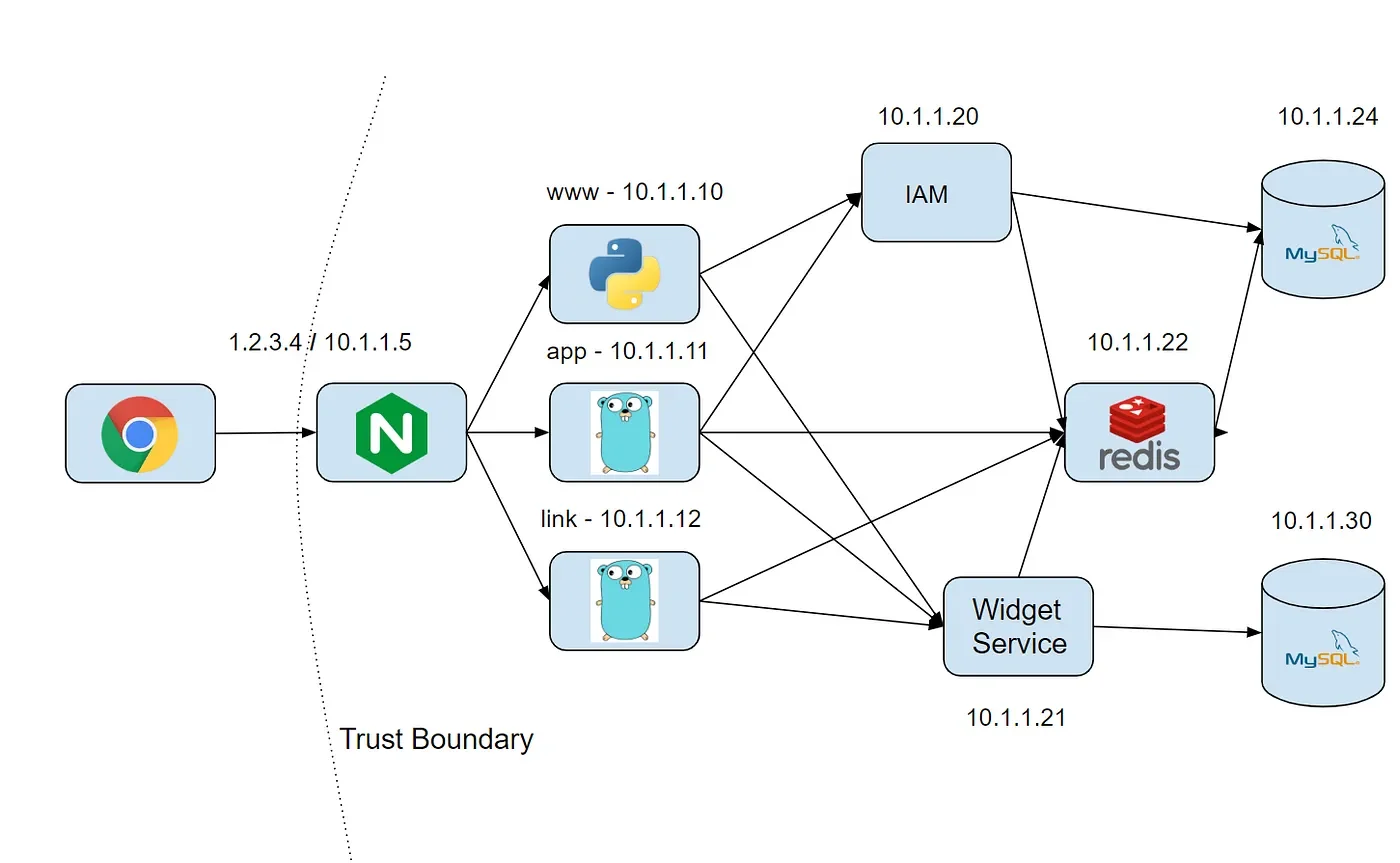
An example modern web application architecture
The architecture diagram shows the usual shape of a modern stack: an nginx instance with public and private IP addresses as the only directly reachable service, with vHosts exposing www, app and link services, and internal services such as IAM, Redis, a Widget Service and two MySQL instances that external parties cannot meaningfully control. Internal services are often less well secured than the perimeter, which is what makes SSRF valuable.
Setup
The author was hacking as a bug bounty hunter, roughly a year and a half into that work, with a background in triaging reports and working in security. The tools used across the stories are Burp Suite (HTTP History, and a Burp Collaborator instance used both for out-of-band callbacks and as a disposable mailbox during signup), sublist3r, dirsearch, and the aws cli client. No specific versions are given.
The DuckDuckGo story begins in the middle of October 2018. At the time, DuckDuckGo was configured as the default search engine in Chrome, and a search query was accidentally submitted to DuckDuckGo while Burp was intercepting, so all of the requests that page made were captured. The report is public.
Finding it
While reviewing HTTP History before shutting down for the night, the author noticed a request to https://duckduckgo.com/iu with a query parameter named url. The parameter appeared to return a page response whenever it contained a URL with a domain name of yimg.com.
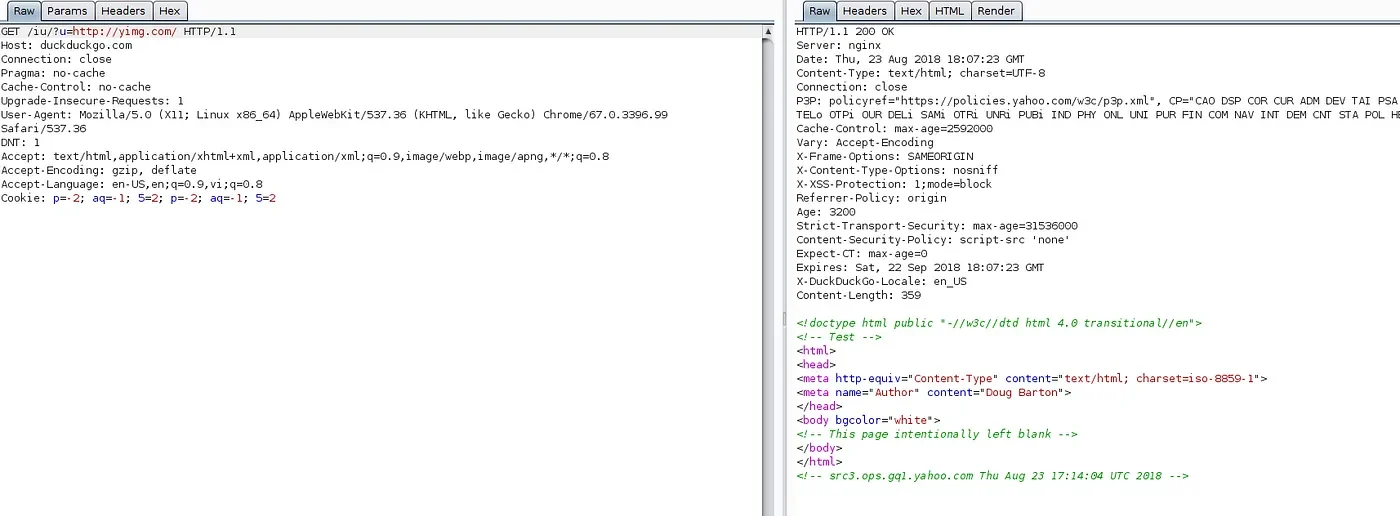
Successful request
When another domain such as google.com was supplied, the response was an error indicating that requests to other domains were being filtered. The unsuccessful response carried 403 Forbidden, as opposed to the 200 OK above.
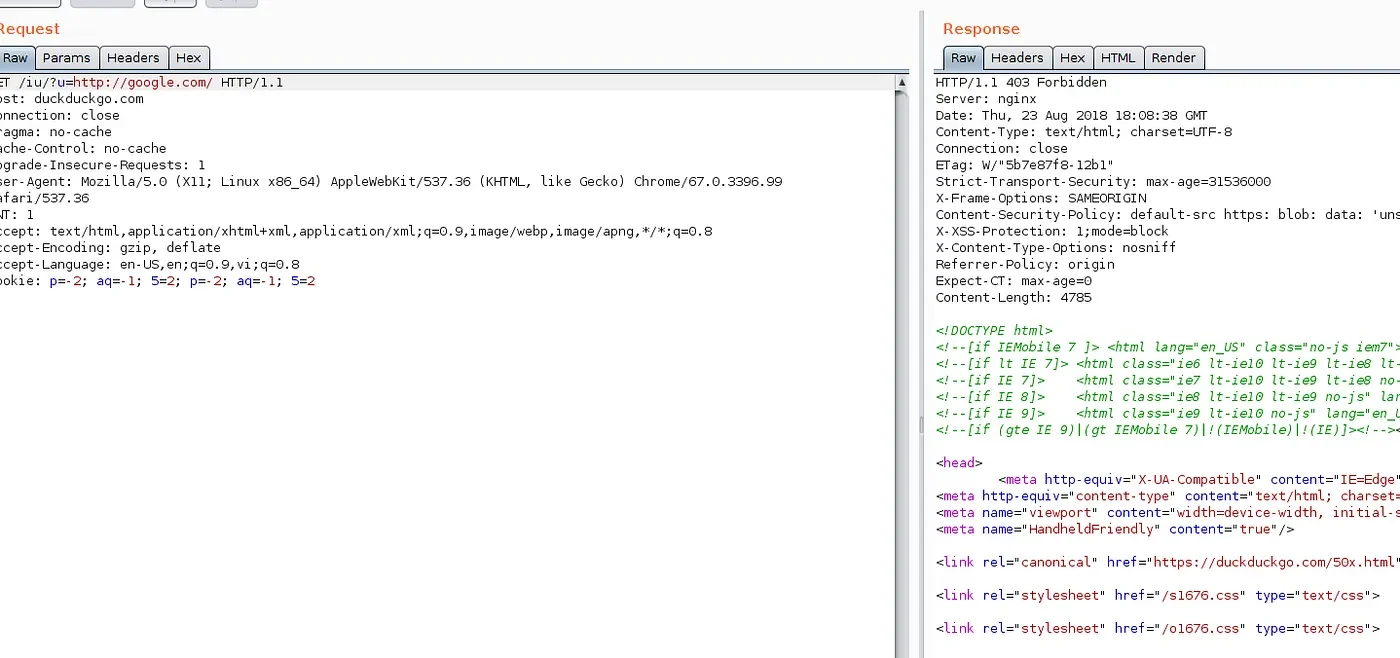
Unsuccessful request
On a hunch, the author tested whether the service was actually parsing the URL for the allowlist or merely running a string.contains-style check. Appending the allowlisted domain to a fake query parameter was enough to bypass the filter.
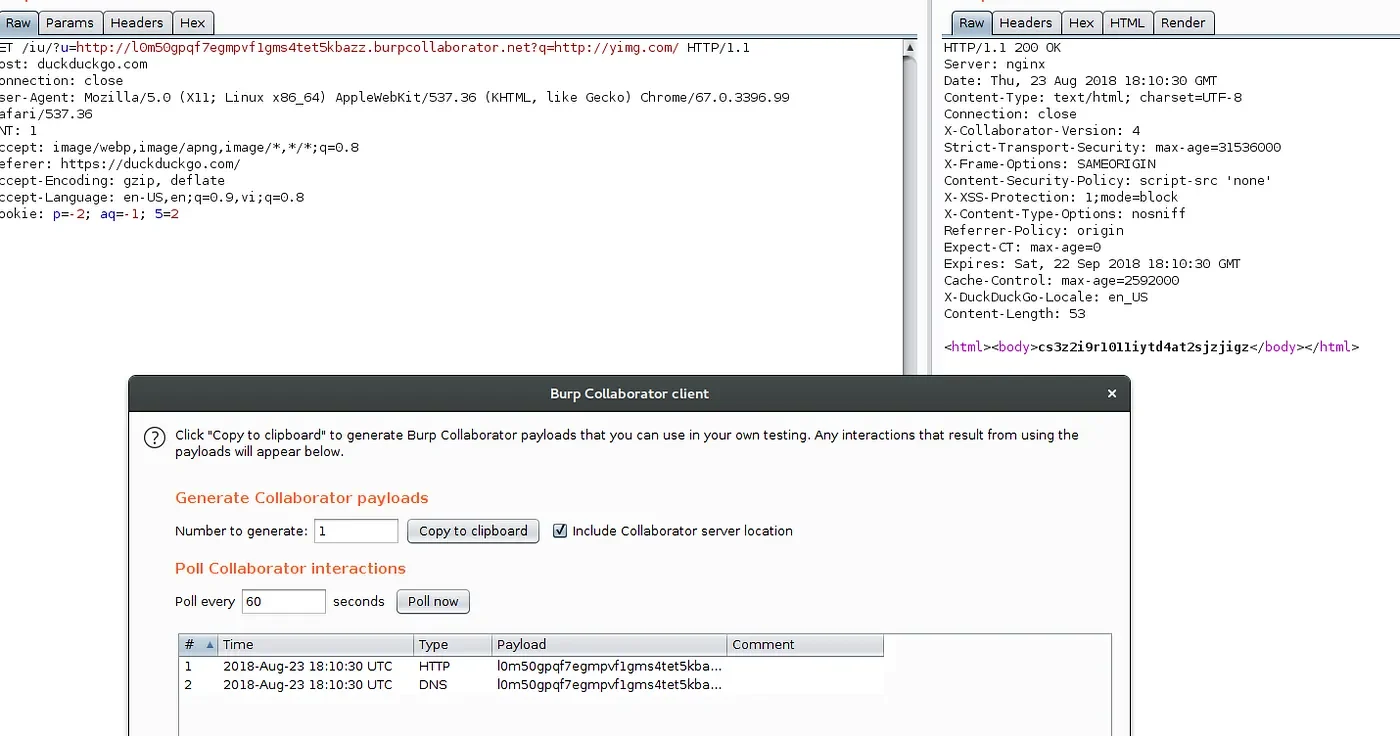
Bypassing a string.contains filter by appending the domain to a fake query parameter
Exploitation
Step 1: confirm redirects are followed
The first property to test was redirect behaviour. The author pointed DuckDuckGo at an endpoint that responded with a 302 redirect to a Burp Collaborator instance and confirmed that the redirect was followed.
Step 2: test the gopher protocol through a redirect
Next, the author checked whether the gopher protocol was supported by placing it in the Location header of the redirect. Gopher would allow talking to many more services internally, so learning whether the client supported it was useful and would increase the severity of the finding. It was supported.
Step 3: port scan localhost
Using the SSRF, the author performed a port scan and discovered a number of services running on localhost. One of them, on port 6868, was Redis, which was returning some data when hit with HTTP. The JSON that came back mentioned a domain that only seemed resolvable internally.
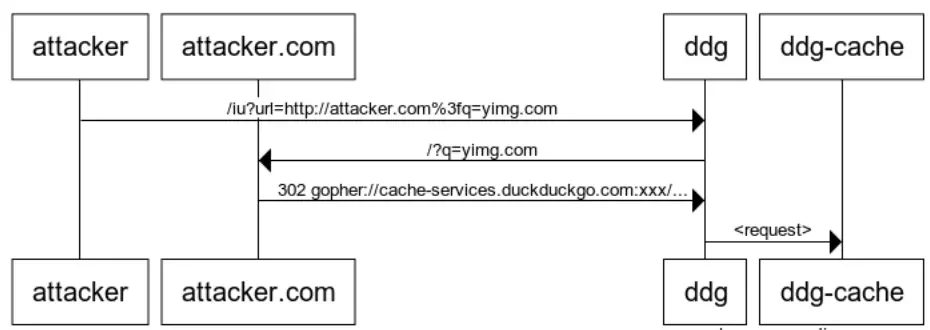
SSRF against duckduckgo
Step 4: identify further internal services
Eventually the author noticed that port 8091 was open on cache-services.duckduckgo.com and was returning a large amount of data. The report had already been opened with DuckDuckGo a little earlier, and this further probing was done to see what else could be done to increase impact.
Aftermath
DuckDuckGo does not pay for bugs, but it does offer swag. The author received a DuckDuckGo t-shirt, the story, and a public disclosure.
The other stories
Story 2: In ursmtp
On a private program that felt like it could be replaced by any other CRUD app, the author found an account-update feature with a personal website address field, similar to the one on Twitter. If the website did not exist or was inaccessible, the field turned yellow; if the site did exist, it turned green.
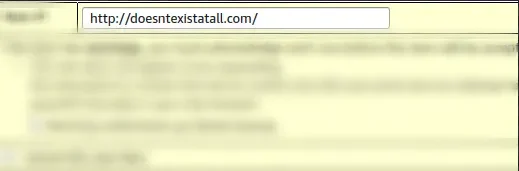
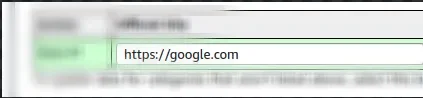
Site doesn't exist vs site does exist
That feedback mechanism showed the service was issuing an HTTP request to the supplied address. A Burp Collaborator address confirmed it: a request came in. The feedback mechanism was then used to perform a local port scan, which found SSH, SMTP, DNS and a few other services that could not be identified by port. Redirect and gopher behaviour were tested as with DuckDuckGo, and both were available. With gopher available, the author crafted an SMTP message in gopher and fired it at localhost:25; moments later a new email arrived in the inbox. The finding was awarded $800 and rated high.
Story 3: CMSSRF
On a recently opened private program, the author skipped the core domain and looked at interesting subdomains. sublist3r found subdomains with cms in the name. dirsearch was run against the asset, and after about 15 minutes an endpoint mentioning user management was found that returned a 302 to another endpoint with a login page for a management system. JavaScript files referenced an API on the asset. The qa subdomain of that asset had unobfuscated JavaScript, which revealed how to call the API and which calls were available. One call was named createWebRequest and took one url parameter in a POST body.
Knowing the asset ran on AWS, the author issued a request to that API endpoint for the AWS metadata IP address, and got a hit.
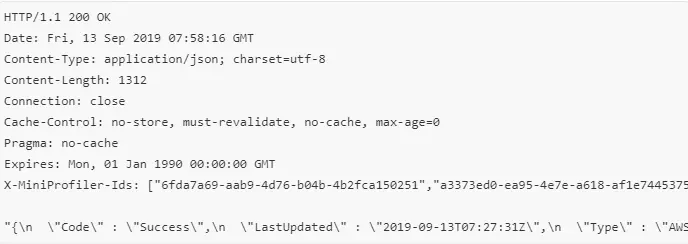
Response from createwebrequest api
Using the returned AWS keys in the aws cli client gave an absurd level of access to dozens of S3 buckets, dozens more EC2 instances, Redis and more. The finding was paid $3,000 (the maximum payout) and marked critical.
Story 4: Authenticated Request
On a new private program, after finding a couple of stored XSS issues, the author checked a Burp Collaborator instance left open and saw an HTTP request with a User-Agent mentioning the service being hacked on. Reconstructing the timeline explained it: signing up with an email like [redacted] produced, seconds later, both an SMTP message and an HTTP request for the homepage. Signing up again with an address like [redacted] was used to check whether 302 behaviour was respected; the forwarded request arrived in the Collaborator instance. The request was fronted by Squid Proxy, which would probably block attempts to access the internal network, so gopher was tested on a 302 redirect and worked for interacting with internal services. There was no feedback of any kind, so a port scan was not possible. A localhost SMTP message was attempted anyway, and a new email arrived in the inbox, proving the SSRF was real. At the time of writing the report had been triaged as high with no payout yet.
Story 5: Owning the Clout
On a financial-space program with an analytics product, an image upload feature stored images for use in other features. The author tested whether HTML could be uploaded and, if so, what happened when that HTML fetched external resources. The service rejected the HTML upload. Lying about the content type in the multipart upload by changing it to image/jpeg made the document upload fine.
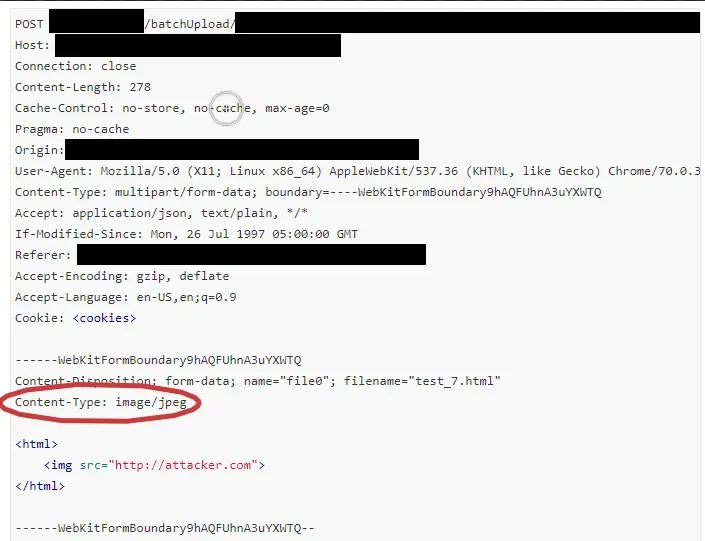
A request to another endpoint that gave updates on the status of the document triggered an internal renderer/browser to issue a request to attacker.com.
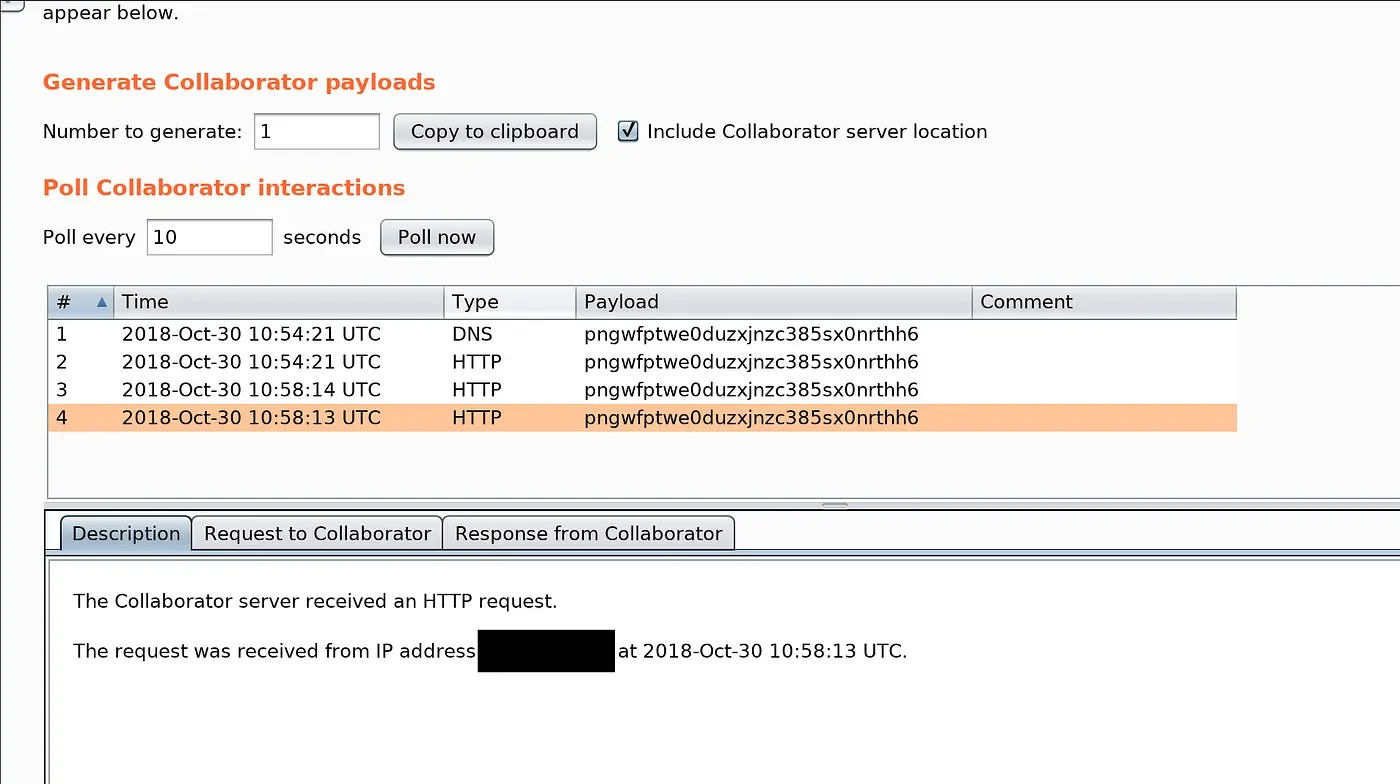
This was reported and paid $1,000 at medium. In retrospect, the author says more should have been done to prove additional impact, which would likely have raised the payout.
Root cause
In the DuckDuckGo case, the allowlist check was not parsing the URL. It was a string.contains-style check, so a URL that merely contained the allowlisted domain anywhere in the string passed. Appending the domain to a fake query parameter was enough. The redirect handling then compounded it: redirects were followed, and the Location header accepted the gopher scheme, so the initial allowlist check on the first request did not constrain where the client ultimately connected. The report does not describe the server-side code; the author's hunch was that the check was a string.contains-style one rather than real URL parsing.
In the other stories the pattern is the same class of mistake: a user-controlled address is fetched by a service in a privileged network position, with no effective restriction on destination, scheme or redirects. In Story 2 the only signal was a colour change in the UI, which still leaked enough to port scan. In Story 3 the API accepted an arbitrary url and reached the AWS metadata service. In Story 4 signing up with an email at a Collaborator domain produced an SMTP message and an HTTP request for the homepage. In Story 5 the upload accepted a mislabelled content type and an internal renderer issued a request to attacker.com.
Impact
With the DuckDuckGo SSRF the author could port scan localhost, identify internal services including Redis on port 6868 and a service on port 8091 on cache-services.duckduckgo.com that returned a large amount of data, and interact with internal services using gopher. The report does not describe reading credentials or taking over a host in this case.
In Story 2 the impact was proven by sending an email through the local SMTP service on localhost:25. In Story 3 the keys from the AWS metadata service gave an absurd level of access to dozens of S3 buckets, dozens more EC2 instances and Redis. In Story 4 the impact was again proven by an email through localhost SMTP. In Story 5 the impact was an internal renderer issuing a request to attacker.com; the author notes that with an address to hit, an internal system would have been reachable.
Fix
It notes that proxies in front of internal HTTP clients can properly discern whether a request should be forwarded to its destination. For upload and renderer features, validate the actual content rather than the declared content type, and do not let the renderer reach arbitrary addresses.
Variants to test
- Substring allowlist bypass. Take any parameter that takes a URL and is checked against an allowlisted domain, and append the allowlisted domain to a fake query parameter, as in the DuckDuckGo case. A positive result is a page response for a URL that should have been rejected by the allowlist.
- Redirect to an internal address. Point the parameter at an endpoint you control that returns a 302 to an internal address or to a Collaborator instance. A positive result is a callback or an internal response, showing redirects are followed without re-validation.
- Scheme switching in
Location. Usegopherin theLocationheader of a redirect. A positive result is a successful gopher interaction with an internal service, which also widens the set of reachable services. - Cloud metadata. On any asset known to run on a cloud provider, point the URL parameter at the metadata IP address. A positive result is credentials or instance data in the response, as in Story 3.
- UI side channels. Where the only feedback is a visual state, such as a green or yellow field, use it to port scan localhost and to confirm out-of-band requests with a Collaborator address, as in Story 2.
- Signup and email flows. Register with an address whose domain points at a Collaborator or at
xip.ioand watch for HTTP requests to the homepage, as in Story 4. - Upload content-type lies. Upload HTML while declaring
image/jpegin the multipart request, then trigger the renderer through a status endpoint and watch for a request to your host, as in Story 5. - Local SMTP. Where gopher is available, craft an SMTP message and send it to
localhost:25; a new email in your inbox proves interaction with an internal service even when responses cannot be read.
What happened, in plain words
This is a story about a class of security bug called Server-Side Request Forgery, usually shortened to SSRF. Before the stories, the author explains what SSRF is, why companies care about it, and how to test for it. Then come five short stories of SSRF findings, the headline one being against DuckDuckGo.
In plain words: a website sometimes has a feature where it fetches something from another address on your behalf. For example, it might fetch a web page, an image, or check that a website you typed in actually exists. The website's server does the fetching, not your browser. If you can trick that server into fetching an address it was never meant to reach, you have SSRF. The interesting part is that the server usually sits inside a private network, behind the scenes, where it can talk to other machines that you, sitting at home, cannot reach. If you can make the server fetch an address inside that private network, you are effectively borrowing its position.
The title is inspired by another security researcher's blog post about SSRF, which the author credits at the end.
Why this bug class matters
Modern web applications
A modern website is not just a couple of files on one computer. It is a whole collection of services running on many machines inside a private network. Some of those machines handle logins, some store data, some run background jobs, some talk to databases. Most of them are not reachable from the public internet at all. They are deliberately hidden behind a front door.
An example modern web application architecture
The diagram shows the usual shape. On the left is the public internet, where you and I sit. The only thing we can reach directly is an nginx instance, which is a piece of software that acts as the front door and forwards requests to the right place. It has both a public address and a private address. Behind it sit services called www, app and link, and further back sit internal systems such as IAM (identity and access management), Redis (an in-memory data store), a Widget Service, and two MySQL databases.
The point is that attackers and normal users start in the same place: outside, with no special access. The only thing either of us can talk to directly is the front door. We cannot meaningfully control the internal services. That is by design.
But now imagine that you could talk to those internal services directly. In practice, internal services are often less well protected than the front door, because teams assume nobody outside can reach them. If you could reach them, it would be a field day.
What SSRF actually is
The author gives a strict definition: SSRF is a vulnerability where an attacker can direct a system in a privileged network position to issue a request to another system with a privileged network position.
The bold parts matter. There are legitimate features where a server makes a request to an address you supply, and that is fine. A good example is a webhook. A webhook is a feature where you tell a service, "when something happens, send a message to this address of mine." GitHub and Dropbox both have webhooks. If you point a webhook at your own test server and see the request arrive, that is not a vulnerability. The server is in a privileged position, but it is talking to a machine that is not privileged. That is the whole point of the feature.
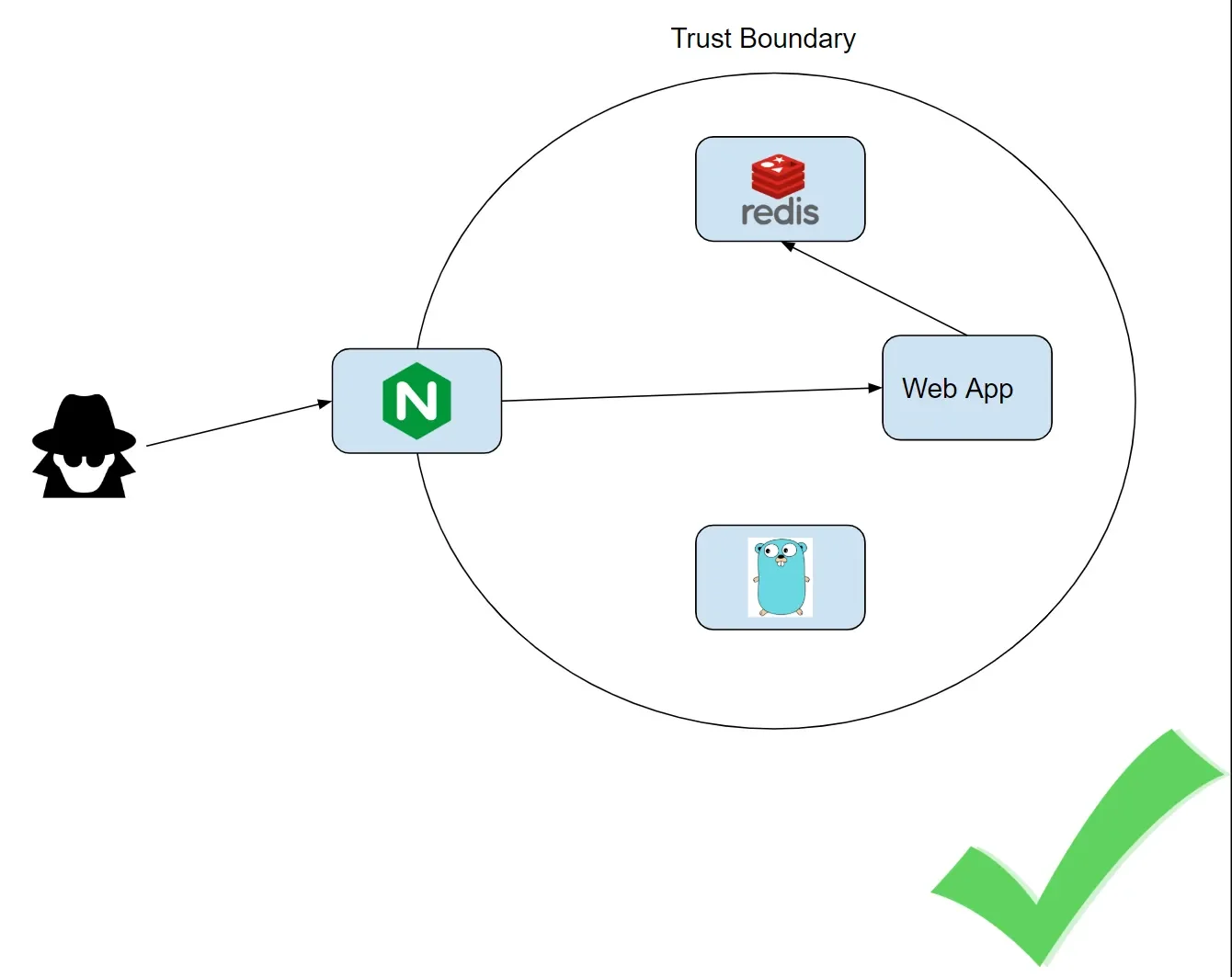
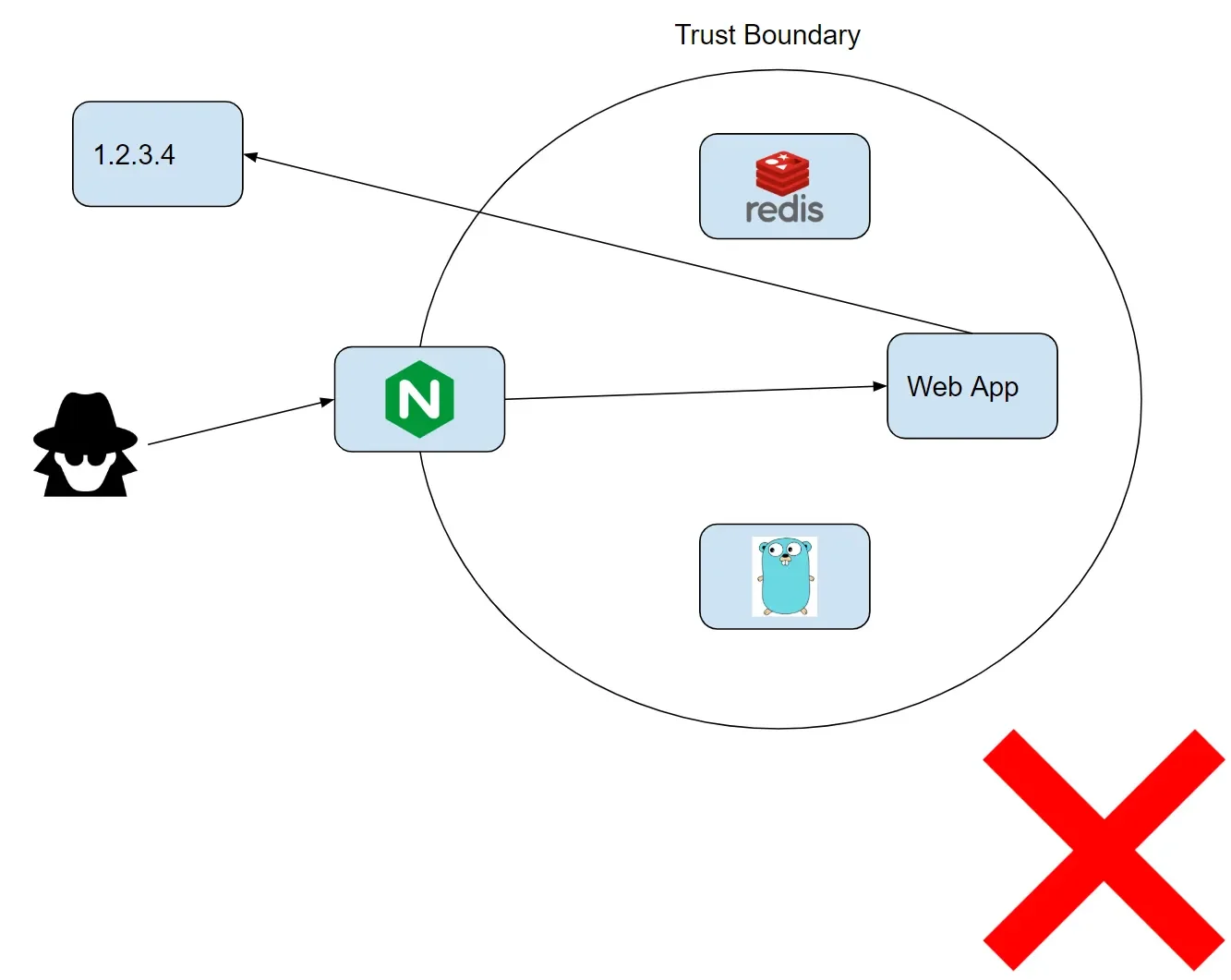
Impactful SSRF on left; not right
The two diagrams contrast the two situations: impactful SSRF on the left, not on the right.
The author adds one caveat from personal experience. Once, being able to change an address to an attacker-controlled machine, even without a privileged network position, allowed reading the Authorization header and stealing credentials used on an internal API call. So the strict definition is a useful guide, not an absolute law.
Where SSRF tends to hide
The typical place to find SSRF is any feature where a parameter holds a URL or a domain name. A request like this is a strong hint:
POST /fetchPage HTTP/1.1Host: app.example.com...Content-Type: application/x-www-form-urlencodedurl=http%3A%2F%2Ffoobar.com%2fendpoint
Line by line, in plain words:
POST /fetchPage HTTP/1.1means the browser is sending data to a page called/fetchPage, using version 1.1 of the HTTP protocol, which is the language browsers and servers speak.Host: app.example.comtells the server which website name the request is for. One server can host many websites, so it needs to know which one you want....stands for other headers the author left out, such as cookies or a content length.Content-Type: application/x-www-form-urlencodedsays the body of the request is formatted like a form submission, the same format a web form uses when you press submit.url=http%3A%2F%2Ffoobar.com%2Fendpointis the actual data. The value is a URL, but it has been percent-encoded, which is a way of writing special characters safely.%3Ais a colon,%2Fis a slash. Decoded, it readshttp://foobar.com/endpoint.
The reason this is suspicious is simple: the server is being handed an address and asked to go fetch it. If the server does not carefully check where it is allowed to go, you can hand it an address inside its own private network instead.
Other features worth testing include HTML to PDF generators, where a headless browser runs on the server to turn a page into a PDF. The author points to a DEFCON talk by Daeken and Nahamsec for more on those. In fact, anywhere you can control an address to another system is worth testing. Even a HOST header, which is normally just the website name, could in theory be a vulnerable parameter.
How to test for SSRF
The author did not set out to write a testing guide, but lists the questions they ask when testing a feature.
Can I read the response?
Can you see what came back from the address the server fetched? If yes, proving impact is easy: find an internal service that responds, and read its response. If no, look for side channels. A side channel is any indirect signal, such as a different error message when a port is open versus closed, or the ability to make an internal service send a request out to the internet where you can see it.
Where are we?
Is the vulnerable service running on a cloud platform such as AWS or GCP, or on something more custom? This tells you whether a metadata service might be reachable. A metadata service is a special address that cloud providers expose from inside their machines, and it can hand out information about the machine, sometimes including credentials. It is meant only for the machine itself, never for the public.
Can I redirect?
What happens if the address you supply responds with a redirect? A redirect is a server saying, "not here, go look at this other address instead." Many SSRF protections only check the first address. If the server follows redirects without re-checking, you can point the first address at something harmless and have it redirect to an internal address. The author warns to watch out for proxies in front of the internal client, because a good proxy can tell whether a request should really be forwarded.
What protocols does the client support?
Does it only speak HTTP and HTTPS, the normal web protocols? Or does it also speak FTP, or Gopher? Gopher is an old, simple protocol that lets you send almost arbitrary text to a service. If the client supports Gopher, you can talk to many more internal services, which raises the impact. The author also notes that moving away from HTTP and HTTPS can bypass internal proxies, because those proxies often only handle web traffic.
One of the author's favourite tricks for proving SSRF is to use a local mail service on the server to send an email to themselves. If an email arrives, you have proven you can make the server talk to an internal service. The author has used this twice in HackerOne reports.
Story 1: Duck Duck Gopher
The report is public, and the author links to it.
The story starts in the middle of October 2018, early in the author's bug hunting career. They were hacking on a new private program invite for Nintendo, on the advice of a friend. After a few hours with nothing interesting, they gave up and were about to close Burp Suite, a tool that sits between the browser and the internet and records every request. Before closing, they took one last look at the HTTP History, which is the list of all requests Burp has seen.
At the time, DuckDuckGo was set as the default search engine in Chrome, though the author admits they mostly opened Google instead. At one point a search query was accidentally submitted to DuckDuckGo while Burp was recording, so every request that page made was captured. One request stood out: a request to https://duckduckgo.com/iu with a query parameter named url. Whenever that parameter contained a URL with the domain yimg.com, the response was a page.
Successful request
When the author tried another domain, such as google.com, the response was an error. This suggested the service was filtering requests to other domains. The failed response carried 403 Forbidden, which means "you are not allowed", as opposed to the 200 OK above, which means "here is your page".
Unsuccessful request
On a hunch, the author tested whether the service was really parsing the URL and checking the domain properly, or just looking for the text yimg.com somewhere in the string. This is the difference between checking that a parcel is addressed to the right street, and just checking that the word "street" appears somewhere on the label. Appending the allowed domain to a fake query parameter was enough to get past the filter.
Bypassing a string.contains filter by appending the domain to a fake query parameter
With the filter bypassed, the author began investigating for SSRF. First, redirects. The author pointed DuckDuckGo at an endpoint that responded with a 302 redirect to a Burp Collaborator instance. A 302 is the standard "go look over there" redirect. Burp Collaborator is a service that gives you a unique address and tells you when anything contacts it, which is perfect for confirming that a server made a request. The redirect was followed.
Next, the author checked whether the gopher protocol was supported, by putting it in the Location header of the redirect. The Location header is where a redirect tells the client where to go. Gopher support would let the author talk to many more internal services, so it was worth knowing, and it would raise the severity. It was supported.
Using the SSRF, the author performed a port scan and found a number of services running on localhost. A port scan means trying many numbered doors on a machine to see which ones are open. One service, on port 6868, was Redis, which was returning some data when hit with HTTP. The JSON that came back mentioned a domain that only seemed resolvable internally. JSON is a common text format for structured data, and resolvable means the name can be turned into an address, here only from inside the network.
SSRF against duckduckgo
The diagram demonstrates where the attack had got to.
Eventually the author noticed that port 8091 was open on cache-services.duckduckgo.com and was returning a large amount of data. The report had already been opened with DuckDuckGo a little earlier, and this extra probing was to see what else could be done to increase impact.
Aftermath
DuckDuckGo does not pay for bugs, but it does offer swag. The author received a DuckDuckGo t-shirt, the story, and a public disclosure.
Story 2: In ursmtp
The author was invited to a private program that did not inspire much hope. It felt like a service that could be replaced by any other CRUD app. CRUD stands for Create, Read, Update, Delete, the four basic things most apps do with data. It did not seem to offer anything interesting, and the author was getting bored. The scope allowed a *. domain, meaning any subdomain, but nothing interesting turned up there either.
Eventually the author found a feature that let a user update their account information. One field was a personal website address, similar to the one on Twitter. An interesting behaviour appeared: if the website did not exist or could not be reached, the field turned yellow. If the site did exist, it turned green.
Site doesn't exist vs site does exist
That colour change was a clue. It meant the service was not just storing the text; it was actually making an HTTP request to the address to check it. The author put a Burp Collaborator address in the field to confirm, and a request came in.
The colour feedback could then be used as a port scanner. By trying different addresses and watching for green or yellow, the author found SSH, SMTP, DNS and a few other services that could not be identified by port. SSH is a way to log into a machine remotely, SMTP is the protocol for sending email, and DNS is the system that turns names into addresses.
The author then ran the same tests as with DuckDuckGo: redirects and gopher. Both worked. With gopher available, the author crafted an SMTP message in gopher and sent it to localhost:25, which is the standard local mail port. Moments later, a new email arrived in the inbox. That proved the SSRF was real and could reach an internal service.
The finding was awarded $800 and rated high.
Story 3: CMSSRF
The author was invited to a recently opened private program. When a program has just opened, there is a sense of blood in the water: every other invited hacker is about to tear it apart, so if you want the easy wins, you need to move fast.
Instead of starting on the core domain, the author jumped to interesting subdomains. A subdomain is a name like shop.example.com under the main example.com. The tool sublist3r was used to find subdomains, and it turned up a couple with cms in the name. CMS stands for content management system, software for building and managing websites, and in the author's experience such services tend to have many problems.
The home page of the asset did not show much, so the author ran dirsearch, a tool that guesses common file and folder names to find hidden pages. After about 15 minutes, an endpoint mentioning user management was found. It returned a 302 redirect to another endpoint with a login page for some management system. JavaScript files on the asset referenced an API. An API is a set of addresses a program can call to do things, like a service counter where you ask for something specific rather than browsing the shelves. JavaScript is the language web pages use to run code in your browser.
The qa subdomain of that asset had unobfuscated JavaScript. Obfuscation is the practice of making code hard to read on purpose; unobfuscated means it was readable. From that code, the author worked out how to call the API and which calls were available. One call was named createWebRequest and took one url parameter in a POST body.
By this point the author already knew the asset was running on AWS, Amazon's cloud platform. So the next step was to point that API at the AWS metadata address. The metadata service is a special internal address that cloud machines use to learn about themselves, and it can hand out credentials. The request got a hit.
Response from createwebrequest api
When the returned AWS keys were tried in the aws cli client, which is Amazon's command-line tool for managing cloud resources, the author found an absurd level of access: dozens of S3 buckets, dozens more EC2 instances, Redis and more. S3 is cloud storage for files, and EC2 is cloud servers. The finding was paid $3,000, the maximum payout, and marked critical.
Story 4: Authenticated Request
This was the author's most recent SSRF at the time, and the most entertaining. On a new private program, the author found a couple of stored XSS issues. Stored XSS is a bug where malicious script is saved on the server and runs in other users' browsers later. The author was in a good mood and about to stop when they checked a Burp Collaborator instance left open. What they saw was surprising.
As an aside, the author explains a habit: when signing up for services they plan to hack, they use a Burp Collaborator instance to receive email. That keeps their real email accounts clean of advertising after the hacking is done, and it lets them see if anything interesting happens later.
In the Collaborator, there was an HTTP request with a User-Agent that mentioned the service being hacked. The User-Agent header is a line the browser sends to say what software it is. The author wondered whether they had accidentally found an SSRF feature, and set out to trigger it again.
Putting the timeline together explained it. The author had just signed up with an email like [redacted], and seconds later received both an SMTP message (an email) and an HTTP request for the homepage. In other words, signing up with that email produced both an SMTP message and an HTTP request for the homepage.
Signing up again with an address like [redacted] was used to check whether 302 redirects were respected. xip.io is a service that turns a name containing an IP address into that address, which is handy for testing. The forwarded request arrived in the Collaborator instance.
The request was fronted by Squid Proxy. A proxy is a middleman that forwards traffic, and Squid is a common one. It would probably block attempts to reach the internal network, so the author tested gopher on a 302 redirect. It worked for interacting with internal services. Unfortunately there was no feedback of any kind, so a port scan was not possible here. The author tried a localhost SMTP message anyway, and a new email arrived in the inbox, proving the SSRF was real.
At the time of writing, the report had been triaged as high with no payout yet. Triaged means a security team has looked at it and confirmed it is valid.
Story 5: Owning the Clout
The author wishes this story had been inspired by the Nahamsec and Daeken DEFCON talk, but it was found about a year before that talk came out. The program was for a company in the financial space, with a product the author had never seen, heavily involved in analytics. One feature let you upload images and store them for use in other features.
One test the author always wants to run on upload features is: can I upload HTML? HTML is the language web pages are written in. And if I can, what happens when that HTML fetches external resources, such as an image from another site?
The service rejected the HTML upload. The author then tried lying about the content type in the multipart upload, changing it to say image/jpeg. A multipart upload is a way of sending a file together with other form fields in one request, and the content type is the label saying what kind of file it is. The document uploaded fine.
After making a request to another endpoint that gave updates on the status of the document, an internal renderer or browser was triggered to issue a request to attacker.com. A renderer is software that turns a document into something viewable, often by loading it like a browser would.
In this case the author would have done more to prove impact, but it was pretty clear the behaviour was unintended, and that with an address to hit, an internal system would have been reachable. The finding was reported and paid $1,000 at medium. In retrospect, the author says more should have been done to prove additional impact, which would likely have raised the payout.
Wrap up
SSRF is the author's favourite bug class because it is simple to execute, hard to fix, and shows up in a crazy number of ways. The author has even heard of methods using FTP to trigger it. Being able to interact with private internal networks is fascinating, and the hope is that readers feel more empowered to find and explore the inaccessible networks behind the modern web.
The author thanks Alyssa Herrera, whose Piercing the Veil post inspired them to look for SSRF in the first place.
Glossary
- SSRF (Server-Side Request Forgery): a bug where an attacker makes a server fetch an address it should not reach, usually inside a private network.
- Server: a computer that runs a website or service and answers requests from other computers.
- Client: the software making a request, usually your browser, but in SSRF it is often the server acting as a client to fetch something.
- HTTP: the language browsers and servers use to exchange requests and responses.
- HTTPS: HTTP with encryption, so others cannot read the traffic.
- Request: a message asking a server to do something, such as fetch a page.
- Response: the message a server sends back, such as a page or an error.
- Header: a line in a request or response carrying extra information, such as the website name or the browser type.
Hostheader: the header that says which website name the request is for.User-Agentheader: the header that says what software is making the request.Authorizationheader: a header carrying credentials, such as a token, to prove who you are.Locationheader: the header in a redirect that says where to go next.- Query parameter: the part of a URL after a
?, made of names and values, like?url=.... - URL: a web address, such as
https://example.com/page. - Domain name: the name part of a URL, such as
example.com. - Subdomain: a name under a main domain, such as
shop.example.com. - Percent-encoding: writing special characters in a URL as
%plus a code, such as%3Afor a colon. - Status code: the number a server sends to say how it went, such as
200 OKor403 Forbidden. 200 OK: the request succeeded and here is the result.403 Forbidden: you are not allowed to do that.- 302 redirect: a response telling the client to go to another address instead.
- nginx: a common web server and front door that forwards requests to other services.
- vHost (virtual host): a way for one server to host several websites under different names.
- Proxy: a middleman that forwards traffic between a client and a destination.
- Squid Proxy: a common proxy server.
- IAM: identity and access management, the system that controls who can do what in a cloud account.
- Redis: an in-memory data store often used for fast lookups and caching.
- MySQL: a common database system.
- JSON: a text format for structured data, using curly braces and key-value pairs.
- API: a set of addresses a program can call to do specific things.
- CRUD: create, read, update, delete, the four basic operations most apps perform on data.
- CMS: content management system, software for building and managing websites.
- JavaScript: the programming language web pages use to run code in the browser.
- Obfuscation: making code hard to read on purpose; unobfuscated means readable.
- HTML: the language web pages are written in.
- XSS (Cross-Site Scripting): a bug where an attacker gets script to run in someone else's browser.
- Stored XSS: XSS where the malicious script is saved on the server and served to later visitors.
- Webhook: a feature where a service sends a message to an address you supply when something happens.
- Burp Suite: a tool that sits between your browser and the internet and records and lets you edit requests.
- HTTP History: Burp's list of every request it has seen.
- Burp Collaborator: a service that gives you a unique address and tells you when anything contacts it, used to confirm out-of-band requests.
- Out-of-band: a signal that comes back through a different channel than the main response, such as a callback to your own server.
- Side channel: any indirect signal, such as a different error or a colour change, that leaks information.
- Port: a numbered door on a machine, where a particular service listens.
- Port scan: trying many ports to see which are open.
- localhost: the machine itself, reached from inside.
- Gopher: an old, simple protocol that lets you send almost arbitrary text to a service.
- FTP: an old protocol for transferring files.
- SMTP: the protocol for sending email.
- SSH: a way to log into a machine remotely.
- DNS: the system that turns names into addresses.
- Metadata service: a special internal address on cloud machines that hands out information about the machine, sometimes including credentials.
- AWS: Amazon Web Services, Amazon's cloud platform.
- S3: Amazon's cloud storage for files.
- EC2: Amazon's cloud servers.
aws cli: Amazon's command-line tool for managing cloud resources.sublist3r: a tool for finding subdomains.dirsearch: a tool that guesses common file and folder names to find hidden pages.string.containscheck: a check that only looks for a piece of text anywhere in a string, rather than properly parsing it.- Allowlist: a list of things that are allowed, such as domains.
- Multipart upload: a way of sending a file together with other form fields in one request.
- Content type: the label saying what kind of file something is, such as
image/jpeg. - Renderer: software that turns a document into something viewable, often by loading it like a browser would.
- Headless browser: a browser with no visible window, run by a server to load pages.
- Triage: a security team's first review of a report to confirm it is valid.
- Severity: a rating of how serious a bug is, such as
low,medium,highorcritical. - Bounty: a reward paid for a valid security report.
- Bug bounty program: a scheme where companies pay researchers for reporting bugs.
- Private program: a bug bounty program you can only join by invitation.
- Disclosure: making a report public.
- Swag: free merchandise, such as a t-shirt, given instead of or alongside money.
xip.io: a service that turns a name containing an IP address into that address, handy for testing.- RFC1918 address: a private network address, such as those starting
10.or192.168., not reachable from the public internet. - IP address: the numeric address of a machine on a network.




