Abusing Broken Link In Fitbit (Google Acquisition)To Collect BugBounty Reports On Behalf Of Google !
A help page on Fitbit's official site still pointed researchers to a Bugcrowd programme page for Fitbit that no longer existed, even though Google had acquired Fitbit and moved the programme to its own VRP. An attacker could register that Bugcrowd handle and receive vulnerability reports meant for Google.
 Published on infosecwriteups.com
I knew that Fitbit acquisition has been completed by Google and is eligible for bounty in GoogleVRP platform.
The full write-up lives on its author's site
It belongs to its author, so we link to it rather than copy it. The other two tabs are our own rewrites, checked against it.
Context
Fitbit had been acquired by Google, and the researcher understood that Fitbit was therefore eligible for reports through the Google VRP. Before the acquisition, Fitbit had also been listed on another bug bounty platform, so the researcher wanted to confirm which platform was the correct destination for Fitbit vulnerability reports.
The target here is not an application endpoint but the official Fitbit help content that tells security researchers where to send vulnerability reports. The relevant page is the Fitbit help article on reporting security issues, which at the time of the report linked researchers to a Bugcrowd programme page for Fitbit.
Setup
No accounts, roles or special tooling were needed. The researcher's normal workflow is to track Google acquisitions, and the only tools used were a Google search and the Wayback Machine to confirm the page state at the time of reporting.

The image shows the researcher's own tracking of Google acquisitions.
Finding it
The researcher ran a simple Google search to check which platform currently handled Fitbit reports:
fitbit bugbounty
On the first page of results, the official Fitbit help article appeared. That page linked to the following URL as the place to report vulnerabilities:
https://bugcrowd.com/fitbit
The link was broken. The page still told researchers that vulnerabilities found in Fitbit should be reported through Bugcrowd, even though the acquisition by Google was complete. An archived copy of the page shows the link as it was when the report was filed.
The concern is a broken link hijacking one: a third party could register the abandoned programme URL and receive reports intended for the vendor. The researcher explicitly noted that Bugcrowd itself may not host a malicious page at that address, but applied a zero trust approach: no entity, internal or external, should be trusted blindly.
Exploitation
Step 1: Identify the stale reporting link
A search for the Fitbit bug bounty programme surfaced the official help article, which pointed researchers at https://bugcrowd.com/fitbit. The link was broken.
Step 2: Confirm the page state
An archived copy of the page shows the help article still directing researchers to Bugcrowd. The archived copy shows the help article still directing researchers to Bugcrowd.
Step 3: Assess the abuse path
An attacker might create a new company on Bugcrowd at that URL and collect vulnerability reports that researchers believe they are submitting to Fitbit, then exploit the reported issues. The researcher also noted that the Bugcrowd platform itself could exploit the situation, while acknowledging that it might not, so this remains a possibility rather than a demonstrated action.
Step 4: Report through Google VRP
The researcher wrote up the issue and submitted it through the Google VRP platform. Because the issue was classified as an abuse risk rather than a conventional vulnerability, it was triaged to the Trust & Safety team.
Root cause
The root cause is a stale outbound link in official vendor documentation after a change of ownership. The help article continued to direct security researchers to a third party programme URL that was no longer controlled by the party the page was instructing researchers to trust. The page still told researchers to report Fitbit vulnerabilities through Bugcrowd, even though the acquisition was complete.
The failure is one of content maintenance and trust: the page asserted an authoritative reporting channel that no longer existed.
Impact
An attacker could register the abandoned Bugcrowd URL as a new company and receive vulnerability reports that researchers intended for Fitbit, then exploit the reported issues. The Bugcrowd platform itself could also exploit the situation, although the researcher notes it might not, so there is still a possibility.
Fix
The issue was fixed. The researcher notes that the reported vulnerability is fixed and points readers to the archived copy to see how the page looked when the report was submitted. The report does not describe the specific change made to the page.
The timeline recorded by the researcher:
| Event | Date |
|---|---|
| Reported | Aug 10 2022 |
| Triaged | Aug 11 2022 |
| Accepted | Aug 16 2022 |
| Fixed | Sep 9 2022 |
The report was awarded honorable mentions only. Because this was the researcher's first abuse risk report rather than a usual vulnerability report, they asked the team how severity was assessed and evaluated in order to learn more.
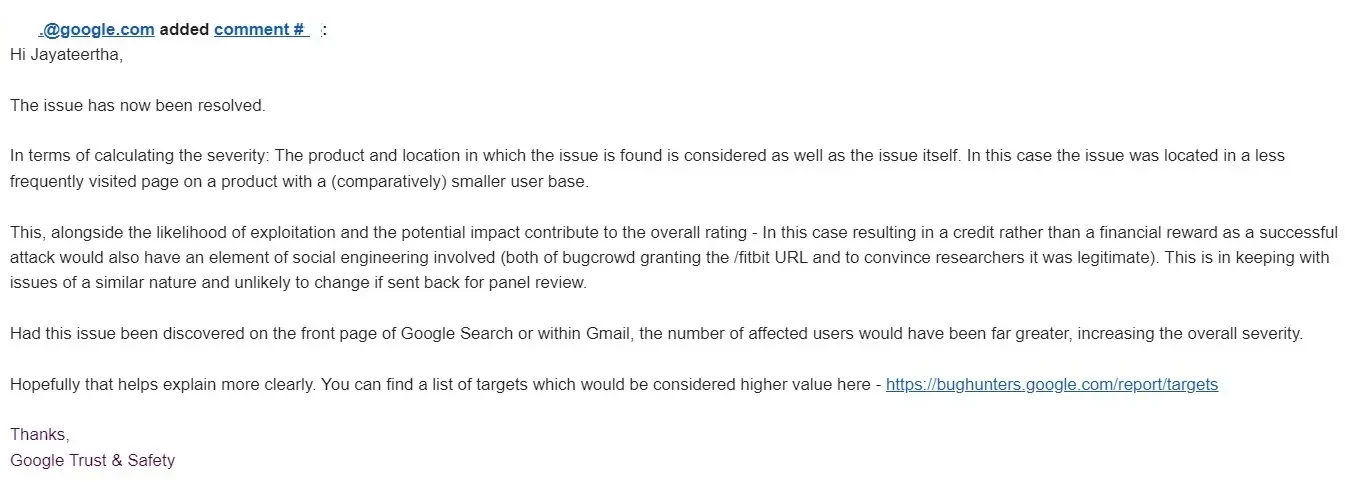
The image appears next to that passage about asking the team how the severity was assessed.
Variants to test
- Search official vendor security pages for links to bug bounty platforms and check whether each programme URL still resolves to a live programme. A positive result is a link that returns a not-found or unclaimed programme page while the vendor page still presents it as the reporting channel.
- Repeat the check after acquisitions, mergers or rebrands, when programme ownership is most likely to have moved. A positive result is an official page that names the old platform after the move has completed.
- Check archived copies of security reporting pages against the live page to spot links that were removed without a replacement being published. A positive result is a live page that still instructs researchers to use a destination that no longer exists.
- Look for the same stale link in other places where researchers are directed, such as security.txt files, README files and disclosure policy pages. A positive result is any of these pointing at an unclaimed programme URL.
What happened, in plain words
A security researcher noticed that the official Fitbit help pages still told people to send security bug reports to a page on a website called Bugcrowd. That page no longer existed. Google had bought Fitbit, so reports should have gone to Google instead. Because the old Bugcrowd address was free for anyone to claim, a stranger could have set up a company there and received bug reports meant for Fitbit. The researcher reported this to Google, and the page was fixed.
This article walks through the whole story slowly, explaining every term as it appears, so you can follow it even if you have never done security work before.
Context
What Fitbit and Google have to do with each other
Fitbit makes fitness trackers and smartwatches. Google is the company behind the search engine. Google bought Fitbit, which means Fitbit became part of Google. When one company buys another, we say the buyer has acquired the other, and the purchase is an acquisition.
Many large technology companies run a bug bounty programme. A bug is a mistake in software that can cause it to behave in ways its makers did not intend, and some of those mistakes can be used by criminals. A bug bounty programme is an offer: if you find a security bug in our products and tell us about it privately, we will thank you, and often pay you money. The money is called a bounty. The person who reports the bug is a security researcher.
Google runs such a programme, called the Google VRP (VRP stands for Vulnerability Reward Program). A vulnerability is a weakness in software that an attacker could use to do harm.
Why the researcher cared which platform was correct
Before Google bought Fitbit, Fitbit had its own bug bounty programme on a different platform. A platform here means a website that hosts many companies' bug bounty programmes in one place, so researchers can find them and submit reports through it. Bugcrowd is one such platform.
After the acquisition, the researcher understood that Fitbit bugs were now eligible for the Google VRP. Eligible means "accepted under the rules of the programme". But because Fitbit had previously been on another platform, the researcher wanted to be sure which place was now the correct destination for a Fitbit bug report. Sending a report to the wrong place wastes time and may mean the bug never gets fixed.
What the target actually was
The target of this research was not a piece of software. It was a web page: the official Fitbit help article that tells security researchers where to send vulnerability reports. That page, at the time, linked to a Bugcrowd programme page for Fitbit.
A link (also called a hyperlink) is clickable text or a button on a web page that takes you to another page when you click it. The address it points to is called a URL (Uniform Resource Locator), which is the technical name for a web address like https://example.com/page.
Setup
No accounts, no special roles and no special tools were needed. The researcher's normal habit is to keep track of which companies Google has bought. The only tools used were:
- A normal Google search.
- The Wayback Machine, a free public service at web.archive.org that stores old copies of web pages. If a page changes, the Wayback Machine may still have a snapshot of how it looked on an earlier date. This is useful for proving what a page said at a particular moment.
The image shows the researcher's own tracking of Google acquisitions.
Finding it
Step 1: A simple search
The researcher ran a Google search to check which platform currently handled Fitbit reports. The search text was:
fitbit bugbounty
This is just two words typed into the Google search box. The researcher used it to find pages that talk about a Fitbit bug bounty. The point of the search was not to find a bug, but to find out where Fitbit wanted bug reports sent.
On the first page of results, the official Fitbit help article appeared. That page linked to the following URL as the place to report vulnerabilities:
https://bugcrowd.com/fitbit
This line is a web address. https:// is the secure version of the protocol browsers use to fetch pages. bugcrowd.com is the website's domain, the name that identifies the site. /fitbit is the path, which identifies a particular page or programme on that site. So the whole address means "the Fitbit programme page on the Bugcrowd website".
Step 2: The link was broken
The link was broken. A broken link is a link that points to a page which no longer exists, so clicking it gives an error or a "not found" message instead of the expected content.
The page still told researchers that vulnerabilities found in Fitbit should be reported through Bugcrowd, even though the acquisition by Google was complete. In other words, the official instructions were out of date.
Step 3: Saving the evidence
An archived copy of the page shows the link as it was when the report was filed. Archiving here means asking the Wayback Machine to save a copy of the page as it looked on that day. The archived copy shows the link as it was when the report was filed. This matters because, once the page is fixed, nobody can see the old version on the live site any more. The archive is the proof.
Step 4: What the concern actually is
The concern is called broken link hijacking. To understand it, imagine a shop that prints flyers saying "report shoplifters by calling this phone number". Then the shop moves to a new owner, and the old phone number is disconnected. Anyone can now get that number and answer calls. People who trust the flyer will give sensitive information to whoever picked up the number.
In the same way, a third party could register the abandoned programme URL and receive reports intended for the vendor. Register here means claiming the address on the platform, for example by creating a company account with that name.
The researcher explicitly noted that Bugcrowd itself may not host a malicious page at that address. Malicious means intended to cause harm. But the researcher applied a zero trust approach. Zero trust is a security principle that says: do not trust any person or system just because it is familiar or official-looking. Verify instead. No entity, internal or external, should be trusted blindly.
Exploitation
Exploitation means working out how an attacker could actually use a weakness. In this case, no attack was carried out. The researcher described the path an attacker could take.
Step 1: Identify the stale reporting link
A search for the Fitbit bug bounty programme surfaced the official help article, which pointed researchers at https://bugcrowd.com/fitbit. The link was broken. Stale means old and no longer accurate. Resolve here means "lead to a working page".
Step 2: Confirm the page state
An archived copy of the page shows the help article still directing researchers to Bugcrowd. The archived copy shows the help article still directing researchers to Bugcrowd. Verifying after the fix matters because a report is much stronger when you can show exactly what the page said when you found it.
Step 3: Assess the abuse path
An attacker might create a new company on Bugcrowd at that URL and collect vulnerability reports that researchers believe they are submitting to Fitbit, then exploit the reported issues.
Let us unpack that. A researcher who finds a bug in Fitbit reads the official help page, clicks the link, and lands on what looks like the Fitbit programme. If an attacker has claimed that address, the researcher is now sending the details of a real, unfixed bug to the attacker. The attacker can then use those details to attack Fitbit users before the bug is fixed. This is why bug reports are treated as sensitive: they are, in effect, a map to a weakness.
The researcher also noted that the Bugcrowd platform itself could exploit the situation, while acknowledging that it might not, so this remains a possibility rather than a demonstrated action. In other words, this is a risk, not a proven attack.
Step 4: Report through Google VRP
The researcher wrote up the issue and submitted it through the Google VRP platform. Because the issue was classified as an abuse risk rather than a conventional vulnerability, it was triaged to the Trust & Safety team.
Two terms here. Triaged means sorted and sent to the right team, the way a hospital receptionist sends you to the right department. Abuse risk means a risk that someone could misuse a system, rather than a flaw in code that can be broken. Trust & Safety teams deal with misuse: fake accounts, scams, impersonation and similar problems.
Root cause
The root cause is the underlying reason a problem exists, as opposed to its symptoms. Here, the root cause is a stale outbound link in official vendor documentation after a change of ownership.
Outbound means the link points away from the vendor's own site to somewhere else. Vendor documentation means the help pages published by the company that makes the product. After the acquisition, the help article continued to direct security researchers to a third party programme URL that was no longer controlled by the party the page was instructing researchers to trust.
The page still told researchers to report Fitbit vulnerabilities through Bugcrowd, even though the acquisition was complete.
A technical control is an automated or built-in safeguard, for example a tool that regularly tests every link on a website and flags the ones that no longer work. The failure here is one of content maintenance and trust: the page asserted an authoritative reporting channel that no longer existed. Authoritative means officially presented as the correct source.
Impact
Impact means the harm that could result if the problem is not fixed.
An attacker could register the abandoned Bugcrowd URL as a new company and receive vulnerability reports that researchers intended for Fitbit, then exploit the reported issues. The Bugcrowd platform itself could also exploit the situation, although the researcher notes it might not, so there is still a possibility.
If either condition fails, the risk does not materialise. This is why the researcher framed it as a risk rather than a demonstrated attack.
Fix
The issue was fixed. The researcher notes that the reported vulnerability is fixed and points readers to the archived copy to see how the page looked when the report was submitted. The report does not describe the specific change made to the page.
The timeline recorded by the researcher:
| Event | Date |
|---|---|
| Reported | Aug 10 2022 |
| Triaged | Aug 11 2022 |
| Accepted | Aug 16 2022 |
| Fixed | Sep 9 2022 |
Each row is a stage in the life of a bug report. Reported is when the researcher submitted it. Triaged is when the programme sorted it and routed it to the right team. Accepted is when the programme agreed it was a valid issue. Fixed is when the problem was corrected.
The report was awarded honorable mentions only. An honorable mention is public credit, such as a name on a thank-you list, without a cash payment. Because this was the researcher's first abuse risk report rather than a usual vulnerability report, they asked the team how severity was assessed and evaluated in order to learn more. Severity is a measure of how serious an issue is, often expressed as a score.
The image appears next to that passage about asking the team how the severity was assessed.
Variants to test
Variants are other, similar situations you could look for using the same idea. These are suggestions for further research, not things that were done in this report.
- Search official vendor security pages for links to bug bounty platforms and check whether each programme URL still resolves to a live programme. A positive result is a link that returns a not-found or unclaimed programme page while the vendor page still presents it as the reporting channel.
- Repeat the check after acquisitions, mergers or rebrands, when programme ownership is most likely to have moved. A rebrand is when a company changes its name or image. A positive result is an official page that names the old platform after the move has completed.
- Check archived copies of security reporting pages against the live page to spot links that were removed without a replacement being published. A positive result is a live page that still instructs researchers to use a destination that no longer exists.
- Look for the same stale link in other places where researchers are directed, such as security.txt files, README files and disclosure policy pages. A security.txt file is a small text file a website can publish to say how to contact its security team. A README is a plain text file that usually explains what a project is. A disclosure policy is a page that explains how a company wants security problems reported. A positive result is any of these pointing at an unclaimed programme URL.
Glossary
- Abuse risk: a risk that someone could misuse a system, rather than a flaw in code that can be broken.
- Acquisition: the purchase of one company by another.
- Archiving: saving a copy of a web page as it looks on a given day, for example with the Wayback Machine.
- Authoritative: officially presented as the correct source.
- Bounty: money paid by a bug bounty programme for a valid security report.
- Broken link: a link that points to a page which no longer exists.
- Broken link hijacking: taking over an abandoned web address that an official page still points to, so that people following the official page end up at the attacker's page.
- Bug: a mistake in software that makes it behave in ways its makers did not intend.
- Bug bounty programme: an offer by a company to reward people who privately report security bugs in its products.
- Bugcrowd: a website that hosts bug bounty programmes for many companies.
- Disclosure policy: a page explaining how a company wants security problems reported.
- Domain: the name that identifies a website, such as
bugcrowd.com. - Eligible: accepted under the rules of a programme.
- Exploitation: working out how an attacker could actually use a weakness.
- Fix: the change that corrects a problem.
- Google VRP: Google's Vulnerability Reward Program, its bug bounty programme.
- Honorable mention: public credit without a cash payment.
- Hyperlink: clickable text or a button that takes you to another page.
- Impact: the harm that could result if a problem is not fixed.
- Link: see hyperlink.
- Malicious: intended to cause harm.
- Outbound link: a link that points away from the site you are on to a different site.
- Path: the part of a web address after the domain that identifies a particular page, such as
/fitbit. - Platform: a website that hosts many companies' bug bounty programmes in one place.
- README: a plain text file that usually explains what a project is.
- Rebrand: a change of a company's name or image.
- Register: to claim an address or name on a platform, for example by creating a company account.
- Resolve: to lead to a working page.
- Root cause: the underlying reason a problem exists, as opposed to its symptoms.
- Security researcher: a person who looks for security weaknesses and reports them.
- security.txt: a small text file a website can publish to say how to contact its security team.
- Severity: a measure of how serious an issue is.
- Stale: old and no longer accurate.
- Technical control: an automated or built-in safeguard, such as a tool that checks links.
- Triaged: sorted and sent to the right team.
- Trust & Safety team: the team that deals with misuse of a service, such as scams and impersonation.
- URL: the technical name for a web address.
- Vendor documentation: help pages published by the company that makes a product.
- Variant: a similar situation you could look for using the same idea.
- Vulnerability: a weakness in software that an attacker could use to do harm.
- Wayback Machine: a free public service that stores old copies of web pages.
- Web page: a document you view in a browser.
- Zero trust: a security principle that says do not trust any person or system blindly; verify instead.