CSP "script-src" includes "unsafe-inline" in https://gratipay.com
The Content-Security-Policy header for gratipay.com includes 'unsafe-inline' in the script-src directive, which permits inline scripts and event handlers. This weakens the CSP's protection against cross-site scripting, though the report notes it does not result in an immediate threat.

- Disclosed after 48 days
#SUMMARY:
Related Report: #225833
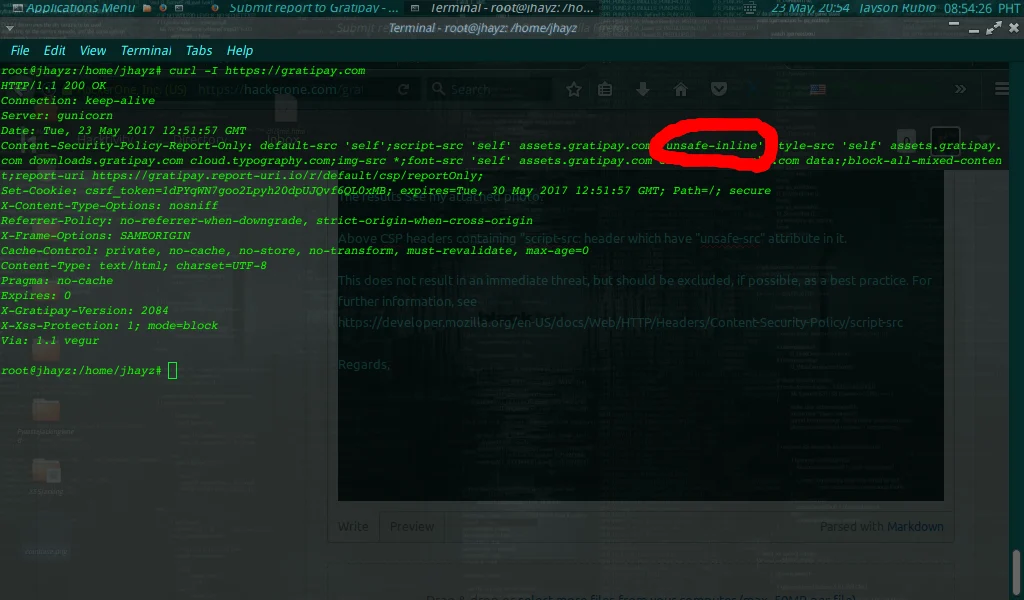
Gratipay is using unsafe-inline in script-src csp headers which allows the use of inline resources, such as inline <script> elements, javascript: URLs, inline event handlers, and inline <style> elements. Proof Of Concept
#By Using cURL:
curl -I https://gratipay.com
The results See my attached photo.
Above CSP headers containing "script-src: header which have "unsafe-src" attribute in it.
This does not result in an immediate threat, but should be excluded, if possible, as a best practice. For further information, see https://developer.mozilla.org/en-US/docs/Web/HTTP/Headers/Content-Security-Policy/script-src
Regards,
Attachments
Not written yet. The AI write-up for this report has not been written yet. The Original tab links to the source.
How it worked
Root cause
The CSP script-src directive was configured with 'unsafe-inline', which permits inline scripts and event handlers.
Impact
The weakened CSP could make cross-site scripting easier to exploit, but the report states this does not result in an immediate threat.
What the attacker needed
None
Explained by bugbounty.wiki with AI from the original and checked against quotes from it; it can still be wrong. Read the original before relying on a detail.
Not written yet. The AI write-up for this report has not been written yet. The Original tab links to the source.
A Content-Security-Policy (CSP) is a browser rule that tells the page which sources of scripts are allowed. When 'unsafe-inline' is included, the browser also allows scripts written directly inside the page, which makes it easier for an attacker who can inject HTML to run their own code. This report only points out that the rule is weaker than it could be; it does not show an actual attack.
What is Misconfiguration?
Settings left unsafe: exposed panels, open storage buckets, debug modes, default credentials.





