Bypass hackerone 2FA
The embedded submission form on HackerOne did not enforce a program's 2FA requirement or its hacker blacklist, so a user without 2FA, or a banned user, could still submit reports to that program.
 Published on medium.com
My routine when i am hunting on HackerOne main platform is always checking if they have new incoming feature, And i saw that there is beta feature called Embedded Submission Form which enables hackers to Anonymouslysubmit reports without having to create an account on HackerOne. For additional information.
The full write-up lives on its author's site
It belongs to its author, so we link to it rather than copy it. The other two tabs are our own rewrites, checked against it.
Context
HackerOne runs a bug bounty platform where programs publish policies and receive reports from hackers. Two controls sit in front of report submission for a program:
- A program owner can require that hackers have two-factor authentication enabled on their account before they can submit new reports. The setting lives at
https://hackerone.com/<program>/submission_requirements. - A program owner can ban or blacklist a hacker, which stops that hacker from submitting reports to the program, for both private and public programs.
The feature at the centre of this report is the beta Embedded Submission Form. It lets hackers submit reports anonymously, without creating an account on HackerOne. The researcher's routine on the main platform is to look for new incoming features, and this one turned out to be an authorisation gap: the embedded form did not apply the same checks as the normal submission flow.
The report covers two bypasses that share one root cause. The first is the 2FA requirement bypass, the second is the blacklist bypass. The second was closed as a duplicate of the first, report #418767.
Setup
The researcher used the Parrot Sec program, which had the 2FA requirement enabled. To test the blacklist bypass, a friend who is a triager on the Parrot Sec HackerOne program and a Parrot Security ambassador banned the researcher's account, h1/japz, from the program. No special tooling is described: the testing was done through the normal web interface and the embedded submission form.
Finding it
The embedded submission form is meant to let anonymous users send a report to a program. The normal submission flow blocked the researcher when 2FA was missing and when the account was banned. The embedded flow is a separate entry point, and the researcher found that it did not enforce either of them. That is an improper authorisation issue: the same action, submitting a report to a program, is reachable through a path that skips the program owner's controls.
Exploitation
Step 1: Confirm the 2FA gate works on the normal flow
The program owner enables the requirement from the submission requirements page:
https://hackerone.com/<program>/submission_requirements

The image shows the setting that lets a program owner enforce 2FA setup before hackers submit new reports. With Parrot Sec enforcing it, the researcher removed 2FA from his own account and was blocked from submitting new reports through the normal flow.
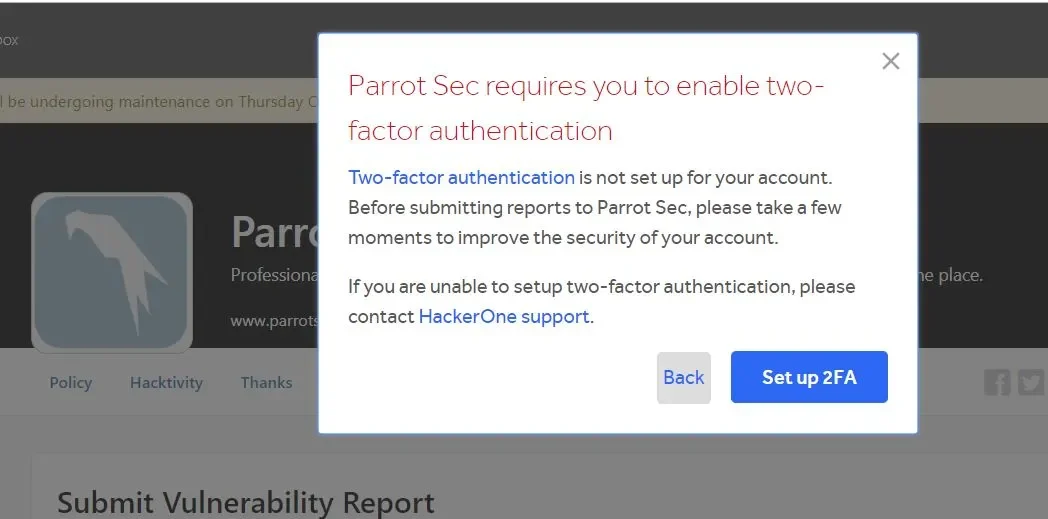
The image shows the block a hacker gets when the program requires 2FA and the account does not have it set up.
Step 2: Remove 2FA and try the normal submit button
- Log in and remove 2FA from the account, if it was set up.
- Go to
https://hackerone.com/parrot_secand pressSubmit Report. The normal flow refuses the submission until 2FA is enabled.
Step 3: Use the embedded submission URL
The bypass is to take the embedded submission URL from the program's policy page. In this case the URL was:
Step 4: Submit through the embedded form
Submitting a report through that embedded form succeeds even though the account has no 2FA and the program enforces it. The requirement is bypassed.
Step 5: Confirm the blacklist gate works on the normal flow
Program owners can ban hackers from private and public programs when behaviour conflicts with the program's security page or the HackerOne Code of Conduct.
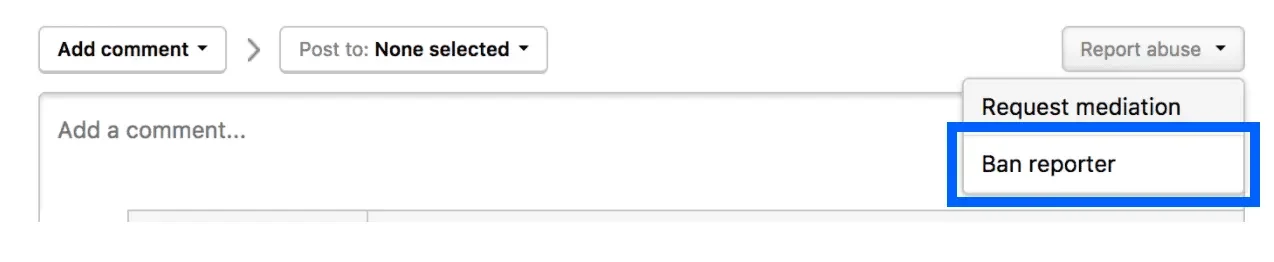
The image shows the program-side blacklisting feature. After the researcher's account was banned on Parrot Sec, pressing the submit report button redirected to a Page not found error page.
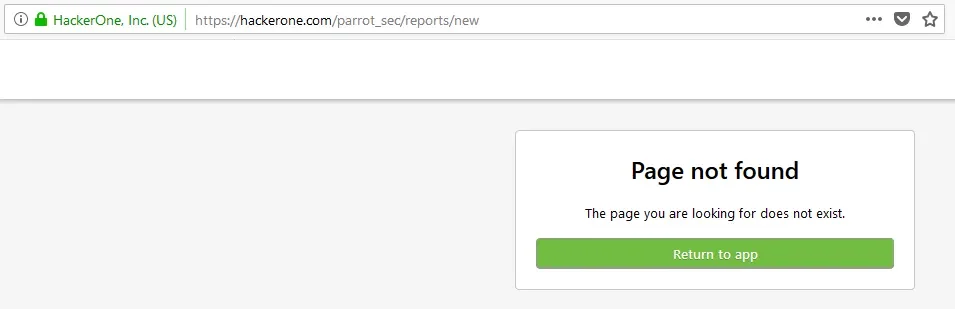
The image shows that error page, which is what a banned hacker sees when trying to submit to the program.
Step 6: Repeat the embedded submission
Using the same steps as the 2FA bypass, the researcher submitted a new report to the program through the embedded form despite being banned. The blacklist was bypassed in the same way.
Root cause
The embedded submission form did not apply the program's submission requirements: the 2FA check and the reporter blacklist. The report does not describe the implementation, so the exact reason is not stated;
Impact
A user can submit a report to a program even when the program owner requires 2FA on the account. A banned or blacklisted user can still submit as many reports as they want to the program through the embedded form. The blacklist bypass was demonstrated on the Parrot Sec program. The report does not describe any further consequence beyond submitting reports.
Fix
The report gives a timeline rather than the code change. The High severity bug was fixed in production on 2018-10-06, one day after triage, while the initial Medium submission was still being fixed. The Medium severity bug was fixed on 2018-10-25 and the report was marked Resolved.
Variants to test
- Other anonymous or embedded entry points. Look for forms, widgets or APIs that create reports or tickets without an authenticated session. A positive result is a submission that succeeds for a program whose requirements would block the same account through the normal flow.
- Program-level requirements on alternate paths. Test 2FA requirements, ban lists and any other per-program submission rules against each submission path. A positive result is a report created through a path that never evaluates the rule.
- Ban list enforcement after a ban. Ban an account, then try every submission route, including embedded forms and any API endpoints. A positive result is a successful submission from the banned account.
- Anonymous submissions against programs that require 2FA. If anonymous submission is allowed, check whether the program's 2FA requirement is silently skipped. A positive result is a report accepted without any account-level check.
Disclosure timeline
| Time | Event |
|---|---|
| 2018-10-04 02:41:19 | Report submitted to the HackerOne security team |
| 2018-10-05 20:07:59 | Security team acknowledged and triaged the report |
| 2018-10-05 20:53:21 | $10,000 bounty rewarded |
| 2018-10-06 00:38:15 | Fix for the High severity bug released to production, while the initial Medium submission was still being fixed |
| 2018-10-25 23:11:03 | Fix for the Medium severity bug released to production; status Resolved |
The initial submission received $2,500. During the root cause analysis of that report, HackerOne found another vulnerability with High severity, and because the submission pointed them in the right direction they awarded another $7,500 for the increased scope of the finding, for $10,000 in total. The second bypass was closed as a duplicate of the first report, #418767, because it had the same root cause.

The image shows HackerOne co-founder Jobert closing the second report as a duplicate of the first.
What happened, in plain words
HackerOne is a website where companies (called programs) publish the rules for their bug bounty, and security researchers (called hackers) send them reports about security problems they find. A bug bounty is simply a reward, usually money, paid to someone who reports a security flaw responsibly instead of abusing it.
A program owner has two switches they can turn on to control who is allowed to send reports:
- They can require that a hacker has two-factor authentication (2FA) switched on before sending a new report. Two-factor authentication means logging in with two things: your password plus a second proof, such as a code from a phone app. It makes it much harder for someone who steals your password to get in.
- They can ban (blacklist) a hacker, which stops that person from sending reports to the program. This works for both private and public programs.
The feature at the centre of this story is a beta (early, still being tested) feature called the Embedded Submission Form. It lets a hacker send a report anonymously, without even creating an account on HackerOne. Think of it like a suggestion box placed outside a building: anyone walking past can drop a note in, no membership card needed.
The researcher's habit is to look around the main HackerOne platform for new features as they appear. This one turned out to have an authorisation gap. Authorisation means deciding whether a particular person is allowed to do a particular thing. The embedded form did not apply the same checks as the normal report form, so the two controls above could be skipped.
The report describes two bypasses that share one root cause (one underlying mistake):
- the 2FA requirement bypass;
- the blacklist bypass.
The second was closed as a duplicate of the first, report #418767, because it was the same underlying bug.
Setup
The researcher used the Parrot Sec program, which had the 2FA requirement switched on. To test the blacklist bypass, a friend who is a triager on the Parrot Sec HackerOne program and a Parrot Security ambassador banned the researcher's account, h1/japz, from the program. A triager is a person who reviews incoming reports for a program and decides what happens to them.
No special tools are described. All the testing was done through the normal web interface and the embedded submission form, the same kind of clicking around anyone can do in a browser.
Finding it
The embedded submission form exists so that anonymous visitors can send a report to a program. The normal submission flow blocked the researcher when 2FA was missing and when the account was banned. The embedded flow is a separate entrance, and the researcher found that it enforced neither. That is an improper authorisation issue: the same action, sending a report to a program, can be reached through a path that skips the program owner's controls. It is like a shop with a strict doorman at the front door and an unlocked side door that leads to the same counter.
Exploitation
Step 1: Confirm the 2FA gate works on the normal flow
The program owner turns the requirement on from the submission requirements page:
https://hackerone.com/<program>/submission_requirements
This is a web address. https:// is the secure way browsers talk to websites. hackerone.com is the site. <program> is a placeholder for the program's name, and submission_requirements is the page where the program owner sets the rules for sending reports. The angle brackets are not typed literally; they stand for whatever the real name is.
The image shows the setting that lets a program owner enforce 2FA setup before hackers submit new reports. With Parrot Sec enforcing it, the researcher removed 2FA from his own account and was blocked from submitting new reports through the normal flow.
The image shows the block a hacker gets when the program requires 2FA and the account does not have it set up.
Step 2: Remove 2FA and try the normal submit button
- Log in and remove 2FA from the account, if it was set up. This is done on purpose, to recreate the situation of a hacker who has not enabled 2FA.
- Go to
https://hackerone.com/parrot_secand pressSubmit Report. The normal flow refuses the submission until 2FA is enabled.
This step matters because you first have to prove the gate actually works. If the normal button let the report through anyway, there would be nothing to bypass. Seeing the refusal confirms the program's rule is live and that the account is genuinely blocked.
Step 3: Use the embedded submission URL
The bypass is to take the embedded submission URL from the program's policy page. In this case the URL was:
A URL is just a web address, the text you type into the browser's address bar. A UUID is a long, unique identifier made of letters, numbers and dashes, used so that each thing has its own name that nobody else will accidentally have. Here it has been redacted, meaning replaced with a placeholder, because it identifies a specific program's form. embedded_submissions/new is the part of the address that points at the embedded form for creating a new report. The researcher found this address published on the program's policy page, which is the page describing the program's rules.
Step 4: Submit through the embedded form
Submitting a report through that embedded form succeeds even though the account has no 2FA and the program enforces it. The requirement is bypassed. The reason this works is that the embedded form is a different entrance to the same room, and the check was only placed at the front door.
Step 5: Confirm the blacklist gate works on the normal flow
Program owners can ban hackers from private and public programs when behaviour conflicts with the program's security page or the HackerOne Code of Conduct. A Code of Conduct is a written set of rules about how people are expected to behave.
The image shows the program-side blacklisting feature. After the researcher's account was banned on Parrot Sec, pressing the submit report button redirected to a Page not found error page.
The image shows that error page, which is what a banned hacker sees when trying to submit to the program. A redirect is when the server sends your browser to a different address than the one you asked for. Again, this step proves the ban is real before trying to get around it.
Step 6: Repeat the embedded submission
Using the same steps as the 2FA bypass, the researcher submitted a new report to the program through the embedded form despite being banned. The blacklist was bypassed in the same way. The same side door was open again.
Root cause
The embedded submission form did not apply the program's submission requirements: the 2FA check and the reporter blacklist. A code path simply means one route through a program's logic, the sequence of steps the software follows for a particular action. The report does not describe the implementation, so the exact reason is not stated.
Impact
A user can submit a report to a program even when the program owner requires 2FA on the account. A banned or blacklisted user can still submit as many reports as they want to the program through the embedded form. The blacklist bypass was demonstrated on the Parrot Sec program. The report does not describe any further consequence beyond submitting reports.
Fix
The report gives a timeline rather than the code change. The High severity bug was fixed in production on 2018-10-06, one day after triage, while the initial Medium submission was still being fixed. Production means the live version of the site that real users see. The Medium severity bug was fixed on 2018-10-25 and the report was marked Resolved.
Variants to test
- Other anonymous or embedded entry points. Look for forms, widgets or APIs that create reports or tickets without an authenticated session. An API is a way for software to talk to other software, like a service counter where one program hands a request to another. A session is the period during which the site remembers who you are. A positive result is a submission that succeeds for a program whose requirements would block the same account through the normal flow.
- Program-level requirements on alternate paths. Test 2FA requirements, ban lists and any other per-program submission rules against each submission path. A positive result is a report created through a path that never evaluates the rule.
- Ban list enforcement after a ban. Ban an account, then try every submission route, including embedded forms and any API endpoints. An endpoint is a specific address where a service accepts requests. A positive result is a successful submission from the banned account.
- Anonymous submissions against programs that require 2FA. If anonymous submission is allowed, check whether the program's 2FA requirement is silently skipped. A positive result is a report accepted without any account-level check.
Disclosure timeline
| Time | Event |
|---|---|
| 2018-10-04 02:41:19 | Report submitted to the HackerOne security team |
| 2018-10-05 20:07:59 | Security team acknowledged and triaged the report |
| 2018-10-05 20:53:21 | $10,000 bounty rewarded |
| 2018-10-06 00:38:15 | Fix for the High severity bug released to production, while the initial Medium submission was still being fixed |
| 2018-10-25 23:11:03 | Fix for the Medium severity bug released to production; status Resolved |
The initial submission received $2,500. During the root cause analysis of that report, HackerOne found another vulnerability with High severity, and because the submission pointed them in the right direction they awarded another $7,500 for the increased scope of the finding, for $10,000 in total. Root cause analysis means working backwards from a bug to understand the underlying mistake that allowed it. The second bypass was closed as a duplicate of the first report, #418767, because it had the same root cause.
The image shows HackerOne co-founder Jobert closing the second report as a duplicate of the first.
Glossary
- 2FA (two-factor authentication): logging in with two separate proofs, such as a password plus a code from a phone app.
- Anonymous: without an account or identity attached.
- API: a way for one piece of software to send requests to another, like a service counter between programs.
- Authorisation: deciding whether a particular person is allowed to perform a particular action.
- Ban / blacklist: a program owner's decision to stop a specific hacker from sending reports to that program.
- Beta feature: an early feature that is still being tested.
- Bug bounty: a reward, usually money, paid for responsibly reporting a security flaw.
- Code of Conduct: a written set of rules about expected behaviour.
- Code path: one route through a program's logic, the sequence of steps followed for a particular action.
- Duplicate: a report closed because it describes the same underlying bug as another report.
- Embedded Submission Form: a HackerOne feature that lets someone send a report to a program anonymously, without an account.
- Endpoint: a specific address where a service accepts requests.
- Hacker: here, a security researcher who looks for flaws and reports them.
- Improper authorisation: a flaw where an action can be performed by someone who should not be allowed to perform it.
- Production: the live version of a site that real users use.
- Program: a company's bug bounty on HackerOne, with its own rules and rewards.
- Redirect: when a server sends your browser to a different address than the one you requested.
- Root cause: the underlying mistake that allows a bug to exist.
- Root cause analysis (RCA): working backwards from a bug to find that underlying mistake.
- Session: the period during which a website remembers who you are.
- Severity: a rating of how serious a bug is.
- Triager: a person who reviews incoming reports for a program and decides what happens to them.
- URL: a web address, the text typed into a browser's address bar.
- UUID: a long, unique identifier made of letters, numbers and dashes.
- Vulnerability: a weakness in software that can be used to make it behave in a way its owner did not intend.


