Report Design Critical Stored DOM XSS Vulnerability
A stored DOM XSS vulnerability existed in the report designer's Overview Table, allowing an attacker to inject a malicious link that executes JavaScript when a victim hovers over it. This could let an attacker run arbitrary script in the context of the victim's session.
 Originally disclosed on HackerOne
- Triaged in under an hour
- Fixed in 5 days
- Disclosed after 44 days
Hi Team,
Another XSS vulnerability in report designer but this one is critical.
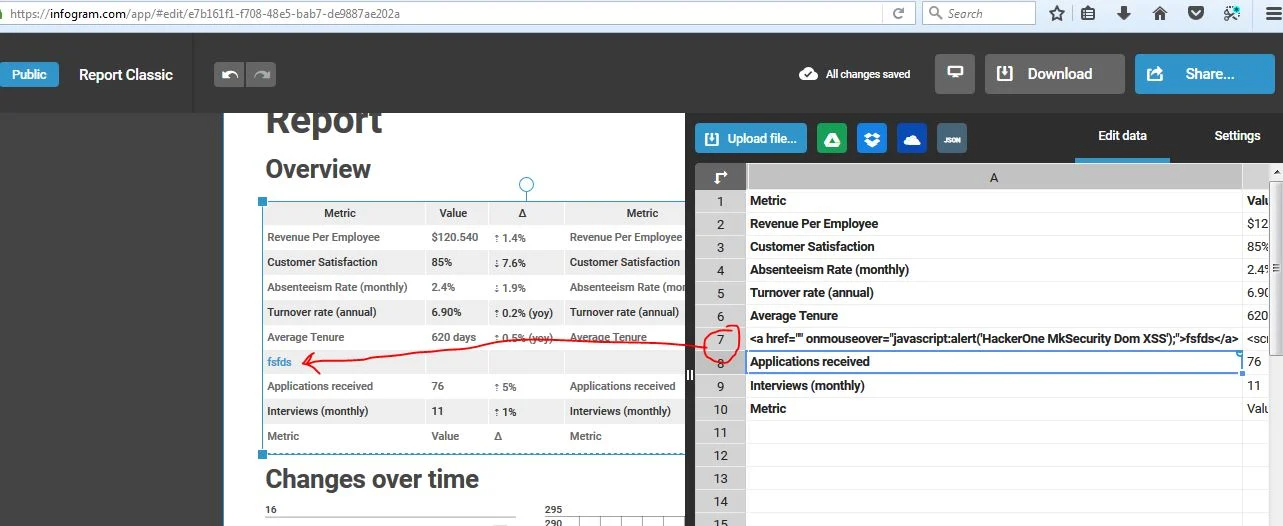
Problem Point Report's Overview Table
Report Creation Url https://infogram.com/app/#edit/e7b161f1-f708-48e5-bab7-de9887ae202a
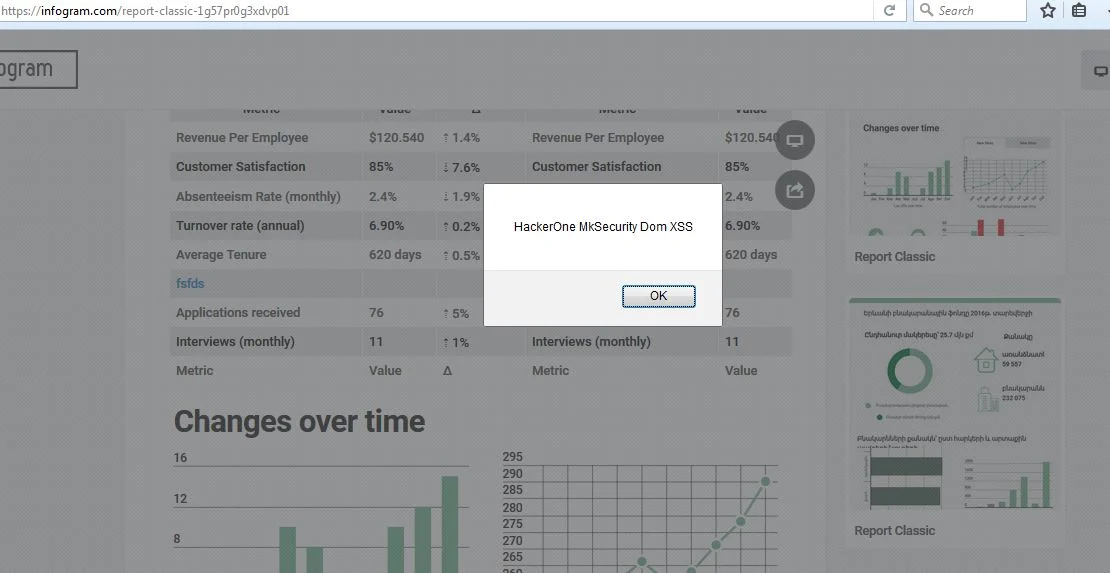
Sample Data <a href="" onmouseover="javascript:alert('HackerOne MkSecurity Dom XSS');">Click for Detail</a>
Sample URL https://infogram.com/report-classic-1g57pr0g3xdvp01
Attachments
Not written yet. The AI write-up for this report has not been written yet. The Original tab links to the source.
How it worked
Root cause
Likely the report designer did not properly sanitise or encode user-supplied HTML in the Overview Table, allowing a stored event handler to execute.
Impact
An attacker could execute arbitrary JavaScript in a victim's browser when the victim hovers over the crafted link, potentially leading to session compromise or other client-side attacks.
What the attacker needed
Ability to create or edit a report; victim views the report and hovers the link
Explained by bugbounty.wiki with AI from the original and checked against quotes from it; it can still be wrong. Read the original before relying on a detail.
Not written yet. The AI write-up for this report has not been written yet. The Original tab links to the source.
This is a cross-site scripting (XSS) bug. The report designer let someone save a link containing JavaScript code, and when another person viewed the report and hovered over that link, the code ran in their browser. That could let an attacker do things like steal session data or act as the victim.
What is XSS?
Script an attacker supplies runs in another user's browser, on the target's origin, with that user's session.




