Plaintext storage of a password on kubernetes release bucket
A publicly readable Kubernetes release bucket contained a build artefact with an rsync password stored in plaintext. An attacker who found it could use the leaked password together with the username in the accompanying script to access environments that used that build.

- Disclosed after 8 months
Report Submission Form
Summary:
During my recon I found these two buckets dl.k8s.io and dl.kubernetes.io which actually redirects to https://storage.googleapis.com/kubernetes-release/. By searching the string "password" under https://storage.googleapis.com/kubernetes-release/ I found a file called rsyncd.password (https://storage.googleapis.com/kubernetes-release/archive/anago-v1.10.0-alpha.1/k8s.io/kubernetes/_output-v1.10.0-alpha.1/images/kube-build:build-734df85a63-5-v1.9.2-1/rsyncd.password) where the password "VmvrL2DyKbJB5jb5EkNfqYPpmLBf0LjS" is stored in plaintext.
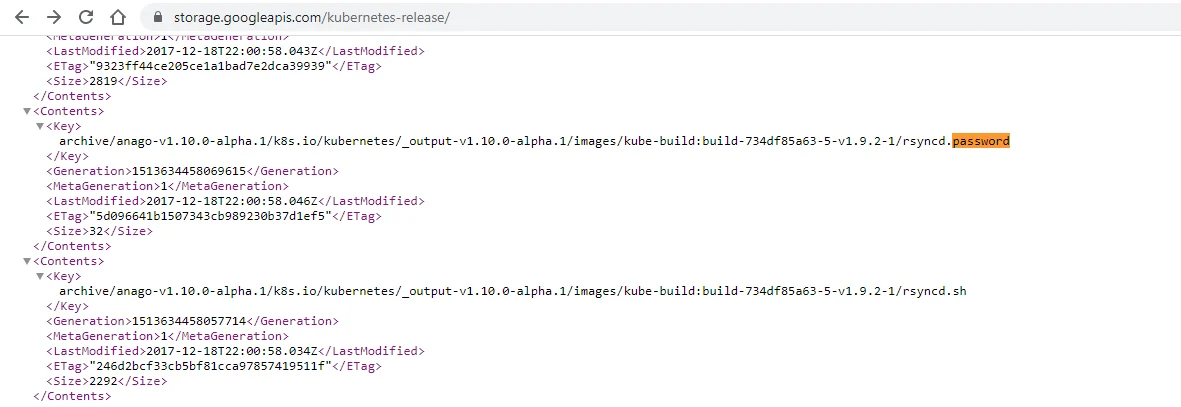
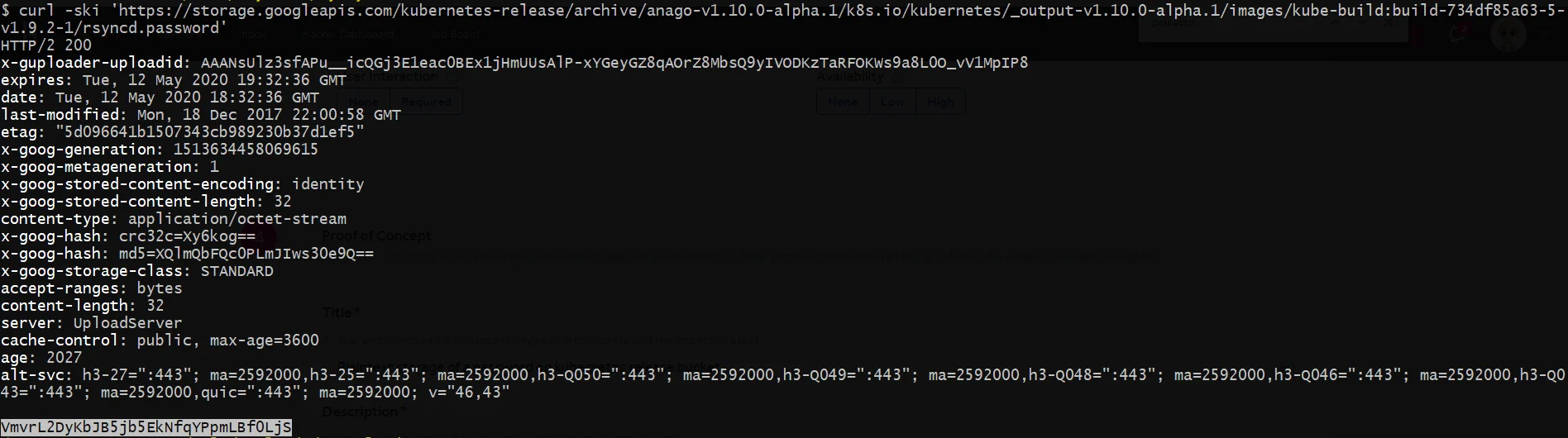
This password is used in this script https://storage.googleapis.com/kubernetes-release/archive/anago-v1.10.0-alpha.1/k8s.io/kubernetes/_output-v1.10.0-alpha.1/images/kube-build:build-734df85a63-5-v1.9.2-1/rsyncd.sh. The script rsyncd.sh is used to set up and run rsyncd to allow data to move into and out of our dockerized build system.

From the github repo https://github.com/kubernetes/release we can see what is anago where this password was found.

Fix:
Impact
Storing password in plaintext in a public bucket on the web is a security bad practice. People that used or still using the anago-v1.10.0-alpha.1 could have their environment compromised if an attacker use this leaked password and the username k8s defined here https://storage.googleapis.com/kubernetes-release/archive/anago-v1.10.0-alpha.1/k8s.io/kubernetes/_output-v1.10.0-alpha.1/images/kube-build:build-734df85a63-5-v1.9.2-1/rsyncd.sh.
Not written yet. The AI write-up for this report has not been written yet. The Original tab links to the source.
How it worked
Root cause
Likely a build script wrote a credentials file into the published output directory, and the storage bucket allowed public listing and reading.
Impact
Anyone who used or still uses that build could have their environment compromised if an attacker combines the leaked password with the username from the script.
What the attacker needed
Publicly listable storage bucket; no account needed
The fix
The report asks for the exposed password file to be deleted from the bucket.
How it was found
- Find the release buckets and follow the redirect to the public storage bucket.
- Search the bucket contents for the string password.
- Open the matching file and read the plaintext password.
- Read the companion script to learn the matching username.
Explained by bugbounty.wiki with AI from the original and checked against quotes from it; it can still be wrong. Read the original before relying on a detail.
Not written yet. The AI write-up for this report has not been written yet. The Original tab links to the source.
A published build output folder contained a file with a password in readable form, and the bucket was publicly accessible. Anyone who browsed it could read the password and try it against the service it belongs to.
What is Info disclosure?
Data the application should keep private (personal data, internal details, other users' records) reaches someone it should not.





