Stored XSS in app.lemlist.com
A stored cross-site scripting flaw existed in the custom variables feature, where a crafted value was saved and later rendered without proper escaping. An attacker could execute script in a victim's browser when the variable was used in an email editor, potentially stealing cookies or redirecting the user.

- Triaged in 18 hours
- Fixed in 18 hours
- Disclosed after 43 hours
Summary:
[add summary of the vulnerability]
Steps To Reproduce:
- Go to Company > Buddies-to-Be > Custom variables
- Add malicious code:
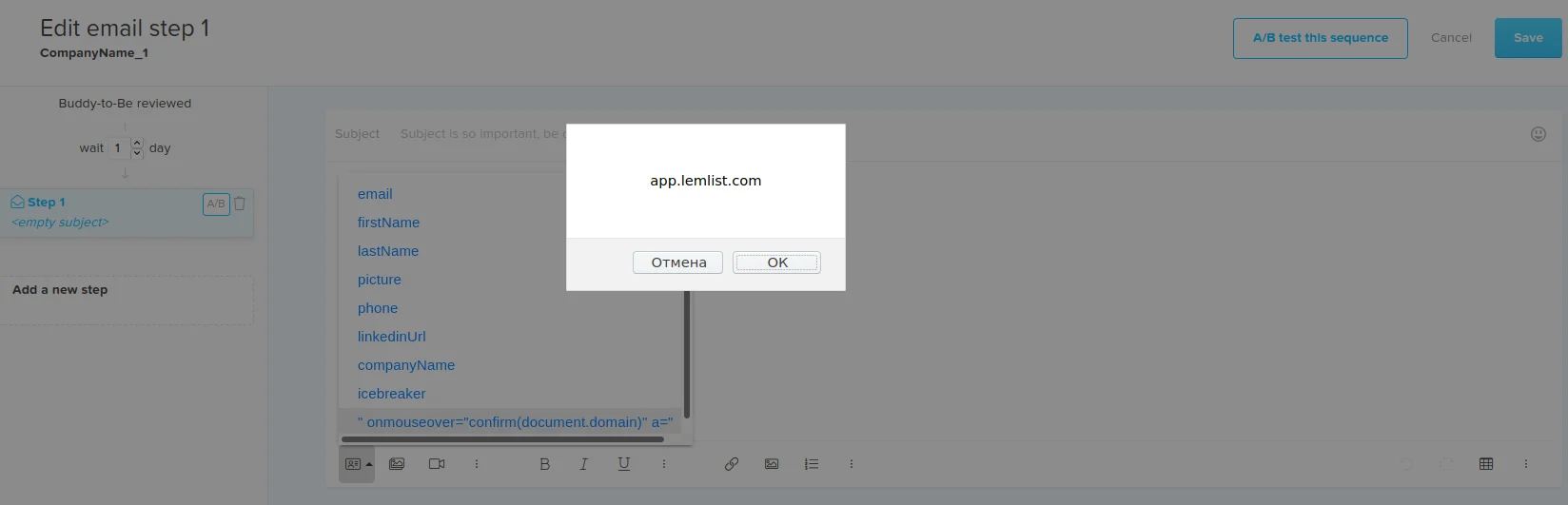
" onmouseover="confirm(document.domain)" a="

- Go to Company > Messages > Blank email
- In the WYSIWYG editor select
Custom variables - Malicious code executed
Impact
With this vulnerability, an attacker can for example steal users cookies or redirect users on malicious website.
Not written yet. The AI write-up for this report has not been written yet. The Original tab links to the source.
How it worked
Root cause
Likely the custom variable value was stored and then inserted into the page without output encoding or sanitisation, allowing an attribute breakout.
Impact
An attacker could steal users' cookies or redirect them to a malicious website, as the report states.
What the attacker needed
Ability to set custom variables; victim views the variable in the editor
How it was found
- Open the company section and go to the buddies-to-be custom variables page.
- Add a custom variable whose value contains a crafted attribute-breaking payload.
- Open the company messages section and create a blank email.
- In the rich-text editor, insert the custom variable.
- The payload executes in the browser.
Explained by bugbounty.wiki with AI from the original and checked against quotes from it; it can still be wrong. Read the original before relying on a detail.
Not written yet. The AI write-up for this report has not been written yet. The Original tab links to the source.
The application let a user save a value containing special characters that were later inserted into a web page without being made safe. When another user viewed that value in the email editor, the browser treated part of it as code and ran it. This is called stored cross-site scripting because the harmful content is saved on the server and runs later for anyone who views it.
What is XSS?
Script an attacker supplies runs in another user's browser, on the target's origin, with that user's session.