Clickjacking & CSRF attack can be done at https://app.mavenlink.com/login
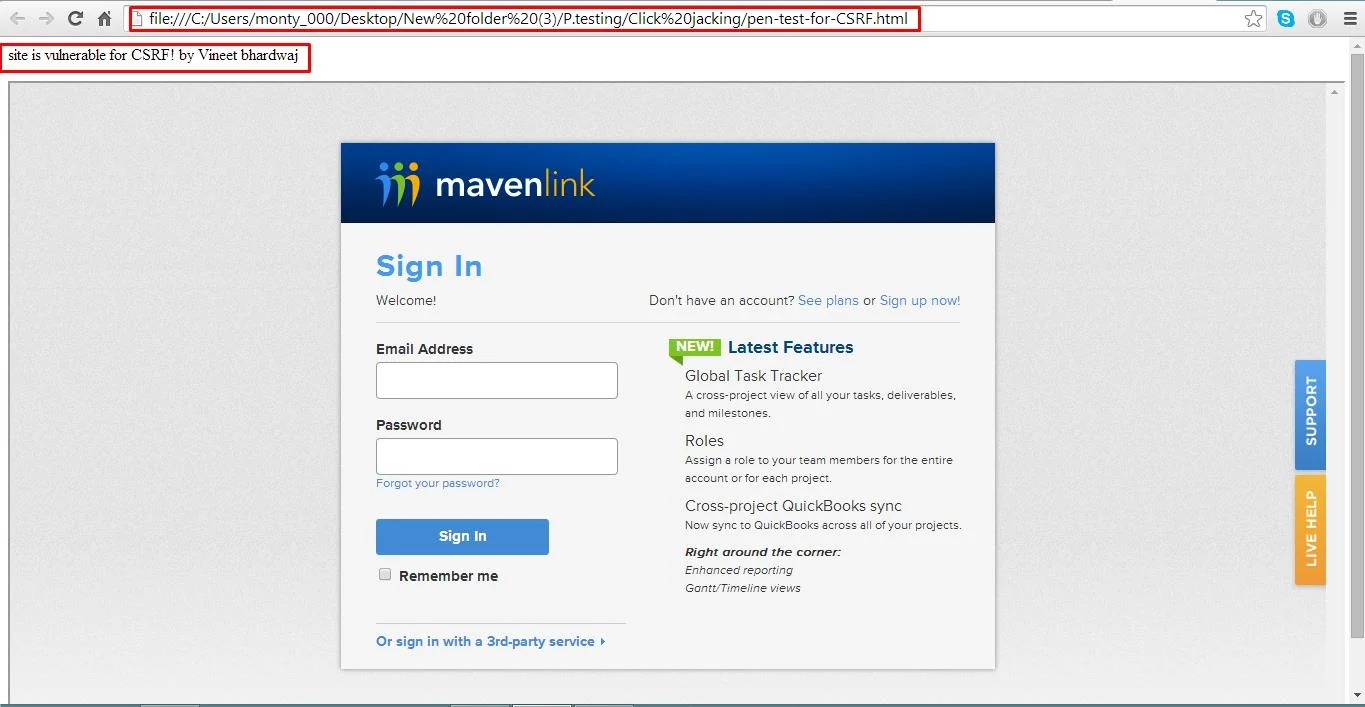
The login page can be embedded in an iframe, which the reporter claims enables clickjacking and CSRF. The reporter asserts an attacker could overlay the page to trick users into submitting credentials or redirecting them to a phishing site.

- Fixed in 2 hours
- Disclosed after 4 months
Hello, My name is Vineet bhardwaj. i am security researcher and i pen test your website( https://app.mavenlink.com/login) and i found there is click jacking attack and CSRF attack can be done.
POC:
<html><head> <title> CSRF testing </title> <style>frame {
opacity: 0.5; border: none; position: absolute; top: 0px; left: 0px; z-index: 1000; } </style>
</head> <body> <script> window.onbeforeunload = function() { return " Do you want to leave ?"; } </script> <p> site is vulnerable for CSRF! by Vineet bhardwaj</p> <iframe id="frame" width="100%" height="100%" src="https://app.mavenlink.com/login"></iframe> </body> </html>Procedure: 1. for test your website is vulnerable to clickjacking or CSRF or not ...... open pen-test-for-CSRF.html (in attachment)
- in iframe tag give link to https://app.mavenlink.com/login (already given in .html file)
save "pen-test-for-CSRF.html" open in your browser if your website open with the text "site is vulnerable " and given below with your whole site than your domain is vulnerable to clickjacking attack & CSRF.
Impact: An attacker can host this domain in other evil site by using iframe and if a user fill the given filed it can directly redirect as logs to attacker and after its redirect to your web server.. its lead to steal user information too and use that host site as phishing of your site its CSRF and Clickjacking
Note : check the attachment.;- 1. pent-test-for-CSRF.html 2. image for proof
waiting for positive response ........
Thanks, Vineet
Attachments
Not written yet. The AI write-up for this report has not been written yet. The Original tab links to the source.
How it worked
Root cause
Likely the login page does not send headers that stop other sites from framing it, such as X-Frame-Options or a frame-ancestors content security policy.
Impact
An attacker could frame the login page to trick a user into entering credentials or redirect them to a phishing site, though the report does not demonstrate a working CSRF attack.
What the attacker needed
Victim visits attacker-controlled page; victim interacts with the framed login page
How it was found
- Create an HTML file that loads the login page inside an iframe.
- Open the file in a browser.
- Observe that the login page appears inside the frame.
Explained by bugbounty.wiki with AI from the original and checked against quotes from it; it can still be wrong. Read the original before relying on a detail.
Not written yet. The AI write-up for this report has not been written yet. The Original tab links to the source.
Clickjacking is when a malicious site loads a real site in an invisible frame and tricks you into clicking something you did not intend to click. CSRF is when another site makes your browser send a request to a site you are logged into without your knowledge. The reporter only showed that the login page can be framed, not that a real CSRF attack works.
What is CSRF?
Another site makes a signed-in user's browser perform an action they did not intend.