WhatsApp — DoS Vulnerability In iOS & Android
A denial-of-service vulnerability in WhatsApp for iOS and Android allowed an attacker to crash the app by sending a contact file with a specially crafted name containing emojis and special characters. The victim's screen would turn black and the app would crash when opening the chat.

Today I wanna share with you one of my finding on Facebook; They reward me with a bounty of 500$ for this bug.
The full write-up lives on its author's site
It belongs to its author, so we link to it rather than copy it. The other two tabs are our own rewrites, checked against it.
Context
WhatsApp is a messaging application available for Android, iOS, Windows Phone and PC, and at the time of this report it had recently been acquired by Facebook in a deal the author cites at $19 billion. The feature involved is the contact-sharing flow: a user can create a contact entry, give it a name, and share that contact with another user inside a chat. When the recipient opens the chat containing the shared contact, the app renders the contact name in the conversation.
The researcher's target was the WhatsApp Messenger app itself rather than a web endpoint, and the goal was a denial of service: making the app crash or freeze for the recipient.
Setup
No special tooling is described. The researcher created a contact entry, put emojis and special characters in its name, and shared it with the victim through a chat. The only materials used were emojis and "special characters" placed in the contact name field, drawn from a list of characters the author links to on Pastebin:
https://pastebin.com/7aSNKVaV
The report does not state which app version, OS version or device model was used.
Finding it
The researcher had been hunting on Facebook's main domain, acquisitions and subdomains, and had mostly hit duplicates and rejections. The idea that led here was to look at WhatsApp instead, reasoning that Facebook had acquired more than 50 companies. Having seen other researchers report similar crash bugs against the Facebook main domain and the Facebook Messenger app, the researcher decided a denial of service was worth trying.
The initial hypothesis was a buffer overflow, which the author later describes as a bad idea because the distinction between a buffer overflow and a plain DoS was not clear at the time. The report was in fact submitted under the title "Buffer Overflow vulnerability on WhatsApp Messenger android app", and the author acknowledges this was wrong: the issue was a simple DoS. Facebook's security team accepted it regardless.
The working idea was to crash the app by sending a single message containing a malicious payload or special characters to a victim. The author links a Pastebin list of special characters and says they had seen such characters on Facebook timelines.
Exploitation
Step 1: Build a contact with a hostile name
The researcher created a contact file and put a few emojis plus "special characters" into the contact name field, the field that is shared when the contact is sent to someone else.
Step 2: Share the contact with the victim
The crafted contact was shared with the victim through a chat.
Step 3: Open the chat
When the victim opened the chat containing the shared contact, the mobile screen turned black and WhatsApp crashed. In some cases the app prompted to restart.
That is the whole exploit: no request, payload file or command is shown in the report beyond the character list, and the crash is triggered by rendering the contact name rather than by any interaction with a server-side endpoint.
Root cause
The report does not identify the faulty code. What it establishes is that a contact name containing certain emoji and special characters, when rendered in the chat, is enough to crash or freeze the app. The report does not say which component is responsible or what the malformed input does to it.
On defences: the report gives no detail on what input validation or sanitisation existed on the contact name path, so it is not possible to say from the text why the existing checks did not catch the string.
Impact
An attacker who can share a contact with a target can crash or freeze the target's WhatsApp when the target opens the chat. The Facebook response quoted in the report states that no private user information was at risk of being exposed, and that the behaviour made it possible to crash or freeze WhatsApp. The impact is a crash or freeze of the app when the victim opens the chat containing the shared contact.
Fix
Facebook's security team replied that they had looked into the issue and believed the vulnerability had been patched, asking the researcher to follow up if the patch did not resolve it:
Hi Vishnu,

We have looked into this issue and believe that the vulnerability has been patched. Please follow up with us if you believe that the patch does not resolve this issue.

Thanks,

Aaron
Security
The author notes that on 4 March the new Messenger app for iOS and Android was released containing the fix. The bounty decision describes the outcome as follows:
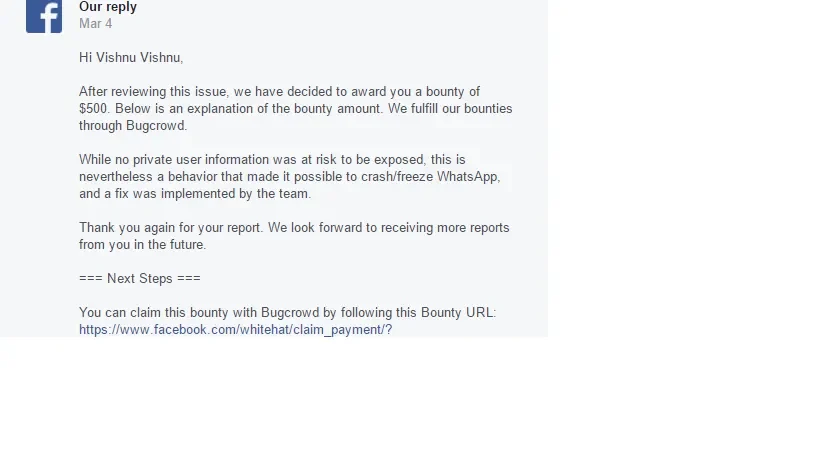
Hi Vishnu Vishnu,

After reviewing this issue, we have decided to award you a bounty of $500. Below is an explanation of the bounty amount. We fulfill our bounties through Bugcrowd.

While no private user information was at risk to be exposed, this is nevertheless a behavior that made it possible to crash/freeze WhatsApp, and a fix was implemented by the team.

Thank you again for your report. We look forward to receiving more reports from you in the future.

=== Next Steps ===
The researcher was also added to the 2017 Hall of Fame at facebook.com/whitehat/thanks.
Timeline as given in the report:
| Date | Event |
|---|---|
| Jan 15 2017 | Initial report sent |
| Feb 7 2017 | Aaron informed the researcher the issue would be investigated |
| Feb 16 2017 | Aaron informed the researcher the bug was fixed |
| Mar 4 2017 | $500 awarded |
The image shows the report's timeline entries, from the initial submission through the fix notification to the $500 award.
Variants to test
- Put the same emoji and special-character strings into other user-controlled fields that get rendered in a chat, such as group names, profile names or message bodies. A positive result is the app crashing or freezing when the recipient opens the conversation.
- Try the character list against the other platforms WhatsApp shipped on at the time, Windows Phone and PC, since the report only describes the mobile crash. A positive result is the same black screen or restart prompt on those clients.
- Share the crafted contact with a group rather than a single recipient, so that every member who opens the chat renders the name. A positive result is multiple clients crashing from one shared contact.
- Test the same class of input against other Facebook acquisitions and Messenger surfaces, which the author cites as prior art for similar crash reports. A positive result is a reproducible crash tied to a single crafted string.
What happened, in plain words
A security researcher found a way to make the WhatsApp messaging app crash on a phone. The trick was to create a contact whose name contained a mix of emojis and unusual characters, then share that contact with someone in a chat. When the other person opened the chat, their screen went black and WhatsApp crashed, sometimes asking them to restart the app.
Facebook, which owns WhatsApp, accepted the report, said the problem had been fixed, and paid the researcher a $500 bounty. The researcher was also added to Facebook's Hall of Fame, a public page thanking people who report security problems responsibly.
This article walks through how the researcher got there, step by step, and explains every technical idea along the way as if you had never heard of it before.
Some background you need first
What WhatsApp is
WhatsApp is a messaging application. You install it on a phone or computer, and you use it to send text messages, photos, and other things to other people who also use WhatsApp. At the time of this report it ran on Android, iOS, Windows Phone, and PC. Facebook had recently bought WhatsApp, in a deal the author describes as worth $19 billion.
What a contact is, and what sharing one means
A contact is simply an entry in your phone's address book: a name plus a phone number. WhatsApp lets you take one of these entries and send it to another person inside a chat, the same way you might send a photo. The other person receives the shared contact, and the app displays the contact's name.
This matters because the contact name is text that one person controls and another person's app has to display. Whenever one person's input ends up on another person's screen, that is a place where security problems can hide.
What a denial of service is
A denial of service, usually shortened to DoS, is an attack that does not steal anything. Instead, it stops something from working. Think of it like jamming a door so nobody can get through it: you have not taken anything from the building, but you have stopped people from using it.
In software, a DoS usually means making a program crash, freeze, or become so slow that it is useless. The app crashes, and in some cases prompts the victim to restart it.
What a buffer overflow is, and why it is different
A buffer overflow is a specific kind of bug. Programs store data in small reserved spaces in memory called buffers, a bit like numbered boxes. If a program puts more data into a box than the box can hold, the extra data spills into the neighbouring boxes, corrupting whatever was stored there. That can crash the program, and in serious cases an attacker can use the spill to run their own code.
A buffer overflow is one possible cause of a crash, but not every crash is a buffer overflow. A program can also crash simply because it does not know what to do with some strange input, even if nothing spills out of any box. The researcher originally thought they had found a buffer overflow, but later realised it was the simpler kind: a plain DoS. The report was submitted under the title "Buffer Overflow vulnerability on WhatsApp Messenger android app", which the author acknowledges was wrong.
What a payload is
A payload is just the content of an attack: the specific data you send to try to trigger the bug. In this case the payload was not a program or a script, it was simply a strange-looking contact name.
How the researcher found it
The researcher had spent a lot of time looking for bugs on Facebook's main domain, acquisitions and subdomains. Most of what they found turned out to be duplicates (someone else had already reported the same thing) or was rejected. This is normal in bug hunting: most attempts do not pay off.
One day the researcher had an idea: instead of looking at Facebook's websites, look at WhatsApp, one of the more than 50 companies Facebook had acquired. The researcher had seen other people report similar crash bugs against Facebook's main site and against Facebook Messenger, so it seemed reasonable that WhatsApp might have the same kind of weakness.
The plan was simple: send a single message to a victim containing something the app could not handle, and see if the app crashed. The researcher's first guess was a buffer overflow, but as explained above, that guess was wrong. The actual bug was a plain DoS.
The characters used
The researcher linked a Pastebin list of special characters, and said they had seen such characters on Facebook timelines.
https://pastebin.com/7aSNKVaV
This is a link to a page of text. The researcher's idea was to take characters from that list, mix them with emojis, and put the result somewhere WhatsApp would display it.
The attack, step by step
Step 1: Create a contact with a hostile name
The researcher created a new contact on their own phone and typed a few emojis plus some of the "special characters" from the list into the contact's name field. The name field is the part of a contact that is shared, so the recipient's app displays it.
Why do this? Because the name is the one part of the shared contact that the attacker fully controls, and it is guaranteed to be rendered (drawn on screen) by the receiving app.
Step 2: Share the contact with the victim
The researcher then shared this crafted contact with the victim through a normal WhatsApp chat. From the app's point of view, this is an ordinary action: people share contacts all the time.
Why do this? Because sharing is the delivery mechanism. The attacker does not need to break into anything; they just need the victim to receive the contact.
Step 3: The victim opens the chat
When the victim opened the chat containing the shared contact, the mobile screen turned black and WhatsApp crashed. In some cases the app prompted the victim to restart it.
Why does opening the chat matter? Because that is the moment the app tries to draw the contact name on screen. Before that, the strange text is just sitting in a message; the crash happens when the app actually processes it.
That is the entire exploit. There is no malicious file, no command, and no interaction with any server. The crash happens when the victim opens the chat containing the shared contact.
Why it worked
The report does not identify the exact piece of code that was at fault. What it establishes is that a contact name containing certain emoji and special characters, when displayed in a chat, is enough to crash or freeze the app.
The report does not say which part of the app is responsible or what exactly goes wrong with the malformed input.
As for defences: the report gives no detail on what checks existed on the contact name before it was displayed, so it is not possible to say from the text why those checks did not catch the string.
What the impact was
An attacker who can share a contact with a target can crash or freeze the target's WhatsApp when the target opens the chat. Facebook's response, quoted in the report, states that no private user information was at risk of being exposed, and that the behaviour made it possible to crash or freeze WhatsApp.
The impact is limited to availability: the app crashes or freezes, and no private user information was at risk of being exposed. It requires the victim to open the chat containing the shared contact.
The fix and the reward
Facebook's security team replied that they had looked into the issue and believed it had been patched, asking the researcher to follow up if the patch did not resolve it:
Hi Vishnu,

We have looked into this issue and believe that the vulnerability has been patched. Please follow up with us if you believe that the patch does not resolve this issue.

Thanks,

Aaron
Security
This message is a standard reply from a security team. It says three things: they investigated, they believe they have fixed the problem, and they invite the reporter to come back if the fix does not work. The name Aaron is the security team member who handled the report.
The author notes that on 4 March the new Messenger app for iOS and Android was released containing the fix. The bounty decision describes the outcome as follows:
Hi Vishnu Vishnu,

After reviewing this issue, we have decided to award you a bounty of $500. Below is an explanation of the bounty amount. We fulfill our bounties through Bugcrowd.

While no private user information was at risk to be exposed, this is nevertheless a behavior that made it possible to crash/freeze WhatsApp, and a fix was implemented by the team.

Thank you again for your report. We look forward to receiving more reports from you in the future.

=== Next Steps ===
This message explains the reward. A bounty is a payment a company makes to someone who reports a security problem to them privately, instead of exploiting it or publishing it. The message says the payment is $500, that payments are made through Bugcrowd (a company that handles bug bounty programmes), that no private user information was exposed, and that the crash or freeze was still serious enough to fix and reward.
The report does not describe the code change itself. The researcher was also added to the 2017 Hall of Fame at facebook.com/whitehat/thanks, a public page that thanks people who report security issues responsibly.
Timeline
The report gives the following dates:
| Date | Event |
|---|---|
| Jan 15 2017 | Initial report sent |
| Feb 7 2017 | Aaron informed the researcher the issue would be investigated |
| Feb 16 2017 | Aaron informed the researcher the bug was fixed |
| Mar 4 2017 | $500 awarded |
The image shows the report's timeline entries, from the initial submission through the fix notification to the $500 award.
Other places to try the same idea
Once you understand the pattern, you can look for it elsewhere. The idea is: find a field that one person controls and another person's app displays, then put strange characters in it and see what happens.
- Put the same emoji and special-character strings into other user-controlled fields that get displayed in a chat, such as group names, profile names, or message bodies. A positive result is the app crashing or freezing when the recipient opens the conversation.
- Try the character list against the other platforms WhatsApp shipped on at the time, Windows Phone and PC, since the report only describes the mobile crash. A positive result is the same black screen or restart prompt on those clients.
- Share the crafted contact with a group rather than a single recipient, so that every member who opens the chat displays the name. A positive result is multiple clients crashing from one shared contact.
- Test the same class of input against other Facebook acquisitions and Messenger surfaces, which the author cites as prior art for similar crash reports. A positive result is a reproducible crash tied to a single crafted string.
What to take away
The researcher's own summary is simple: use your creativity, look for bugs on iOS and Android, work hard, and you will see results. The bug here was not complicated. It did not require special tools or deep knowledge of memory corruption. It required noticing that a contact name is displayed on someone else's screen, and then being curious about what happens if that name contains something unusual.
Glossary
- Bounty: a payment a company makes to someone who reports a security problem to them privately.
- Buffer overflow: a bug where a program writes more data into a memory space than it can hold, spilling into neighbouring memory and often crashing the program.
- Bugcrowd: a company that runs bug bounty programmes on behalf of other companies and handles the payments.
- Contact: an entry in an address book, consisting of a name and a phone number.
- Denial of service (DoS): an attack that stops a program or service from working, usually by crashing or freezing it, without stealing data.
- Duplicate: a bug report that describes a problem someone else has already reported.
- Emoji: a small picture character, such as a smiley face, that is stored as text and displayed as an image.
- Hall of Fame: a public page where a company thanks people who have reported security problems to it.
- Payload: the specific data sent in an attack to try to trigger a bug.
- Pastebin: a website for sharing plain text, often used to post lists of characters or code snippets.
- Patch: a fix applied to software to correct a bug or close a security hole.
- Render: to draw something on screen, such as displaying a contact name inside a chat.
- Sanitisation: the process of cleaning or checking input before a program uses it, to remove anything dangerous.
- Security team: the group of people inside a company who receive and investigate reports of security problems.
- Vulnerability: a weakness in software that can be used to make it behave in a way its creators did not intend.





