Whatsapp DOS vulnerability on android and iOS
A malicious contact containing a crafted payload and a long list of emoticons could crash the victim's phone when delivered via WhatsApp. The attacker could repeatedly send the contact to increase the severity of the crash.
 Published on medium.com
Just writing this post to share my first experience on Bug Hunting.. Happy to say that I’ve received my first bounty right from Facebook which is considered to be a Tough Platform to get rewarded…
The full write-up lives on its author's site
It belongs to its author, so we link to it rather than copy it. The other two tabs are our own rewrites, checked against it.
Context
WhatsApp is the messaging product in scope here, and the report covers the Android, iOS and Web clients. The feature involved is the delivery of a contact card: a user sends another user a contact, and the receiving client parses it and shows a notification. The researcher's claim is that a crafted contact file, rather than the message text, is enough to crash the receiving phone the moment the contact is delivered.
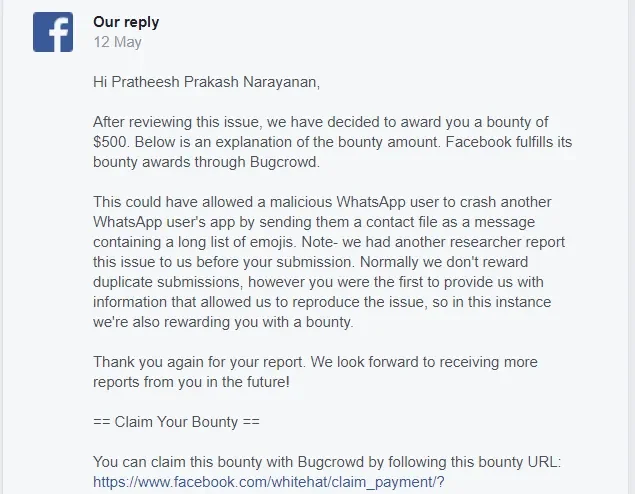
The report was submitted to Meta / Facebook and disclosed on 15 May 2018. The researcher is Pratheesh P Narayanan (@PRATHEESH_PPN), and the reward was 500.00 USD. The weakness class recorded is denial of service.
Setup
The report does not describe a test account setup, client versions, build numbers or tooling. What it does describe is the reproduction path: the researcher had a video proof of concept and detailed instructions, but the Facebook security team could not reproduce the crash from them. The researcher then asked the team to message him on WhatsApp so that he could send the payload directly, and they did. The same was later done with the WhatsApp security team. The report does not describe the preconditions beyond sending the crafted contact.
Finding it
The researcher describes the payload as embedded inside a contact file, together with a long list of emoticons. The victim receives the contact as a normal contact message and has no indication that anything is wrong with it. On delivery, the phone shows a notification and then crashes.
The published text replaces it with a note saying the issue is an Android framework issue and that the payload cannot be shared until Google issues a fix. The report also states that the issue is fixed and that the payload should not be tried again.
Exploitation
Step 1: build the contact file
The payload is placed inside a contact file along with a long list of emoticons. The report gives no field names, no file format details and no construction steps beyond this. The payload is not published:
//**removed[THIS IS AN ANDROID FRAMEWORK ISSUE AND I CANNOT SHARE THE PAYLOAD UNTIL GOOGLE ISSUES A FIX]**//
Step 2: send the contact to the victim
The attacker sends the malicious payload to the victim as a contact. The report stresses that the payload is embedded within the contact and that the victim has no way of being aware of it. As soon as the payload is delivered, the victim's phone crashes. The contact can be sent N times, which the researcher says increases the severity of the crash.
Step 3: reproduce with the security teams
The Facebook team could not reproduce the bug from the video proof of concept and the written instructions. The researcher asked them to message him on WhatsApp so he could send the payload himself, and they did. He then crashed the test device of the Facebook security team.
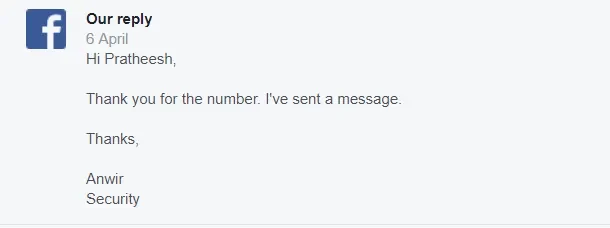
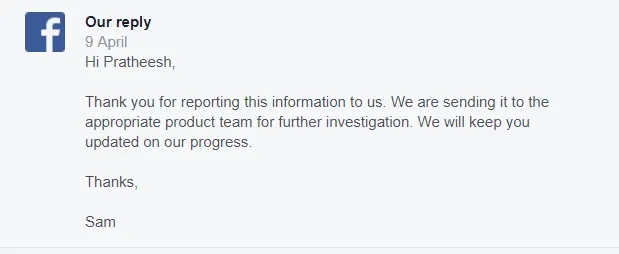
The images are captioned as the chat with the Facebook team.
He then repeated the reproduction with the WhatsApp security team.
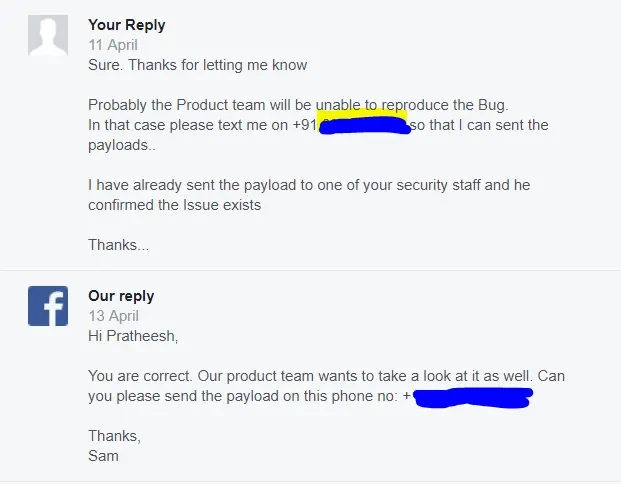
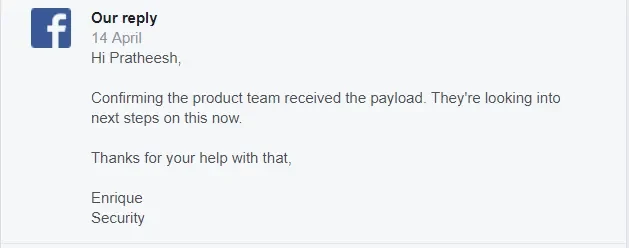
The images are captioned as the WhatsApp security team.
Root cause
The report attributes the crash to an Android framework issue, which is why the payload was withheld until Google issued a fix. It does not identify the vulnerable component, the parsing code or the exact malformed structure.
Impact
The impact described is a denial of service against the receiving device: the phone crashes as soon as the contact is delivered, without any interaction from the victim beyond receiving the message. Because the contact can be sent repeatedly, the researcher states that repetition increases the severity of the crash.
Fix
The issue was fixed by the vendor. The report says the fix came after almost two months of waiting, and that the reward was 500 USD with the researcher's name added to the Hall of Fame. It does state that the issue is fixed and that the payload should not be tried again.
Variants to test
- Send crafted contact files with unusual field content, such as very long strings or large emoticon lists, to other messaging clients that import contacts. A positive result is a crash or hang on delivery, before the recipient opens anything.
- Test the same contact delivery path on each platform the product ships (Android, iOS, Web) to see whether the parsing differs. A positive result is one platform crashing where another handles the file normally.
- Repeat delivery of the same crafted contact to see whether repeated messages compound the effect, as the report claims. A positive result is a device that becomes progressively less stable or crashes more readily with each delivery.
- Try the same embedded-content approach in other structured payloads a client parses automatically, such as calendar invites or rich previews. A positive result is a crash triggered by delivery alone, with no user interaction.
What happened, in plain words
A security researcher found that he could crash a phone by sending a specially crafted contact card through WhatsApp. The victim did not have to tap anything: as soon as the contact arrived, the phone showed a notification and then crashed. The researcher reported this to Facebook (which owns WhatsApp), and after some back and forth to reproduce the crash, WhatsApp fixed it and paid a $500 bounty. The title names Android, iOS and Web clients, and the weakness is a denial of service (DoS).
Context
WhatsApp is a messaging app that lets you send text, photos, and contacts. In this report, the feature involved is sending a contact card: you share someone's phone number and name with another person, and their phone shows it as a contact. The researcher's claim is that a contact file, not the message text, can be made to crash the receiving phone the moment it is delivered.
The report was submitted to Meta / Facebook and disclosed on 15 May 2018. The researcher is Pratheesh P Narayanan (@PRATHEESH_PPN), and the reward was 500.00 USD. The weakness class is denial of service.
Setup
The report does not describe test accounts, app versions, build numbers or tools. What it does describe is how the researcher got the security teams to see the crash: he had a video proof of concept and written steps, but the Facebook security team could not reproduce the crash from them. So he asked them to message him on WhatsApp so he could send the payload directly, and they did. He later did the same with the WhatsApp security team. The report does not describe the preconditions beyond sending the crafted contact.
Finding it
The researcher says the payload was embedded inside a contact file together with a long list of emoticons. The victim receives the contact as a normal contact message and has no indication that anything is wrong. On delivery, the phone shows a notification and then crashes.
The published text replaces it with a note saying the issue is an Android framework issue and that the payload cannot be shared until Google issues a fix. The report also states that the issue is fixed and that the payload should not be tried again.
Exploitation
Step 1: build the contact file
The payload is placed inside a contact file along with a long list of emoticons. The report gives no field names, no file format details and no construction steps beyond this. The payload is not published:
//**removed[THIS IS AN ANDROID FRAMEWORK ISSUE AND I CANNOT SHARE THE PAYLOAD UNTIL GOOGLE ISSUES A FIX]**//
This is not code you can run; it is a placeholder where the real payload would be. The note says the payload is tied to an Android framework issue and cannot be shared until Google fixes it.
Step 2: send the contact to the victim
The attacker sends the malicious payload to the victim as a contact. The report stresses that the payload is embedded within the contact and that the victim has no way of being aware of it. As soon as the payload is delivered, the victim's phone crashes. The contact can be sent N times, which the researcher says increases the severity of the crash.
Step 3: reproduce with the security teams
The Facebook team could not reproduce the bug from the video proof of concept and the written instructions. The researcher asked them to message him on WhatsApp so he could send the payload himself, and they did. He then crashed the test device of the Facebook security team.
The images are captioned as the chat with the Facebook team.
He then repeated the reproduction with the WhatsApp security team.
The images are captioned as the WhatsApp security team.
Root cause
The report attributes the crash to an Android framework issue, which is why the payload was withheld until Google issued a fix. It does not identify the vulnerable component, the parsing code or the exact malformed structure.
Impact
The impact described is a denial of service against the receiving device: the phone crashes as soon as the contact is delivered, without any interaction from the victim beyond receiving the message. Because the contact can be sent repeatedly, the researcher states that repetition increases the severity of the crash.
Fix
The issue was fixed by the vendor. The report says the fix came after almost two months of waiting, and that the reward was 500 USD with the researcher's name added to the Hall of Fame. It does state that the issue is fixed and that the payload should not be tried again.
Variants to test
- Send crafted contact files with unusual field content, such as very long strings or large emoticon lists, to other messaging clients that import contacts. A positive result is a crash or hang on delivery, before the recipient opens anything.
- Test the same contact delivery path on each platform the product ships (Android, iOS, Web) to see whether the parsing differs. A positive result is one platform crashing where another handles the file normally.
- Repeat delivery of the same crafted contact to see whether repeated messages compound the effect, as the report claims. A positive result is a device that becomes progressively less stable or crashes more readily with each delivery.
- Try the same embedded-content approach in other structured payloads a client parses automatically, such as calendar invites or rich previews. A positive result is a crash triggered by delivery alone, with no user interaction.
Glossary
- API: Application Programming Interface; a set of rules that lets one program talk to another, like a waiter taking your order to the kitchen.
- Bounty: A reward paid by a company for reporting a security bug.
- Client: The app or program you use to connect to a service, such as the WhatsApp app on your phone.
- Contact card: A file or message that contains a person's name and phone number, which you can save to your contacts.
- Cookie: A small piece of data a website stores in your browser to remember you, like a name tag.
- Denial of service (DoS): An attack that makes a service or device unavailable, often by crashing it.
- Emoticon: A small image or symbol used to express emotion in text, like a smiley face.
- Framework: A set of pre-built code that apps rely on to work; here, the Android framework is part of the Android operating system.
- Hall of Fame: A public list of people who have reported security bugs, often shown on a company's website.
- Payload: The part of an attack that does the damage, such as the malicious content in a file.
- Proof of concept (PoC): A demonstration that a bug is real, often a video or a set of steps.
- Token: A piece of data used to prove who you are, like a temporary password.
- Vulnerability: A weakness in software that can be exploited to cause harm.
- Web client: A version of an app that runs in a web browser instead of being installed.


