[redis-commander] Reflected SWF XSS via vulnerable "clipboard.swf" component
The clipboard.swf file bundled with Redis Commander accepts a highlighterId parameter that is injected into JavaScript without proper escaping, allowing reflected cross-site scripting. An attacker could craft a URL that, when opened and clicked by another user, runs arbitrary JavaScript in that user's session context.

- Triaged in 17 days
- Fixed in 46 days
- Disclosed after 46 days
Summary by the researcher
An injection in the highlighterId parameter of the clipboard.swf component can be leveraged in a reflected XSS on hosts serving Redis Commander.
The report
Hi,
An injection in the highlighterId parameter of the clipboard.swf component can be used to reflect JavaScript in the context of hosts running Redis Commander.
Module specification
- Name: redis-commander
- Version: 0.4.5 (latest release build)
Verified conditions
- Test server: Ubuntu 16.04 LTS
- Browser version: Firefox 57.0 (64-bit)
- Flash version: 27.0.0.187
Proof of concept
Please globally install the redis-commander package and run redis-commander -p 80 to start serving the Commander interface.
To reproduce this vulnerability, please access the below URL in a browser with Adobe Flash enabled and click on the content which appears.
http://instance/jstree/_docs/syntax/clipboard.swf?highlighterId=\%22))}%20catch(e)%20{alert(document.domain);}//
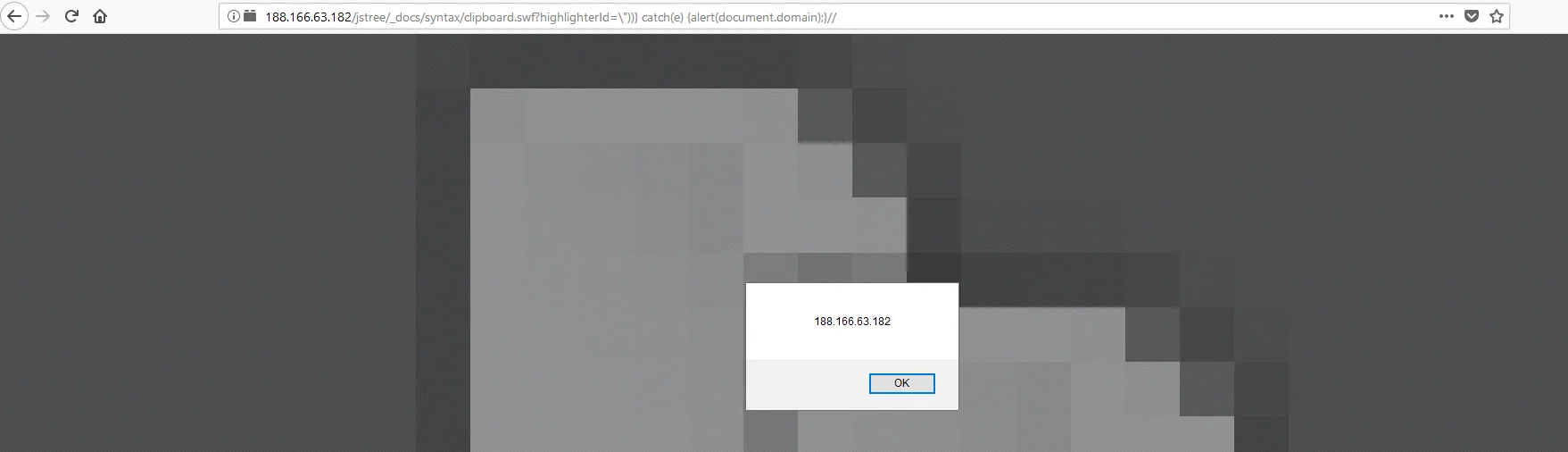
Thanks,
Yasin
Impact
An adversary can leverage this vulnerability in a crafted request that, if issued by another Redis Commander user, will cause arbitrary JavaScript code to execute within the target's browser in the context of their session.
Not written yet. The AI write-up for this report has not been written yet. The Original tab links to the source.
How it worked
Root cause
Likely the clipboard.swf component inserts the user-supplied highlighterId value into a JavaScript context without escaping, so crafted characters break out of the string.
Impact
If another Redis Commander user opens the crafted request, arbitrary JavaScript could execute in their browser within the context of their session; the exploit requires Adobe Flash to be enabled and the victim to click the page.
What the attacker needed
Adobe Flash enabled in the browser; Victim opens the crafted URL; Victim clicks on the page content
How it was found
- Install the redis-commander package globally and start it serving on a port.
- Open the crafted clipboard.swf URL with the injected highlighterId value in a browser that has Adobe Flash enabled.
- Click on the content that appears on the page to trigger the script.
Explained by bugbounty.wiki with AI from the original and checked against quotes from it; it can still be wrong. Read the original before relying on a detail.
Not written yet. The AI write-up for this report has not been written yet. The Original tab links to the source.
Redis Commander is a web tool for browsing a Redis database. It ships with an old Flash file that takes a value from the web address and puts it into a script without cleaning it, so a crafted link can make the browser run the attacker's code. The victim has to have Flash enabled and click on the page for it to work.
What is XSS?
Script an attacker supplies runs in another user's browser, on the target's origin, with that user's session.








