[static-server-gx] Path Traversal allowing to read any files on the server
The static-server-gx module fails to sanitise file paths, allowing an attacker to use dot-dot-slash sequences to read files outside the web root, including system files like /etc/passwd. This could lead to remote code execution.
 Originally disclosed on HackerOne
- Triaged in 12 hours
- Fixed in 15 months
- Disclosed after 16 months
I would like to report path traversal vulnerability in module "static-server-gx" It allows an attacker to read any files even system files via this path traversal vulnerability.
Module
module name: static-server-gx version: 1.2.1 npm page: https://www.npmjs.com/package/static-server-gx
Module Description
N/A
Module Stats
[21] downloads in the last week [77] downloads in the last month
Vulnerability
##Vulnerability Description Path traversal attack (also known as directory traversal) aims to access files and directories that are stored outside the web root folder. By manipulating variables that reference files with “dot-dot-slash (../)” sequences and its variations or by using absolute file paths, it may be possible to access arbitrary files and directories stored on file system including application source code or configuration and critical system files.
##Steps To Reproduce:
- Install the module
npm install -g static-server-gx
- Run 'static-server-gx in "~/Desktop" directory:
nodejs /usr/lib/node_modules/static-server-gx/server.js
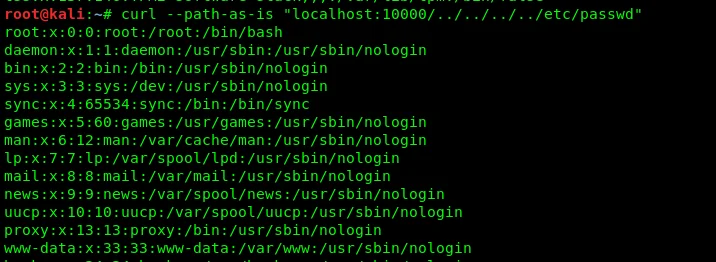
- Use cURL to access etc/passwd file:
curl --path-as-is --url "localhost:10000/../../../../etc/passwd"
Patch
User input should be properly sanitized and filtered to remove dot-dot-slash (../)” sequences and its variations in path.
Supporting Material/References:
- Linux kali 4.15.0-kali2-amd64
- node 10.15.3
- npm 6.9
- Firefox ESR 52.7.3 (64-bit)
Wrap up
- I contacted the maintainer to let them know: N
- I opened an issue in the related repository: N
Impact
It could have enabled an attacker to view system files and leverage attacks like remote code execution and so on.
Not written yet. The AI write-up for this report has not been written yet. The Original tab links to the source.
How it worked
Root cause
Likely the server did not sanitise or normalise user-supplied paths, allowing '../' sequences to escape the web root.
Impact
An attacker could view system files and potentially leverage this to achieve remote code execution.
What the attacker needed
Static-server-gx installed and running; network access to the server
How it was found
- Install the static-server-gx module globally.
- Run the server from a directory such as the Desktop.
- Send a request with '../' sequences to read /etc/passwd.
Explained by bugbounty.wiki with AI from the original and checked against quotes from it; it can still be wrong. Read the original before relying on a detail.
Not written yet. The AI write-up for this report has not been written yet. The Original tab links to the source.
A path traversal bug lets someone trick a web server into reading files it shouldn't, by using '../' to climb out of the folder it's supposed to serve. Here, the static file server didn't clean up those '../' sequences, so a request could reach sensitive system files like the password file.
What is Path traversal?
Input that builds a file path escapes the intended folder, reading or writing files the application should never touch.




