Windows Device Names Still Allow Path Traversal in UNC Paths After CVE-2025-27210 Fix
The CVE-2025-27210 fix for Windows device names in Node.js path handling does not cover UNC network paths when using path.join(), so a crafted device name with traversal sequences can escape the intended directory. An attacker could read files outside the intended directory on Windows network shares.
 Originally disclosed on HackerOne
- Disclosed after 12 days
Summary:
I found that Windows device names (CON, PRN, AUX, etc.) can still be used for path traversal attacks when working with UNC network paths, even after the CVE-2025-27210 patch. So basically, the fix only covered regular paths but missed the UNC path scenario when using path.join()
Description:
I was testing the recent CVE-2025-27210 fix and noticed something . The patch works fine for regular paths - if I try path.normalize('CON:../../secret.txt'), it correctly returns .\CON:..\..\secret.txt. Great that's fixed
But then I started testing UNC paths (you know, network paths like \\server\share) and found the vulnerability still exists there. The issue is that when you use path.join() with a UNC path and a device name, the device name gets stripped and the traversal happens
Here's what I mean:
const path = require('path');

// This is fixed (regular path)
console.log(path.normalize('CON:../../secret.txt'));
// Output: .\CON:..\..\secret.txt ✓

// But this is still vulnerable (UNC path)
console.log(path.join('\\\\server\\share\\uploads', 'CON:../../secret.txt'));
// Output: \\server\share\secret.txt ✗
// Should be: \\server\share\uploads\.\CON:..\..\secret.txt
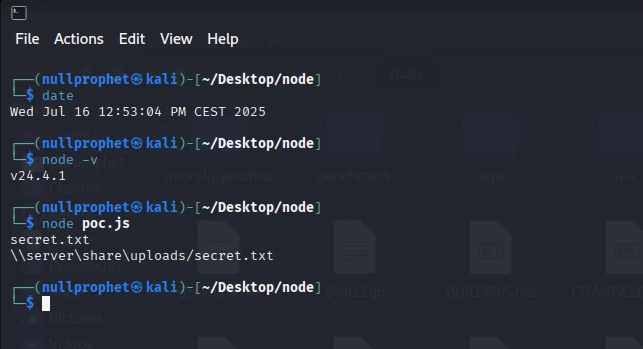
This happens because the normalize function inside path.join() handles UNC paths differently than regular paths
Steps to Reproduce:
-
Use any Node.js version including the latest v24.4.1 (with CVE-2025-27210 fix)
-
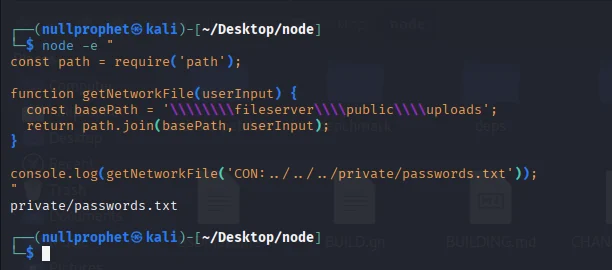
Create a simple test file:
const path = require('path');

function getNetworkFile(userInput) {
  const basePath = '\\\\\\\\fileserver\\\\public\\\\uploads';
  return path.join(basePath, userInput);
}

console.log(getNetworkFile('CON:../../../private/passwords.txt'));
"
-
Run the code
-
Expected result:
\\fileserver\public\uploads\.\CON:..\..\..\private\passwords.txt -
Actual result:
\\fileserver\public\private\passwords.txt(escaped the uploads directory!)
Why This is Different from CVE-2025-27210:
So I know what you're thinking - "didn't we just fix this?" Well, kinda. CVE-2025-27210 fixed the issue for regular paths by adding the .\ prefix when it detects device names. But that fix only applies to direct normalize() calls or regular local paths
The difference:
- CVE-2025-27210: Fixed
path.normalize('CON:../')for local paths - This bug: UNC paths like
\\server\share+ device names still vulnerable when usingpath.join()
It's essentially a bypass of the CVE-2025-27210 fix for network scenarios
Mitigation:
To fix this, you should apply the same device name validation logic to UNC paths in the path.join() function. Specifically, when joining paths that start with \\, the code needs to check for device names and add the .\ prefix just like it does for regular paths
The fix probably needs to go in the normalize function's UNC path handling section, around where it processes paths starting with \\.
Impact
An attacker could read files outside the intended directory on Windows network shares :
- File sharing applications (escape to other users' folders)
- Cloud storage systems using UNC paths
- Corporate network shares (access sensitive documents)
- Any Node.js app that serves files from network locations
Also, this could lead to lateral movement in corporate networks - imagine escaping from \\webapp\public to \\webapp\C$\Windows\System32\config or even to other servers like \\adminserver\C$.
Not written yet. The AI write-up for this report has not been written yet. The Original tab links to the source.
How it worked
Root cause
Likely the device-name validation added for CVE-2025-27210 is not applied in the UNC path handling branch of path.join()'s internal normalisation, so device names are stripped and traversal sequences are resolved.
Impact
An attacker could read files outside the intended directory on Windows network shares; lateral movement is a possible scenario.
What the attacker needed
Node.js on Windows; App uses path.join() with UNC base path; Attacker controls part of the path
The fix
The device name validation logic should be applied to UNC paths in path.join() so that a .\ prefix is added when a device name is detected.
How it was found
- Use a Node.js version that includes the CVE-2025-27210 fix.
- Create a test script that calls path.join() with a UNC base path and a device-name input containing traversal sequences.
- Run the script.
- Observe that the resulting path escapes the intended uploads directory.
Explained by bugbounty.wiki with AI from the original and checked against quotes from it; it can still be wrong. Read the original before relying on a detail.
Not written yet. The AI write-up for this report has not been written yet. The Original tab links to the source.
Windows has special reserved names like CON and PRN that can behave oddly in file paths. Node.js tried to fix a bug where these names could be used to climb out of a folder, but the fix missed network paths (UNC paths like \\server\share). This means an attacker can still use a device name to reach files outside the folder the app meant to serve.
What is Path traversal?
Input that builds a file path escapes the intended folder, reading or writing files the application should never touch.