owncloud.com: Persistent XSS In Account Profile
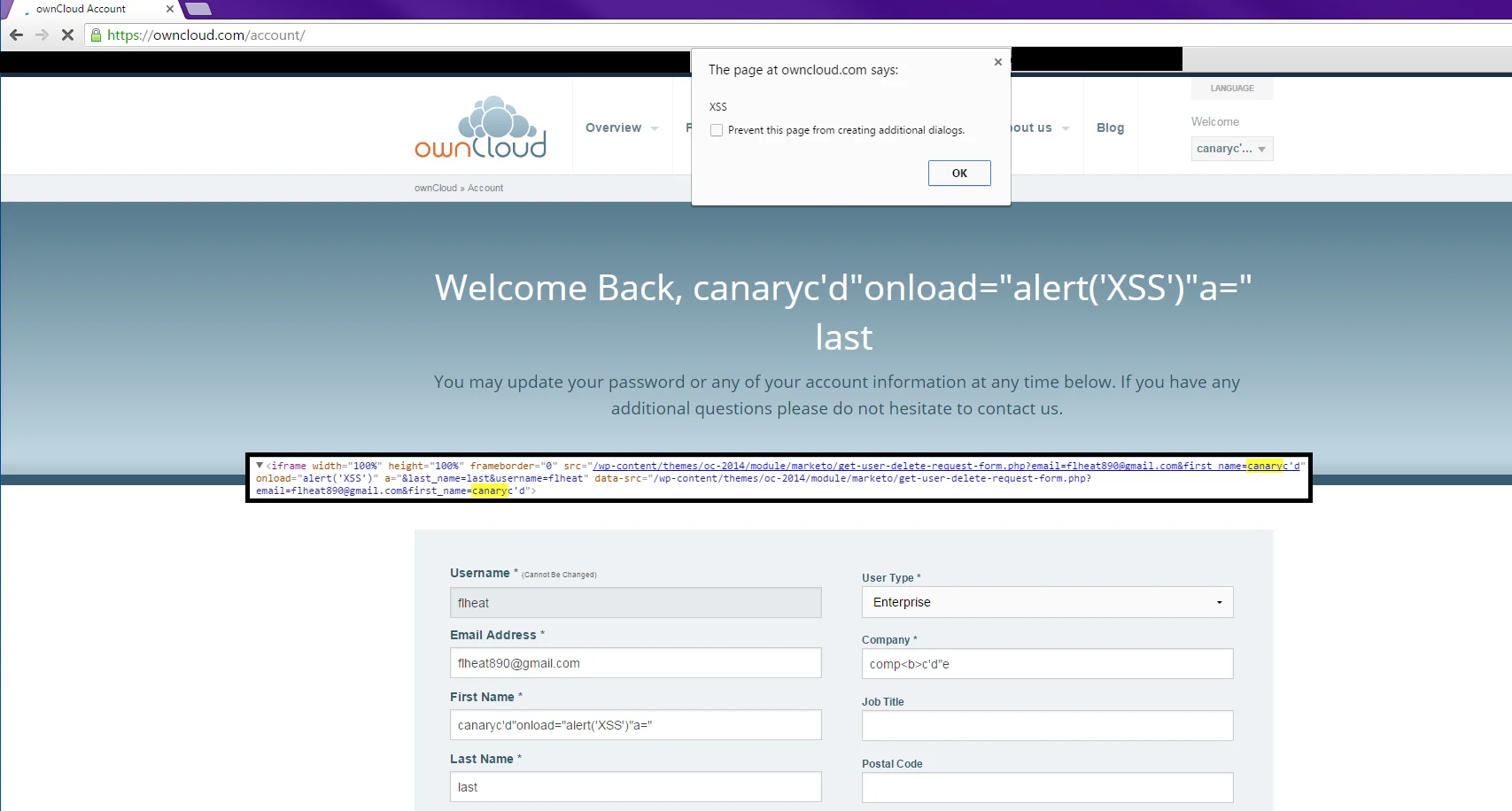
The first and last name fields in the user profile were not sanitised for quotation marks within an iframe tag, allowing persistent cross-site scripting. An attacker could inject a script that executes when the profile is viewed, potentially stealing session cookies or hooking browsers.
 Originally disclosed on HackerOne
- Triaged in 1 hour
- Fixed in 46 hours
- Disclosed after 2 days
Quotation marks are not sanitized in one of the HTML tags inside of the profile when dealing with first & last names. It is an <iframe> tag. In the attached PoC screenshot, I included a functional first name that triggers an alert() call. Inside, I pasted the HTML tag where it breaks.
I don't know owncloud inside-out, so I don't know if anybody else is able to see my user profile. If they are, then this would be able to pull anybody else's session cookies. However, even if not, it could still be used to BeEF-hook others if they access your account or you get one-time access to their account, so it should still be fixed.
Attachments
Not written yet. The AI write-up for this report has not been written yet. The Original tab links to the source.
How it worked
Impact
If other users can view the profile, an attacker could steal their session cookies; even if not, it could be used to hook browsers via BeEF when someone accesses the account.
What the attacker needed
Ability to set first/last name; victim views the profile
Explained by bugbounty.wiki with AI from the original and checked against quotes from it; it can still be wrong. Read the original before relying on a detail.
Not written yet. The AI write-up for this report has not been written yet. The Original tab links to the source.
A user's profile page includes a part that shows their name inside a small embedded window (an iframe). The site failed to clean up special characters like quotation marks in the name, so someone could type a name that actually contains code. When other people view that profile, the code runs in their browser, which could let the attacker take over their session.
What is XSS?
Script an attacker supplies runs in another user's browser, on the target's origin, with that user's session.



