Server-Side Request Forgery on SAML Application - Import via URL
The SAML application import feature accepted a user-supplied URL and made a server-side request to it, returning different error messages depending on whether the target was reachable. An attacker could use these responses to probe internal hosts and services, including the AWS metadata endpoint.

- Triaged in 21 hours
- Fixed in 6 months
- Paid in 12 days
- Disclosed after 13 months
Summary
The My Applications feature on PingOne Identity admin allows you to add new SAML applications to your account. One feature allows you to import metadata via URI instead of via upload. This uses Java 1.8 to make an external web request to the URI supplied. Typically this is hard to validate if it's a vulnerability or not because it functions as intended. However, the error responses I was able to get back suggests it can hit internal services and you can perform recon or attack internal services using it.
Steps
- Go to My Applications and click the Add Application button:
- Fill out basic details and go to the next step
- Next to Upload metadata, select
or use URL - Try these URLs:
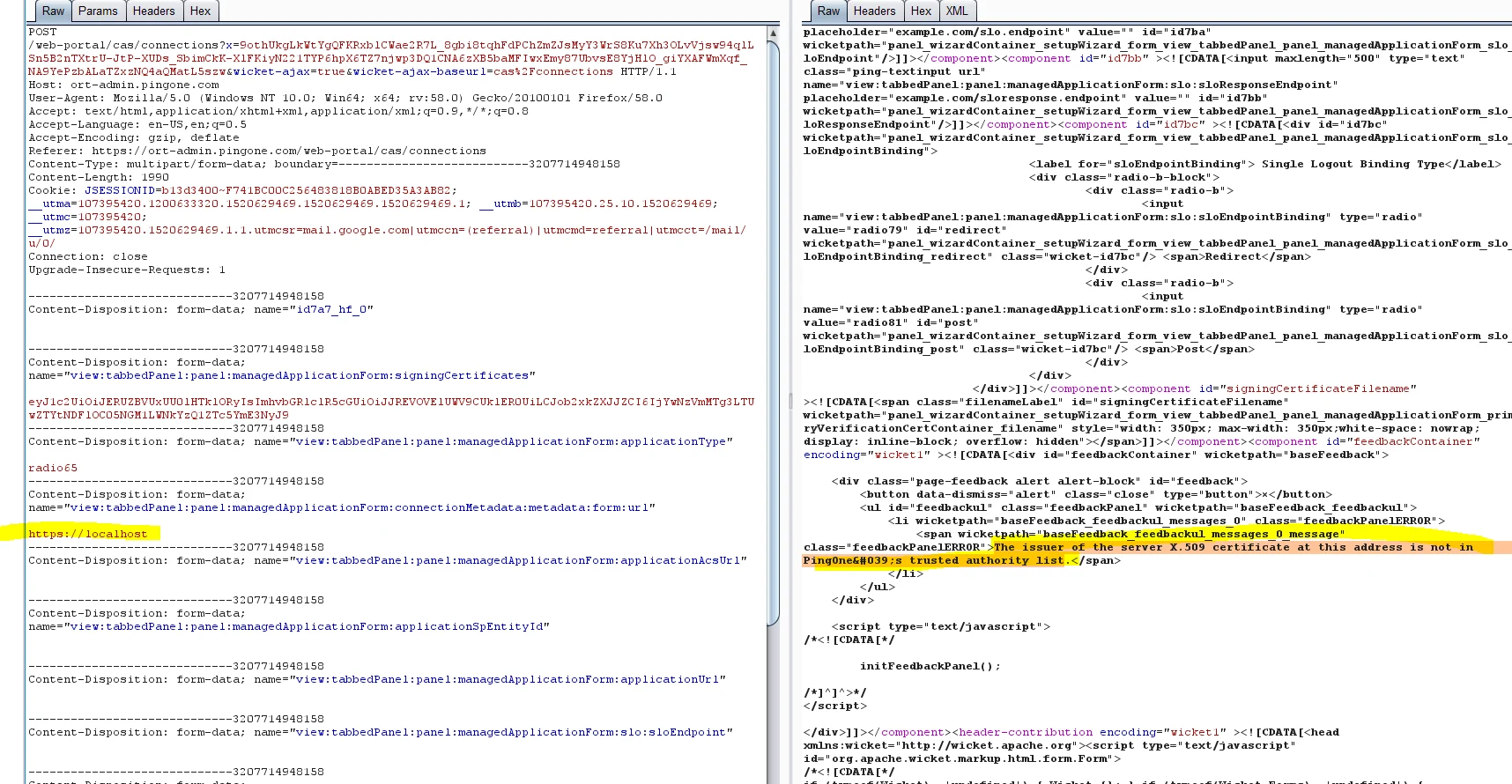
- https://localhost
- https://localhost:22
- http://169.254.169.254/latest/meta-data/
- http://169.254.169.254/latest/meta-data/a
- ---> The error responses determine it's hitting internal resources you specify.
Additional Info
https://localhost response:
The issuer of the server X.509 certificate at this address is not in PingOne's trusted authority list.
https://localhost:22 response:
We could not connect to the address 'https://localhost:22'.
http://169.254.169.254/latest/meta-data/ response:
<ajax-response><redirect><![CDATA[../error]]></redirect></ajax-response>
http://169.254.169.254/latest/meta-data/a response:
We could not connect to the address 'http://169.254.169.254/latest/meta-data/a'.
Impact
Server-Side Request Forgery that allows internal requests and provides useful feedback on errors could lead an attacker to mapping internal services and hosts. If there are any vulnerable services such as internal APIs, old ElasticSearch, etc it could lead to an attacker escalating to more critical vulnerabilities.
The hacker selected the Server-Side Request Forgery (SSRF) weakness. This vulnerability type requires contextual information from the hacker. They provided the following answers:
Can internal services be reached bypassing network access control? Yes
What internal services were accessible? https://localhost Internal AWS meta data
Security Impact This allows you to hit internal IPs and hostnames in the AWS environment. Any application or host that has security groups preventing external access could potentially be discovered and exploited. Due to no response back, it would mostly be used for recon against internal services/ports.
Attachments
Not written yet. The AI write-up for this report has not been written yet. The Original tab links to the source.
How it worked
Root cause
Likely the metadata import feature fetched any user-supplied URL without restricting destinations to public addresses or blocking internal ranges.
Impact
An attacker could map internal hosts and ports and potentially reach vulnerable internal services, though the report notes that no response body came back so it would mostly be used for reconnaissance.
What the attacker needed
Access to the PingOne admin console; ability to add a SAML application
How it was found
- Open the My Applications page and start adding a new application.
- Complete the basic details and continue to the next step.
- Choose to supply metadata by URL instead of uploading a file.
- Enter URLs pointing at localhost, a local port, and the AWS metadata address.
- Compare the error responses to infer whether the internal target was reachable.
Explained by bugbounty.wiki with AI from the original and checked against quotes from it; it can still be wrong. Read the original before relying on a detail.
Not written yet. The AI write-up for this report has not been written yet. The Original tab links to the source.
When a website lets you give it a link to fetch, the server may fetch that link from inside its own network. If it does not restrict where it can go, you can make it visit internal machines that are not reachable from the internet. Here the different error messages told the tester whether an internal address existed and accepted connections.
What is SSRF?
The server can be made to fetch an address the attacker chooses, reaching internal services, cloud metadata or other customers' data.





