HTTP PUT method is enabled ratelimited.me
The web server accepted an HTTP PUT request and stored the uploaded file, which could then be retrieved with a GET request. An attacker could upload arbitrary content, potentially leading to script execution or server compromise depending on configuration.
 Originally disclosed on HackerOne
- Fixed in 5 hours
- Disclosed after 8 hours
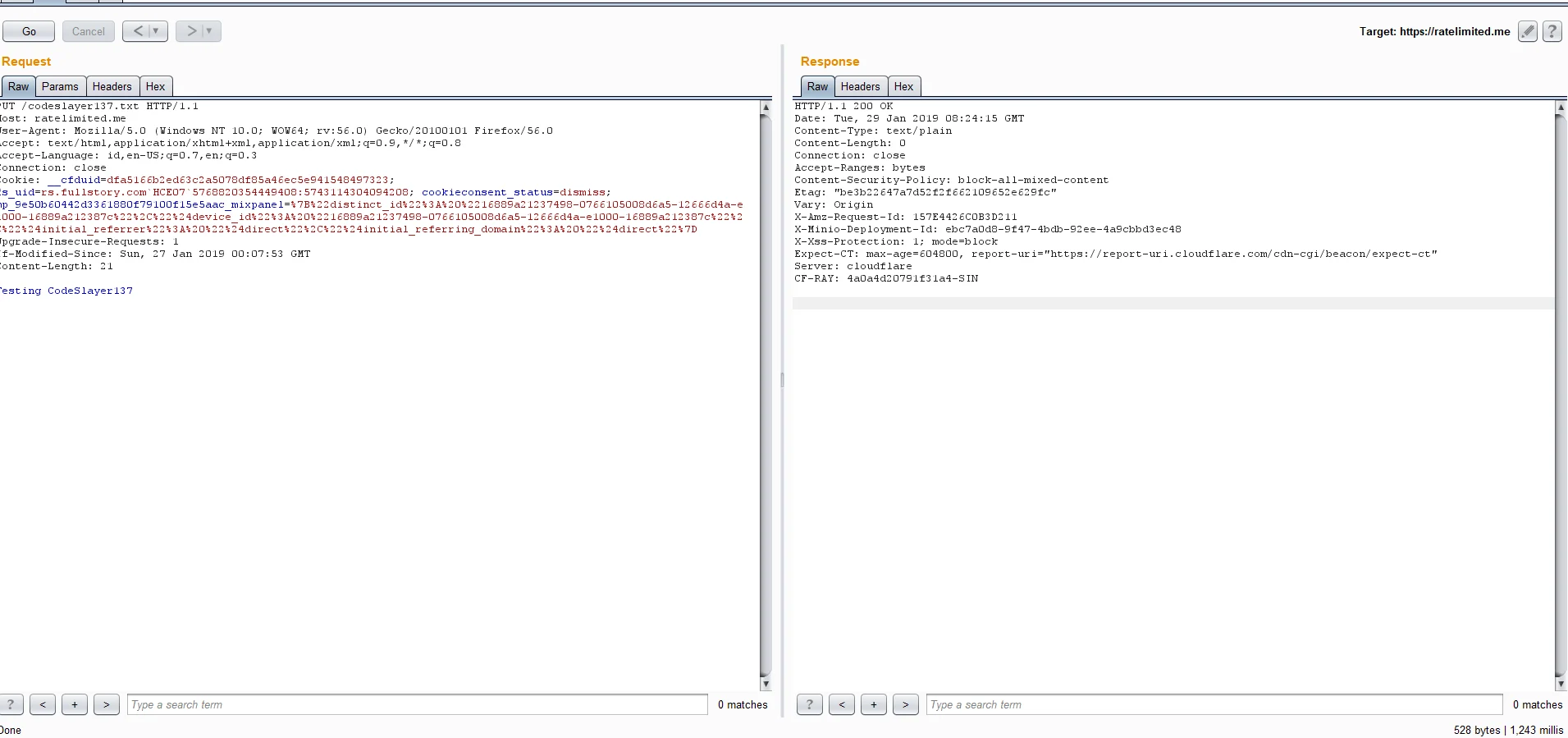
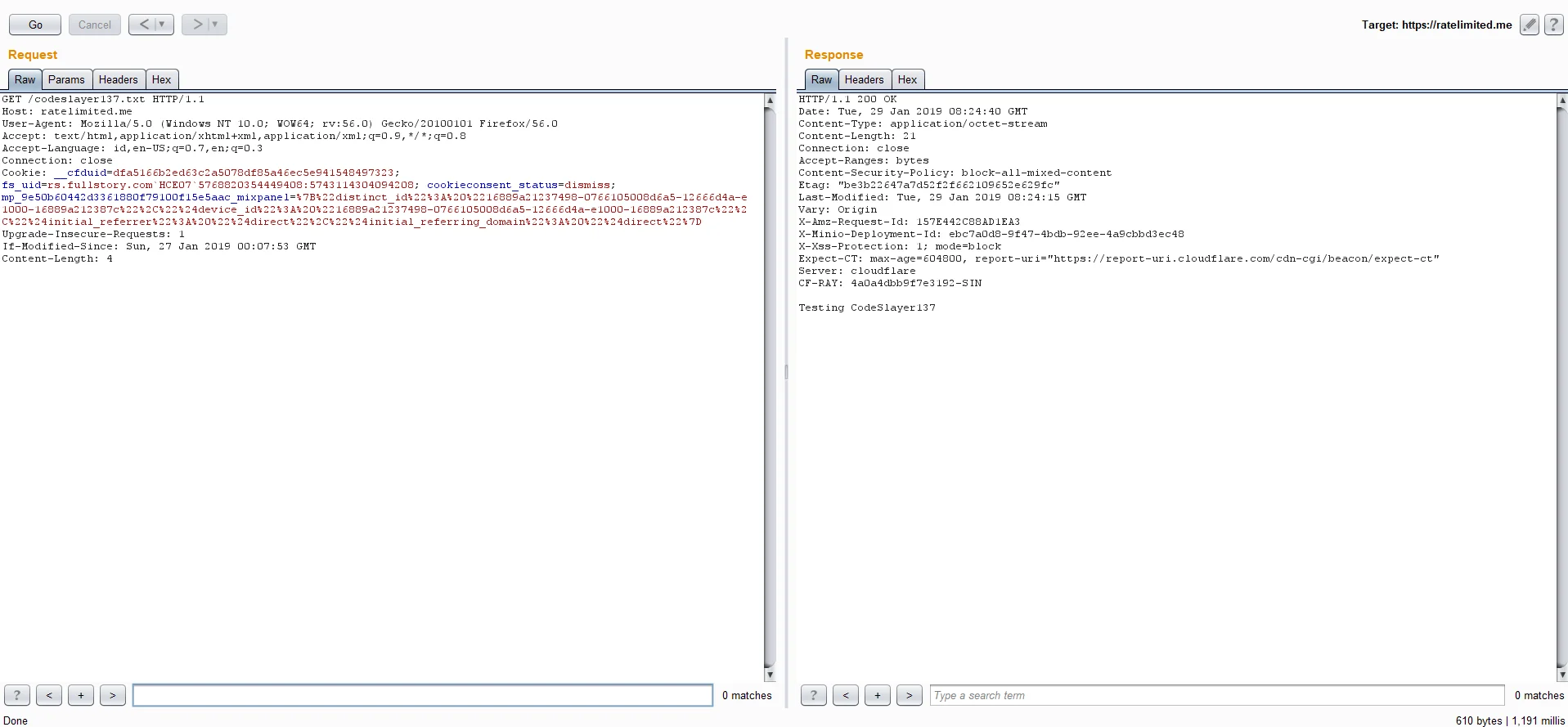
Found on HTTP PUT sites enabled on web servers. I tried testing to write the file / codelayer137.txt uploaded to the server using the PUT verb, and the contents of the file were then taken using the GET verb. the following is POC
Request:
PUT /codeslayer137.txt HTTP/1.1
Host: ratelimited.me
User-Agent: Mozilla/5.0 (Windows NT 10.0; WOW64; rv:56.0) Gecko/20100101 Firefox/56.0
Accept: text/html,application/xhtml+xml,application/xml;q=0.9,/;q=0.8
Accept-Language: id,en-US;q=0.7,en;q=0.3
Connection: close
Cookie: __cfduid=dfa5166b2ed63c2a5078df85a46ec5e941548497323; fs_uid=rs.fullstory.comHCE075768820354449408:5743114304094208; cookieconsent_status=dismiss; mp_9e50b60442d3361880f79100f15e5aac_mixpanel=%7B%22distinct_id%22%3A%20%2216889a21237498-0766105008d6a5-12666d4a-e1000-16889a212387c%22%2C%22%24device_id%22%3A%20%2216889a21237498-0766105008d6a5-12666d4a-e1000-16889a212387c%22%2C%22%24initial_referrer%22%3A%20%22%24direct%22%2C%22%24initial_referring_domain%22%3A%20%22%24direct%22%7D
Upgrade-Insecure-Requests: 1
If-Modified-Since: Sun, 27 Jan 2019 00:07:53 GMT
Content-Length: 21
Testing CodeSlayer137
Response: HTTP/1.1 200 OK Date: Tue, 29 Jan 2019 08:24:15 GMT Content-Type: text/plain Content-Length: 0 Connection: close Accept-Ranges: bytes Content-Security-Policy: block-all-mixed-content Etag: "be3b22647a7d52f2f662109652e629fc" Vary: Origin X-Amz-Request-Id: 157E4426C0B3D211 X-Minio-Deployment-Id: ebc7a0d8-9f47-4bdb-92ee-4a9cbbd3ec48 X-Xss-Protection: 1; mode=block Expect-CT: max-age=604800, report-uri="https://report-uri.cloudflare.com/cdn-cgi/beacon/expect-ct" Server: cloudflare CF-RAY: 4a0a4d20791f31a4-SIN
Impact
The HTTP PUT method is normally used to upload data that is saved on the server at a user-supplied URL. If enabled, an attacker may be able to place arbitrary, and potentially malicious, content into the application. Depending on the server's configuration, this may lead to compromise of other users (by uploading client-executable scripts), compromise of the server (by uploading server-executable code), or other attacks.
Attachments
Not written yet. The AI write-up for this report has not been written yet. The Original tab links to the source.
How it worked
Root cause
Likely the web server or storage service was misconfigured to allow unauthenticated PUT requests, permitting arbitrary file uploads.
Impact
An attacker may be able to place arbitrary, potentially malicious content, which could lead to compromise of other users or the server depending on configuration.
What the attacker needed
None
How it was found
- Send a PUT request to the target with a filename and file content.
- The server responds with 200 OK, indicating the file was written.
- Retrieve the file with a GET request to confirm it was stored.
Explained by bugbounty.wiki with AI from the original and checked against quotes from it; it can still be wrong. Read the original before relying on a detail.
Not written yet. The AI write-up for this report has not been written yet. The Original tab links to the source.
HTTP has different methods for different actions. PUT is meant to upload or replace a file on the server. Here the server allowed anyone to upload a file, which is dangerous because an attacker could put harmful files there.
What is Misconfiguration?
Settings left unsafe: exposed panels, open storage buckets, debug modes, default credentials.







