Improper sanitisation of input in the settings could cause DoS
Values saved in the email sender name and company fields of the account settings page are stored and later rendered without output encoding, so injected script runs in the browsers of people who view the affected pages. The reporter claims this can replace or disable the page interface, acting as a denial-of-service against users, including admins.

- Triaged in 14 hours
- Fixed in 3 days
- Disclosed after 25 days
h1 team
I found an input sanitization/encoding issue in account-settings-email.php where attacker-controlled values saved in email_fromName and email_fromCompany are persisted and later rendered to pages without proper output encoding. Because arbitrary JavaScript can be persisted and executed in viewers’ browsers, an attacker can run scripts that disrupt or replace the page UI — effectively disabling the site for victims (DOM-level denial-of-service). This is a stored/script injection vulnerability with high impact when rendered to admin or privileged users.
Safe Proof-of-Concept
1 go to http://localhost/test2/revive-adserver-6.0.1/www/admin/account-settings-email.php
2 add payload email_fromName and email_fromCompany
3 the will disable all website you cant use it
http request
POST /test2/revive-adserver-6.0.1/www/admin/account-settings-email.php HTTP/1.1
Host: localhost
Content-Length: 1122
Cache-Control: max-age=0
sec-ch-ua: "Not=A?Brand";v="24", "Chromium";v="140"
sec-ch-ua-mobile: ?0
sec-ch-ua-platform: "Windows"
Accept-Language: en-US,en;q=0.9
Origin: http://localhost
Content-Type: multipart/form-data; boundary=----WebKitFormBoundaryAFTySI5FcKHdgQSw
Upgrade-Insecure-Requests: 1
User-Agent: Mozilla/5.0 (Windows NT 10.0; Win64; x64) AppleWebKit/537.36 (KHTML, like Gecko) Chrome/140.0.0.0 Safari/537.36
Accept: text/html,application/xhtml+xml,application/xml;q=0.9,image/avif,image/webp,image/apng,*/*;q=0.8,application/signed-exchange;v=b3;q=0.7
Sec-Fetch-Site: same-origin
Sec-Fetch-Mode: navigate
Sec-Fetch-User: ?1
Sec-Fetch-Dest: document
Referer: http://localhost/test2/revive-adserver-6.0.1/www/admin/account-settings-email.php
Accept-Encoding: gzip, deflate, br
Cookie: sessionID=44958de8497392e940916ecd332da541; ox_install_session_id=ln1aq7d4aopg1511andp5oocji
Connection: keep-alive

------WebKitFormBoundaryAFTySI5FcKHdgQSw
Content-Disposition: form-data; name="submitok"

true
------WebKitFormBoundaryAFTySI5FcKHdgQSw
Content-Disposition: form-data; name="email_fromAddress"

[email protected]
------WebKitFormBoundaryAFTySI5FcKHdgQSw
Content-Disposition: form-data; name="email_fromName"

[email protected]
------WebKitFormBoundaryAFTySI5FcKHdgQSw
Content-Disposition: form-data; name="email_fromCompany"

[email protected]
------WebKitFormBoundaryAFTySI5FcKHdgQSw
Content-Disposition: form-data; name="submitok"

true
------WebKitFormBoundaryAFTySI5FcKHdgQSw
Content-Disposition: form-data; name="email_logOutgoing"

true
------WebKitFormBoundaryAFTySI5FcKHdgQSw
Content-Disposition: form-data; name="submitok"

true
------WebKitFormBoundaryAFTySI5FcKHdgQSw
Content-Disposition: form-data; name="email_pluginType"


------WebKitFormBoundaryAFTySI5FcKHdgQSw
Content-Disposition: form-data; name="token"

62f4ed819fb1ccc904033105a8d567ad
------WebKitFormBoundaryAFTySI5FcKHdgQSw
Content-Disposition: form-data; name="submitsettings"

Save Changes
------WebKitFormBoundaryAFTySI5FcKHdgQSw--
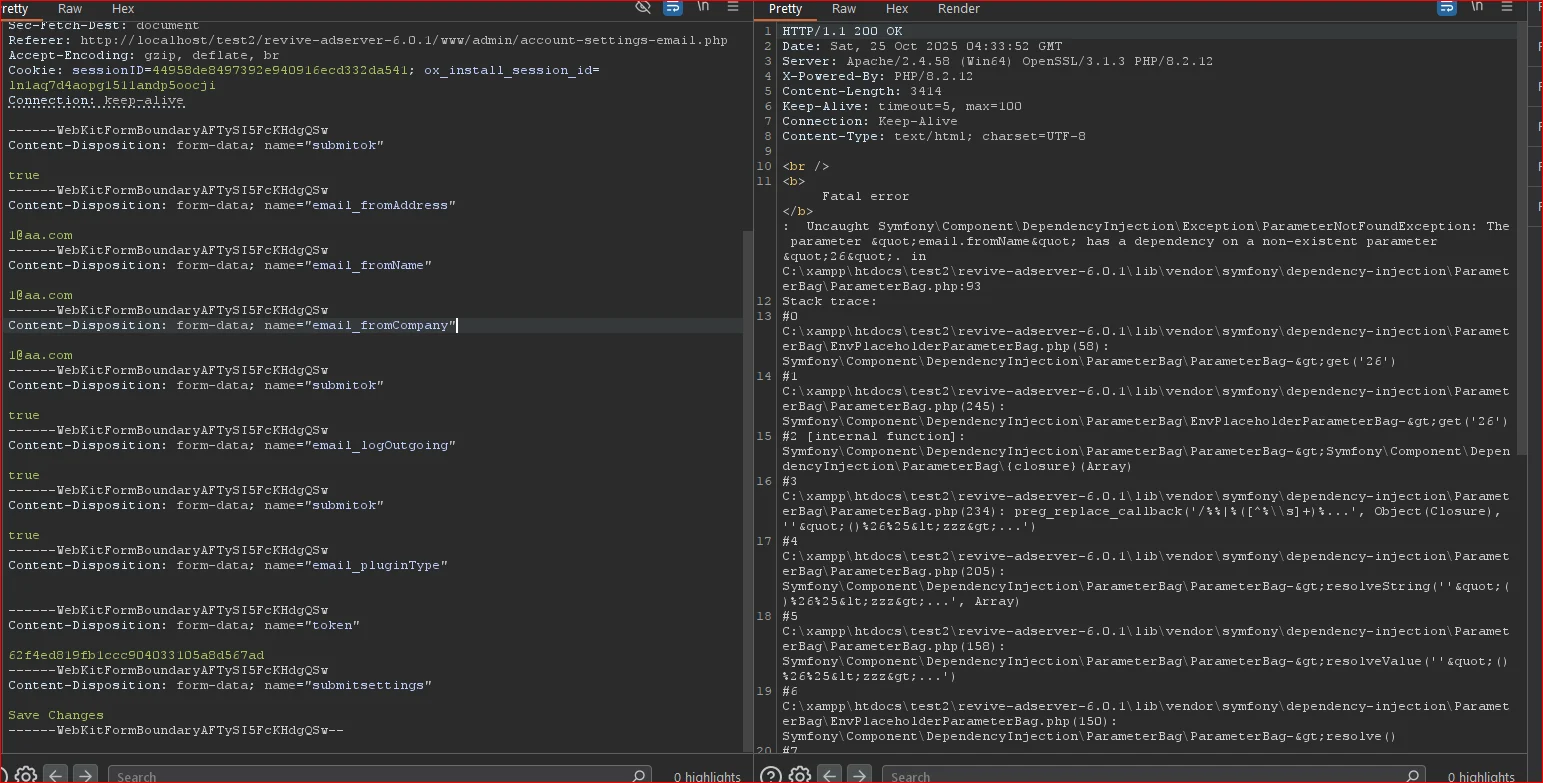
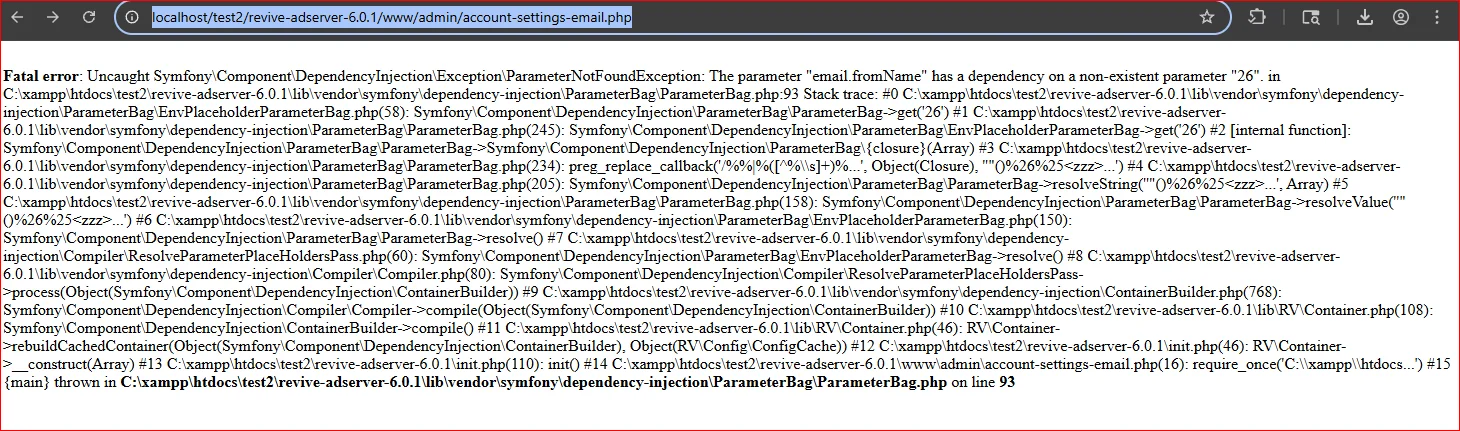
test url http://localhost/test2/revive-adserver-6.0.1/www/admin/account-settings-email.php
Impact
Arbitrary script execution in the application origin when persisted value is rendered to any page viewed by users.
Possible attacker actions include:
Replace page content or remove UI controls (rendering site unusable for the victim).
Block interaction with the app (disable buttons, hide forms) — effectively a targeted denial-of-service for users who view the infected page.
Phishing overlays, forced actions, or other client-side attacks against the user (exfiltration only possible if cookies/session not hardened).
If admin users view affected pages, the impact is high (site disruption; potential for privileged actions performed under admin context).
Severity: High — depends on which roles see the persisted values and cookie/session protections in place.
Not written yet. The AI write-up for this report has not been written yet. The Original tab links to the source.
How it worked
Root cause
Likely the settings page stores the sender name and company values and later prints them into HTML without encoding, so markup and script in those values are treated as page code.
Impact
Script saved in the settings could run for anyone who views the affected pages, letting an attacker alter or hide the interface and disrupt the site for those users, with higher risk if admins view them; the report notes the real severity depends on which roles see the values and on cookie and session protections.
What the attacker needed
Access to the email settings page; victim views a page showing the values
How it was found
- Open the email settings page of the admin panel.
- Enter a crafted value in the sender name and company fields.
- Save the settings and view the page to see the effect.
Explained by bugbounty.wiki with AI from the original and checked against quotes from it; it can still be wrong. Read the original before relying on a detail.
Not written yet. The AI write-up for this report has not been written yet. The Original tab links to the source.
Some web pages save what you type and show it again later. If the site does not clean that text before displaying it, a malicious entry can contain code that the browser runs as if the site itself wrote it. Here the reporter says the sender name and company fields in the email settings let that happen, so a saved entry could break the page for anyone who opens it.
What is XSS?
Script an attacker supplies runs in another user's browser, on the target's origin, with that user's session.






