Information Disclosure via Verbose Error Messages
Revive Adserver v6.0.0 displays verbose error messages when a single quote is entered in the Execution order field, revealing the exact MySQL/MariaDB version, SQL query, and PHP environment details. An attacker could use this information to identify known vulnerabilities or craft targeted attacks.

- Triaged in 4 hours
- Fixed in 5 hours
- Disclosed after 21 days
##Version: ==revive-adserver 6.0.0==
##Summary: Revive Adserver v6.0.0 exposes sensitive technical details through verbose error messages, revealing the exact MySQL/MariaDB version, SQL queries, and PHP environment details. Attackers can use this information to identify known vulnerabilities or craft targeted attacks.
##Step to reproduce:
- Log in website
- Go to
http://<IP-address>>/admin/channel-acl.php?affiliateid=<<id>>&channelid=<<id>> - Add
Client-Language-->Save changes - Intercept request, Enter ' (single quote) in the Execution order field.
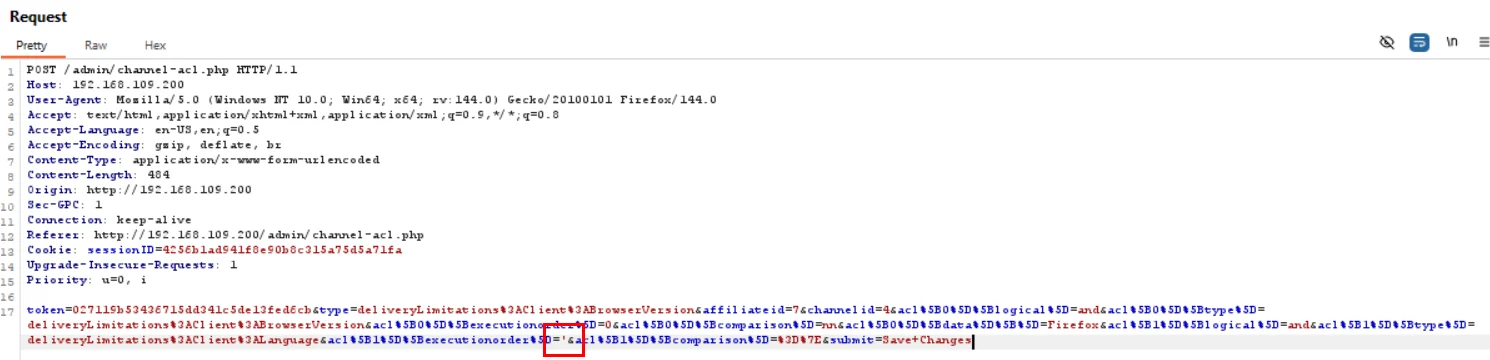
- Submit and observe the detailed error output exposing MySQL/MariaDB version and SQL query.
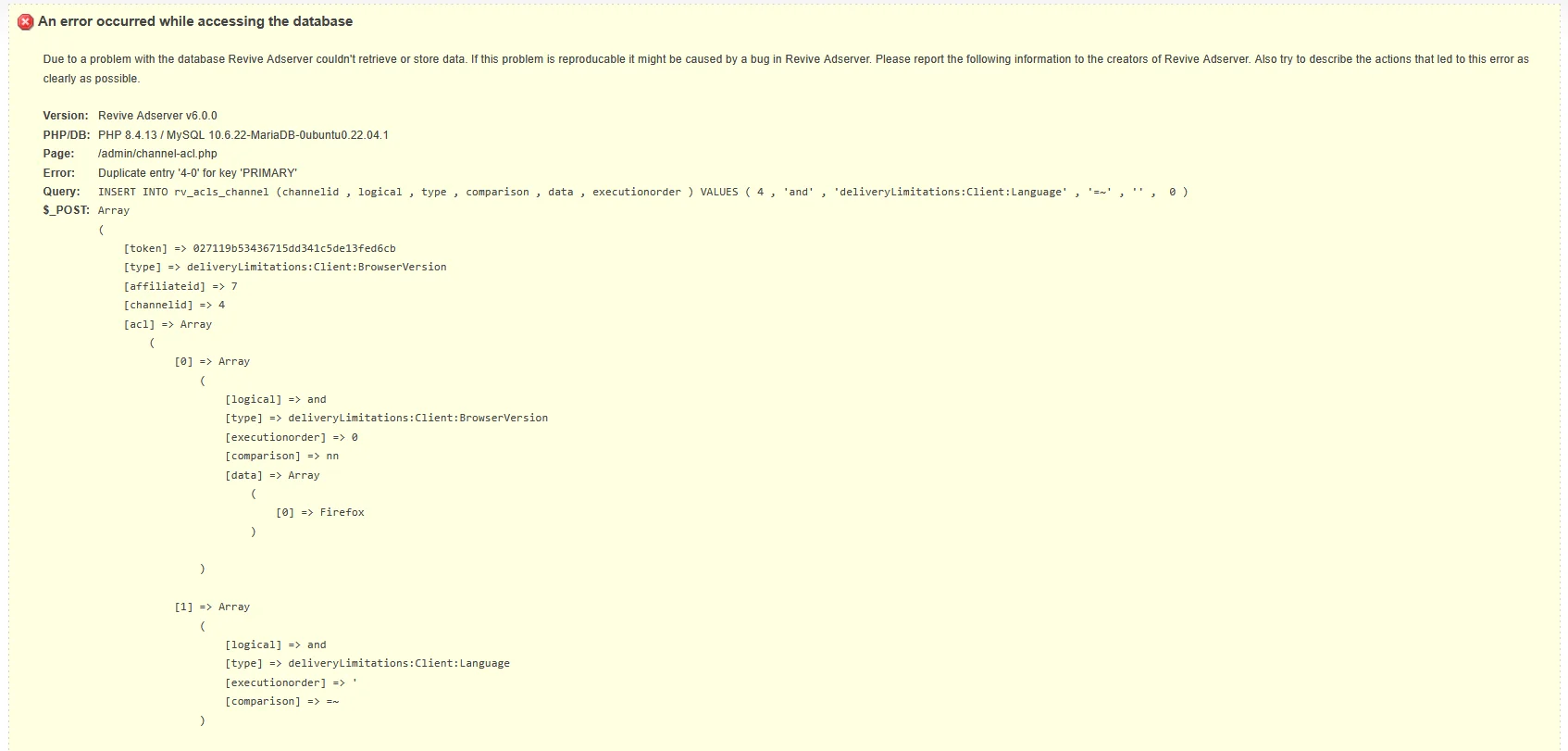
Impact
- Disclosure of backend details (DB version, structure, PHP info) may help attackers identify vulnerabilities or tailor attacks against the server.
Version: Revive Adserver v6.0.0
PHP/DB: PHP 8.4.13 / MySQL 10.6.22-MariaDB-0ubuntu0.22.04.1
INSERT INTO rv_acls_channel (channelid , logical , type , comparison , data , executionorder ) VALUES ...
INSERT INTO rv_acls_channel (...) VALUES (...)
##http header raw:
POST /admin/channel-acl.php HTTP/1.1
Host: 192.168.109.200
User-Agent: Mozilla/5.0 (Windows NT 10.0; Win64; x64; rv:144.0) Gecko/20100101 Firefox/144.0
Accept: text/html,application/xhtml+xml,application/xml;q=0.9,*/*;q=0.8
Accept-Language: en-US,en;q=0.5
Accept-Encoding: gzip, deflate, br
Content-Type: application/x-www-form-urlencoded
Content-Length: 514
Origin: http://192.168.109.200
Sec-GPC: 1
Connection: keep-alive
Referer: http://192.168.109.200/admin/channel-acl.php
Cookie: sessionID=<<sessions>>
Upgrade-Insecure-Requests: 1
Priority: u=0, i

token=3f62fcfd14d8336b06e12b5adb678962&type=deliveryLimitations%3AClient%3ABrowserVersion&affiliateid=7&channelid=4&acl%5B0%5D%5Blogical%5D=and&acl%5B0%5D%5Btype%5D=deliveryLimitations%3AClient%3ABrowserVersion&acl%5B0%5D%5Bexecutionorder%5D=0&acl%5B0%5D%5Bcomparison%5D=nn&acl%5B0%5D%5Bdata%5D%5B%5D=Firefox&acl%5B1%5D%5Blogical%5D=and&acl%5B1%5D%5Btype%5D=deliveryLimitations%3AClient%3ALanguage&acl%5B1%5D%5Bexecutionorder%5D=1&acl%5B1%5D%5Bcomparison%5D=%3D%7E&acl%5B1%5D%5Bdata%5D%5B%5D=ar&submit=Save+Changes
Not written yet. The AI write-up for this report has not been written yet. The Original tab links to the source.
How it worked
Root cause
Likely the application does not suppress detailed database error messages, so malformed input triggers an error that includes the SQL query and environment details.
Impact
Disclosure of backend details (DB version, structure, PHP info) may help attackers identify vulnerabilities or tailor attacks against the server.
What the attacker needed
Authenticated admin access
How it was found
- Log in to the website.
- Navigate to the channel-acl.php page with affiliate and channel IDs.
- Add a Client-Language entry and save changes.
- Intercept the request and enter a single quote in the Execution order field.
- Submit and observe the detailed error output.
Explained by bugbounty.wiki with AI from the original and checked against quotes from it; it can still be wrong. Read the original before relying on a detail.
Not written yet. The AI write-up for this report has not been written yet. The Original tab links to the source.
When a website shows detailed error messages, it can accidentally reveal private information about how the site is built. Here, typing a single quote into a form field caused the site to show its database version and the exact database command it tried to run. This helps attackers learn what software is running so they can look for known weaknesses.
What is Info disclosure?
Data the application should keep private (personal data, internal details, other users' records) reaches someone it should not.