Bug Report : [ No Valid SPF Records ]
The reporter claims the domain lacks a strict SPF policy because its record ends in a soft-fail qualifier, which they say allows an attacker to send spoofed emails appearing to come from the organisation. The text itself shows the SPF record passed validation, so the practical claim is limited to possible email spoofing for phishing.

- Disclosed after 5 months
Hi Team,
Hope you are doing well. I found vulnerability in your web app
URL : https://www.ruby-lang.org/en/s
Description :
There is an email spoofing vulnerability. Email spoofing is the forgery of an email header so that the message appears to have originated from someone or somewhere other than the actual source. Email spoofing is a tactic used in phishing and spam campaigns because people are more likely to open an email when they think it has been sent by a legitimate source. The goal of email spoofing is to get recipients to open, and possibly even respond to a solicitation.
Attack Scenario & PoC:
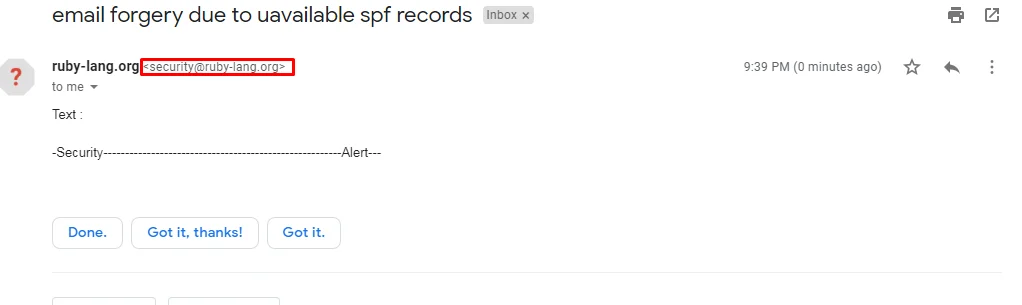
Once there is No SPF Records.An attacker can spoof email via any fake mailer Like Emkei.cz.An attacker can send email from name "Support" and Email: "[email protected]" with social engineering attack he can takeover user account let victim knows the phishing attack but when he see the email from the Authorized Domain. He got tricked easily.
Checking Missing SPF There are various ways of checking missing SPF Records on a website But the Most Common and Popular way is kitterman.com
Steps to Check SPF Records on a website:- Go to http://www.kitterman.com/spf/validate.html
Enter Target Website Ex: target.com (Do Not Add https/http or www) Hit Check SPF (IF ANY)
I found :
SPF record lookup and validation for: ruby-lang.org
SPF records are published in DNS as TXT records.
The TXT records found for your domain are: _globalsign-domain-verification=6GywlC8PVV6mLfL6ToMeVqCDeqFk9IDu2uEqmYPqx3 v=spf1 +ip4:210.251.121.208/28 +ip4:221.186.184.64/28 include:_spf.google.com ~all
Checking to see if there is a valid SPF record.
Found v=spf1 record for ruby-lang.org: v=spf1 +ip4:210.251.121.208/28 +ip4:221.186.184.64/28 include:_spf.google.com ~all
evaluating... SPF record passed validation test with pySPF (Python SPF library)!
Screenshot and video:
image.pngimage.png
Remediation :
Replace ~all with -all to prevent fake email.
References :
https://www.digitalocean.com/community/tutorials/how-to-use-an-spf-record-to-prevent-spoofing-improve-e-mail-reliability Reference Report
https://hackerone.com/reports/629087
Hope you will fix that soon. Looking forward to your positive response.
Thanks.
Kind Regards, Sohaib
Impact
Impact: An attacker would send a Fake email. The results can be more dangerous.
Attachments
Not written yet. The AI write-up for this report has not been written yet. The Original tab links to the source.
How it worked
Root cause
Likely the SPF record uses a soft-fail qualifier rather than a hard-fail one, so receivers are not told to reject mail from unauthorised senders.
Impact
An attacker could send forged email that appears to come from the domain, which may help phishing; the text gives no evidence that mail was actually delivered or that an account was taken over.
What the attacker needed
Domain uses soft-fail SPF; attacker has a mail-sending service
How it was found
- Open the SPF validation tool at kitterman.com.
- Enter the target domain without a scheme or www prefix.
- Run the SPF check and read the published TXT records.
- Note that the record ends with a soft-fail qualifier.
Explained by bugbounty.wiki with AI from the original and checked against quotes from it; it can still be wrong. Read the original before relying on a detail.
Not written yet. The AI write-up for this report has not been written yet. The Original tab links to the source.
SPF is a DNS record that lists which mail servers are allowed to send email for a domain. A soft-fail setting tells receiving mail servers to be suspicious but not to reject outright, so a forged sender may still get through. The reporter argues the domain should use a hard-fail setting instead.
What is Misconfiguration?
Settings left unsafe: exposed panels, open storage buckets, debug modes, default credentials.



