Stored Cross-Site Scripting vulnerability in example Custom Digital Agreement
The advanced vetting settings page passes an unsanitised Program Name into a Markdown component that expects sanitised HTML, leading to stored XSS. A program manager could inject script that executes when the example document is viewed, but only in sandbox mode with no real data.

- Triaged in under an hour
- Fixed in 6 months
- Disclosed after 6 months
The advanced vetting settings page is vulnerable to a Cross-Site Scripting (XSS) vulnerability by passing the unsanitized Program Name into a Markdown component, which expects sanitized HTML to be given. This leads to a stored XSS vulnerability that can be exploited by a program member when the program is in sandbox mode.
Proof of concept
- create a new program, set the name to
<blink><marquee><a href="//anything">XSS</a></marquee></blink> - go to http://localhost:8080/handle/advanced_vetting
- click the "View document" button, which generates an example DCA based on the Program Name
- the Program Name in the example DCA isn't properly sanitized and is passed directly to the
MarkdownReact component, which assumes the HTML is sanitized
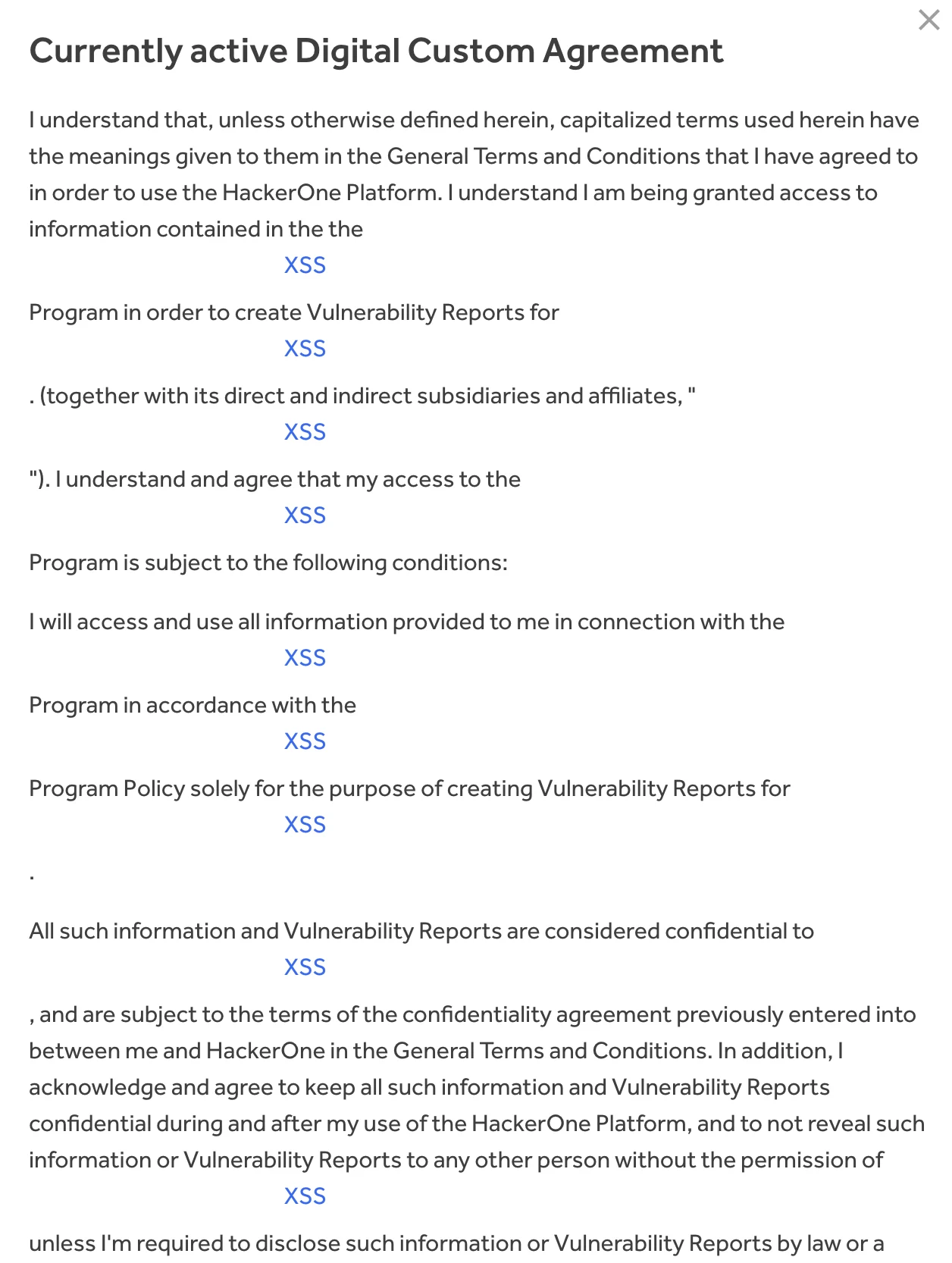
Impact
The impact is limited due to the fact that the example DCA is only generated when the program is in sandbox mode. It can only be exploited by Program Managers, since only they are authorized to update the Program Name. Programs in sandbox mode do not contain real vulnerability data.
Not written yet. The AI write-up for this report has not been written yet. The Original tab links to the source.
How it worked
Root cause
Likely the Program Name was inserted into a Markdown renderer that trusts its input as already-safe HTML, so no sanitisation happened before rendering.
Impact
The impact is limited: the example document is only generated in sandbox mode, only program managers can change the name, and sandbox programs hold no real vulnerability data.
What the attacker needed
Program manager role; program in sandbox mode
How it was found
- Create a new program and set its name to HTML containing a link.
- Open the advanced vetting settings page.
- Click the button that generates an example document from the program name.
- The program name appears unsanitised in the generated document.
Explained by bugbounty.wiki with AI from the original and checked against quotes from it; it can still be wrong. Read the original before relying on a detail.
Not written yet. The AI write-up for this report has not been written yet. The Original tab links to the source.
A web page took a name typed by a user and put it into the page without cleaning it first. That let someone insert code that runs in another person's browser, which is called cross-site scripting. Here it only worked in a test (sandbox) area with fake data.
What is XSS?
Script an attacker supplies runs in another user's browser, on the target's origin, with that user's session.




