Clickjacking in [exchangemarketplace.com]
The site used an X-Frame-Options ALLOW-FROM directive that several browsers do not support, so the page could be framed by an attacker. An attacker could trick a logged-in user into clicking sensitive actions such as inbox, logout, or store functions.

- Triaged in 6 hours
- Fixed in 51 days
- Disclosed after 56 days
Hi Team,
#Summary: X-Frame-Options ALLOW-FROM https://exchangemarketplace.com not supported by several Browser, this caused Clickjacking on https://exchangemarketplace.com
#Type of issue : Clickjacking
#Description: Clickjacking (User Interface redress attack, UI redress attack, UI redressing) is a malicious technique of tricking a Web user into clicking on something different from what the user perceives they are clicking on.
#Sensitive Action : If user already logged in it will more sensitive to victim Inbox Logout Searching Store Browsing the Store Sell your business related Almost Everything can vulnerable to clickjacking on the site
#Steps To Reproduce: Save Code as HTML file contains following code:
Vulnerable to Clickjacking
<script  >function t(e){window.setTimeout("stop();",10);}window.onbeforeunload=t;var frames=new Array();</script>
<div  qjid="quickjack" style="overflow: hidden; width: 1330px; height: 539px; position: relative;" id="cksl6">
<iframe   name="cksl7" src="https://exchangemarketplace.com" style="border: 0pt none ; left: -6px; top: -3px; position: absolute; width: 1366px; height: 576px;" scrolling="no" onload="window.cksl3='';window.cksl1=function(arg){if(!window.cksl2)window.cksl2=arg;if(window.cksl2<arg){if(window.cksl3){self.location.href=window.cksl3;}else {var c4=document.getElementById('cksl6').style;var c5=document.getElementsByName('cksl7')[0].style;document.body.style.overflow='hidden';document.body.style.width=document.body.style.height=c4.width=c5.width=c4.height=c5.height='100%';c4.position=c5.position='absolute';c4.overflow=c5.overflow='visible';c4.top=c5.top=c4.left=c5.left='0px';}window.cksl2=arg;}setTimeout('window.cksl1(history.length)',1000);};setTimeout('window.cksl1(history.length)',2000);"></iframe></div>
#Solution: Based on Report : #591432 The vulnerability can be fixed by adding "frame-ancestors 'self';" to the CSP (Content-Security-Policy) header.
#Reference (Related Case in this Report) https://hackerone.com/reports/591432 https://www.owasp.org/index.php/Clickjacking
#Proof of Concept
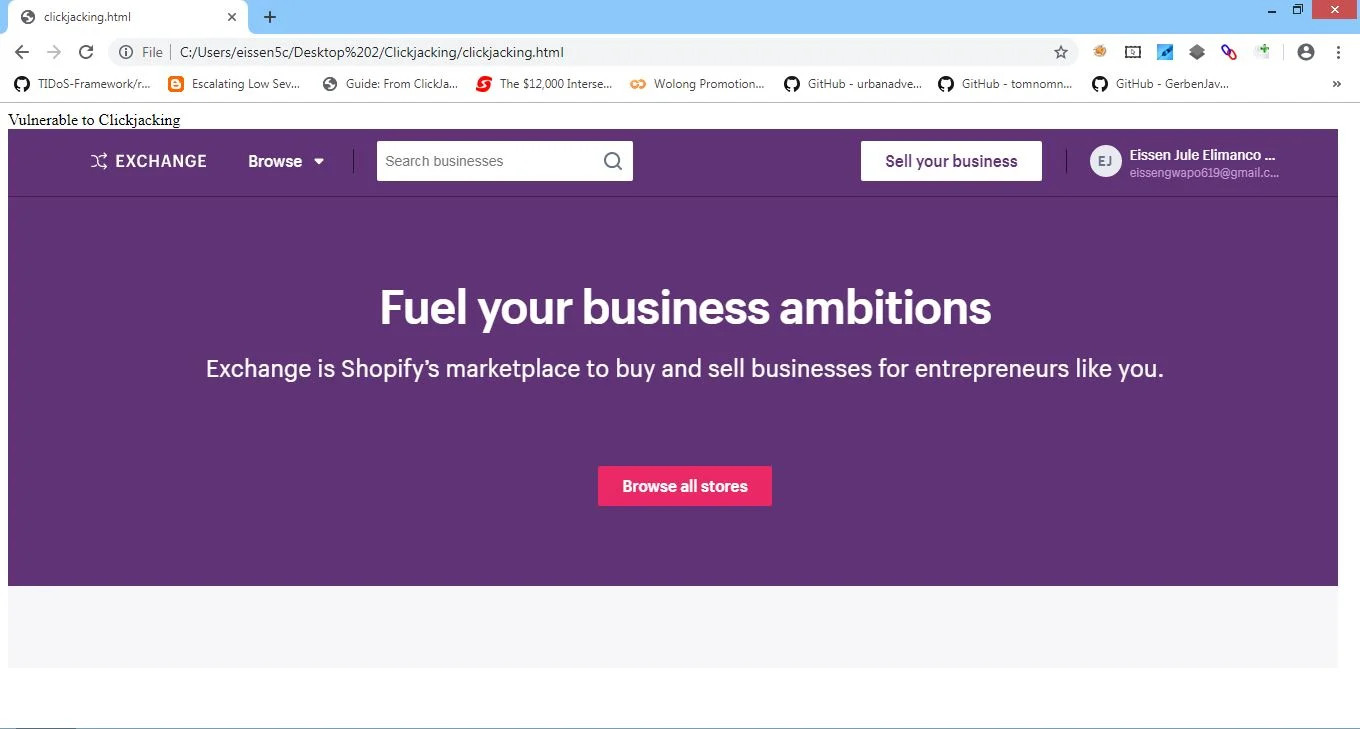
Impact
Attacker may tricked user, sending them malicious link then user open it clicked some , Sensitive actions such as the more user already logged in it will more sensitive , inbox , logout , searching store , browsing the store , sell your business related and Almost Everything can vulnerable to clickjacking on the site.
Regards eissen5c
Not written yet. The AI write-up for this report has not been written yet. The Original tab links to the source.
How it worked
Root cause
Likely the site relied on the X-Frame-Options ALLOW-FROM directive, which is not supported by several browsers, instead of a modern frame-ancestors CSP.
Impact
An attacker could trick a logged-in user into clicking sensitive actions such as inbox, logout, or store functions, but the report does not show a working exploit beyond framing.
What the attacker needed
Victim is logged in; victim visits attacker page
The fix
The vulnerability should be fixed by adding "frame-ancestors 'self';" to the CSP header.
How it was found
- Save the provided HTML code as a file.
- Open the HTML file.
- The page loads the target site in an iframe, demonstrating clickjacking.
Explained by bugbounty.wiki with AI from the original and checked against quotes from it; it can still be wrong. Read the original before relying on a detail.
Not written yet. The AI write-up for this report has not been written yet. The Original tab links to the source.
Clickjacking is when a malicious site loads a real site in an invisible frame and tricks you into clicking buttons you cannot see. Here the site tried to stop this with a header that many browsers ignore, so the protection did not work. An attacker could make you click things like logout or inbox without you realising.
What is UI spoofing?
The interface lies to the user: a framed page catches their clicks, or a browser shows the wrong address or a fake prompt. Paid when it leads to a sensitive action or convincing phishing.