Clickjacking
Several pages on the sifchain.finance domain did not send the X-Frame-Options header, so they could be embedded in an iframe on another site. An attacker could trick a user into clicking or typing into the embedded page while believing they were interacting with something else.
 Originally disclosed on HackerOne
- Disclosed after 7 months
Bug Bounty Report(Vulnerability Report)
Vulnerability Name: UI Redressing (Clickjacking)
Vulnerability Description: Clickjacking (classified as a User Interface redress attack, UI redress attack, UI redressing) is a malicious technique of tricking a user into clicking on something different from what the user perceives, thus potentially revealing confidential information or allowing others to take control of their computer while clicking on seemingly innocuous objects, including web pages.Clickjacking is an instance of the confused deputy problem, wherein a computer is tricked into misusing its authority.
Summery: The below listed links, dont have X-FRAME-OPTIONS set to DENY or SAMEORIGIN so they are vulnerable to clickjacking
Vulnerable Website: https://sifchain.finance/
Beowser Verified in:Firefox[Version: 78.3.0esr (64-bit)]
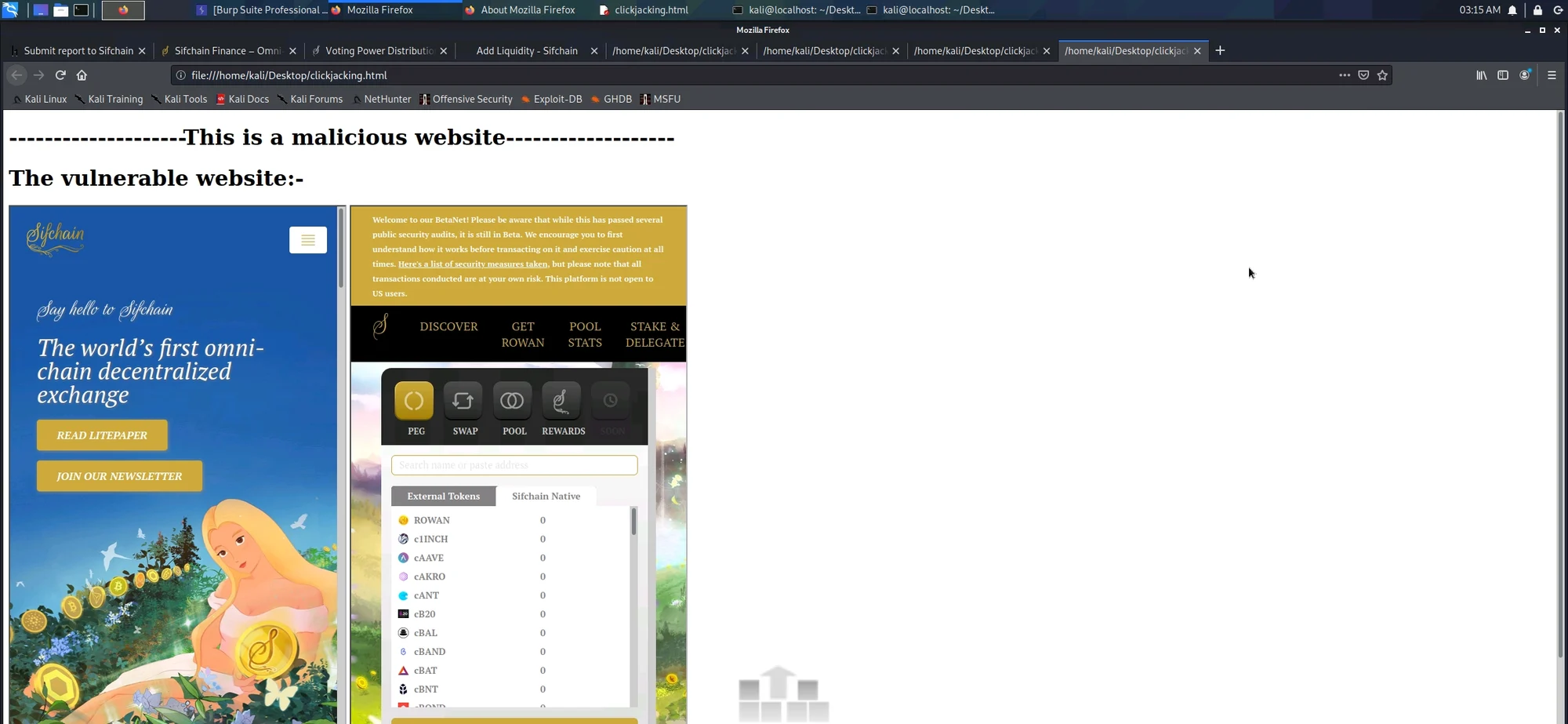
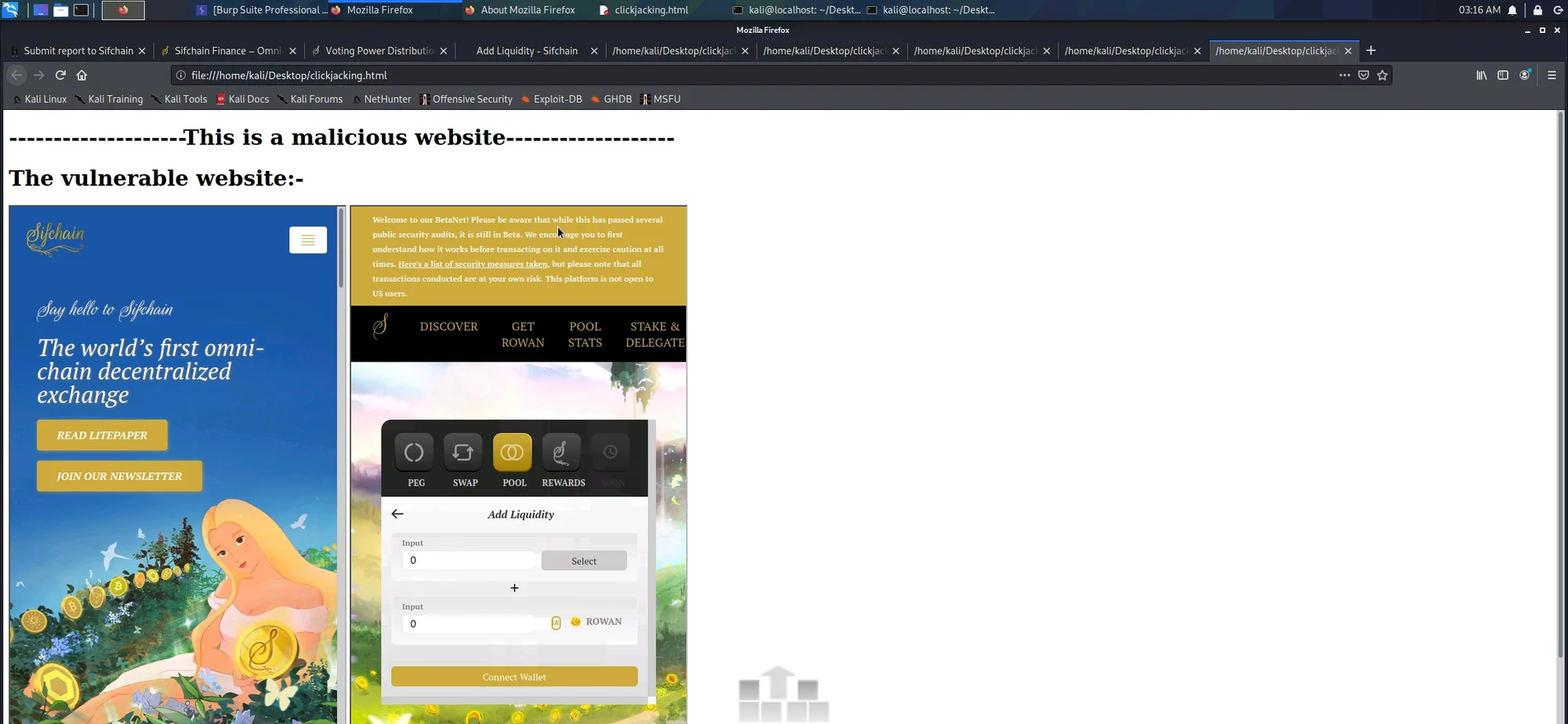
Steps To Reproduce: i. Here are the steps to reproduce the attack: 1.Run the bellow code from browser and you can see that the website is vulnerable to clickjacking attack
<!doctype html> <html> <head> <style> iframe{ width:500px; height:900px; } #http{ height:900px; width:500px; } </style> </head> <body> <h1>--------------------This is a malicious website-------------------</h1> <h1>The vulnerable website:-</nn></h1> <iframe src="https://sifchain.finance/"></iframe> <iframe id="http" src="https://dex.sifchain.finance/#/peg"></iframe> </body> </html>this html code can embed these urls on another malicious website whice can be harmful for users.
Following links are vulnerable to Clickjacking: 1.https://sifchain.finance/ 2.https://dex.sifchain.finance/#/peg 3.https://blockexplorer.sifchain.finance/voting-power-distribution 4.https://blockexplorer.sifchain.finance/transactions 5.https://dex.sifchain.finance/#/stake-delegate 6.https://dex.sifchain.finance/#/swap 7.https://dex.sifchain.finance/#/pool/add-liquidity 8.etc.
Impact
Here are the impacts of the vulnerability: 1.with this vulnerability attackers can control or hijack users clicks 2.Affect the users interaction on your platform. Such unintended behavior is definitely not wanted by any user. 3.Such effect upon your users could significantly harm your overall reputation and customer loss. 4.Using a similar technique, keystrokes can also be hijacked. With a carefully crafted combination of stylesheets, iframes, and text boxes, a user can be led to believe they are typing in the password to their email or bank account, but are instead typing into an invisible frame controlled by the attackerp
Attachments
Not written yet. The AI write-up for this report has not been written yet. The Original tab links to the source.
How it worked
Root cause
Likely the web server did not send the X-Frame-Options response header (or a Content-Security-Policy frame-ancestors directive) to prevent the pages from being embedded in frames.
Impact
An attacker could hijack user clicks and keystrokes on the embedded pages, potentially leading users to perform unintended actions or reveal credentials, though the report does not demonstrate a specific exploit beyond framing.
What the attacker needed
Victim visits attacker-controlled page; victim interacts with the framed page
How it was found
- Create an HTML page that includes an iframe pointing to the target site.
- Open that HTML page in a browser.
- Observe that the target site loads inside the iframe, showing it can be framed.
Explained by bugbounty.wiki with AI from the original and checked against quotes from it; it can still be wrong. Read the original before relying on a detail.
Not written yet. The AI write-up for this report has not been written yet. The Original tab links to the source.
Clickjacking is when a malicious site loads a real site inside an invisible frame and places fake buttons on top. The user thinks they are clicking one thing but actually clicks a button on the real site. This report says the site did not tell browsers to block being framed, so the trick was possible.
What is UI spoofing?
The interface lies to the user: a framed page catches their clicks, or a browser shows the wrong address or a fake prompt. Paid when it leads to a sensitive action or convincing phishing.


