Stored XSS in Adress Book (starbucks.com/account/profile)
The Address.FirstName field in the user profile address book was not properly sanitised, allowing an attacker to inject a stored cross-site scripting payload. When the address was viewed, the payload could execute in the context of the victim's browser, potentially leading to session hijacking or other malicious actions.

- Triaged in 3 days
- Fixed in 5 months
- Paid in 3 days
- Disclosed after 6 months
Hello,
I just found a stored XSS in the "Adress book menu" of a user's profile : https://www.starbucks.com/account/profile
Description :
XSS is happening due to the lack of filtering on the Address.FirstName parameter when you POST a new address on the URL : https://www.starbucks.com/account/profile/AddressSave :
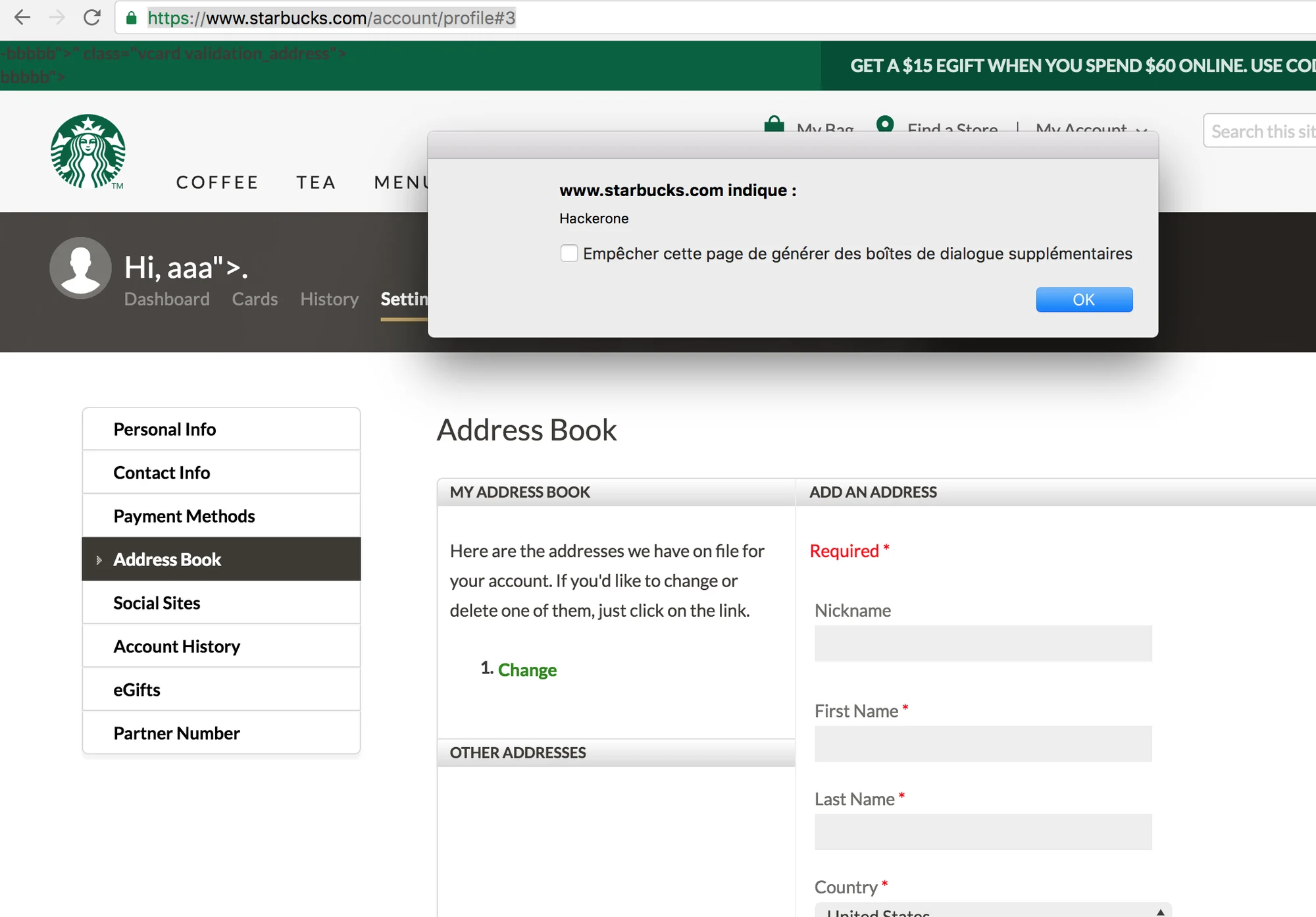
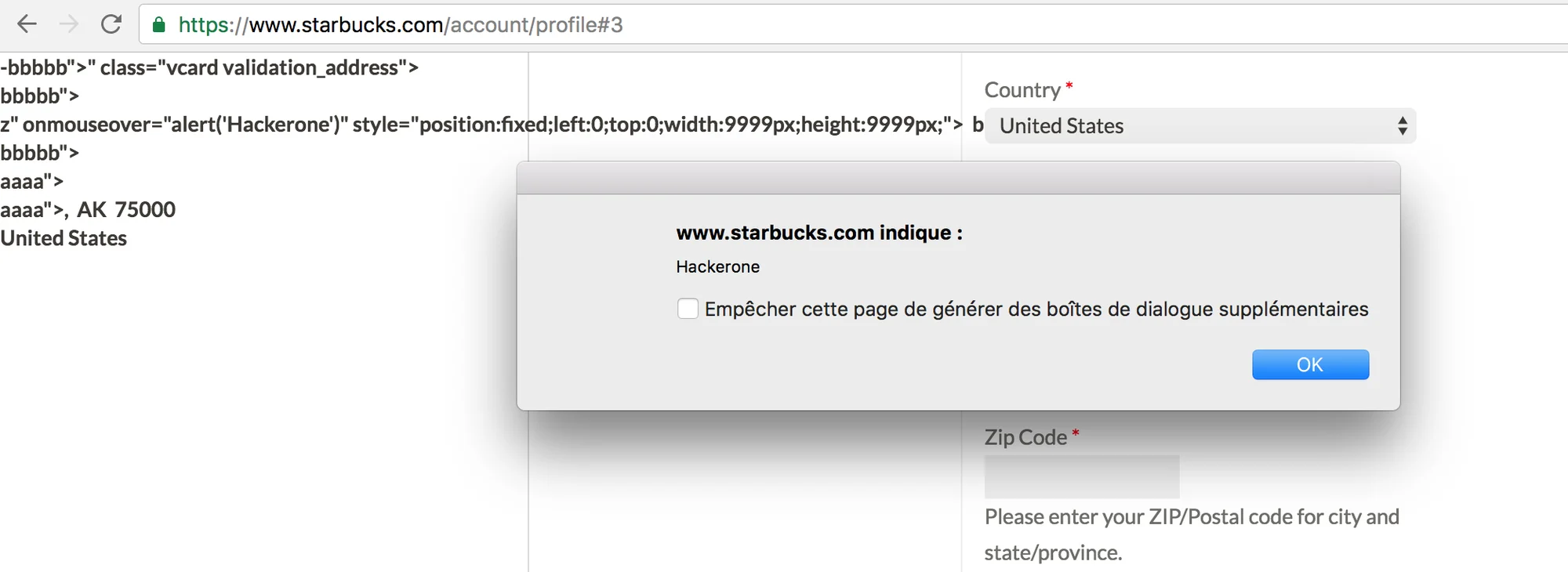
Here are the POST Parameters to reproduce the issue:
██████████
Address.AddressName=bbbbb%22%3E&Address.FirstName=z%22 onmouseover="alert('Hackerone')" style="position:fixed;left:0;top:0;width:9999px;height:9999px;">&Address.LastName=bbbbb%22%3E&Address.Country=US&Address.AddressLine1=bbbbb%22%3E&Address.AddressLine2=aaaa%22%3E&Address.City=aaaa%22%3E&Address.CountrySubdivision=AK&Address.PostalCode=75000&Address.PhoneNumber=███████&Address.PhoneExtension=&Address.AddressType=Registration&Address.AddressId=32ecef14-f8af-4b5e-adad-d8d2adc8ddad&Address.VerificationStatus=Override&IsAddress=true&__RequestVerificationToken=MDSbXzmn-5j18ck06PpT7Og05zgwOzgq8FMwiqTXIeUfcfRS-keyp9i_x0VbBaIfvUo7EhzYGMvvzPUc0WG5QqlG_YathJ80lgs-p3PCoyNfdvo_E-XY6JfoC9R4tPir0
It was quite tricky to leveraged. Indeed :
- It looks like no parameter from this request is filtered. However, except Address.FirstName, they are printed are inside an HTML tag and you prevented the opening of a new tag by blocking anything with "<." (where the point can be anything of course)
- The maximum length of each field (15 characters) is only checked client-side, though short XSS exists
- That is why my final payload is :
z" onmouseover="alert('Hackerone')" style="position:fixed;left:0;top:0;width:9999px;height:9999px;">
Here is the email of my account if you can check by yourself: ██████
Risks
I assume that you perfectly know the risks of an XSS. This one presents a high/critical risk as my addresses can, I think, be seen in the admin panel. I just have to contact the Customer Support for them to look at my account and trigger the XSS.
#Remediation I also assume that you know how to correct XSS properly as it looks like it is well done elsewhere on the website.
Best regards,
Not written yet. The AI write-up for this report has not been written yet. The Original tab links to the source.
How it worked
Root cause
Likely the application failed to properly sanitise or encode user input in the Address.FirstName field before rendering it in HTML, allowing script injection.
Impact
The reporter thinks an admin viewing the stored address might trigger the payload, but this is not confirmed.
What the attacker needed
A user account; victim views the stored address
The fix
The application should properly sanitise or encode user input in the Address.FirstName field before rendering it in HTML.
How it was found
- Navigate to the profile page and access the address book.
- Submit a new address with a malicious payload in the Address.FirstName field.
- The payload is stored; the reporter assumes it may execute when an admin views the address.
Explained by bugbounty.wiki with AI from the original and checked against quotes from it; it can still be wrong. Read the original before relying on a detail.
Not written yet. The AI write-up for this report has not been written yet. The Original tab links to the source.
A user could save a malicious script in their address book; the reporter thinks an admin viewing it might trigger it.
What is XSS?
Script an attacker supplies runs in another user's browser, on the target's origin, with that user's session.



