Object injection in `stripe-billing-typographic` GitHub project via /auth/login
The login endpoint accepted a JSON object in the email field, which was passed to a SQL query and caused an authentication bypass. An attacker could log in as any user by supplying a valid password, without knowing the victim's email.

- Triaged in 35 days
- Fixed in 3 months
- Paid in 3 months
- Disclosed after 22 months
Summary:
It is possible to use an object injection failure to achieve a sql injection, where attacker uses the means to bypass authentication, requiring only a valid password within the database.
The vulnerable code is: https://github.com/stripe/stripe-billing-typographic
For a failure to occur, it is necessary that the environment is configuring with the mysql database.
The same scenario is seen in the demonstration environment: https://typographic.io/
Steps To Reproduce:
- Register a simple user in the application, with a password at your desire. Ex:
user: [email protected]
password:123
- Send a request to /auth/login like this:
POST /auth/login

{"email":{"email":1},"password":"1234"}
- You will then see that the login was performed without the need to provide a valid user!
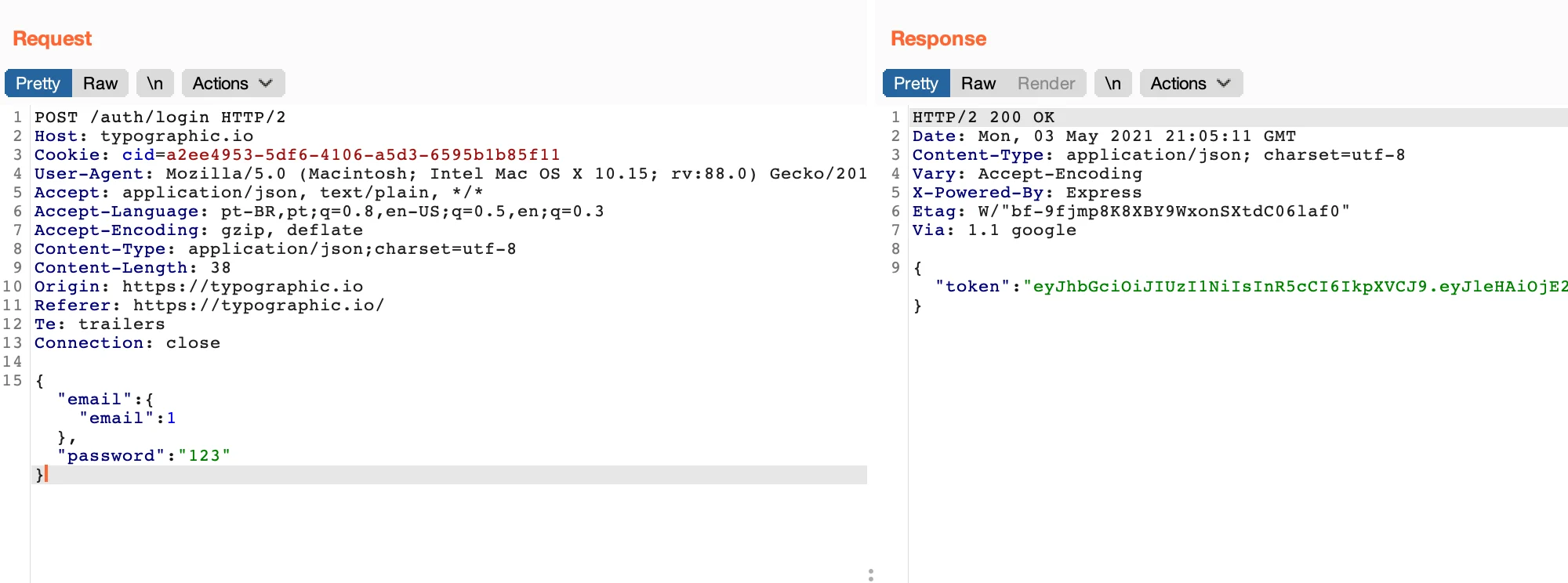
Supporting Material/References:
Well, the failure occurs due to the possibility of an object reaching the query, which will be handled by a dependency called sqlstring, performing some scapes, where it will cause a confusion to the query.
Sqlstring will handle {,} replacing with `. So your login query will be:
SELECT * FROM `accounts` WHERE `email`=`email`=1
The sql string library is a dependency on the mysql library, which is used by knex.
Mitigation
Is a simple step, use JSON.stringfy e resolve your problem, because JSON.stringfy will transform the malicious object into a string, preventing treatment during a query.
Impact
This vulnerability to the applied scenario makes it easier for the attacker to acquire accounts, as the attacker only needs to discover a valid password to gain access to the victim's account.
Not written yet. The AI write-up for this report has not been written yet. The Original tab links to the source.
How it worked
Root cause
Likely the application passed a user-supplied object directly into a SQL query without converting it to a string, allowing the database library to misinterpret it.
Impact
An attacker could take over accounts by discovering only a valid password, bypassing the need to know the victim's email.
What the attacker needed
MySQL database configured; Knowledge of a valid password
The fix
The application should convert the email input to a string (for example with JSON.stringify) before using it in a query.
How it was found
- Register a normal user account with any password.
- Send a login request where the email field is a JSON object instead of a string.
- Observe that the login succeeds without a valid user email.
Explained by bugbounty.wiki with AI from the original and checked against quotes from it; it can still be wrong. Read the original before relying on a detail.
Not written yet. The AI write-up for this report has not been written yet. The Original tab links to the source.
The login form expected a simple text email, but the server also accepted a structured object. That object was inserted into a database query, confusing the query so it matched any account with the supplied password. This let an attacker log in as someone else if they knew that person's password.
What is SQL injection?
Input reaches a database query as code, letting an attacker read or change data the application never meant to expose.





