The Vulnerability That Exposed an UN Website to Remote Code Execution
A UN website was running an outdated version of Confluence that was vulnerable to an unauthenticated OGNL injection, allowing remote code execution. An attacker could exploit this to run arbitrary code on the server without logging in.
 Published on medium.com
This time I’ll tell you the story of how I got my name on the UN Hall of fame. 😁
The full write-up lives on its author's site
It belongs to its author, so we link to it rather than copy it. The other two tabs are our own rewrites, checked against it.
Context
This is a story about a bug bounty finding on a United Nations asset. The target was https://wedevelop-new.unep.org/, a subdomain of the UN Environment Programme that was running Atlassian Confluence version 7.12.4. Confluence is a collaboration and documentation platform: teams use it to write, organise and share pages and knowledge bases. The researcher had not used Confluence before this engagement and had to look up what it was for.
The bug class involved is OGNL injection leading to remote code execution (RCE), unauthenticated. OGNL (Object-Graph Navigation Language) is an expression language that Confluence uses internally; when user-controlled input reaches an OGNL evaluation sink, an attacker can execute expressions on the server. The researcher identified the version as vulnerable to this class of issue and created a POC against the host.
Setup
The researcher worked without any account on the target: the vulnerability was unauthenticated, so no credentials or roles were needed. The tooling was deliberately light:
- Assetfinder and Subfinder for subdomain enumeration.
- httpx to check which domains were alive.
- Google, for researching the product and its known vulnerabilities.
A small bash script was used to scrape domains from the UN Hall of Fame page, and a public proof-of-concept script was used for exploitation (linked below).
Finding it
The methodology was a four-step loop:
- Check the scope for assessment.
- Gather subdomains.
- Manually analyse subdomains for interesting functionality.
- Analyse the interesting sites manually, alongside port scanning and content discovery on the backend.
Step 1: scope
The researcher could not find an official, complete scope published by the UN. Instead, the UN Hall of Fame page was used as a proxy: all .org domains listed on that page were scraped with a small bash script and treated as the starting set.
Step 2: subdomains
Subdomain enumeration was run against the main domains collected in step 1 using the tools listed above.
Step 3: manual analysis
Each subdomain was visited by hand and explored for interesting functionality. During this pass the researcher noticed that https://wedevelop-new.unep.org/ was running Confluence v7.12.4. At that point the product was unfamiliar, so it was researched first, then its known open vulnerabilities were looked up. That research showed the version was vulnerable to OGNL injection RCE, unauthenticated.
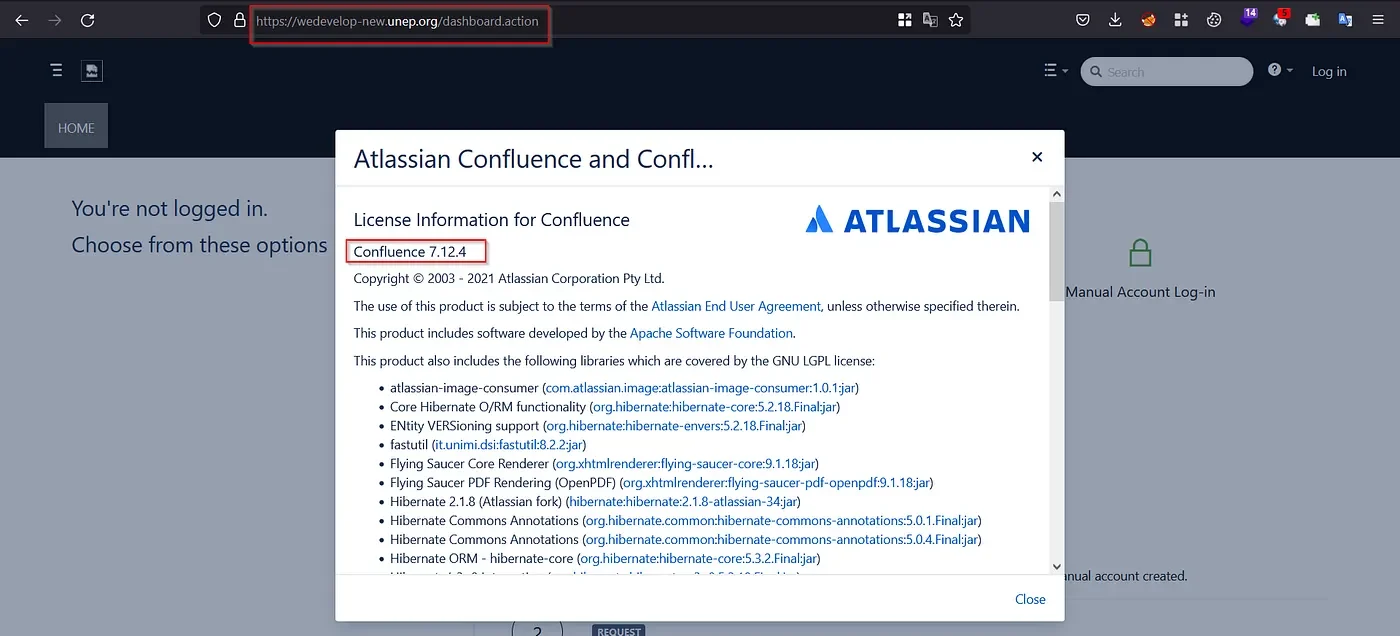
The screenshot shows the Confluence version identified on the host, which is what triggered the vulnerability lookup.
Exploitation
Step 1: research the vulnerability class
Before touching the target, the researcher read up on what OGNL injection is and how this particular RCE is reproduced. The public proof-of-concept used was:
https://github.com/Udyz/CVE-2021-26084/blob/main/confluence-rce.py
That script is the basis of the POC. The report does not reproduce the payloads or the HTTP requests it sends, so the exact request and response are not shown here.
Step 2: run the POC against the host
With the script in hand, the researcher was able to create a POC for the same vulnerability against wedevelop-new.unep.org.
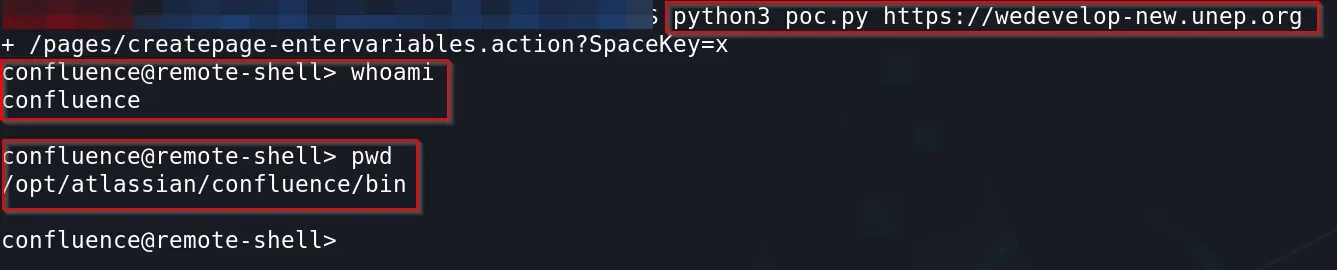
The screenshot is captioned as the POC.
Step 3: report
The finding was reported to [redacted] with CRITICAL in the subject line, in bold and capitals. The researcher notes self-deprecatingly that this was a beginner's move.
Step 4: validation and Hall of Fame
The UN security team revalidated the issue, confirmed it, and asked for the researcher's details so they could be added to the Hall of Fame page.
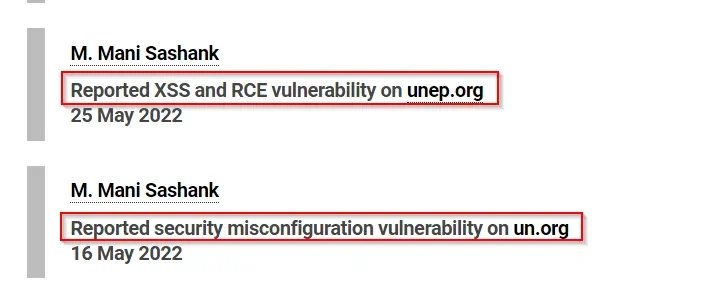
The screenshot is captioned as the Hall of Fame.
Root cause
The instance was running Confluence 7.12.4, a version with a known unauthenticated OGNL injection that leads to remote code execution. The report does not analyse the vulnerable code path itself; it identifies the version and reproduces the public exploit. In general terms, the flaw is that attacker-controlled input reaches an OGNL expression evaluation sink without adequate sanitisation, so an unauthenticated request can cause the server to evaluate an expression and execute code. The host was running a version with a known unauthenticated OGNL injection.
Impact
Because the issue is unauthenticated RCE, an attacker reaching the host could execute code on the Confluence server without any account. The report does not enumerate what was done post-exploitation, what data was reachable, or which systems sat behind the instance; it only establishes that code execution was possible on wedevelop-new.unep.org. The practical impact therefore depends on what that Confluence instance could reach and what it stored, which the report does not describe.
Fix
The report does not state what remediation was applied. The obvious fix, given the root cause, is to upgrade Confluence off the affected 7.12.4 version to a patched release. Whether the UN did that, or applied a mitigation in front of the host, is not recorded here.
Variants to test
- Version fingerprinting on other Confluence hosts. Look for the version banner or page footer on any Confluence instance in scope. A positive result is a version matching a known unauthenticated OGNL injection advisory.
- Public POC against a lab instance first. Stand up a matching Confluence version locally and run the same public script to confirm the exploit path before pointing it at anything in scope. A positive result is code execution in the lab, which tells you the payload shape to expect on the live target.
- Scope discovery via Hall of Fame pages. The same scraping trick used here (collecting
.orgdomains from a vendor's acknowledgement page) can be applied to other programmes that publish researcher credits. A positive result is a list of in-scope-looking hosts that are not in the official scope document, which you then confirm with the programme before testing. - Subdomain enumeration plus manual triage. Run Assetfinder and Subfinder, filter with httpx for live hosts, then visit each one by hand looking for self-hosted collaboration tools. A positive result is an internal-looking or staging-named host (like a
-newor-devsubdomain) exposing a product with a known RCE.
What happened, in plain words
A security researcher found a serious weakness on a website belonging to the United Nations. The site was a subdomain of the UN Environment Programme, at https://wedevelop-new.unep.org/. It was running a piece of software called Confluence, made by a company called Atlassian. Confluence is a tool that teams use to write and share documents and notes together, a bit like a shared online noticeboard or a wiki. The researcher had never used Confluence before and had to look up what it was for.
The version of Confluence on that site was 7.12.4. That version has a known flaw: anyone on the internet, without any username or password, can send it a specially crafted request and make the server run code of their choosing. This kind of flaw is called remote code execution, or RCE. The researcher found the version, looked up the known flaw, created a POC with a public script, and reported it to the UN security team. The team confirmed the finding and added the researcher's name to their Hall of Fame page.
This article walks through the same steps the researcher took, explaining every term from scratch, so that someone who has only ever used a browser can follow along.
The target and the software
The target was https://wedevelop-new.unep.org/. Breaking that down: unep.org is the domain of the UN Environment Programme. A subdomain is a name placed in front of a domain to point at a separate service, here wedevelop-new. The -new part suggests it may have been a newer or staging copy of a site, though the report does not say so explicitly. The https:// at the front means the connection is encrypted, the same padlock you see in your browser's address bar.
That host was running Atlassian Confluence version 7.12.4. Confluence is a collaboration and documentation platform: teams use it to write, organise and share pages and knowledge bases. Think of it as a shared intranet wiki where colleagues draft documents together. The researcher had not used it before and had to research what it was for.
The kind of bug: OGNL injection leading to RCE
The flaw is described as OGNL injection leading to remote code execution (RCE), unauthenticated. Three terms to unpack.
OGNL stands for Object-Graph Navigation Language. It is an expression language that Confluence uses internally. An expression language is a small mini-language a program uses to look up values and call things, a bit like a formula in a spreadsheet cell: you write =A1+B1 and the spreadsheet works it out. OGNL does the same kind of thing inside Confluence.
Injection means that input a user controls gets fed into that mini-language and evaluated as if it were a formula the program itself wrote. If you can slip your own expression into a place where the program expects only plain data, the program will run your expression. That is injection.
RCE, remote code execution, means the attacker can make the server run code, not just read data. Combined with OGNL injection, the attacker's expression causes the server to execute commands. Unauthenticated means no account, no username, no password is needed: anyone who can reach the host can try.
So the whole bug class in one sentence: user-controlled input reaches an OGNL evaluation point without adequate sanitisation, so an unauthenticated request can make the server evaluate an expression and run code.
Setup: what the researcher needed
The researcher worked without any account on the target, because the vulnerability was unauthenticated. No credentials or roles were needed. The tooling was deliberately light:
- Assetfinder and Subfinder for subdomain enumeration.
- httpx to check which domains were alive.
- Google, for researching the product and its known vulnerabilities.
A few of those need explaining for a complete beginner.
Subdomain enumeration is the process of finding all the subdomains that belong to a domain. If example.org is the main site, there may be mail.example.org, dev.example.org, shop.example.org and many more. Tools like Assetfinder and Subfinder try to discover these names from public sources. Think of it as finding all the side doors and back entrances of a building whose main entrance you already know.
httpx is a command-line tool that takes a list of hostnames and checks which ones actually respond, that is, which are alive. It saves you from visiting dead names by hand.
A small bash script was used to scrape domains from the UN Hall of Fame page. A bash script is a short text file of commands that a computer runs in order, like a recipe. Scraping means automatically pulling information out of a web page, rather than copying it by hand.
A public proof-of-concept script was used for exploitation. A proof-of-concept, or POC, is a small program that demonstrates a vulnerability works. It is the difference between saying "this lock looks flimsy" and actually opening it.
Finding it: the four-step method
The researcher followed a four-step loop:
- Check the scope for assessment.
- Gather subdomains.
- Manually analyse subdomains for interesting functionality.
- Analyse the interesting sites manually, alongside port scanning and content discovery on the backend.
Scope is the set of targets a researcher is allowed to test. Bug bounty programmes publish a scope so that researchers do not stray onto systems they are not permitted to touch. Port scanning means checking which network services a host is offering, like knocking on every door of a building to see which ones open. Content discovery means looking for pages and files that are not linked from the main site, such as admin panels or backup files.
Step 1: scope
The researcher could not find an official, complete scope published by the UN. Instead, the UN Hall of Fame page was used as a proxy: all .org domains listed on that page were scraped with a small bash script and treated as the starting set.
Why do this? A Hall of Fame page lists researchers who have reported valid bugs, and often names the affected sites. Those names are a strong hint at what the organisation considers in scope. It is a clever shortcut when no formal scope document exists.
Step 2: subdomains
Subdomain enumeration was run against the main domains collected in step 1 using the tools listed above. The goal is to turn a handful of known domains into a much longer list of possible hosts, because the interesting one is often a forgotten subdomain rather than the main site.
Step 3: manual analysis
Each subdomain was visited by hand and explored for interesting functionality. During this pass the researcher noticed that https://wedevelop-new.unep.org/ was running Confluence v7.12.4. At that point the product was unfamiliar, so it was researched first, then its known open vulnerabilities were looked up. That research showed the version was vulnerable to OGNL injection RCE, unauthenticated.
The screenshot shows the Confluence version identified on the host, which is what triggered the vulnerability lookup. Seeing the version number is the key moment: it tells you exactly which known flaws to check for.
Exploitation
Step 1: research the vulnerability class
Before touching the target, the researcher read up on what OGNL injection is and how this particular RCE is reproduced. The public proof-of-concept used was:
https://github.com/Udyz/CVE-2021-26084/blob/main/confluence-rce.py
Line by line, in plain words:
https://github.com/is the address of GitHub, a website where people share code.Udyz/is the account that published the script.CVE-2021-26084is the name of the vulnerability. A CVE is a public catalogue number for a known security flaw, so that everyone can refer to the same bug by the same name.blob/main/is GitHub's way of saying "this file, on the main branch".confluence-rce.pyis the script itself, written in the Python programming language.
That script is the basis of the POC. The report does not reproduce the payloads or the HTTP requests it sends, so the exact request and response are not shown here.
Step 2: run the POC against the host
With the script in hand, the researcher was able to create a POC for the same vulnerability against wedevelop-new.unep.org.
The screenshot is captioned as the POC.
Step 3: report
The finding was reported to [redacted] with CRITICAL in the subject line, in bold and capitals. The researcher notes self-deprecatingly that this was a beginner's move.
Why mention this? Because a report's subject line is the first thing a security team sees. Shouting CRITICAL in capitals is not how experienced researchers usually write, but it does get attention. The lesson for a beginner is that clarity and evidence matter more than volume.
Step 4: validation and Hall of Fame
The UN security team revalidated the issue, confirmed it, and asked for the researcher's details so they could be added to the Hall of Fame page.
The screenshot is captioned as the Hall of Fame.
Root cause
The instance was running Confluence 7.12.4, a version with a known unauthenticated OGNL injection that leads to remote code execution. The report does not analyse the vulnerable code path itself; it identifies the version and reproduces the public exploit. In general terms, the flaw is that attacker-controlled input reaches an OGNL expression evaluation sink without adequate sanitisation, so an unauthenticated request can cause the server to evaluate an expression and execute code. The host was running a version with a known unauthenticated OGNL injection.
In everyday terms: the software had a known hole, and the host was still running the affected version.
Impact
Because the issue is unauthenticated RCE, an attacker reaching the host could execute code on the Confluence server without any account. The report does not enumerate what was done post-exploitation, what data was reachable, or which systems sat behind the instance; it only establishes that code execution was possible on wedevelop-new.unep.org. The practical impact therefore depends on what that Confluence instance could reach and what it stored, which the report does not describe.
For a beginner, the important point is that RCE is among the most serious classes of bug. It is not just reading a page you should not see; it is running your own instructions on someone else's server.
Fix
The obvious fix, given the root cause, is to upgrade Confluence off the affected 7.12.4 version to a patched release. Whether the UN did that, or applied a mitigation in front of the host, is not recorded here.
Variants to test
If you want to practise the same approach, here are four directions the researcher's method suggests.
- Version fingerprinting on other Confluence hosts. Look for the version banner or page footer on any Confluence instance in scope. A positive result is a version matching a known unauthenticated OGNL injection advisory. Version fingerprinting means simply noticing which version a product reports about itself, often in a footer or an about page.
- Public POC against a lab instance first. Stand up a matching Confluence version locally and run the same public script to confirm the exploit path before pointing it at anything in scope. A positive result is code execution in the lab, which tells you the payload shape to expect on the live target. A lab instance is a copy of the software you run on your own machine, so you can experiment safely.
- Scope discovery via Hall of Fame pages. The same scraping trick used here, collecting
.orgdomains from a vendor's acknowledgement page, can be applied to other programmes that publish researcher credits. A positive result is a list of in-scope-looking hosts that are not in the official scope document, which you then confirm with the programme before testing. Always confirm before testing: a name on a thank-you page is a hint, not permission. - Subdomain enumeration plus manual triage. Run Assetfinder and Subfinder, filter with httpx for live hosts, then visit each one by hand looking for self-hosted collaboration tools. A positive result is an internal-looking or staging-named host, like a
-newor-devsubdomain, exposing a product with a known RCE. Triage means sorting a long list into what is worth a closer look and what is not.
Glossary
- Assetfinder: a command-line tool that discovers subdomains and related hosts for a domain.
- Atlassian: the company that makes Confluence.
- Bash script: a short text file of commands that a computer runs in order.
- Bug bounty programme: an arrangement where an organisation invites researchers to report security flaws, often with rewards or recognition.
- Confluence: a collaboration and documentation platform where teams write and share pages and knowledge bases.
- Content discovery: looking for pages and files that are not linked from the main site.
- CVE: a public catalogue number for a known security vulnerability.
- Domain: the main name of a website, such as
unep.org. - Hall of Fame: a page where an organisation lists researchers who have reported valid bugs.
- httpx: a command-line tool that checks which hostnames respond.
- Injection: a flaw where user-controlled input is evaluated as if it were program instructions.
- Lab instance: a copy of software you run on your own machine for safe experimentation.
- OGNL: Object-Graph Navigation Language, an expression language Confluence uses internally.
- Port scanning: checking which network services a host is offering.
- Proof-of-concept (POC): a small program that demonstrates a vulnerability works.
- RCE (remote code execution): a flaw that lets an attacker make a server run code of their choosing.
- Scope: the set of targets a researcher is allowed to test.
- Scraping: automatically pulling information out of a web page.
- Subdomain: a name placed in front of a domain to point at a separate service, such as
wedevelop-new.unep.org. - Subdomain enumeration: the process of finding all subdomains that belong to a domain.
- Subfinder: a command-line tool that discovers subdomains for a domain.
- Triage: sorting a long list into what is worth a closer look and what is not.
- Unauthenticated: reachable without any account, username or password.
- Version fingerprinting: noticing which version a product reports about itself.


