Authenticated Stored Cross-site Scripting in bbPress
The bbPress plugin stored unfiltered content from the forum creation editor and rendered it on the forum listing page in wp-admin, so a script entered in the text editor ran for every user who viewed that page. An authenticated user, including an administrator, could execute JavaScript in the WordPress dashboard context.
 Originally disclosed on HackerOne
- Triaged in 15 hours
- Fixed in 4 days
- Paid in 5 days
- Disclosed after 36 days
Summary by the researcher
CVE-2020-13487 | The bbPress plugin through 2.6.4 for WordPress has stored XSS in the Forum creation section, resulting in JavaScript execution at wp-admin/edit.php?post_type=forum (aka the Forum listing page) for all users. An administrator can exploit this at the wp-admin/post.php?action=edit URI.
The report
Description:
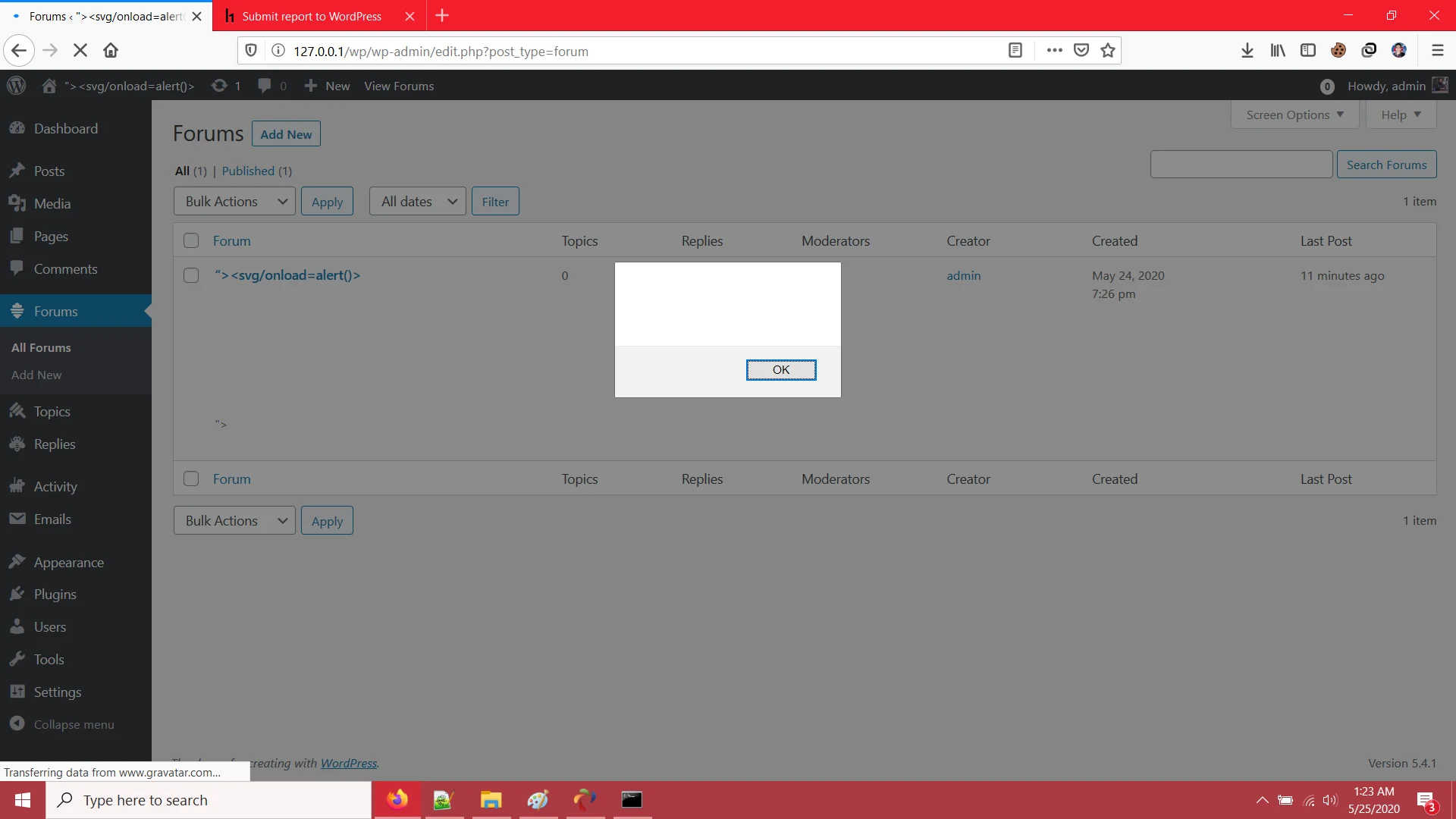
There exists a stored XSS vulnerability in bbPress, due to which the XSS payload which I enter in my content, gets executed at /wp-admin/edit.php?post_type=forum. This vulnerability requires you to be an authenticated user.
Steps To Reproduce:
Step 1. Visit /wp-admin/edit.php?post_type=forum Step 2. Click on Add New Step 3. Write any title, and in content, write your XSS payload through the "Text" editor, rather than the "Visual" one, and publish the content. Step 4. Now, visit /wp-admin/edit.php?post_type=forum, and you will be able to see the payload getting executed.
Recommendations
Making use of proper functions in PHP or WordPress core in the bbPress source code regarding the filtering or sanitization of user input is a recommended way to fix this vulnerability.
Impact
By taking an advantage of this vulnerability, an owner of a WordPress-based website would be able to execute their malicious JavaScript codes in context to the WordPress dashboard, which could result in bad issues to other users.
Attachments
Not written yet. The AI write-up for this report has not been written yet. The Original tab links to the source.
How it worked
Root cause
Likely the forum content was saved and output on the admin forum listing without proper sanitisation or escaping.
Impact
An authenticated user could run JavaScript in the WordPress dashboard context, which could affect other users who view the forum listing.
What the attacker needed
An authenticated WordPress account; ability to create a forum post; victim views the forum listing page
The fix
The plugin should filter and sanitise user input using proper PHP or WordPress core functions.
How it was found
- Open the forum listing page in the WordPress admin area.
- Click Add New to create a forum.
- Enter a title and put the script in the content using the Text editor, then publish.
- Return to the forum listing page and the script runs.
Explained by bugbounty.wiki with AI from the original and checked against quotes from it; it can still be wrong. Read the original before relying on a detail.
Not written yet. The AI write-up for this report has not been written yet. The Original tab links to the source.
Stored cross-site scripting means a site saves something dangerous you typed and later shows it to other people as part of the page. Here forum content was saved without cleaning, so a script in it ran for anyone opening the forum list in the admin area, which could cause problems for other users.
What is XSS?
Script an attacker supplies runs in another user's browser, on the target's origin, with that user's session.





