Clickjacking wordcamp.org
The server did not return an X-Frame-Options header, so the site could be embedded in an iframe on another domain. An attacker could use this to trick users into clicking on something different from what they perceive, potentially stealing information or redirecting them.
 Originally disclosed on HackerOne
- Fixed in 4 days
- Disclosed after 34 days
Hello Security, Clickjacking (User Interface redress attack, UI redress attack, UI redressing) is a malicious technique of tricking a Web user into clicking on something different from what the user perceives they are clicking on, thus potentially revealing confidential information or taking control of their computer while clicking on seemingly innocuous web pages. The server didn't return an X-Frame-Options header which means that this website could be at risk of a clickjacking attack. The X-Frame-Options HTTP response header can be used to indicate whether or not a browser should be allowed to render a page in a <frame> or <iframe>. Sites can use this to avoid clickjacking attacks, by ensuring that their content is not embedded into other sites. This vulnerability affects Web Server. IMPACT: An attacker can host this domain in other evil site by using iframe and if a user fill the given filed it can directly redirect as logs to attacker and after its redirect to your web server.. its lead to steal user information too and use that host site as phishing of your site its CSRF and Clickjacking POC: 1.Open URL :https://www.blockchain.com/ 2.put the url in the below code of iframe
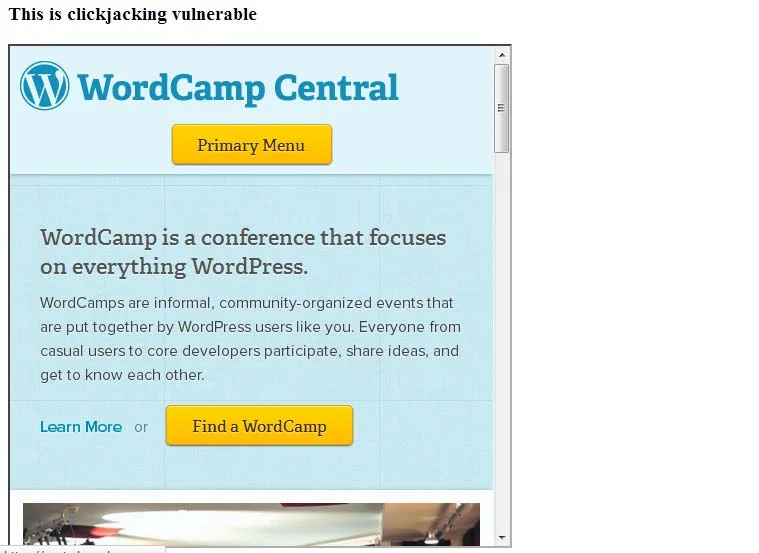
<!DOCTYPE HTML> <html lang="en-US"> <head> <meta charset="UTF-8"> <title>i Frame</title> </head> <body> <h3>This is clickjacking vulnerable</h3> <iframe src="https://www.blockchain.com/" frameborder="2 px" height="500px" width="500px"></iframe> </body> </html>3.Observe that site is getting displayed in Iframe
Impact: By using Clickjacking technique, an attacker hijack's click's meant for one page and route them to another page, most likely for another application, domain, or both.
Remediation: Frame busting technique is the better framing protection technique. Sending the proper X-Frame-Options HTTP response headers that instruct the browser to not allow framing from other domains
Attachments
Not written yet. The AI write-up for this report has not been written yet. The Original tab links to the source.
How it worked
Root cause
Likely the server did not send the X-Frame-Options header, allowing the page to be framed by other sites.
Impact
An attacker could host the site in an iframe on a malicious page and trick users into clicking, potentially stealing information or using the site for phishing; the report does not show this working against the stated target.
What the attacker needed
Victim visits attacker's page; victim interacts with framed content
The fix
The server should send the X-Frame-Options header to prevent framing from other domains.
How it was found
- Open the provided URL.
- Put the URL into an iframe in an HTML page.
- Observe that the site is displayed inside the iframe.
Explained by bugbounty.wiki with AI from the original and checked against quotes from it; it can still be wrong. Read the original before relying on a detail.
Not written yet. The AI write-up for this report has not been written yet. The Original tab links to the source.
Clickjacking is when a malicious site loads a real site inside an invisible or disguised frame, so your clicks go to the attacker's page instead of where you think you are clicking. This report says the site did not send a header that tells browsers not to allow such framing, so it could be abused. The proof of concept, however, uses a different website, which weakens the claim.
What is UI spoofing?
The interface lies to the user: a framed page catches their clicks, or a browser shows the wrong address or a fake prompt. Paid when it leads to a sensitive action or convincing phishing.


