A 403 Bypass Worth $900: How a Semicolon Exposed API Documentation
A Cloudflare rule blocked access to an API documentation page, but adding a semicolon to the URL path bypassed the block and loaded the page. After the first fix, a different semicolon placement bypassed it again.

Hacking
The full write-up lives on its author's site
It belongs to its author, so we link to it rather than copy it. The other two tabs are our own rewrites, checked against it.
Context
The target was an API subdomain of a web application, anonymised in the write-up as example.com. The application exposed routes under the /service/ path, and among them an interactive REST API documentation page served as Swagger UI. The documentation lived at a path under the versioned API prefix, and a Cloudflare rule in front of the host returned 403 Forbidden for that path.
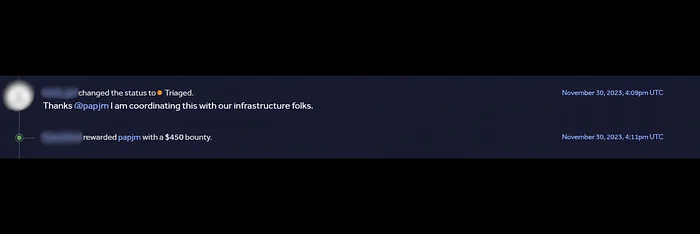
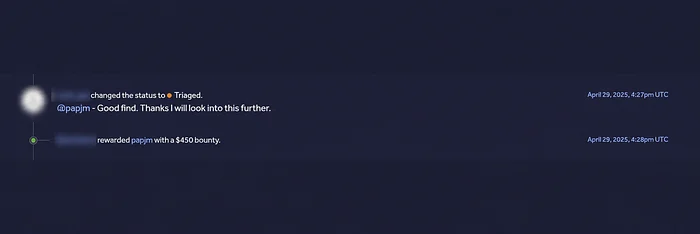
The finding is about reaching that documentation page despite the Cloudflare restriction, by changing how the path is written rather than by attacking the application itself. The researcher reported the behaviour twice: once for the original bypass, and again in 2025 when the first payload had been fixed and a different semicolon placement worked. Both reports were accepted, each paid $450, for a total of $900. The first was rated Medium with a CVSS score of 5.3.
All target URLs in the write-up use example.com, and the paths and query parameters are invented replacements that preserve the structure of the technique.
Setup
The work started with reconnaissance in 2023 and continued with follow-up testing in 2025. No accounts or roles are described; the researcher used search engines during reconnaissance. The precondition for the finding was that the API documentation path was blocked by Cloudflare.
Finding it
Visiting the root of the API subdomain returned a Cloudflare 403 Forbidden response. Google searches produced no useful leads, so the researcher tried Yahoo instead. That search returned an indexed API URL with a structure like this:
https://example.com/service/v4/catalog/en/items/482901/feedback?limit=10&page=1&sort=recent&direction=desc
The important part was the path prefix: the application had routes under /service/. Visiting the prefix itself:
https://example.com/service
returned a page offering an Interactive REST API documentation link. Following that link led to a Swagger UI page, but Cloudflare blocked the request:
https://example.com/service/v4/reference/start.html
At that point there was a specific, blocked endpoint to investigate: a documentation page that the application clearly served, sitting behind a rule that refused the ordinary path.
Exploitation
Step 1: add a semicolon after the version segment
The first bypass was a single extra character, a semicolon placed immediately after the version segment:
https://example.com/service/v4;/reference/start.html
The response changed to 200 OK, and the API documentation loaded. The comparison the researcher recorded was:
| Request path | Observed result |
|---|---|
/service/v4/reference/start.html |
Cloudflare 403 |
/service/v4;/reference/start.html |
200 OK; documentation accessible |
The evidence that mattered was the content of the response: the documentation the original request had been prevented from reaching was now being served. The finding was reported, triaged and reviewed by the program, rated Medium with a CVSS score of 5.3, and paid $450.
Step 2: retest after the fix
In 2025 the original payload no longer worked. Both the normal URL and the first bypass returned 403. The researcher tested another variation, placing a semicolon with a name-value pair in a later part of the path:
https://example.com/service/v4/reference/;foo=bar/start.html
That variation reached the documentation again. The follow-up results were:
| Request path | Result during follow-up testing |
|---|---|
/service/v4/reference/start.html |
403 Forbidden |
/service/v4;/reference/start.html |
403 Forbidden |
/service/v4/reference/;foo=bar/start.html |
Documentation accessible |
A second report demonstrating the new bypass was accepted and paid another $450, bringing the total to $900.
Step 3: further placements
During later retesting the researcher also demonstrated these placements:
https://example.com/service/v4/reference;/start.html
https://example.com/service/v4/reference/;/start.html
The original report was reopened after the team reproduced the behaviour. The team said additional reports were unnecessary for those variants because the underlying fix was the same.
Root cause
The behaviour suggested that the security layer and the application interpreted the path differently. Semicolons can carry meaning inside URL path segments: some frameworks support semicolon-delimited path parameters, often called matrix variables, and Spring's documentation provides examples of this syntax, including parameters attached to individual path segments.
A plausible explanation, in the researcher's words, is that the blocking rule matched one representation of the URL while another component still routed the modified path to the documentation. The exact parsing behaviour of the target was not established and its framework was not confirmed. What was observed is that semicolon variations reached a resource whose ordinary path was blocked.
After the first report, the original semicolon placement no longer worked, but a semicolon with a name-value pair in a later segment still reached the same page. The lesson drawn is to consider how each layer interprets the request: the WAF, any proxy, and the application router.
Impact
The demonstrated impact was bypassing the Cloudflare restriction protecting the API documentation page. A reachable Swagger UI can help someone understand an API's routes, parameters and request formats. It does not automatically prove that protected API operations can be called without authorisation.
The researcher deliberately kept the claim narrow. Access to the documentation did not prove access to configuration files, source repositories, user accounts or sensitive records. Separately, login pages were noticed and a concern about rate limiting was raised, but the triage team asked for that to be reported on its own, so it is outside this finding.
Fix
The first semicolon placement stopped working, and the second report was accepted for the remaining variation. The team treated the later placements as covered by the same underlying fix and reopened the original report rather than accepting further reports for them.
The guidance the researcher draws from this is consistent path handling across the security and routing layers, together with authentication and authorisation on resources that require restricted access. If semicolon path parameters are not needed, rejecting them consistently reduces the ambiguity that made the bypass possible.
Variants to test
- Semicolon after a path segment. Insert
;after a segment that the rule matches on, as in/service/v4;/reference/start.html. A positive result is a 200 response with the protected content, where the plain path returns 403. - Semicolon with a name-value pair in a later segment. Use a matrix-style parameter such as
/service/v4/reference/;foo=bar/start.html. A positive result is the same protected content being served after the first placement has been blocked. - Semicolon at the end of a segment before the final component. Try
/service/v4/reference;/start.htmland/service/v4/reference/;/start.html. A positive result is the documentation or other blocked resource loading while the plain path stays at 403. - Compare layers, not just payloads. For each variant, check whether the WAF, any proxy and the application router agree on the path. A positive result is any representation that the rule does not match but the router still resolves to the protected resource.
- Retest after every fix. When a payload stops working, vary the placement rather than abandoning the target; a fix that blocks one semicolon position may leave others open.
The most useful part of this finding, as the researcher puts it, was learning to compare what a security rule blocks with what the application still accepts. That small difference led to two accepted reports and $900 in bounties.
What happened, in plain words
Imagine a building with a front desk guard. The guard has a list of rooms you are not allowed to enter, and one of them is the room with the building's instruction manuals. You walk up and ask for that room by its usual name, and the guard says no. Then you ask for the same room using a slightly different spelling of its name, one the guard's list does not recognise, and the guard waves you through. The room is the same room. The guard simply compared your words against a list instead of checking where you actually ended up.
That is the shape of this finding. A website had a page of API documentation, which is essentially a manual describing how software can talk to the site. A security service called Cloudflare sat in front of the site and refused to let anyone load that page. By writing the page's address with an extra semicolon character in a particular spot, the researcher got the page to load anyway. The guard (Cloudflare) did not recognise the address, but the building (the application) still knew which room was meant.
The researcher reported this, was paid $450, and then in 2025 found that the first trick no longer worked. A different semicolon placement opened the same page again, and a second report earned another $450, for $900 in total. The first report was rated Medium with a CVSS score of 5.3.
All the addresses in this article use example.com, and the paths and query parameters are invented stand-ins that keep the same shape as the real ones, so the target stays anonymous.
The words you need before we start
A few everyday ideas come up constantly, so here they are up front.
A URL is a web address, the thing you type into the bar at the top of your browser. It has parts. In https://example.com/service/v4/reference/start.html, example.com is the host (which computer you are talking to), and /service/v4/reference/start.html is the path (which page on that computer). Think of the host as a street address and the path as which door and which corridor inside the building.
An API is a way for one piece of software to ask another piece of software to do something, without a human clicking. A restaurant comparison works well: the menu is the API, the kitchen is the software, and the waiter carries your order. You do not walk into the kitchen yourself; you use the agreed menu.
API documentation is the menu itself, written out. It lists what you can order, what words to use, and what you get back. When that menu is public, anyone can read the list of things the kitchen can make, even if they still cannot get served without permission.
Swagger UI is a popular tool that turns API documentation into a readable, clickable web page. It is the printed menu with pictures, rather than a wall of text.
Cloudflare is a company that sits between the public internet and a website, like a receptionist in front of the building. It can block requests it does not like before they ever reach the website itself. A WAF (Web Application Firewall) is the general name for that kind of filtering service.
HTTP status codes are the short numbers a web server sends back. 200 OK means here is your page. 403 Forbidden means I understood you and I am refusing. You have seen these without knowing it: a 404 page is the famous one.
Reconnaissance (recon) means looking around before attacking anything: finding out which computers, pages and features exist. It is the equivalent of walking around a neighbourhood reading the signs.
A payload here just means the particular version of a request you send to try to get past a filter.
A semicolon is the ; character. In ordinary writing it separates two clauses. In some web addresses it has a special meaning, which is the heart of this story.
Matrix variables (also called matrix parameters) are a way of attaching extra information to a single part of a path using a semicolon, for example ;foo=bar. Some web frameworks, meaning the software libraries used to build a site, understand this syntax. Spring is one such framework, and its documentation gives examples of it.
CVSS is a standard scoring system for how serious a security flaw is, from 0 to 10. A 5.3 is in the middle: Medium.
A bounty is money a company pays someone for reporting a security problem responsibly instead of exploiting it.
Step 1: finding a way in
The researcher started with reconnaissance in 2023. During that looking around, they found an API subdomain. A subdomain is a smaller address under a main one, like api.example.com under example.com; it often points at a separate machine or service.
Visiting the root of that subdomain, meaning the bare address with no path after it, returned a Cloudflare 403 Forbidden. The receptionist said no at the front door.
Google searches gave nothing useful. So the researcher tried Yahoo instead. That is a small but important habit: different search engines index different things, and one may have a page the other does not. Yahoo returned an indexed API URL, meaning a page that Yahoo had crawled and stored, with a structure like this:
https://example.com/service/v4/catalog/en/items/482901/feedback?limit=10&page=1&sort=recent&direction=desc
Line by line, in plain words:
https://is the secure way a browser talks to a website.example.comis the host, the building./service/v4/catalog/en/items/482901/feedbackis the path, the corridor and room. Reading it left to right, it says: underservice, versionv4, acatalog, languageen, item number482901, and that item'sfeedback.- The
?marks the start of the query string, extra instructions sent along with the request, like a note clipped to the order. limit=10says give me at most 10 results.page=1says start at page one.sort=recentsays order them newest first.direction=descsays descending order.- The
&characters simply join those notes together.
The valuable part was not the item or the feedback. It was the beginning of the path: /service/. That told the researcher the application had a whole area of pages under that prefix. One indexed page had leaked the shape of the site.
So they visited the prefix on its own:
https://example.com/service
https://example.comis the same host as before./serviceis the shared prefix, the corridor rather than a specific room.
That page offered a link labelled Interactive REST API documentation. Following it led to a Swagger UI page, but Cloudflare blocked the request:
https://example.com/service/v4/reference/start.html
/service/v4/reference/start.htmlis the path to the documentation page.v4is the version of the API,referenceis the documentation area, andstart.htmlis the page itself.
Now the researcher had something specific: a page the application clearly served, sitting behind a rule that refused the ordinary address. That is the ideal situation for testing, because you know the room exists and you know exactly which door is locked.
Step 2: the first bypass, one extra character
The first trick was a single extra character. A semicolon was placed immediately after the version segment:
https://example.com/service/v4;/reference/start.html
- Everything is the same as the blocked address except that
v4has becomev4;. - The semicolon sits between the version part and the next slash.
The response changed to 200 OK, and the API documentation loaded. The researcher recorded the comparison like this:
| Request path | Observed result |
|---|---|
/service/v4/reference/start.html |
Cloudflare 403 |
/service/v4;/reference/start.html |
200 OK; documentation accessible |
What mattered was not the number alone but the content: the documentation that the original request had been prevented from reaching was now being served. A 200 with an empty page would have proved nothing. A 200 with the actual manual proved the room had been reached.
The semicolon made the guard and the building read the address differently. If the guard matches the address against a list of forbidden patterns, and the building's routing software treats a semicolon as a harmless separator, then a semicolon can make the two disagree. The guard sees a string it does not recognise; the building still walks you to the right room.
The finding was reported. The program triaged and reviewed it, rated it Medium with a CVSS score of 5.3, and paid $450.
Step 3: coming back after the fix
In 2025 the original payload no longer worked. Both the normal address and the first bypass returned 403. The guard's list had been updated.
This is where many people stop. The researcher did not. They tested another variation, placing a semicolon with a name-value pair in a later part of the path:
https://example.com/service/v4/reference/;foo=bar/start.html
- The path is the same up to
/service/v4/reference/. - Then comes
;foo=bar, a semicolon followed by a made-up name (foo) and value (bar), in the style of a matrix parameter. - Then
/start.html, the page itself.
That variation reached the documentation again. The follow-up results were:
| Request path | Result during follow-up testing |
|---|---|
/service/v4/reference/start.html |
403 Forbidden |
/service/v4;/reference/start.html |
403 Forbidden |
/service/v4/reference/;foo=bar/start.html |
Documentation accessible |
Read the table as a story. The plain address is still blocked. The first trick is now blocked too. But the same page is reachable by moving the semicolon to a different segment and attaching a name-value pair to it. The fix had blocked one spelling, not the idea.
A second report demonstrated the new bypass. The team accepted it and paid another $450, bringing the total to $900.
Step 4: more placements
During later retesting the researcher also demonstrated these placements:
https://example.com/service/v4/reference;/start.html
https://example.com/service/v4/reference/;/start.html
- The first line puts the semicolon directly after
reference, before the slash:reference;/start.html. - The second line puts a slash, then a semicolon, then another slash:
reference/;/start.html.
Both are further ways of writing the same address so that the guard's pattern does not match while the building still finds the room.
The original report was reopened after the team reproduced the behaviour, meaning they confirmed it themselves. They said additional reports were unnecessary for those variants because the underlying fix was the same. In other words, one repair would close all of them, so there was no need to file each one separately.
Why a semicolon could matter
The behaviour suggested that the security layer and the application interpreted the path differently. That is the whole idea in one sentence.
Semicolons can carry meaning inside URL path segments. Some frameworks support semicolon-delimited path parameters, often called matrix variables. Spring's documentation provides examples of this syntax, including parameters attached to individual path segments. So to the building, ;foo=bar is not noise; it is a labelled note attached to that part of the corridor, and the corridor still leads to the same room.
A plausible explanation, in the researcher's words, is that the blocking rule matched one representation of the URL while another component still routed the modified path to the documentation. The exact parsing behaviour of the target was not established and its framework was not confirmed. What was observed is that semicolon variations reached a resource whose ordinary path was blocked.
After the first report, the original semicolon placement no longer worked, but a semicolon with a name-value pair in a later segment still reached the same page. The lesson drawn is to consider how each layer interprets the request: the WAF, any proxy, and the application router. A proxy is another middleman that forwards requests. The router is the part of the application that decides which code handles which path. If any two of those three disagree about what a path means, there is room for a bypass.
Keeping the impact honest
The demonstrated impact was bypassing the Cloudflare restriction protecting the API documentation page. That is the claim, and no more.
A reachable Swagger UI can help someone understand an API's routes, parameters and request formats. It is a menu. Reading a menu tells you what the kitchen can cook; it does not mean you can walk in and cook it. It does not automatically prove that protected API operations can be called without authorisation. Authorisation is the check that you are allowed to do a particular thing, as opposed to authentication, which is proving who you are.
The researcher deliberately kept the claim narrow. Access to the documentation did not prove access to configuration files, source repositories, user accounts or sensitive records. This restraint matters: overstating impact is the fastest way to have a report downgraded or rejected.
Separately, login pages were noticed and a concern about rate limiting was raised. Rate limiting is a cap on how many requests someone can make in a period, like a shop limiting how many items one person can buy. The triage team asked for that to be reported on its own, so it is outside this finding.
The fix, and what it teaches
The first semicolon placement stopped working, and the second report was accepted for the remaining variation. The team treated the later placements as covered by the same underlying fix and reopened the original report rather than accepting further reports for them.
The guidance the researcher draws from this is consistent path handling across the security and routing layers, together with authentication and authorisation on resources that require restricted access. In plain terms: make the guard and the building read addresses the same way, and put a lock on the room itself rather than relying only on the guard's list. If semicolon path parameters are not needed, rejecting them consistently reduces the ambiguity that made the bypass possible.
Variants worth trying
These are the shapes of request to test, written as a checklist. Each one is the same idea in a different position.
- Semicolon after a path segment. Insert
;after a segment that the rule matches on, as in/service/v4;/reference/start.html. A positive result is a 200 response with the protected content, where the plain path returns 403. - Semicolon with a name-value pair in a later segment. Use a matrix-style parameter such as
/service/v4/reference/;foo=bar/start.html. A positive result is the same protected content being served after the first placement has been blocked. - Semicolon at the end of a segment before the final component. Try
/service/v4/reference;/start.htmland/service/v4/reference/;/start.html. A positive result is the documentation or other blocked resource loading while the plain path stays at 403. - Compare layers, not just payloads. For each variant, check whether the WAF, any proxy and the application router agree on the path. A positive result is any representation that the rule does not match but the router still resolves to the protected resource.
- Retest after every fix. When a payload stops working, vary the placement rather than abandoning the target; a fix that blocks one semicolon position may leave others open.
The most useful part of this finding, as the researcher puts it, was learning to compare what a security rule blocks with what the application still accepts. That small difference led to two accepted reports and $900 in bounties.
Glossary
- API: a way for one piece of software to ask another to do something, using an agreed set of requests and responses, like a restaurant menu.
- API documentation: the written description of an API's routes, parameters and formats, the menu itself.
- Authentication: proving who you are, like showing a passport.
- Authorisation: the check that you are allowed to do a particular thing, like a door key that only opens certain rooms.
- Bounty: money paid by a company for a responsibly reported security problem.
- Cloudflare: a service that sits in front of a website and can block requests before they reach it.
- CVSS: a standard 0 to 10 score for how serious a security flaw is.
- Host: the part of a web address naming which computer you are talking to, such as
example.com. - HTTP status code: the short number a server returns, such as 200 OK or 403 Forbidden.
- Matrix variables: extra name-value information attached to a single path segment with a semicolon, such as
;foo=bar. - Path: the part of a web address after the host that says which page or resource you want.
- Payload: the particular version of a request you send when testing a filter.
- Proxy: a middleman that forwards requests between you and a server.
- Query string: the extra instructions after a
?in a web address, joined by&. - Rate limiting: a cap on how many requests someone can make in a given period.
- Reconnaissance (recon): looking around to discover what exists before testing anything.
- Router: the part of an application that decides which code handles which path.
- Semicolon: the
;character, which some web frameworks treat as a separator for path parameters. - Spring: a popular framework for building web applications, whose documentation describes semicolon path parameters.
- Subdomain: a smaller address under a main one, such as
api.example.comunderexample.com. - Swagger UI: a tool that displays API documentation as a readable, clickable web page.
- URL: a web address, made up of a host and a path, and optionally a query string.
- WAF (Web Application Firewall): a filtering service that inspects requests and blocks ones matching rules it considers unwanted.

