An Email Address Was Enough to Act as Another User —Vulnerability or Acceptable Risk?
An unauthenticated marketplace API accepted a publisher's email address in a task-creation request and attributed the resulting job to that existing publisher account, without any password, session or token. An attacker could create attacker-controlled jobs that became active in a paid contractor marketplace under someone else's identity, and the workflow was scriptable with no effective throttling observed.
 Published on medium.com
Bugbounty Writeup
The full write-up lives on its author's site
It belongs to its author, so we link to it rather than copy it. The other two tabs are our own rewrites, checked against it.
Context
The target is a two-sided service marketplace. Customers (publishers) post jobs for renovation, repair, construction and related services, and professionals (contractors) working in relevant regions discover those opportunities and pursue potential customers. The flow the author sketches is:
Publisher / Customer
        │
        │ creates job
        ▼
   Marketplace
        │
        │ regional distribution
        ▼
Professional / Contractor
        │
        │ pays for access to
        │ relevant opportunities
        ▼
Potential Customer
Contractors do not browse an unrestricted collection of public posts. Access to relevant regional jobs is part of the marketplace's commercial service: contractors pay to access those opportunities. The platform is therefore selling access to potentially genuine customer demand, not just software functionality:
Real publisher
      │
      ▼
Genuine job request
      │
      ▼
Marketplace
      │
      ▼
Regional opportunity
      │
      ▼
Contractor pays for access
If unauthorised or fabricated jobs can enter that same pipeline, content integrity is directly connected to the business model. That distinction is central to the finding.
The research was performed during an authorised bug bounty assessment. The organisation, application hostname, report identifiers, real account details, customer information, object identifiers and unnecessary infrastructure details are omitted or generalised in the write-up. All cross-account testing used accounts under the researcher's control and benign test content, and test marketplace objects were closed after sufficient evidence had been collected.
Setup
The researcher worked against the application's API rather than assuming the visible web interface was the complete security boundary. Several operations sat beneath a public namespace similar to:
/public/*
No special tooling or versions are described.
- At least one publisher account under the researcher's control, with a known email address.
- The ability to send unauthenticated HTTP requests to the public API.
- A second controlled publisher account, used later to confirm the pattern.
Finding it
The investigation began as a set of small, individually unremarkable observations. An unauthenticated API returning marketplace listings might be information disclosure. An endpoint revealing whether an email belongs to a particular account type might be account enumeration. An endpoint allowing anonymous marketplace submissions might simply be an abuse or spam problem. The shift that mattered was to stop asking what each endpoint does and start asking what happens when these behaviours interact.
Public task data
One endpoint returned marketplace task information without authentication:
GET /public/tasks
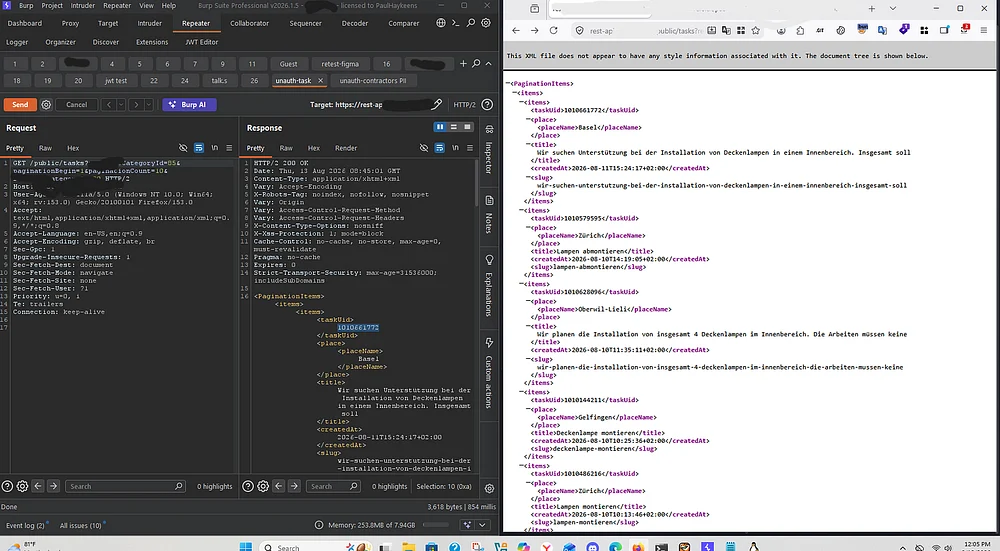
No authorisation header, no authenticated session and no account were required. Individual records could also be queried, with a response shaped like:
{
  "taskUid": "[REDACTED]",
  "title": "Example marketplace request",
  "place": {
    "postalCode": "[REDACTED]",
    "placeName": "[REDACTED]"
  },
  "state": "CLOSED",
  "createdAt": "[REDACTED]",
  "expires": "[REDACTED]",
  "maxNumberOfOffers": 10
}
The API exposed a substantial collection of marketplace records. Initially this looked like information disclosure (CWE-200), but a meaningful portion of the returned information was already intended to be visible through the public marketplace, so calling all of it sensitive would have overstated the confidentiality impact.
Public contractor data
Another operation exposed structured contractor information:
GET /public/contractors
Again, authentication was not required.
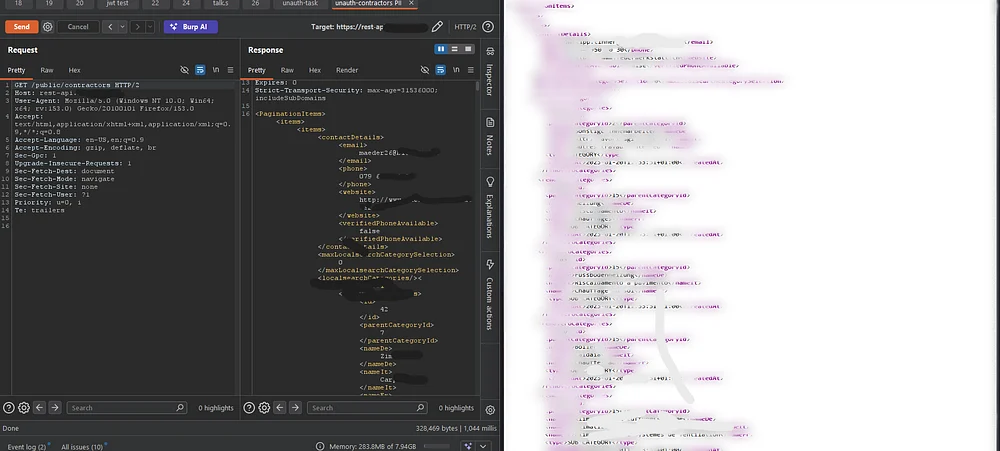
Depending on the record, responses contained attributes relating to contractor profiles, categories, geographic coverage, account metadata, and business or contact information. Some of this overlapped with publicly available contractor profiles, which limited the standalone confidentiality impact, but it raised the question of how the application uses account identity elsewhere in the public API.
An account-role oracle
An account-related public endpoint accepted an email address:
POST /public/account
Content-Type: application/json

{
  "email": "[redacted]",
  "password": ""
}
The application's behaviour changed depending on whether the supplied email already belonged to an account. For certain existing accounts, the response explicitly indicated that the account existed and revealed its role, along the lines of:
Unexpected existing account [REDACTED]
with role=CONTRACTOR
That meant an unauthenticated requester could potentially distinguish certain account types.
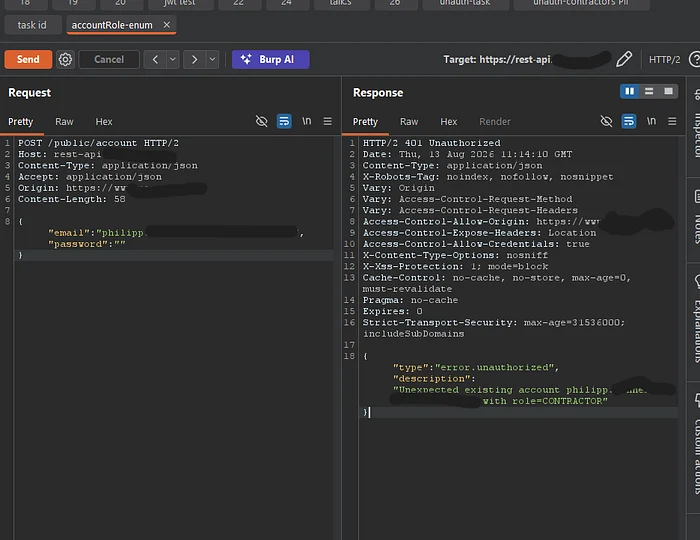
At this point the map looked like this:
/public/tasks
 │
 └── marketplace information

/public/contractors
 │
 └── contractor information

/public/account
 │
 └── account / role enumeration
None of these became the main finding. They led to a different question: which public operations can actually change marketplace state?
Exploitation
Step 1: Check whether tasks can be created anonymously
The API exposed task-creation functionality:
POST /public/tasks
If tasks can be read anonymously, can they also be created anonymously? The first requests did not immediately result in active marketplace jobs. Some objects remained in what appeared to be an incomplete or review-like state, which suggested the backend implemented some kind of completeness gate before a job entered the marketplace. It also meant that receiving:
HTTP 201 Created
was not sufficient evidence of meaningful impact.
Step 2: Compare with the legitimate creation workflow
The researcher compared the request with the legitimate task-creation workflow. Several fields were relevant to constructing a complete marketplace submission: task description information, category selection, execution details, attachments, offer configuration and publisher information. One structure stood out:
"publisherAccountCreate": {
  "firstName": "…",
  "lastName": "…",
  "phone": "…",
  "email": "…"
}
That produced the question that changed the investigation: what happens if the email already belongs to an existing publisher?
Step 3: Submit a task without authenticating as the publisher
Using a publisher account under the researcher's control, a task-creation request was submitted without authenticating as that publisher. There was no:
Authorization: Bearer [token]
There were no publisher session cookies, and no authenticated principal connected the request to the publisher account. Instead, the request contained:
"publisherAccountCreate": {
  "email": "[redacted]"
}
The server accepted it:
HTTP/2 201 Created
and returned a response similar to:
{
  "taskUid": "[REDACTED]",
  "accountAlreadyExists": true,
  "conversionValue": null
}
accountAlreadyExists: true demonstrated that the backend recognised the email address, but it did not establish that the resulting job had actually been attributed to that account.
Step 4: Verify attribution from the publisher side
The researcher then authenticated normally to the controlled publisher account and checked. The new task was there.
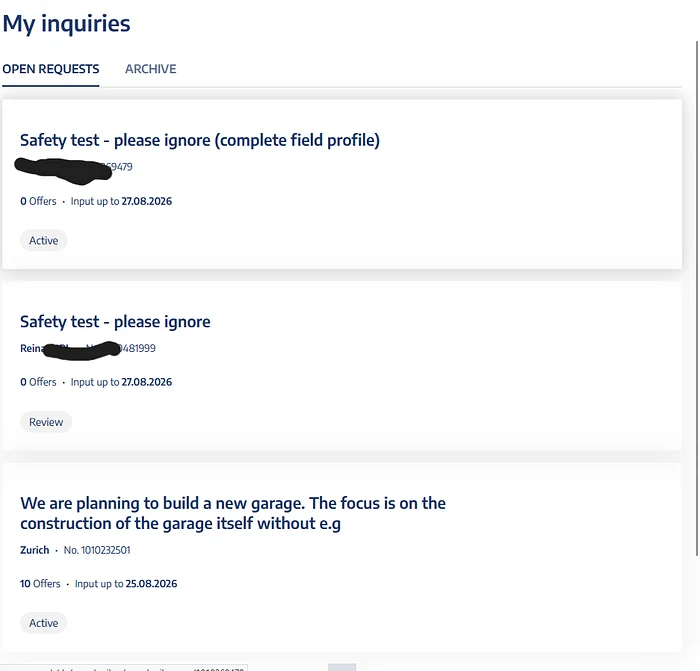
The publisher associated with the task corresponded to the account whose email had been supplied in the unauthenticated request. That established the authorisation failure.
Step 5: Reproduce with a second controlled account
One account is not always enough to establish a pattern, so the process was repeated with another publisher account under the researcher's control. The behaviour remained consistent:
Controlled publisher A
 │
 ▼
Email A supplied anonymously
 │
 ▼
Task attributed to A

Controlled publisher B
 │
 ▼
Email B supplied anonymously
 │
 ▼
Task attributed to B
Neither creation request contained an authenticated publisher session, which reduced the likelihood that the first result was caused by some unusual account state.
Step 6: Watch the job become active
Cross-account attribution established the authorisation issue, but the next question was what happens to the resulting job. If it remained an inert database object requiring manual verification, the practical impact would be different. The resulting task transitioned into:
ACTIVE
It appeared in the controlled publisher's dashboard and, more importantly, entered the contractor discovery workflow. The observed chain was:
Unauthenticated requester
          │
          ▼
Supply existing publisher email
          │
          ▼
Backend selects publisher
          │
          ▼
Task created under publisher
          │
          ▼
        ACTIVE
          │
          ▼
Regional marketplace
          │
          ▼
Contractor discovery
The unauthenticated request had crossed two boundaries:
Anonymous user
      ↓
Existing account identity
      ↓
Live marketplace activity
Step 7: Attach attacker-controlled content
The public API also exposed file-upload functionality:
POST /public/files
A benign image could be uploaded without authentication, and the resulting file identifier could then be associated with the newly created task. The researcher deliberately used harmless content: this was not a stored-XSS test or an attempt to upload executable content. The goal was to establish whether content supplied by the unauthenticated requester could travel through the same marketplace workflow. It could:
Anonymous requester
 │
 ▼
Anonymous benign upload
 │
 ▼
 file UID
 │
 ▼
Anonymous task creation
 │
 ▼
Existing publisher
 │
 ▼
 ACTIVE task
 │
 ▼
Paid marketplace pipeline
Step 8: Automate the sequence
The next question was whether exploitation requires meaningful human interaction or can be automated. A small proof of concept reproduced the minimum relevant sequence:
1. Upload benign test content
2. Submit marketplace task
No publisher credentials and no authenticated publisher session were required. A controlled publisher email was supplied as the target identity. The API-side operation completed within seconds, so the vulnerability was not constrained by a complicated browser workflow or repeated manual interaction. It was scriptable.
Step 9: Look for rate limiting
During limited authorised testing, no effective rate-limiting mechanism preventing repeated task submissions through the vulnerable workflow was observed. The researcher deliberately did not attempt to flood the production marketplace or benchmark its maximum throughput, because doing so would have created unnecessary operational risk. The write-up explicitly does not claim thousands of jobs per minute were generated. What was demonstrated was the prerequisite for that class of abuse:
Unauthenticated operation
+
Scriptable request
+
Attacker-controlled publisher identifier
+
No effective throttling observed
+
Automatic marketplace activation
Because the account identity was supplied as data, automation could theoretically vary that identifier across requests. That changes the threat model from someone manually submitting a fake marketplace job to an unauthenticated actor holding a scriptable primitive capable of injecting unauthorised marketplace activity at scale. The exact maximum throughput was not determined.
Root cause
Conceptually, the backend appeared to do something like this:
Client supplies email
 │
 ▼
Backend searches accounts
 │
 ▼
Existing publisher found
 │
 ▼
Create marketplace task
 │
 ▼
Associate task with publisher
The missing security decision was:
Existing publisher found
 │
 ▼
WHO IS MAKING THIS REQUEST?
 │
 ▼
ARE THEY AUTHORIZED
TO ACT AS THIS PUBLISHER?
An email address answers which account. It does not answer who is authorised to act as that account. The backend treated a client-supplied identifier as authority over an existing account.
The distinction between account creation and account attribution matters because anonymous marketplace submission may itself be intentional. In one scenario, an unauthenticated visitor provides an email that does not belong to an existing publisher, and the platform creates some form of new account or pending publisher state as part of onboarding. That may be completely intentional. In the other scenario, an unauthenticated visitor supplies an email belonging to an existing publisher, the backend recognises the account, and the resulting marketplace activity is associated with it. The requester provided:
No password
No authentication token
No publisher session
No demonstrated email ownership
Yet the task became activity belonging to that existing publisher. The requester is not merely creating content; they are causing the application to perform an action through another existing marketplace identity.
The completeness gate observed earlier only delayed activation until a sufficiently complete submission was sent. No effective throttling was observed during testing.
Impact
An unauthenticated requester could create an active marketplace job attributed to an existing publisher account without authenticating as that publisher or demonstrating control of the associated email address. The job became ACTIVE, appeared in the controlled publisher's dashboard, and entered the contractor discovery workflow. Content uploaded anonymously through /public/files could travel with it.
Because contractors pay for access to regional opportunities, the integrity of marketplace content is connected to the product being sold. The normal commercial flow is:
Publisher creates genuine job
 │
 ▼
Job enters marketplace
 │
 ▼
Regional contractor discovers it
 │
 ▼
Contractor pays for access
 │
 ▼
Potential business opportunity
The vulnerable path introduced another source of marketplace activity:
Unauthenticated requester
 │
 ▼
Creates attacker-controlled job
 │
 ▼
Attributes job to existing publisher
 │
 ▼
Job becomes ACTIVE
 │
 ▼
Regional marketplace
 │
 ▼
Paid contractor ecosystem
Describing this solely as spam does not capture the complete risk. The write-up lists potential consequences, explicitly as potential consequences rather than demonstrated ones:
- dilution of legitimate marketplace opportunities;
- fraudulent activity attributed to real publishers;
- wasted contractor time;
- contractors encountering fabricated opportunities in a paid service;
- abuse of marketplace categories or regions;
- increased moderation and support burden;
- reduced trust in marketplace leads;
- systematic marketplace manipulation.
The demonstrated behaviour introduces three integrity concerns. Identity integrity: marketplace activity can be attributed to an existing publisher without that publisher's authorisation. Marketplace integrity: attacker-generated jobs can enter the same pipeline used for genuine customer demand. Commercial integrity: contractors pay for access to regional opportunities, so unauthorised jobs injected into that pipeline touch the integrity of the product being sold.
The researcher did not make an unrelated contractor pay for access to a test job and did not attempt to demonstrate direct financial loss. The write-up also lists what was not demonstrated: authentication-session takeover, password compromise, arbitrary access to publisher credentials, modification of every existing task, persistent publisher-profile takeover, stored XSS through the upload workflow, compromise of the entire account system, access to unrelated private customer data, direct financial loss to contractors, contractors actually purchasing access to test content, production flooding, thousands of task creations, and maximum request throughput.
The demonstrated behaviour is narrower: an unauthenticated requester could programmatically create attacker-controlled marketplace activity attributed to an existing controlled publisher account, have that activity become active in a marketplace where contractors pay for access to regional opportunities, and no effective throttling preventing repeated submissions was observed during limited testing.
Triage outcome
The findings were reported through the authorised vulnerability-disclosure programme. The public marketplace and contractor-data observations were assessed as falling below the programme's validity threshold, because much of the returned information was considered non-sensitive business information already available through the public marketplace.
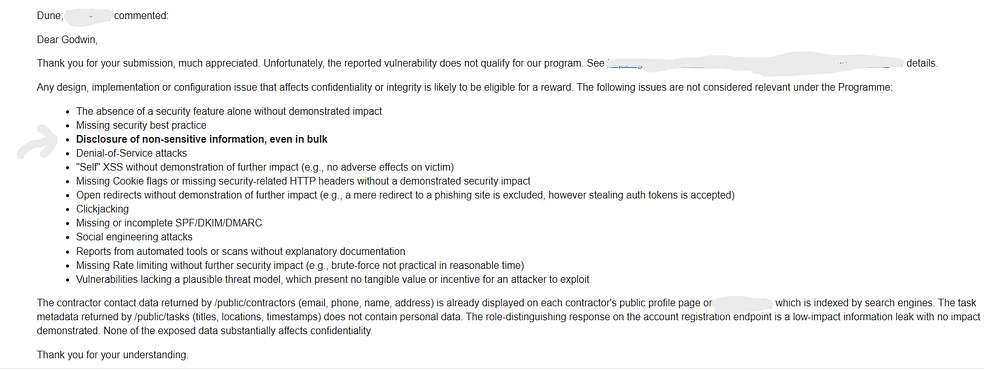
The cross-account authorisation behaviour had a different history. The researcher was informed that another researcher had discovered the underlying issue over a year earlier.
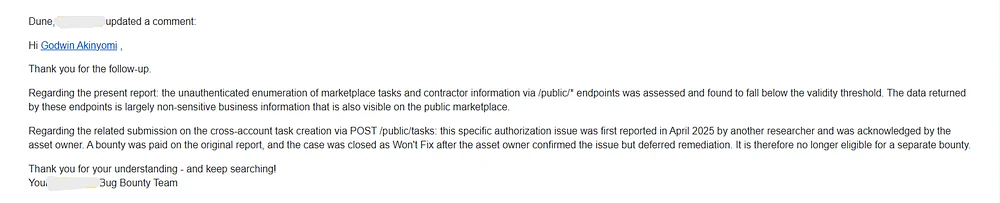
According to the programme response, the earlier report had been:
Reported
 │
 ▼
Reproduced
 │
 ▼
Acknowledged
 │
 ▼
Rewarded
 │
 ▼
Closed as "Won't Fix"
The asset owner had reportedly confirmed the behaviour but deferred remediation. The submission was therefore treated as a duplicate. The researcher does not dispute the duplicate decision. What interested him was the security state that remained: at the time of independent testing, the underlying behaviour could still be reproduced.
The write-up acknowledges that organisations make risk-acceptance decisions with an internal picture an external researcher does not have: fraud detection, abuse monitoring, operational controls, architectural constraints, remediation costs, product requirements, historical abuse data and compensating controls. A Won't Fix decision does not automatically prove that an organisation misunderstood a vulnerability; sometimes it means the risk was consciously accepted. The open question is what level of risk is acceptable once an authorisation flaw like this is understood.
Fix
The earlier report was closed as Won't Fix and the behaviour remained reproducible at the time of testing. The write-up proposes remediation rather than describing a change.
The central principle is that an account identifier must never substitute for authorisation. If an existing publisher is creating marketplace activity, the server should derive the publisher identity from an authenticated principal:
Authenticated session
 │
 ▼
Authenticated account
 │
 ▼
Authorization check
 │
 ▼
Create marketplace task
Not:
Client-supplied email
 │
 ▼
Account lookup
 │
 ▼
Existing account
 │
 ▼
Create marketplace task
If anonymous task creation is an intentional product feature, it should be logically separated from actions attributed to existing accounts. A safer anonymous workflow could resemble:
Anonymous submission
 │
 ▼
Verify email ownership
 │
 ▼
Pending task
 │
 ▼
Ownership established
 │
 ▼
Marketplace activation
The write-up also recommends:
- server-side authorisation checks for existing accounts;
- email ownership verification;
- separation of anonymous onboarding from existing-account actions;
- effective rate limiting on task and file creation;
- per-identity and behavioural abuse controls;
- marketplace activation safeguards;
- anomaly detection for high-volume submissions;
- monitoring for unusual publisher/region activity;
- review of other public APIs accepting account identifiers.
Rate limiting alone would not fix the authorisation vulnerability; it would only make automated exploitation more expensive. The authorisation boundary itself still needs to be corrected.
Variants to test
- Other public endpoints that accept an account identifier. Look for any unauthenticated operation taking an email, user ID or similar field. A positive result is a state change (created object, notification, listing) that appears under the account matching the supplied identifier when you log in to a controlled account.
- Other
*AccountCreate-style nested objects. The pattern here was a nested object that both creates and attributes. Try supplying the email of an existing controlled account in similar nested structures on other creation endpoints. A positive result is a response flag such asaccountAlreadyExists: truecombined with the object appearing in the existing account's dashboard. - Role oracle variations. Send the account endpoint an email belonging to each role you control and compare responses. A positive result is a response that differs by role for existing accounts, allowing unauthenticated role classification.
- Activation gates. Submit incomplete objects and then complete them field by field to find which fields move an object from pending to
ACTIVE. A positive result is an unauthenticated submission reaching the live marketplace without any ownership check. - Anonymous upload plus association. Upload benign content through a public file endpoint and attach the returned identifier to a created object. A positive result is the file being served alongside the live object.
- Throttling checks. Send a small, bounded number of repeated submissions and record whether any rate limit, CAPTCHA or anomaly control appears. A positive result is many accepted submissions with no throttling; keep the volume low and stop before it becomes abuse.
- Identifier variation. If the workflow is scriptable, check whether the account identifier can be varied across requests. A positive result is multiple controlled accounts each receiving attributed activity from unauthenticated requests.
The lesson
The investigation started with the question of what information is publicly accessible and ended with the question of what authority the application gives to information supplied by an unauthenticated requester. One ordinary field captured the problem:
{
  "email": "[redacted]"
}
An email address can identify an account. It cannot authenticate the requester, and it cannot authorise an action:
IDENTIFIER ≠ AUTHENTICATION
AUTHENTICATION ≠ AUTHORIZATION
Severity is not always visible from one HTTP request. A single anonymous task might look like spam; a cross-account task might look like broken authorisation; an active cross-account task entering a marketplace where contractors pay for opportunities adds a business-integrity dimension; and a scriptable workflow without effective throttling changes the potential scale. The vulnerability becomes clearer when you understand the system, not just the endpoint.
What happened, in plain words
A website runs a marketplace where two groups of people meet. On one side are customers, called publishers, who post jobs: a kitchen to renovate, a roof to repair, a wall to build. On the other side are professionals, called contractors, who look for those jobs in their area and try to win the customer's business. Contractors pay the marketplace for access to the jobs in their region. So the marketplace is not only selling software. It is selling access to real customer demand.
A security researcher was looking at the parts of the website that anyone can reach without logging in. Those parts are called the public API. He found a few small things: a list of jobs anyone could read, a list of contractor profiles anyone could read, and a way to ask the site whether an email address belonged to an account, and of what kind. Each of those looked minor on its own.
Then he asked a different question. What happens if these small behaviours are combined? He discovered that anyone, with no login at all, could create a new job on the marketplace and have that job appear as if it belonged to an existing publisher account. The only thing the attacker had to supply was that publisher's email address. No password, no login session, no proof that the email belonged to them. The job then became active, showed up in the real publisher's dashboard, and entered the pool of jobs that paying contractors browse.
He reported it. The marketplace's security team said the earlier, smaller findings were not serious enough to count. The cross-account issue, they said, had already been reported by someone else more than a year earlier, so his report was a duplicate. That earlier report had been reproduced, acknowledged, rewarded, and then closed as "Won't Fix". At the time of his own testing, the behaviour still worked.
The rest of the article is about what that means: how the flaw works, why it matters for a business that sells access to job listings, what the researcher deliberately did not do (he did not flood the site or make a real contractor pay for a fake job), and how he would fix it if it were his site.
The marketplace, explained from zero
Before any technical detail, you need to understand what the product is, because the severity of the bug depends on it.
The platform is a two-sided service marketplace. "Two-sided" means it serves two different groups who need each other. Customers post jobs for renovation, repair, construction and related services. Professionals working in the relevant regions discover those opportunities and can pursue the potential customers.
The flow the author sketches is:
Publisher / Customer
        │
        │ creates job
        ▼
   Marketplace
        │
        │ regional distribution
        ▼
Professional / Contractor
        │
        │ pays for access to
        │ relevant opportunities
        ▼
Potential Customer
Line by line, in plain words:
Publisher / Customeris the person who needs work done. In this article, "publisher" means the customer who publishes a job.creates jobis the action of posting a request: what needs doing, where, and when.Marketplaceis the website in the middle. It receives the job and decides who should see it.regional distributionmeans the site shows the job only to contractors who work in that area. A plumber in one city does not want to see a job three hundred miles away.Professional / Contractoris the tradesperson who wants the work.pays for access to relevant opportunitiesis the key commercial fact. Contractors do not get the job list for free. They pay the marketplace to see jobs in their region.Potential Customeris the end of the chain: the contractor hopes to win the customer's business.
Contractors do not browse an unrestricted collection of public posts. Access to relevant regional jobs is part of the marketplace's commercial service. The platform is therefore selling access to potentially genuine customer demand, not just software functionality:
Real publisher
      │
      ▼
Genuine job request
      │
      ▼
Marketplace
      │
      ▼
Regional opportunity
      │
      ▼
Contractor pays for access
Again, line by line:
Real publisheris an actual customer with an actual need.Genuine job requestis the job they posted.Marketplaceis the site in the middle.Regional opportunityis the job as it appears to contractors in that area.Contractor pays for accessis the money changing hands.
Why does this matter for security? Because if unauthorised or fabricated jobs can enter that same pipeline, then the integrity of the content is directly connected to the business model. "Integrity" here means: is the content what it claims to be? A job that claims to come from a real customer but was actually created by an anonymous stranger is a content-integrity problem, and in this business it is also a money problem, because contractors are paying to see it.
That distinction is central to the whole finding.
How the research was done, and what was left out
The research was performed during an authorised bug bounty assessment. A bug bounty programme is an arrangement where a company invites outside researchers to look for security problems in its systems, within rules, and sometimes pays for good reports. "Authorised" is the important word: the researcher had permission to test.
The organisation, application hostname, report identifiers, real account details, customer information, object identifiers and unnecessary infrastructure details are omitted or generalised in the write-up. In other words, the article tells you the shape of the problem without telling you which company it was or which real accounts were involved.
All cross-account testing used accounts under the researcher's control and benign test content. "Cross-account" means acting on one account while logged in as, or pretending to be, another. "Benign" means harmless: no malware, no nasty scripts, just ordinary test data. Test marketplace objects were closed after sufficient evidence had been collected, so the fake jobs did not linger on the live site.
Setup: what you need before you can test this
The researcher worked against the application's API rather than assuming the visible web interface was the complete security boundary.
Two ideas need unpacking here.
What is an API? Think of a restaurant. The dining room is the website you see in your browser: menus, buttons, pictures. The kitchen is the server where the real work happens. The API is the waiter: a fixed set of requests you can make ("one soup, please") and responses you get back ("here is your soup"). Websites use APIs internally all the time, and many APIs can also be called directly by anyone who knows the address. When you use a mobile app, it is usually talking to an API, not to the web page.
What is a security boundary? It is the line between "things an outsider is allowed to do" and "things only trusted insiders or logged-in users can do". The researcher's point is that the visible web page is not the whole boundary. Even if a button is hidden or a page looks locked down, the API underneath may still accept requests. So he looked at the API directly.
Several operations sat beneath a public namespace similar to:
/public/*
A "namespace" is just a naming pattern for addresses. Here, anything starting with /public/ is meant to be reachable without logging in. The * is a wildcard meaning "anything after this". So /public/tasks, /public/contractors and so on all live under the same public roof. Seeing that pattern is a hint: whatever is under it is designed to be open, and open things deserve a closer look.
No special tooling or versions are described.
- At least one publisher account under the researcher's control, with a known email address. He needed his own account so that testing could not harm a real customer.
- The ability to send unauthenticated HTTP requests to the public API. "Unauthenticated" means without logging in. "HTTP request" is the standard message a browser or tool sends to a server to ask for something or to submit something.
- A second controlled publisher account, used later to confirm the pattern. One result can be a fluke; two results from two different accounts make a fluke much less likely.
Finding it: the small observations
The investigation began as a set of small, individually unremarkable observations. An unauthenticated API returning marketplace listings might be information disclosure. An endpoint revealing whether an email belongs to a particular account type might be account enumeration. An endpoint allowing anonymous marketplace submissions might simply be an abuse or spam problem.
Let us define those terms before going further.
- Information disclosure means the site gives out information it should not, or gives it out more widely than intended. Example: a private document visible to anyone who guesses the address.
- Account enumeration means an attacker can work out which accounts exist. Example: a login page that says "no such user" for unknown emails and "wrong password" for known ones lets an attacker build a list of real users. It sounds harmless, but it is a useful first step for phishing and password guessing.
- Spam in this context means junk content: fake listings, fake messages, fake reviews.
The shift that mattered was to stop asking what each endpoint does and start asking what happens when these behaviours interact. That is a general research habit worth remembering. A single brick is not a wall. A single open door is not a burglary. But an open door next to an unattended key cabinet is a different story.
Public task data
One endpoint returned marketplace task information without authentication:
GET /public/tasks
Line by line:
GETis the HTTP method. Methods are verbs:GETmeans "give me something",POSTmeans "here is something, please create or change something"./public/tasksis the address (the path) being requested. "tasks" here means marketplace jobs.- There is no login step, no password, no session. Anyone who can reach the site can send this request.
The screenshot shows a mass disclosure of marketplace tasks and regions returned without authentication.
No authorisation header, no authenticated session and no account were required. An "authorisation header" is a small piece of information attached to a request that proves who you are, like showing a badge at a door. A "session" is the state of being logged in: the server remembers you between requests. Here, neither was needed.
Individual records could also be queried, with a response shaped like:
{
  "taskUid": "[REDACTED]",
  "title": "Example marketplace request",
  "place": {
    "postalCode": "[REDACTED]",
    "placeName": "[REDACTED]"
  },
  "state": "CLOSED",
  "createdAt": "[REDACTED]",
  "expires": "[REDACTED]",
  "maxNumberOfOffers": 10
}
This is JSON, a common text format for structured data. Curly braces group things together, and "name": value pairs give each field a name. Line by line:
taskUidis a unique identifier for the task. "UID" stands for unique ID. It is redacted here so the real job cannot be found.titleis the job's short description.placeis a nested group (a group inside a group) holding location details.postalCodeandplaceNameare the postcode and the place name. Both redacted.stateis the job's status.CLOSEDmeans this particular job is no longer open.createdAtis when the job was created. Redacted.expiresis when the job stops being shown. Redacted.maxNumberOfOffersis the maximum number of contractor offers the job will accept. Here it is 10.
The API exposed a substantial collection of marketplace records. Initially this looked like information disclosure (CWE-200). CWE-200 is a catalogue number for that class of weakness; CWE is a public list of common software weakness types, and 200 is the entry for exposure of sensitive information.
But a meaningful portion of the returned information was already intended to be visible through the public marketplace, so calling all of it sensitive would have overstated the confidentiality impact. "Confidentiality" is one of the three classic security goals: keeping information away from people who should not see it. If the information was already public by design, then leaking it is not much of a leak. That is why this finding alone was not the main event.
Public contractor data
Another operation exposed structured contractor information:
GET /public/contractors
Line by line:
GETagain means "give me something"./public/contractorsis the address for contractor records.- Again, no login is involved.
Again, authentication was not required.
The screenshot shows structured contractor information returned without authentication.
Depending on the record, responses contained attributes relating to contractor profiles, categories, geographic coverage, account metadata, and business or contact information. "Attributes" are just fields: name, category, area covered, and so on. "Metadata" is data about the account rather than the business itself, such as when it was created or what type it is.
Some of this overlapped with publicly available contractor profiles, which limited the standalone confidentiality impact, but it raised the question of how the application uses account identity elsewhere in the public API. In other words: if the site is this relaxed about who can see account information, maybe it is also relaxed about who can act as an account. That question led to the next endpoint.
An account-role oracle
An account-related public endpoint accepted an email address:
POST /public/account
Content-Type: application/json

{
  "email": "[redacted]",
  "password": ""
}
Line by line:
POSTmeans "here is some data, please do something with it". It is the method used for submitting forms and creating things./public/accountis the address of the account-related operation.Content-Type: application/jsontells the server what format the body is in. Here, JSON.- The blank line separates the headers (the envelope) from the body (the letter inside).
"email": "[redacted]"is the email address being asked about. It is an address the researcher controls, so no real person is affected."password": ""is an empty password. The request is not trying to log in; it is just supplying the field the endpoint expects.
The application's behaviour changed depending on whether the supplied email already belonged to an account. For certain existing accounts, the response explicitly indicated that the account existed and revealed its role, along the lines of:
Unexpected existing account [REDACTED]
with role=CONTRACTOR
Line by line:
Unexpected existing account [REDACTED]means the server found an account for that email and said so. The actual email is redacted.with role=CONTRACTORmeans the server also said what kind of account it is. A "role" is the account's type or permission level: contractor, publisher, administrator, and so on.
An "oracle" in security means something that answers a question you are not supposed to be able to ask. Here, the oracle answers: does this email have an account, and what kind? That meant an unauthenticated requester could potentially distinguish certain account types.
The screenshot shows the account enumeration endpoint and its response.
At this point the map looked like this:
/public/tasks
 │
 └── marketplace information

/public/contractors
 │
 └── contractor information

/public/account
 │
 └── account / role enumeration
Line by line:
/public/tasksleads to marketplace information: the job listings./public/contractorsleads to contractor information: the professional profiles./public/accountleads to account and role enumeration: the ability to ask whether an email exists and what type it is.
None of these became the main finding. They led to a different question: which public operations can actually change marketplace state? "State" means the data the site holds. Reading state is one thing; changing it is another. A stranger reading your noticeboard is annoying. A stranger writing on it is worse.
Exploitation: from reading to writing
Step 1: Check whether tasks can be created anonymously
The API exposed task-creation functionality:
POST /public/tasks
Line by line:
POSTmeans "create something"./public/tasksis the same address used earlier for reading jobs, but with a different method. This is a common API pattern: the same address behaves differently depending on the verb.GET /public/tasksreads;POST /public/taskscreates.
If tasks can be read anonymously, can they also be created anonymously? That is the natural next question, and it is the one that turned a minor information leak into a serious authorisation problem.
The first requests did not immediately result in active marketplace jobs. Some objects remained in what appeared to be an incomplete or review-like state, which suggested the backend implemented some kind of completeness gate before a job entered the marketplace. "Backend" means the server-side part of the application, the kitchen rather than the dining room. A "completeness gate" is a check that refuses to publish something until all required fields are filled in, like a form that will not submit until every starred box is complete.
It also meant that receiving:
HTTP 201 Created
was not sufficient evidence of meaningful impact. Line by line:
HTTPis the protocol used to talk to web servers.201is a status code. Status codes are three-digit numbers the server sends back to say how it went.200means "OK",404means "not found",500means "server error".201 Createdspecifically means "I created the thing you asked for".
Why is that not enough? Because "created" might mean "created a draft that nobody will ever see". A draft is not a live job. To claim real impact, the researcher had to show that the job actually reached the marketplace where contractors browse. That is a good habit in security reporting: a status code is a claim, not proof.
Step 2: Compare with the legitimate creation workflow
The researcher compared the request with the legitimate task-creation workflow. "Legitimate" here means the normal path a real customer takes through the website. By watching what the real form sends, you learn which fields the server expects. Then you can build your own request that looks complete.
Several fields were relevant to constructing a complete marketplace submission: task description information, category selection, execution details, attachments, offer configuration and publisher information. In plain words: what the job is, what kind of work it is, when and how it should be done, any photos, how offers should work, and who the publisher is.
One structure stood out:
"publisherAccountCreate": {
  "firstName": "…",
  "lastName": "…",
  "phone": "…",
  "email": "…"
}
Line by line:
"publisherAccountCreate"is the name of a nested group of fields. The name is a strong hint: it looks like it creates a publisher account."firstName","lastName","phone"and"email"are the details of that publisher. The ellipses mean "some value goes here".
That produced the question that changed the investigation: what happens if the email already belongs to an existing publisher? If the field is meant to create a new account, then supplying an existing account's email is an unusual case. Unusual cases are where bugs live. The server has to decide: create a duplicate? reject? or, dangerously, attach the job to the existing account?
Step 3: Submit a task without authenticating as the publisher
Using a publisher account under the researcher's control, a task-creation request was submitted without authenticating as that publisher. There was no:
Authorization: Bearer [token]
Line by line:
Authorizationis the name of an HTTP header used to prove identity.Beareris a common style of token. Think of it as "whoever bears (carries) this token is the user".[token]is the actual secret string. It is redacted here because it is a credential.
A "token" is a long random string the server gives you after you log in, and which you send with each request to prove you are still you. It is like a wristband at an event: you show it at the door, and you get in without showing your ID again. A "cookie" is a similar idea, but stored by the browser and sent automatically. The point here is that the request had neither.
There were no publisher session cookies, and no authenticated principal connected the request to the publisher account. "Principal" is the security word for "the identity making the request". No principal means the server had no idea who was asking.
Instead, the request contained:
"publisherAccountCreate": {
  "email": "[redacted]"
}
Line by line:
"publisherAccountCreate"is the same nested group as before."email": "[redacted]"is the email of the researcher's own publisher account. This is the only piece of identity information in the request.
The server accepted it:
HTTP/2 201 Created
Line by line:
HTTP/2is the version of the HTTP protocol. Version 2 is a newer, faster version of the same idea.201 Createdagain means "I made the thing".
and returned a response similar to:
{
  "taskUid": "[REDACTED]",
  "accountAlreadyExists": true,
  "conversionValue": null
}
Line by line:
taskUidis the unique ID of the newly created task. Redacted.accountAlreadyExists: trueis the interesting one. The server is saying: "yes, I found an account for that email".conversionValue: nullis some other field, empty here. "null" means "no value".
accountAlreadyExists: true demonstrated that the backend recognised the email address, but it did not establish that the resulting job had actually been attributed to that account. "Attributed" means the job is recorded as belonging to that publisher. Recognising an email and giving a job to that email's owner are two different things. The response proved the first, not the second. So the researcher had to check from the other side.
Step 4: Verify attribution from the publisher side
The researcher then authenticated normally to the controlled publisher account and checked. "Authenticated normally" means he logged in the ordinary way, with his own password, like any user would. This is the clean way to verify: look at the account as its owner and see what is there.
The new task was there.
The screenshot shows the newly created task sitting in the controlled publisher's account.
The publisher associated with the task corresponded to the account whose email had been supplied in the unauthenticated request. That established the authorisation failure. In plain words: a stranger, with no login, had made a job appear inside someone else's account. The account owner never approved it, never typed a password, never clicked anything. The job simply appeared.
Step 5: Reproduce with a second controlled account
One account is not always enough to establish a pattern, so the process was repeated with another publisher account under the researcher's control. The behaviour remained consistent:
Controlled publisher A
 │
 ▼
Email A supplied anonymously
 │
 ▼
Task attributed to A

Controlled publisher B
 │
 ▼
Email B supplied anonymously
 │
 ▼
Task attributed to B
Line by line:
Controlled publisher Ais the first account the researcher owns.Email A supplied anonymouslymeans the email of account A was sent in a request with no login.Task attributed to Ameans the job ended up recorded under account A.- The second block repeats the same three steps with a second account, B.
Neither creation request contained an authenticated publisher session, which reduced the likelihood that the first result was caused by some unusual account state. "Account state" means the particular condition of an account: maybe it was half-created, maybe it had a pending invitation, maybe something odd was going on. Repeating with a fresh account rules out that kind of coincidence. This is the same logic as trying a light switch in two rooms before concluding the wiring is wrong.
Step 6: Watch the job become active
Cross-account attribution established the authorisation issue, but the next question was what happens to the resulting job. If it remained an inert database object requiring manual verification, the practical impact would be different. "Inert" means doing nothing: sitting in a database, invisible to the world. "Manual verification" means a human at the company would have to approve it before it went live. If that were the case, the bug would be much less serious, because a person would catch the fake job.
The resulting task transitioned into:
ACTIVE
ACTIVE is a status meaning the job is live and visible. It is the difference between a draft in your drawer and a poster on the wall.
It appeared in the controlled publisher's dashboard and, more importantly, entered the contractor discovery workflow. The "dashboard" is the logged-in home page where a publisher manages their jobs. The "contractor discovery workflow" is the system that shows jobs to contractors looking for work. Entering that workflow means real contractors could see it.
The observed chain was:
Unauthenticated requester
          │
          ▼
Supply existing publisher email
          │
          ▼
Backend selects publisher
          │
          ▼
Task created under publisher
          │
          ▼
        ACTIVE
          │
          ▼
Regional marketplace
          │
          ▼
Contractor discovery
Line by line:
Unauthenticated requesteris the stranger with no login.Supply existing publisher emailis the only thing they provide: an email address.Backend selects publishermeans the server looks up that email and picks the matching account.Task created under publishermeans the job is recorded as belonging to that account.ACTIVEmeans the job is live.Regional marketplacemeans it is shown in the area it claims to be from.Contractor discoverymeans contractors browsing that area can find it.
The unauthenticated request had crossed two boundaries:
Anonymous user
      ↓
Existing account identity
      ↓
Live marketplace activity
Line by line:
Anonymous useris someone with no account and no login.Existing account identityis the identity of a real publisher.Live marketplace activityis a job that contractors can see and act on.
Crossing from the first to the third, using only an email address, is the whole bug in one picture.
Step 7: Attach attacker-controlled content
The public API also exposed file-upload functionality:
POST /public/files
Line by line:
POSTmeans "here is something, please store it"./public/filesis the address for file uploads, again under the public namespace, so no login is needed.
A benign image could be uploaded without authentication, and the resulting file identifier could then be associated with the newly created task. A "file identifier" is a short code the server gives back after an upload, so you can refer to the file later without sending it again. Think of a coat-check ticket: you hand over the coat, you get a number, and you use the number to get the coat back.
The researcher deliberately used harmless content: this was not a stored-XSS test or an attempt to upload executable content. "Stored XSS" (cross-site scripting) is a class of attack where an attacker gets a malicious script saved on a website, so it runs in other users' browsers later. "Executable content" means a file that runs code, like a program. He avoided both on purpose, because the question was not "can I attack visitors?" but "can my content travel through the marketplace workflow?".
The goal was to establish whether content supplied by the unauthenticated requester could travel through the same marketplace workflow. It could:
Anonymous requester
 │
 ▼
Anonymous benign upload
 │
 ▼
 file UID
 │
 ▼
Anonymous task creation
 │
 ▼
Existing publisher
 │
 ▼
 ACTIVE task
 │
 ▼
Paid marketplace pipeline
Line by line:
Anonymous requesteris the stranger.Anonymous benign uploadis a harmless file sent without logging in.file UIDis the ticket number the server returns.Anonymous task creationis the job created without logging in.Existing publisheris the real account the job is attributed to.ACTIVE taskis the live job.Paid marketplace pipelineis the system contractors pay to use.
So the attacker's own file could ride along with a job that looked like it came from a real customer. That makes the fake job more convincing, because it has a picture attached.
Step 8: Automate the sequence
The next question was whether exploitation requires meaningful human interaction or can be automated. "Automated" means done by a script, a small program that sends requests in a loop, rather than a person clicking through a browser. "Human interaction" means a person has to be there, clicking, typing, solving puzzles.
A small proof of concept reproduced the minimum relevant sequence:
1. Upload benign test content
2. Submit marketplace task
Line by line:
1. Upload benign test contentis the harmless file upload from the previous step.2. Submit marketplace taskis the job creation with the target publisher's email.
A "proof of concept" (PoC) is a small demonstration that shows a problem is real, without doing any damage. It is the difference between saying "this door might be unlocked" and gently turning the handle to show that it is.
No publisher credentials and no authenticated publisher session were required. "Credentials" means the things you use to prove identity: password, token, and so on. A controlled publisher email was supplied as the target identity. The API-side operation completed within seconds, so the vulnerability was not constrained by a complicated browser workflow or repeated manual interaction. It was scriptable. "Scriptable" means a script can do it, which means it can be done many times, quickly, without a person watching.
Step 9: Look for rate limiting
During limited authorised testing, no effective rate-limiting mechanism preventing repeated task submissions through the vulnerable workflow was observed. "Rate limiting" is a control that slows down or blocks repeated requests. Think of a bouncer who lets one person in per second: if you try to rush the door, you get stopped. Without it, a script can hammer the door as fast as the network allows.
The researcher deliberately did not attempt to flood the production marketplace or benchmark its maximum throughput, because doing so would have created unnecessary operational risk. "Production" means the live system real people use, as opposed to a test copy. "Throughput" means how many requests per second the system can handle. Flooding it would be like testing whether a bridge holds by driving a hundred lorries onto it at once: you might learn something, but you might also break the bridge.
The write-up explicitly does not claim thousands of jobs per minute were generated. What was demonstrated was the prerequisite for that class of abuse:
Unauthenticated operation
+
Scriptable request
+
Attacker-controlled publisher identifier
+
No effective throttling observed
+
Automatic marketplace activation
Line by line:
Unauthenticated operationmeans the action works without logging in.Scriptable requestmeans a program can send it.Attacker-controlled publisher identifiermeans the attacker chooses whose email to use.No effective throttling observedmeans nothing slowed repeated attempts during testing.Automatic marketplace activationmeans the job goes live without a human approving it.
Each line is a condition. Together they are the recipe for abuse at scale. Any one of them alone would be manageable; all five together are not.
Because the account identity was supplied as data, automation could theoretically vary that identifier across requests. In plain words: a script could use a different publisher's email on each request, spreading fake jobs across many accounts. That changes the threat model from someone manually submitting a fake marketplace job to an unauthenticated actor holding a scriptable primitive capable of injecting unauthorised marketplace activity at scale. A "primitive" in security means a basic building block of attack capability: a small, reliable action that can be combined with others. The exact maximum throughput was not determined, on purpose.
Root cause: why it worked
Conceptually, the backend appeared to do something like this:
Client supplies email
 │
 ▼
Backend searches accounts
 │
 ▼
Existing publisher found
 │
 ▼
Create marketplace task
 │
 ▼
Associate task with publisher
Line by line:
Client supplies emailmeans the browser or script sends an email address.Backend searches accountsmeans the server looks for an account with that email.Existing publisher foundmeans it finds one.Create marketplace taskmeans it makes the job.Associate task with publishermeans it links the job to that account.
The missing security decision was:
Existing publisher found
 │
 ▼
WHO IS MAKING THIS REQUEST?
 │
 ▼
ARE THEY AUTHORIZED
TO ACT AS THIS PUBLISHER?
Line by line:
Existing publisher foundis the same point as before.WHO IS MAKING THIS REQUEST?is the question the server never asked.ARE THEY AUTHORIZED TO ACT AS THIS PUBLISHER?is the follow-up question it also never asked.
An email address answers which account. It does not answer who is authorised to act as that account. The backend treated a client-supplied identifier as authority over an existing account. "Identifier" means a name or label that points to something: an email, a username, an ID number. "Authority" means the right to act. A name tag tells people what to call you; it does not give you the keys to the building.
The distinction between account creation and account attribution matters because anonymous marketplace submission may itself be intentional. In one scenario, an unauthenticated visitor provides an email that does not belong to an existing publisher, and the platform creates some form of new account or pending publisher state as part of onboarding. That may be completely intentional. "Onboarding" is the process of getting a new user set up. Many sites let you start a job before you finish registering, and that is a product decision, not a bug.
In the other scenario, an unauthenticated visitor supplies an email belonging to an existing publisher, the backend recognises the account, and the resulting marketplace activity is associated with it. The requester provided:
No password
No authentication token
No publisher session
No demonstrated email ownership
Line by line:
No passwordmeans they never typed the account's password.No authentication tokenmeans they had no login token.No publisher sessionmeans they were not logged in as the publisher.No demonstrated email ownershipmeans they never proved the email address was theirs, for example by clicking a link sent to it.
Yet the task became activity belonging to that existing publisher. The requester is not merely creating content; they are causing the application to perform an action through another existing marketplace identity. That is the difference between writing your own note and signing someone else's name to it.
The completeness gate observed earlier only delayed activation until a sufficiently complete submission was sent. The gate was checking the form, not the person. No effective throttling was observed during testing.
Impact: what an attacker could actually do
An unauthenticated requester could create an active marketplace job attributed to an existing publisher account without authenticating as that publisher or demonstrating control of the associated email address. The job became ACTIVE, appeared in the controlled publisher's dashboard, and entered the contractor discovery workflow. Content uploaded anonymously through /public/files could travel with it.
Because contractors pay for access to regional opportunities, the integrity of marketplace content is connected to the product being sold. The normal commercial flow is:
Publisher creates genuine job
 │
 ▼
Job enters marketplace
 │
 ▼
Regional contractor discovers it
 │
 ▼
Contractor pays for access
 │
 ▼
Potential business opportunity
Line by line:
Publisher creates genuine jobis the honest path.Job enters marketplacemeans it becomes visible.Regional contractor discovers itmeans a professional in the area finds it.Contractor pays for accessis the money.Potential business opportunityis the hoped-for outcome.
The vulnerable path introduced another source of marketplace activity:
Unauthenticated requester
 │
 ▼
Creates attacker-controlled job
 │
 ▼
Attributes job to existing publisher
 │
 ▼
Job becomes ACTIVE
 │
 ▼
Regional marketplace
 │
 ▼
Paid contractor ecosystem
Line by line:
Unauthenticated requesteris the stranger.Creates attacker-controlled jobmeans the job's content is chosen by the attacker.Attributes job to existing publishermeans it is signed with someone else's name.Job becomes ACTIVEmeans it goes live.Regional marketplacemeans contractors in the area see it.Paid contractor ecosystemmeans the people paying for the service are exposed to it.
Describing this solely as spam does not capture the complete risk. Spam is junk you can ignore. This is junk that appears to come from a real customer, inside a service people pay for. The write-up lists potential consequences, explicitly as potential consequences rather than demonstrated ones:
- dilution of legitimate marketplace opportunities;
- fraudulent activity attributed to real publishers;
- wasted contractor time;
- contractors encountering fabricated opportunities in a paid service;
- abuse of marketplace categories or regions;
- increased moderation and support burden;
- reduced trust in marketplace leads;
- systematic marketplace manipulation.
In plain words: real jobs get buried under fakes, real publishers get blamed for jobs they never posted, contractors waste time chasing nothing, the company spends more on moderation, and trust in the whole service drops. "Dilution" means the good stuff becomes harder to find because it is mixed with junk.
The demonstrated behaviour introduces three integrity concerns.
- Identity integrity: marketplace activity can be attributed to an existing publisher without that publisher's authorisation. In plain words, someone can act under your name.
- Marketplace integrity: attacker-generated jobs can enter the same pipeline used for genuine customer demand. In plain words, fake jobs sit next to real ones with no visible difference.
- Commercial integrity: contractors pay for access to regional opportunities, so unauthorised jobs injected into that pipeline touch the integrity of the product being sold. In plain words, people are paying for something that has been tampered with.
The researcher did not make an unrelated contractor pay for access to a test job and did not attempt to demonstrate direct financial loss. That would have harmed a real person for the sake of a demonstration. The write-up also lists what was not demonstrated: authentication-session takeover, password compromise, arbitrary access to publisher credentials, modification of every existing task, persistent publisher-profile takeover, stored XSS through the upload workflow, compromise of the entire account system, access to unrelated private customer data, direct financial loss to contractors, contractors actually purchasing access to test content, production flooding, thousands of task creations, and maximum request throughput.
Why list all that? Because a good security report is as clear about what it did not prove as about what it did. "Session takeover" would mean stealing someone's login. "Password compromise" would mean getting their password. "Persistent profile takeover" would mean permanently controlling their account. None of that happened here. The bug is narrower, and saying so makes the report more credible, not less.
The demonstrated behaviour is narrower: an unauthenticated requester could programmatically create attacker-controlled marketplace activity attributed to an existing controlled publisher account, have that activity become active in a marketplace where contractors pay for access to regional opportunities, and no effective throttling preventing repeated submissions was observed during limited testing.
Triage outcome: what the company said
The findings were reported through the authorised vulnerability-disclosure programme. "Triage" is the first stage of handling a report: someone reads it, checks whether it is valid, and decides how serious it is. "Vulnerability-disclosure programme" is the formal channel a company runs for receiving security reports.
The public marketplace and contractor-data observations were assessed as falling below the programme's validity threshold, because much of the returned information was considered non-sensitive business information already available through the public marketplace. In plain words: the company said the first two findings did not count, because the information was already public anyway. The researcher did not dispute that assessment.
The screenshot shows the first triage response.
The cross-account authorisation behaviour had a different history. The researcher was informed that another researcher had discovered the underlying issue over a year earlier.
The screenshot shows the triage response.
According to the programme response, the earlier report had been:
Reported
 │
 ▼
Reproduced
 │
 ▼
Acknowledged
 │
 ▼
Rewarded
 │
 ▼
Closed as "Won't Fix"
Line by line:
Reportedmeans someone told the company about the bug.Reproducedmeans the company confirmed it could make the bug happen too.Acknowledgedmeans the company accepted it was real.Rewardedmeans the researcher was paid a bounty.Closed as "Won't Fix"means the company decided not to change the code.
The asset owner had reportedly confirmed the behaviour but deferred remediation. "Asset owner" means the team responsible for the affected system. "Remediation" means fixing it. "Deferred" means postponed, put off for later. The submission was therefore treated as a duplicate. A "duplicate" is a report of a bug that has already been reported. Programmes usually do not pay twice for the same issue.
The researcher does not dispute the duplicate decision. What interested him was the security state that remained: at the time of independent testing, the underlying behaviour could still be reproduced. In other words, the bug was known, confirmed, paid for, and still there.
The write-up acknowledges that organisations make risk-acceptance decisions with an internal picture an external researcher does not have: fraud detection, abuse monitoring, operational controls, architectural constraints, remediation costs, product requirements, historical abuse data and compensating controls. Let us unpack a few of those.
- Fraud detection means systems that spot suspicious activity, like many jobs from one place in a short time.
- Abuse monitoring means watching for misuse in general.
- Compensating controls are other protections that reduce the risk of a flaw without fixing it directly. Example: if a door's lock is broken but a guard stands in front of it, the risk is lower even though the lock is still broken.
- Architectural constraints means the system is built in a way that makes the fix expensive or disruptive.
A Won't Fix decision does not automatically prove that an organisation misunderstood a vulnerability; sometimes it means the risk was consciously accepted. The open question is what level of risk is acceptable once an authorisation flaw like this is understood.
Fix: how it should be repaired
The earlier report was closed as Won't Fix and the behaviour remained reproducible at the time of testing. The write-up proposes remediation rather than describing a change.
The central principle is that an account identifier must never substitute for authorisation. If an existing publisher is creating marketplace activity, the server should derive the publisher identity from an authenticated principal:
Authenticated session
 │
 ▼
Authenticated account
 │
 ▼
Authorization check
 │
 ▼
Create marketplace task
Line by line:
Authenticated sessionmeans the user is logged in, with a valid session.Authenticated accountmeans the server knows exactly which account that session belongs to.Authorization checkmeans the server confirms that this account is allowed to do this action.Create marketplace taskmeans the job is created, and it is created for the logged-in account, not for whatever email was typed.
Not:
Client-supplied email
 │
 ▼
Account lookup
 │
 ▼
Existing account
 │
 ▼
Create marketplace task
Line by line:
Client-supplied emailmeans trusting whatever the browser sends.Account lookupmeans finding the account with that email.Existing accountmeans the account is found.Create marketplace taskmeans the job is created for it, with no check that the requester has any right to it.
If anonymous task creation is an intentional product feature, it should be logically separated from actions attributed to existing accounts. A safer anonymous workflow could resemble:
Anonymous submission
 │
 ▼
Verify email ownership
 │
 ▼
Pending task
 │
 ▼
Ownership established
 │
 ▼
Marketplace activation
Line by line:
Anonymous submissionmeans a stranger can still start a job, which may be good for business.Verify email ownershipmeans the site sends a link to that email and waits for a click, proving the address is really theirs.Pending taskmeans the job is held, not live.Ownership establishedmeans the click happened and the email is confirmed.Marketplace activationmeans only then does the job go live.
This is the same idea as a bank holding a large transfer until you confirm it by phone. The action is allowed, but it is not final until identity is proven.
The write-up also recommends:
- server-side authorisation checks for existing accounts;
- email ownership verification;
- separation of anonymous onboarding from existing-account actions;
- effective rate limiting on task and file creation;
- per-identity and behavioural abuse controls;
- marketplace activation safeguards;
- anomaly detection for high-volume submissions;
- monitoring for unusual publisher/region activity;
- review of other public APIs accepting account identifiers.
In plain words: check permissions on the server, not just in the browser; make people prove they own an email before acting as that account; keep anonymous use separate from logged-in use; slow down repeated requests; watch for odd patterns; and check whether other endpoints have the same mistake.
Rate limiting alone would not fix the authorisation vulnerability; it would only make automated exploitation more expensive. The authorisation boundary itself still needs to be corrected. This is an important distinction. A speed bump slows a car; it does not stop a car that is determined to get through. The real fix is to close the road.
Variants to test: where else to look
If you were testing a site like this, these are the follow-up checks the write-up suggests. Each one is a question you can ask about a system you have permission to test.
- Other public endpoints that accept an account identifier. Look for any unauthenticated operation taking an email, user ID or similar field. A positive result is a state change (created object, notification, listing) that appears under the account matching the supplied identifier when you log in to a controlled account.
- Other
*AccountCreate-style nested objects. The pattern here was a nested object that both creates and attributes. Try supplying the email of an existing controlled account in similar nested structures on other creation endpoints. A positive result is a response flag such asaccountAlreadyExists: truecombined with the object appearing in the existing account's dashboard. - Role oracle variations. Send the account endpoint an email belonging to each role you control and compare responses. A positive result is a response that differs by role for existing accounts, allowing unauthenticated role classification.
- Activation gates. Submit incomplete objects and then complete them field by field to find which fields move an object from pending to
ACTIVE. A positive result is an unauthenticated submission reaching the live marketplace without any ownership check. - Anonymous upload plus association. Upload benign content through a public file endpoint and attach the returned identifier to a created object. A positive result is the file being served alongside the live object.
- Throttling checks. Send a small, bounded number of repeated submissions and record whether any rate limit, CAPTCHA or anomaly control appears. A positive result is many accepted submissions with no throttling; keep the volume low and stop before it becomes abuse. A CAPTCHA is the puzzle that asks you to prove you are human.
- Identifier variation. If the workflow is scriptable, check whether the account identifier can be varied across requests. A positive result is multiple controlled accounts each receiving attributed activity from unauthenticated requests.
Notice the pattern in all seven: use your own accounts, use harmless content, keep volume low, and stop as soon as you have proof. That is what separates security research from an attack.
The lesson
The investigation started with the question of what information is publicly accessible and ended with the question of what authority the application gives to information supplied by an unauthenticated requester. One ordinary field captured the problem:
{
  "email": "[redacted]"
}
Line by line:
- The curly braces make a JSON object.
"email": "[redacted]"is a single field: the nameemailand a value that looks like an address.
That is all it took. One field, filled in by anyone.
An email address can identify an account. It cannot authenticate the requester, and it cannot authorise an action:
IDENTIFIER ≠ AUTHENTICATION
AUTHENTICATION ≠ AUTHORIZATION
Line by line:
IDENTIFIER ≠ AUTHENTICATIONmeans knowing a name is not the same as proving you are that person. Knowing someone's name does not make you them.AUTHENTICATION ≠ AUTHORIZATIONmeans proving who you are is not the same as being allowed to do something. Even a real employee is not allowed into every room.
Severity is not always visible from one HTTP request. A single anonymous task might look like spam; a cross-account task might look like broken authorisation; an active cross-account task entering a marketplace where contractors pay for opportunities adds a business-integrity dimension; and a scriptable workflow without effective throttling changes the potential scale. The vulnerability becomes clearer when you understand the system, not just the endpoint.
In plain words: the same request can be trivial or serious depending on what the business does with it. To judge a bug, you have to understand the product, the money, and the workflow, not just the code.
Glossary
- API: the set of requests a program can send to a server, and the responses it gets back. The waiter between the browser and the kitchen.
- Account enumeration: working out which accounts exist on a site, usually by comparing responses for known and unknown identifiers.
- Account state: the particular condition of an account at a given moment, such as new, pending, or fully set up.
- Active: a status meaning a job is live and visible to users, not a draft.
- Anomaly detection: spotting unusual patterns automatically, such as a sudden burst of submissions.
- Asset owner: the team or organisation responsible for the affected system.
- Attribution: recording that an action belongs to a particular account.
- Authentication: proving who you are, usually with a password, token or session.
- Authorisation: deciding whether an identified user is allowed to perform a particular action.
- Authorisation header: an HTTP header that carries proof of identity, such as a token.
- Backend: the server-side part of an application, where the real processing happens.
- Bearer token: a token where possession alone grants access, like a wristband.
- Benign: harmless; used to describe test content that cannot damage anything.
- Bug bounty: a programme where a company invites outside researchers to find and report security problems, sometimes for payment.
- CAPTCHA: a puzzle designed to be easy for humans and hard for scripts, used to slow automation.
- Completeness gate: a check that refuses to publish something until all required fields are filled in.
- Compensating control: an extra protection that reduces risk without fixing the underlying flaw.
- Confidentiality: the security goal of keeping information away from people who should not see it.
- Content integrity: the property that content is what it claims to be and has not been tampered with.
- Cookie: a small piece of data a browser stores and sends automatically with requests, often used to keep you logged in.
- Credentials: the secrets used to prove identity, such as passwords and tokens.
- Cross-account: acting on one account while logged in as, or pretending to be, another.
- CWE-200: a catalogue entry for exposure of sensitive information to someone who should not have it.
- Dashboard: the logged-in page where a user manages their own content.
- Deferred: postponed; put off for later.
- Duplicate: a report of a bug that has already been reported.
- Endpoint: a specific address and method on an API, such as
GET /public/tasks. - Executable content: a file that runs code when opened or loaded.
- File identifier (file UID): a short code returned after an upload, used to refer to the file later.
- Fraud detection: systems that spot suspicious activity automatically.
- GET: an HTTP method meaning "give me something".
- HTTP: the protocol browsers and servers use to exchange requests and responses.
- HTTP/2: a newer, faster version of HTTP.
- Identifier: a name or label that points to something, such as an email address or user ID.
- Identity integrity: the property that actions are attributed only to the accounts that actually performed them.
- Information disclosure: giving out information that should not be, or should not be so widely, available.
- Inert: doing nothing; stored but not active.
- Integrity: the property that data is accurate and has not been tampered with.
- JSON: a text format for structured data, using curly braces and
"name": valuepairs. - Manual verification: a human checking something before it goes live.
- Marketplace integrity: the property that the listings in a marketplace are genuine and trustworthy.
- Metadata: data about data; for example, when an account was created rather than what it sells.
- Namespace: a naming pattern for addresses, such as everything starting with
/public/. - Nested object: a group of fields inside another group in JSON.
- Onboarding: the process of getting a new user set up on a service.
- Oracle: something that answers a question you are not supposed to be able to ask, such as whether an email has an account.
- POST: an HTTP method meaning "here is some data, please create or change something".
- Principal: the identity making a request.
- Production: the live system real users use, as opposed to a test copy.
- Proof of concept (PoC): a small, safe demonstration that a problem is real.
- Rate limiting: a control that slows down or blocks repeated requests.
- Remediation: fixing a problem.
- Role: the type or permission level of an account, such as contractor or publisher.
- Scriptable: able to be performed by a script, meaning it can be repeated quickly without a person.
- Security boundary: the line between what outsiders may do and what only trusted or logged-in users may do.
- Session: the state of being logged in, remembered by the server between requests.
- Spam: junk content, such as fake listings or messages.
- State: the data a system holds at a given moment.
- Status code: a three-digit number a server returns to say how a request went, such as 200, 201 or 404.
- Stored XSS: an attack where a malicious script is saved on a site and later runs in other users' browsers.
- Throttling: deliberately slowing down repeated requests, usually as a form of rate limiting.
- Throughput: how many requests or operations a system can handle per unit of time.
- Token: a long random string issued after login and sent with requests to prove identity.
- Triage: the first stage of handling a security report, where it is read, checked and prioritised.
- Two-sided marketplace: a service that connects two groups who need each other, such as customers and contractors.
- Unauthenticated: without logging in or proving identity.
- Vulnerability-disclosure programme: a formal channel a company runs for receiving security reports.
- Won't Fix: a decision by a company to accept a known issue rather than change the code.

