Copilot’s Broken Door Check — CVE-2026–50691 Understandings
Microsoft 365 Copilot had an improper authorization flaw that let a low-privilege authenticated user access resources beyond their role. An attacker with a valid account could read, modify, or disrupt data over the network without user interaction.

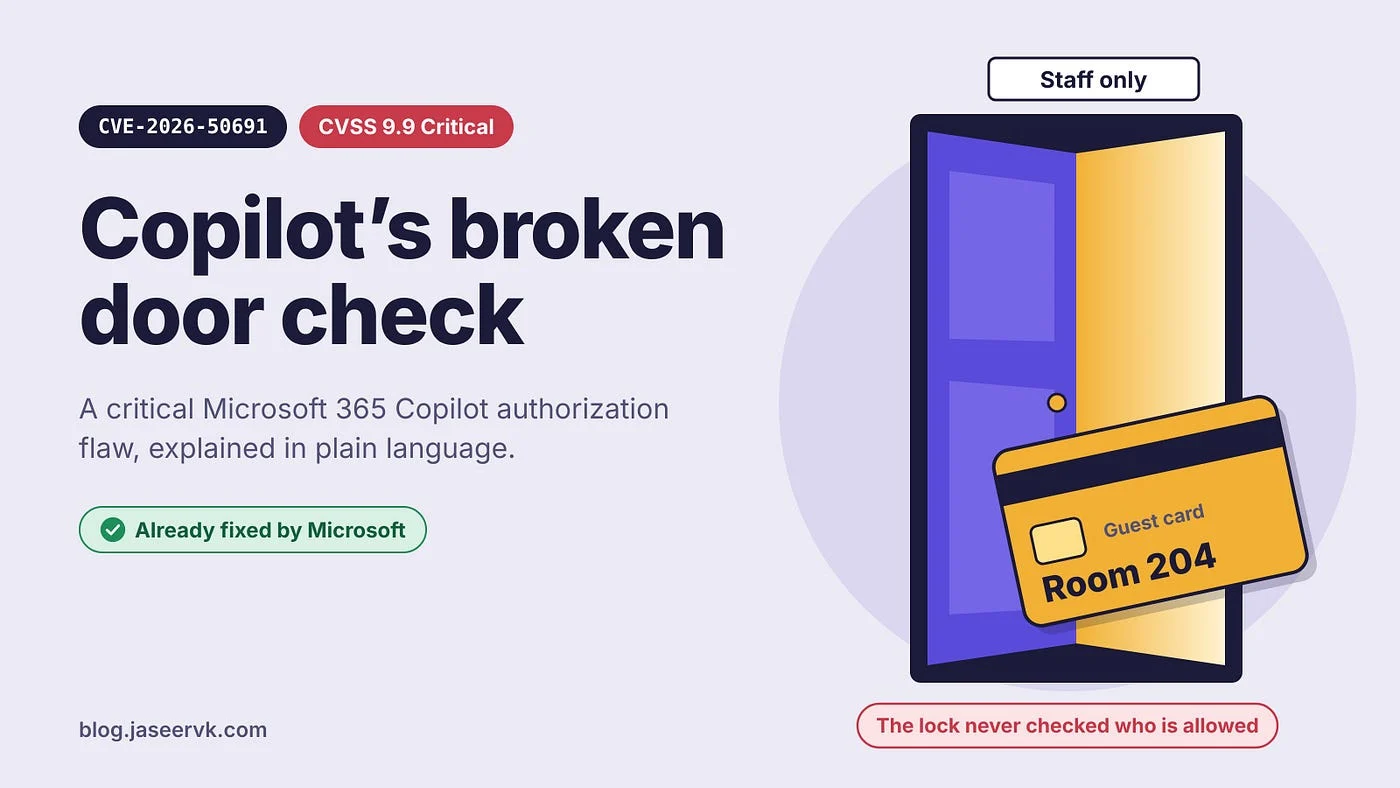
You check into a hotel and get a key card for room 204. On the way out, you tap it on room 205, and it opens.
The full write-up lives on its author's site
It belongs to its author, so we link to it rather than copy it. The other two tabs are our own rewrites, checked against it.
Context
CVE-2026-50691 is an improper authorization flaw (CWE-285) in Microsoft 365 Copilot, a cloud service. The bug class is elevation of privilege: a user who has authenticated successfully can reach data or actions that their role should not permit. Microsoft's advisory is dated 19 November 2026 and the CVE record was published on 23 November 2026. The CVSS 3.1 score is 9.9, Critical. Microsoft states the issue is fully mitigated and that no customer action is needed.
Copilot sits in front of mail, files and chats, so a single missing permission check in front of it can expose many data sources at once. The useful mental model is a hotel key card: the card is genuine and the holder really is a guest, but the lock never asks whether that guest is allowed into this particular room.
Setup
There is no lab, no account and no tooling to reproduce here. Microsoft's public description is a single line: improper authorization in M365 Copilot lets an authorized attacker elevate privileges over a network. No public exploit exists, no technical detail has been released, and exploit maturity is rated "unproven". The preconditions that follow from the CVSS vector are a normal, low-privilege account and network reachability of the service; nothing else is documented.
Because the product is an exclusively hosted service, there are no versions to check. NVD lists no version ranges, and the "all versions" label some sites display is a placeholder for a cloud service rather than a real range.
Finding it
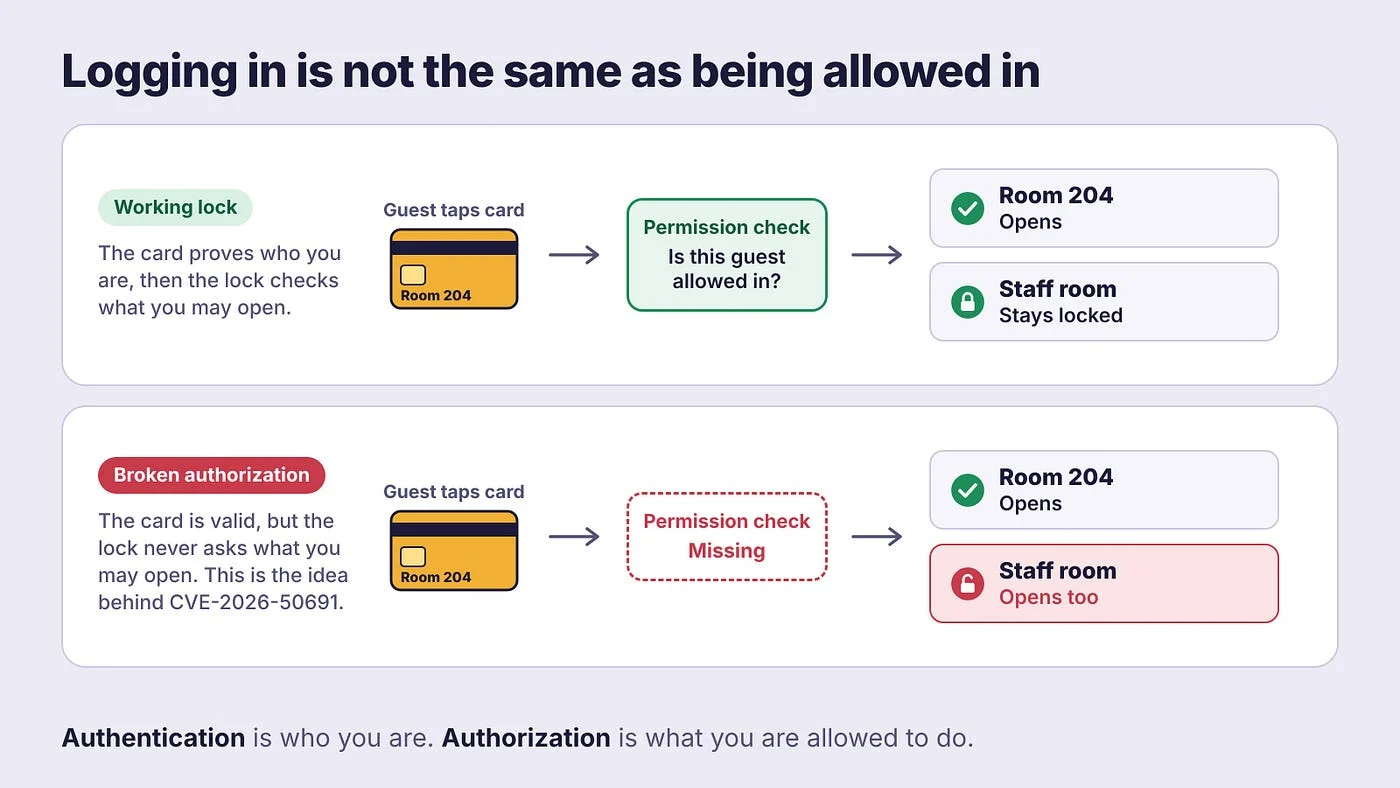
The distinction that matters is authentication versus authorization. Authentication answers who you are, through a password and MFA. Authorization answers what you are allowed to do. An intern who logs in and asks Copilot to show the salary sheet should be refused; with a broken authorization check, the request may succeed because the service established who the intern was but never verified what the intern could reach.
The report is explicit that the exploitation detail is not public. What follows is the general pattern for this bug class, not a confirmed exploit chain for this CVE.
Exploitation
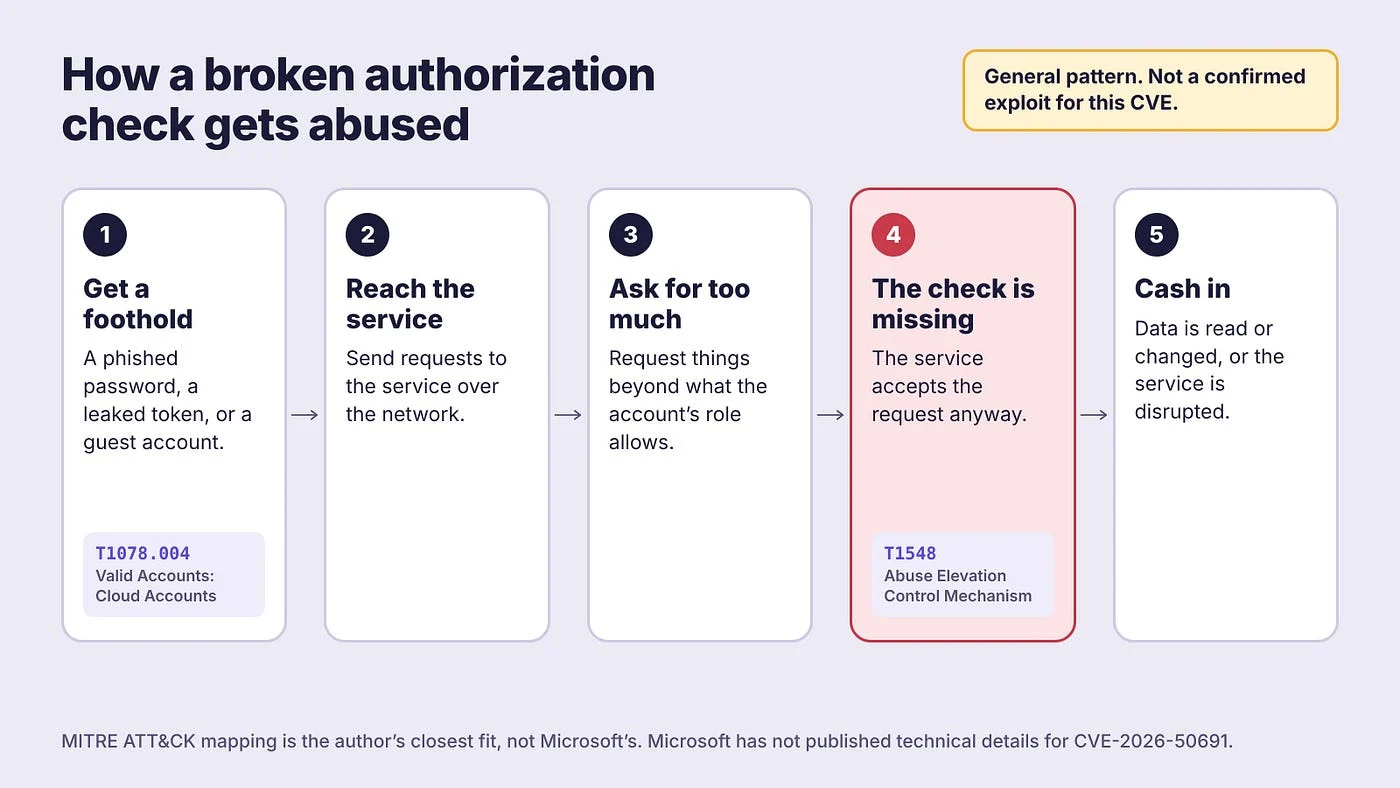
The general flow for improper authorization bugs looks like this:
Low-privilege account (phished, leaked, guest)
        ↓
Send requests to the service over the network
        ↓
Ask for things beyond that role
        ↓
Missing check → request is accepted
        ↓
Data read, changed, or service disrupted
Step 1: Get a foothold
Obtain a valid low-privilege identity: a phished password, a leaked token, or a contractor or guest account. This maps to MITRE ATT&CK T1078.004, Valid Accounts: Cloud Accounts.
Step 2: Push past the role
Send requests that the account should not be permitted to make. The CVSS vector says the attack is remote over the network, with low complexity and no user interaction, so no victim has to click a link or open a file.
Step 3: Use the missing check
The service accepts the request because the authorization check is absent or incomplete. This is the privilege escalation itself. The closest MITRE mapping is T1548, Abuse Elevation Control Mechanism, which is the author's mapping rather than Microsoft's.
Step 4: Cash in
Read data, modify it, or disrupt the service. A contractor holding a basic guest account asks Copilot for something restricted to HR, and the answer comes back. That is the failure mode an authorization bug permits.
Root cause
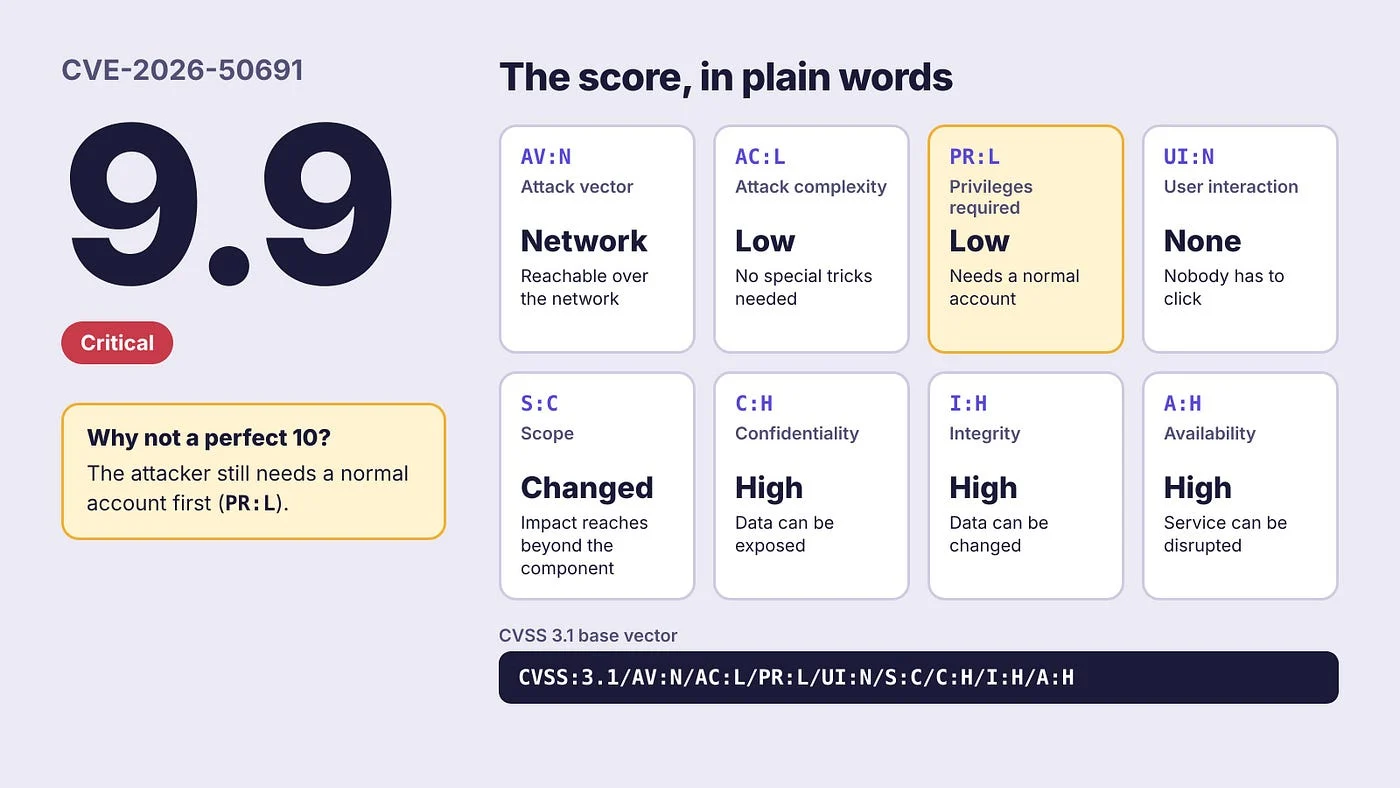
The public description is only that improper authorization lets an authorized attacker elevate privileges over a network; the specific defect is not public. Microsoft's one-line description says an authorized attacker can elevate privileges over a network; how the check fails is not public. The CVSS vector records Scope as Changed, meaning the impact extends beyond the security authority of the vulnerable component, and Confidentiality, Integrity and Availability are all High.
The score is 9.9 rather than 10 because the attacker needs a low-privilege account first. The report does not describe the specific code path or the check that failed, so the precise implementation mistake is not public.
Impact
An authorized attacker with a low-privilege account can elevate privileges over the network. Because the affected component fronts mail, files and chats, one broken check can open many data sources at once. The vector indicates sensitive information can be exposed, data or system resources can be modified, and the service can be significantly disrupted. Microsoft states the flaw was not exploited at publication and is not listed in CISA's KEV catalogue.
Fix
Microsoft fully mitigated the issue on its side, and no customer action is needed; the CVE exists for transparency. There is nothing to install. Headlines urging readers to "patch Copilot now" are wrong, and fake "patches" circulating around a trending CVE are a known lure.
Hardening that reduces exposure to this bug class, though not required for this CVE:
- Least privilege: grant only the access each person needs.
- Clean up oversharing: review SharePoint and OneDrive permissions, since a tool that works with what a user can reach is only as safe as those permissions.
- MFA and Conditional Access, especially for guest and contractor accounts.
- Review Copilot activity in Microsoft Purview audit logs for unusual volume or access outside a user's role.
- Hunt behaviour rather than CVE names; the bug is fixed and no indicators are public, so treat "CVE-specific" detection rules sold on that basis with suspicion.
Variants to test
- Guest and contractor accounts against Copilot prompts. Sign in with the lowest-privilege external identity available and ask for content owned by another department. A positive result is a substantive answer containing data the account cannot open directly in SharePoint or OneDrive.
- Role boundary probes. For each role in the tenant, request resources one tier above it. A positive result is any response that returns content or performs an action the role's permissions do not cover.
- Direct versus Copilot access comparison. Fetch the same document through its native interface and through Copilot. A positive result is Copilot returning content that the native interface refuses for the same identity.
- Audit log correlation. Compare Copilot activity in Purview against the user's role assignments. A positive result is access events outside the assigned role, or volume inconsistent with the user's normal behaviour.
Hunting notes
This bug class hides wherever a service aggregates content on a user's behalf: assistants, search layers and connectors that read mail, files and chats. During recon, the signals are products described as hosted services with no version ranges, advisories that reduce to a single line about improper authorization, and CVSS vectors with Scope Changed plus High across confidentiality, integrity and availability, which point to a permission boundary rather than a memory bug.
Impact in this case rests on the vector and on Microsoft's own description, since no exploit or technical detail is public. For a report of this kind, the credible evidence is the CVSS breakdown and the vendor's confirmation of mitigation, not a reproduction.
What happened, in plain words
Imagine you check into a hotel and get a key card for room 204. On your way out you tap the card on room 205, and that door opens. You tap it on the staff-only door, and that opens too. The card was real, you really were a guest, but the lock never asked the one question that matters: is this guest allowed in here?
That is the idea behind CVE-2026-50691, a critical flaw in Microsoft 365 Copilot. It has already been fixed, but it is a good free lesson in how cloud bugs work.
A few words before we start, because they come up constantly.
- A cloud service is software that runs on the vendor's computers, not yours. You reach it through a browser. There is no installer and no version number on your machine, which matters later.
- Microsoft 365 Copilot is Microsoft's assistant that sits on top of your work account. It sits in front of your mail, your files and your chats and answers questions about them. Think of it as a very well-informed colleague who has a key to every room in the building.
- A CVE is a public catalogue number for one specific security flaw. It is like a case number for a bug, so that vendors, news sites and tools can all refer to the same thing without confusion.
- Authorization is the check that decides what you are allowed to do once the system knows who you are. The whole story is about that check being missing.
Quick facts
| Item | Detail |
|---|---|
| CVE | CVE-2026-50691 |
| Product | Microsoft 365 Copilot, a cloud service |
| Bug type | Improper authorization (CWE-285), leading to elevation of privilege |
| Severity | CVSS 3.1 score of 9.9, Critical |
| Disclosed | Microsoft's advisory is dated 19 Nov 2026, the CVE record was published on 23 Nov 2026 |
| Exploited? | Not exploited at publication, and not listed in CISA's KEV catalogue |
| Fixed? | Yes, Microsoft fully mitigated it and no customer action is needed |
Two of those need unpacking.
CWE-285 is a label from a different catalogue, this one for categories of bug rather than individual bugs. CWE-285 means "improper authorization": the software does not correctly check whether the person asking is allowed to do the thing they are asking for.
CVSS is a scoring system for how bad a flaw is. It produces a number from 0 to 10 and a set of letters describing the conditions needed to abuse it. We will go through those letters in section 2.
CISA's KEV catalogue is a public list kept by the US cybersecurity agency of flaws that are known to be actively exploited in the real world. Not being on it means the agency has not listed it as actively exploited.
1. Login versus permission
Most people mix up two ideas:
- Authentication: who are you? This is your password, your MFA code, your fingerprint.
- Authorization: what are you allowed to do? This is the list of rooms your key card opens.
For example, an intern logs in and asks Copilot, "Show me the salary sheet." Copilot should say no. With broken authorization, it might say yes, because it knew who the intern was but never checked what the intern could access.
This is the single most useful distinction in security, so it is worth a second comparison. Authentication is the bouncer checking your ID at the door. Authorization is the usher checking your ticket to see which section you may sit in. A club can have a perfect bouncer and still let everyone wander into the VIP area if nobody checks tickets.
2. What do we actually know?
Not much, and that is worth saying openly. Microsoft's description is one line: improper authorization in M365 Copilot lets an authorized attacker elevate privileges over a network. There is no public exploit and no technical detail, and the exploit maturity is rated "unproven".
"Exploit maturity: unproven" is a formal way of saying nobody has published working attack code. "Elevate privileges" means moving from a low level of access to a higher one, like a guest key that suddenly opens the manager's office.
Here is the score broken down in simple words:
Attack Vector: Network → The vulnerability can be exploited remotely over a network.
Attack Complexity: Low → No special conditions or complicated techniques are required.
Privileges Required: Low → The attacker needs a normal user account with limited privileges.
User Interaction: None → No victim interaction, such as clicking a link or opening a file, is required.
Scope: Changed → The impact extends beyond the security authority of the vulnerable component.
Confidentiality: High → Sensitive information can be exposed.
Integrity: High → Data or system resources can be modified or manipulated.
Availability: High → The attacker can significantly disrupt or make the affected system unavailable.It scored 9.9 and not a perfect 10 because the attacker needs a low-privilege account first.
Line by line:
- Attack Vector: Network. The attacker does not need to sit at your desk or plug in a cable. They reach the service over the internet, the same way you do.
- Attack Complexity: Low. There is no lucky timing, no special configuration and no clever trick required. No special conditions or complicated techniques are required.
- Privileges Required: Low. The attacker must already have some kind of account, but only an ordinary one. Not an administrator.
- User Interaction: None. Nobody has to be tricked into clicking a link or opening a file. The attacker does not need a victim to do anything at all.
- Scope: Changed. The damage reaches beyond the component that has the bug. In plain terms, the flaw in one part of the system lets the attacker affect other parts.
- Confidentiality: High. Secrets can be read. Confidentiality is about keeping data private.
- Integrity: High. Data can be changed. Integrity is about data staying correct and unaltered.
- Availability: High. The service can be knocked offline or badly disrupted. Availability is about the service being there when people need it.
The last sentence explains the 9.9. A perfect 10 would mean an attacker with nothing at all can do maximum damage. Here they need a low-privilege account first, so the score stops just short.
3. Attack techniques (general pattern)
Microsoft has not published how this was exploited. The flow below is how improper authorization bugs in general are abused, not a confirmed exploit for this CVE.
That warning matters. What follows is the shape these bugs usually take, not a recipe for this specific one.
Low-privilege account (phished, leaked, guest)
        ↓
Send requests to the service over the network
        ↓
Ask for things beyond that role
        ↓
Missing check → request is accepted
        ↓
Data read, changed, or service disrupted
Reading the diagram from the top:
- Low-privilege account. The attacker starts with some ordinary account. "Phished" means obtained by tricking someone into handing over their password. "Leaked" means it turned up in a data breach elsewhere. "Guest" means an outside account, such as a contractor's, that was deliberately given limited access.
- Send requests to the service over the network. A request is simply a message your browser or program sends to a server asking it to do something, such as "give me this page" or "show me this file". A server is the computer on the other end that answers. You can send these messages by hand with a tool, not only by clicking in a browser.
- Ask for things beyond that role. The attacker asks for data or actions their account was never meant to have.
- Missing check, request accepted. The server should compare the request against the account's permissions and refuse. If that comparison is missing, the request goes through.
- Data read, changed, or service disrupted. The consequence: the three things the CVSS letters described, now actually happening.
Step 1: Get a foothold
A phished password, a leaked token, or a contractor or guest account. MITRE: T1078.004, Valid Accounts: Cloud Accounts.
A token here is a small piece of text that a service hands out after you log in, and that your browser sends back with every request to prove who you are. It works like a wristband at an event: you show it once at the gate, then it gets you into the rooms. If someone steals the wristband, they can walk in as you without ever knowing your password.
MITRE ATT&CK is a public catalogue of attacker techniques, the way CVE is a catalogue of bugs. T1078.004 is its entry for attackers logging in with real, valid cloud accounts instead of breaking in. Using a real account is quieter than exploiting software, because from the server's point of view nothing unusual happened.
Step 2: Push past the role
Send requests the account should not be allowed to make. The CVSS vector says the attack is remote over the network, with low complexity and no user interaction, so no victim has to click a link or open a file.
Why do this by hand rather than through the normal Copilot chat box? Because the chat box only offers the buttons the designers put there. Sending requests directly lets you ask for things the interface never shows you, which is exactly where a missing check hides.
Step 3: Use the missing check
This is privilege escalation. The closest MITRE fit is T1548, Abuse Elevation Control Mechanism. This is my mapping, not Microsoft's.
Privilege escalation means going from a lower level of access to a higher one. The attacker used a valid low-privilege account and asked for more than its role allowed. They simply asked for more than they should have, and the service did not say no.
Step 4: Cash in
Read data, change it, or disrupt the service.
For example, a contractor with a basic guest account asks Copilot for something HR-only, and the answer comes back. That is the kind of failure an authorization bug allows.
Why does this matter more for Copilot? It sits in front of mail, files, and chats. One broken check can open many "rooms" at once.
This is the hotel comparison again, and it is the heart of the whole article. A normal application guards one door. Copilot is a single assistant standing in front of many doors at once, so if its one check is broken, every door behind it is effectively unlocked.
4. Who is affected?
- Product: Microsoft 365 Copilot.
- Versions: There are none to check. The CVE is tagged as an exclusively hosted service, and NVD lists no version ranges. Some sites show "all versions," but that is only a placeholder for a cloud service.
- Your risk now: Microsoft says it has already been mitigated on its side.
NVD is the US government's public database of CVE details. When a flaw is in software you install, NVD lists which versions are affected, so you can check yours. A cloud service has no versions on your machine, because there is nothing installed. That is why "all versions" appears: it is filler text, not a real range.
5. Remediation
There is nothing to install. Microsoft says no action is needed for users of the service, and the CVE exists for transparency.
Be careful with headlines that say "patch Copilot now." They are wrong, and attackers love pushing fake "patches" when a big CVE trends.
A patch is an update that fixes a flaw. For a cloud service the vendor applies it on their own servers, so you never see it. The danger is that a scary headline makes people search for a fix, and criminals put up fake download pages promising exactly that. If a story says you must install something for a cloud service, treat it as a warning sign.
6. Mitigation (bonus hardening)
You don't need these for this CVE, but this bug class will come back:
- Least privilege: give people only the access they need.
- Clean up oversharing: review SharePoint and OneDrive permissions. A tool that works with what a user can reach is only as safe as those permissions.
- MFA and Conditional Access: especially for guest and contractor accounts.
- Watch the logs: review Copilot activity in Microsoft Purview audit logs. Look for unusual volume or access outside someone's role.
- Hunt behaviour, not CVE names: the bug is fixed and no indicators are public, so be wary of "CVE-specific" detection rules being sold.
Hardening means making a system harder to abuse in general, even when no specific bug is known. Each item in plain words:
- Least privilege is the principle of handing out the smallest key that still lets someone do their job. If the intern only needs the holiday calendar, do not give them the salary folder "just in case".
- SharePoint and OneDrive are Microsoft's file storage services. Oversharing is when a file is set to be visible to far more people than intended, often by accident. Copilot can only show what the permissions allow, so messy permissions become Copilot's problem too.
- MFA (multi-factor authentication) means logging in with something beyond a password, such as a code on your phone. Conditional Access is a rule that says, for example, "only allow this account to log in from our office network or with MFA". Both make a stolen password much less useful.
- Logs are automatic records of what happened. Microsoft Purview is Microsoft's tool for reading those records. Looking for unusual volume means noticing an account that suddenly reads far more than it normally does.
- Hunting behaviour means looking for suspicious patterns of activity rather than searching for the name of one specific bug. Since this bug is fixed and no technical indicators were published, anyone selling a detection rule named after this CVE is selling something they cannot have.
7. Variants to test
These are checks a defender can run in their own organisation to see whether the same class of mistake exists elsewhere. They are not instructions for attacking anyone.
- Guest and contractor accounts against Copilot prompts. Sign in with the lowest-privilege external identity available and ask for content owned by another department. A positive result is a substantive answer containing data the account cannot open directly in SharePoint or OneDrive.
- Role boundary probes. For each role in the tenant, request resources one tier above it. A positive result is any response that returns content or performs an action the role's permissions do not cover.
- Direct versus Copilot access comparison. Fetch the same document through its native interface and through Copilot. A positive result is Copilot returning content that the native interface refuses for the same identity.
- Audit log correlation. Compare Copilot activity in Purview against the user's role assignments. A positive result is access events outside the assigned role, or volume inconsistent with the user's normal behaviour.
A tenant is one organisation's own separate space inside a shared cloud service, with its own users and its own data. A role is a named bundle of permissions, such as "HR staff" or "contractor".
The third check is the cleverest and worth spelling out. You ask for the same document twice, once the ordinary way and once through Copilot. If the ordinary way says no and Copilot says yes, you have found a broken check without needing to know anything about the code.
8. Hunting notes
This bug class hides wherever a service aggregates content on a user's behalf: assistants, search layers and connectors that read mail, files and chats. During recon, the signals are products described as hosted services with no version ranges, advisories that reduce to a single line about improper authorization, and CVSS vectors with Scope Changed plus High across confidentiality, integrity and availability, which point to a permission boundary rather than a memory bug.
Recon is the early stage of security work where you gather information before testing anything. Aggregates content on a user's behalf means the service collects information from many places and presents it as one answer, which is exactly what an assistant does. A connector is a plugin that lets such a service reach another system, such as a mailbox or a file store.
A memory bug is a completely different family of flaw, where a program mishandles its own working memory and an attacker can corrupt it. The CVSS pattern here, Scope Changed with all three impact letters High, points away from that and towards a permission boundary: the software works fine, it just does not check who is asking.
Impact in this case rests on the vector and on Microsoft's own description, since no exploit or technical detail is public. For a report of this kind, the credible evidence is the CVSS breakdown and the vendor's confirmation of mitigation, not a reproduction.
Conclusion
CVE-2026-50691 is a reminder that logging in is not the same as being allowed in. A cloud service can have a critical bug, and the vendor can fix it without you doing anything. What stays with you is permissions: tidy access today so the next authorization bug has less to find.
Glossary
- Authentication: the process of proving who you are, usually with a password and a second factor such as a code on your phone.
- Authorization: the process of deciding what an identified user is allowed to see or do.
- Availability: whether a service is up and usable; a High availability impact means an attacker can seriously disrupt it.
- Cloud service: software that runs on the vendor's servers and is reached over the internet, with nothing installed on your machine.
- Conditional Access: a rule that allows or blocks a login based on conditions such as location, device or whether MFA was used.
- Confidentiality: whether data stays private; a High confidentiality impact means secrets can be read.
- Connector: a plugin that lets a service reach another system, such as a mailbox or file store.
- Copilot (Microsoft 365 Copilot): Microsoft's assistant that reads a work account's mail, files and chats and answers questions about them.
- CVE: a public catalogue number identifying one specific security flaw.
- CWE-285: the catalogue entry for the bug category "improper authorization", where permission checks are missing or wrong.
- CVSS: a scoring system that turns a flaw's conditions and impact into a number from 0 to 10 plus a set of descriptive letters.
- Elevation of privilege: moving from a lower level of access to a higher one that should not be available to you.
- Exploit: working code or a method that actually abuses a flaw.
- Exploit maturity: how ready and proven the available attack methods are; "unproven" means none has been published.
- Guest account: an account for someone outside the organisation, such as a contractor, deliberately given limited access.
- Hardening: general measures that make a system harder to abuse, even without a specific known bug.
- Integrity: whether data stays correct and unaltered; a High integrity impact means data can be changed.
- KEV catalogue: a public list of flaws known to be exploited in the real world, maintained by the US cybersecurity agency CISA.
- Least privilege: the principle of giving each person only the access their job requires.
- Logs: automatic records of what happened in a system, used to spot unusual activity.
- Memory bug: a flaw where a program mishandles its own working memory, a different family from permission bugs.
- MFA (multi-factor authentication): logging in with more than a password, such as a password plus a phone code.
- MITRE ATT&CK: a public catalogue of attacker techniques, referenced by identifiers such as T1078.004 and T1548.
- NVD: the US government's public database of CVE details, including affected versions where versions exist.
- Oversharing: when files are visible to far more people than intended, often by accident.
- Patch: an update that fixes a flaw; for a cloud service the vendor applies it on their own servers.
- Phishing: tricking someone into handing over credentials, usually through a fake login page or message.
- Privilege escalation: see elevation of privilege.
- Purview: Microsoft's tool for reviewing audit logs and activity records.
- Recon: the early information-gathering stage of security work, before any testing.
- Request: a message sent from a browser or program to a server asking it to do something.
- Role: a named bundle of permissions, such as "HR staff" or "contractor".
- Scope (Changed): a CVSS field meaning the impact reaches beyond the component that contains the bug.
- Server: the computer on the other end of a request that answers it.
- SharePoint / OneDrive: Microsoft's file storage services, where permissions decide who can open what.
- Tenant: one organisation's own separate space inside a shared cloud service, with its own users and data.
- Token: a piece of text issued after login that is sent with later requests to prove identity, like a wristband at an event.
- Unproven (exploit maturity): no working attack code has been published.
- Vector (CVSS vector): the set of letters describing the conditions and impact behind a CVSS score.

