CVE-2026-75854: How ArcadeDB’s Redis Wire-Protocol Plugin Skips Authentication and Hands You Every Database (9.8 Critical)
ArcadeDB's Redis wire-protocol plugin never implemented an authentication step, so any client that could reach the listener could run data commands against every database the server hosted. The permission gate also treated a missing user as 'allow', so nothing downstream stopped the unauthenticated connection.
 Published on medium.com
Xanlar Agamalizade
The full write-up lives on its author's site
It belongs to its author, so we link to it rather than copy it. The other two tabs are our own rewrites, checked against it.
Context: a multi-protocol database and its Redis adapter
ArcadeDB is a multi-model database that is deliberately multi-protocol. Rather than forcing clients into one proprietary dialect, it stands up several wire-protocol adapters side by side so existing clients can talk to it natively: an HTTP/REST API, a Postgres-compatible endpoint, a MongoDB-compatible endpoint, a Redis-compatible endpoint, Gremlin, and more. Each adapter is a plugin that terminates a TCP listener and turns that protocol's bytes into ArcadeDB operations.
From a security point of view that is not one attack surface but N attack surfaces converging on the same data plane. The question the author asks of each adapter is the same: between "bytes arrive on this socket" and "a command executes against a real database", where is the authentication state established, and what is it bound to? A protocol adapter is a small state machine, connected → authenticated → bound-to-database → executing, and the vulnerabilities live in the edges that can be skipped.
The finding is CVE-2026-75854, rated 9.8 Critical and fixed in ArcadeDB 26.8.1. The Redis wire-protocol plugin authenticates no one, ever. If it is listening, the database behind it is public.
Setup: what the audit needed
The method is mechanical: enumerate the adapters, and for each one find the transition into authenticated and prove that executing is unreachable without passing through it. The adapters are audited as a set, not one at a time, because when several components implement the same lifecycle, the one missing an edge stands out the moment you diff them.
For ArcadeDB's Postgres and Mongo adapters the transition is where you would expect it. For Redis, the author went looking for it and it is not there.
The one real precondition is that the Redis plugin has to be enabled. A given deployment may not turn this one on. The author states that plainly, but also that it is a config toggle, not a mitigating control: it decides whether the door exists, and does nothing to narrow what is behind the door once it does. There is no localhost-only default, no token, no allowlist, no "first run generates a password" bootstrap. Enabled means [redacted]:6379, open.
Finding it: a missing edge in a parallel implementation
Most authentication bypasses are a bug in a check: an inverted boolean, a !error guard in the wrong place, a token compared with ==. This one is a check that was never written, in one member of a set of parallel components where every other member wrote it.
The reason this adapter in particular broke is worth naming. Redis authentication is optional by design: vanilla Redis ships with no password, you opt in with requirepass, and only then does AUTH become mandatory. A whole generation of internet-wide compromises exists because operators left Redis on its default, no auth, bound to a routable interface.
A compatibility layer inherits the whole protocol contract, including the authentication semantics. During development the command semantics are what you notice missing, because a real redis-cli has to light up green; the auth semantics are what you notice missing during an incident. The handshake is invisible when you test locally with no password set, so it is exactly the part that quietly never gets built. The result faithfully reproduces Redis's commands and also its most infamous default, bolted onto a real multi-tenant database instead of a cache.
Exploitation
Step 1: connect without credentials
The proof of concept is short because "use the feature as designed" is the exploit:
$ redis-cli -h target -p 6379target:6379> SET k "owned"OKtarget:6379> GET k"owned"target:6379> HSET t field value(integer) 1target:6379> HGET t field"value"
No AUTH, no error, no privilege. The commands resolve against real databases and persist. The author confirmed this dynamically on the current build (commit 97a26fda…, 2026-07-17).
Step 2: prove the writes land in the real store
To rule out a Redis-only shim that the rest of the engine ignores, each write was cross-verified through ArcadeDB's authenticated HTTP API. The mutation was landing in the real, shared store.
Step 3: establish the reach
Read a key, overwrite it, delete it, across every database the server hosts. The Redis map is not scoped to a single tenant database; it reaches the server's databases by name.
Step 4: bound the impact honestly
With an unauthenticated Redis instance the reflexive next thought is remote code execution, via the classic chains: CONFIG SET dir plus dbfilename to drop an RDB into ~/.ssh/authorized_keys or a cron path, or SLAVEOF/replication plus MODULE LOAD to load a malicious module. The author checked whether those verbs exist here. They do not. This is a KV/hash compatibility subset, the data-plane verbs (GET/SET/HSET/HDEL/HGET and neighbours), not the administrative surface (CONFIG, SLAVEOF/REPLICAOF, MODULE, SAVE/BGSAVE with attacker-controlled paths) that the canonical Redis-to-RCE chains weaponise. Host RCE was therefore not claimed.
Root cause
Each adapter has a connection handler that owns the socket lifecycle. In ArcadeDB's security model, executing against a database requires a security context, a ServerSecurityUser resolved through server.getSecurity().authenticate(...), and that context authorises the connection to bind to a database and run commands. The Postgres and Mongo handlers establish it during their handshake, conceptually:
final ServerSecurityUser user = server.getSecurity().authenticate(username, password); bindConnectionToDatabase(user, databaseName);
The Redis handler, RedisNetworkExecutor, the class that owns a Redis connection, never establishes that context. Its lifecycle is, in effect:
final RedisCommand cmd = parseRESP(socket); final Database db = resolveDatabase(cmd); executeRedisCommand(cmd, db);
There is no AUTH verb wired into the command table, no call into server.getSecurity().authenticate(...), no point at which a credential is demanded, parsed or checked. The connected → authenticated edge does not exist in this state machine; the connection goes straight from connected to executing. git log on the module confirms this is not a regression: the handler has never implemented an authentication step since the plugin was added, and the only commit touching the file is an unrelated HA-cluster-status fix. It was born unauthenticated.
The second failure removes the safety net. ArcadeDB's security gate, when it evaluates permissions for an operation, has a path that treats a null user as "no restriction to apply" rather than "deny". The reasoning behind such code is always well-intentioned: "if there's no user, security must be disabled, so let it through." But user == null here does not mean security is off; it means this connection never authenticated, which is exactly the condition to reject. Because RedisNetworkExecutor never establishes a user, every operation it dispatches reaches that gate with user == null and is waved through. The one internal checkpoint that could have caught the missing handshake interprets "missing" as "fine".
Design-level root cause: impersonating a protocol whose authentication is optional by default, and inheriting that default onto a system where it must be mandatory, compounded by a security primitive that fails open on the null user it was always going to receive. The weaknesses are CWE-306 (Missing Authentication for Critical Function) as primary, with CWE-284 (Improper Access Control) as the contributing one for the fail-open gate.
Impact
The proven, complete impact is total compromise of the data plane:
- Confidentiality loss: unauthenticated reads of any key in any database, exfiltrating stored data.
- Integrity loss: overwriting or poisoning records that authenticated application logic then trusts.
- Availability loss: deleting data, or trivially filling or thrashing the store.
That is a full CIA breach of the database itself, bounded to ArcadeDB's security scope; it does not escape to the host.
The blast radius is worse than a lab test suggests. Port 6379 with something speaking RESP on it is, to the internet's scanning infrastructure, an open Redis. Shodan, masscan-driven botnets and commodity "open Redis" exploitation kits fingerprint and hit it automatically; they do not know or care that it is ArcadeDB's compatibility layer rather than real redis-server. They send AUTH-less commands, get OK, and proceed. An ArcadeDB deployment that enables the Redis plugin on a routable interface is in the standing crosshairs of untargeted, automated, internet-wide Redis abuse, and the default [redacted] bind puts it there the moment the plugin turns on.
The CVSS 3.1 vector is AV:N/AC:L/PR:N/UI:N/S:U/C:H/I:H/A:H, giving 9.8 Critical:
| Metric | Value | Reasoning |
|---|---|---|
| AV | N | Network listener; exploitation is remote over TCP/6379 |
| AC | L | No race, no special conditions, no ID to guess; connect and send commands |
| PR | N | No privileges, indeed no credentials at all, are required |
| UI | N | No victim interaction; a direct server-to-attacker exchange |
| S | U | Impact confined to ArcadeDB's security scope; it does not escape to the host |
| C / I / A | H / H / H | Unauthenticated read, write and delete across every database on the server |
The precondition of the plugin being enabled carries no CVSS reduction, because preconditions that gate existence are not the same as controls that gate access, and only the latter belong in AC/PR.
Fix
The fix mirrors the sibling adapters that got it right, in two moves, and 26.8.1 does both:
- Authenticate in the Redis handler before any command touches a database. Implement
AUTH(or bind credentials from the connection) and resolve them throughserver.getSecurity().authenticate(...); with no valid user, refuse every data command withNOAUTH. Makeauthenticateda mandatory edge, not an optional one. - Make the authorization gate fail closed.
user == nullat the permission check must mean reject, not allow. Fail-closed turns the next dropped handshake into an error instead of a breach, and retroactively contains any other adapter that forgets to set a user.
For operators: update to ArcadeDB 26.8.1. If you cannot immediately and the Redis plugin is enabled, treat 6379 as you would an open, passwordless Redis: get it off every untrusted network now, and check your exposure. An external redis-cli PING/GET that returns without AUTH is your answer. It will have been found by automated scanning far sooner than by anyone reading this.
Variants to test
- Audit parallel adapters comparatively. Any system exposing the same capability through several transports, adapters or protocol front-ends is one diff, not N independent reviews. A positive result is one adapter whose handler never calls the shared
authenticate(...)while its siblings do. - Walk each adapter's state machine. For every listener, find the transition into
authenticatedand try to reachexecutingwithout it. A positive result is a data command that succeeds with no credential ever presented. - Check the null-identity path in the authorization gate. Look for permission checks that treat a missing user as "security disabled". A positive result is an operation dispatched with
user == nullthat is allowed rather than denied. - Test compatibility layers for inherited defaults. Where a product emulates a protocol whose auth is optional (Redis, and similar), check whether the emulation inherited the optionality. A positive result is a stock client of that protocol performing reads and writes with no
AUTH. - Verify writes through a second, authenticated channel. Cross-check any unauthenticated mutation through the product's authenticated API. A positive result is the same value visible there, proving the write reached the real store rather than a shim.
- Enumerate the exposed verb set before claiming RCE. Check whether administrative verbs (
CONFIG,SLAVEOF/REPLICAOF,MODULE,SAVE/BGSAVE) exist. A positive result for those would extend impact beyond the data plane; their absence bounds the finding to confidentiality, integrity and availability of the database. - Check the default bind. Confirm whether enabling the plugin exposes it on
[redacted]with no generated credential. A positive result is a routable listener reachable without any bootstrap secret.
What happened, in plain words
Imagine a block of flats where every front door has a lock, except one. The building manager checked the locks on the main entrance, the side entrance and the back entrance, and all of them worked. Nobody ever checked the fire escape, because it was added later and it was never meant to be a way in. That fire escape is the story of CVE-2026-75854.
ArcadeDB is a database: a program that stores information for other programs to read and write. It is unusual because it can speak several different "languages" at once, so that many kinds of existing software can talk to it without being rewritten. One of those languages is the one used by Redis, a very popular fast storage program. The part of ArcadeDB that speaks Redis was added as a plugin, and it never asks anyone for a password. Not once, not ever. If that plugin is switched on and reachable from the network, anyone who can reach it can read, change and delete the data inside.
The problem was rated 9.8 out of 10, which is the "Critical" band, and it was fixed in ArcadeDB version 26.8.1. The person who found it, Xanlar Agamalizade, wrote it up as a bug and as a method: look at every way into a system side by side, and the one that is missing a step will stand out.
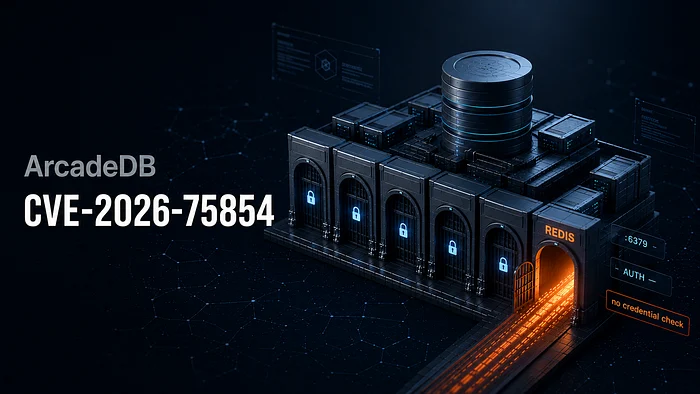
The image above is the article's title card, labelled CVE-2026-75854.
The product, and why it has many doors
Before the bug, you need a picture of what ArcadeDB is.
A database is software that stores data in an organised way and answers questions about it. When you log into a website and it shows your order history, a database is behind that. Programs do not usually read the database files directly; they talk to the database over a connection, sending requests and getting answers.
A protocol is an agreed set of rules for that conversation: who speaks first, what the messages look like, how errors are reported. Think of it as a language plus etiquette. Two programs can only talk if they both speak the same protocol.
ArcadeDB is multi-model, meaning it can store data in more than one shape (tables, graphs, documents), and deliberately multi-protocol: it does not force you to learn one private language. It puts up several adapters side by side, each one speaking a different well-known protocol, so that software written for other databases can connect to ArcadeDB as if nothing had changed. The adapters mentioned are:
- an HTTP/REST API, the same kind of web interface your browser uses;
- a Postgres-compatible endpoint, for software that expects the PostgreSQL database;
- a MongoDB-compatible endpoint, for software that expects MongoDB;
- a Redis-compatible endpoint, for software that expects Redis;
- Gremlin, a language for graph databases;
- and more.
An API (Application Programming Interface) is simply a defined menu of requests one program can make to another. When you use a website, your browser is calling the site's API behind the scenes. A REST API over HTTP is the most common kind: you send a web request to a URL and get data back.
Each adapter is a plugin: an optional extra piece of software that can be switched on. Each one opens a TCP listener. A TCP listener is a program waiting on a numbered door of the computer, called a port, for incoming connections. When a connection arrives, the adapter reads the raw bytes coming through that door, understands them according to its protocol, and turns them into operations on the database.
So from a security point of view, ArcadeDB is not one door. It is several doors, all opening into the same room full of data. That shared room is what the author calls the data plane: the part of the system where the actual reading and writing of data happens.
The question to ask of every door
The author's method starts with a single question, asked of each adapter:
Between "bytes arrive on this socket" and "a command executes against a real database", where is the authentication state established, and what is it bound to?
Unpacking that:
- Authentication is proving who you are, usually with a username and password. It is different from authorisation, which is deciding what a proven identity is allowed to do. Authentication is the bouncer checking your ID; authorisation is the list of which rooms your ticket lets you into.
- State here means remembered information about an ongoing connection. A connection is not a single message; it is a conversation that lasts a while, and the server has to remember things about it, such as "this person has already logged in".
- Bound to means attached to. The question is not only whether a login happened, but what that login is tied to: this particular connection, this particular database, this particular user.
A protocol adapter, the author says, is a small state machine. A state machine is a way of describing something that moves through a fixed set of stages, where each stage allows only certain moves to the next. The stages here are:
connected: a connection has been opened.authenticated: the caller has proved who they are.bound-to-database: the connection has been attached to a specific database.executing: commands are running against real data.
Vulnerabilities, the author notes, live in the edges you can skip: the moves between stages that ought to be compulsory but are not. If you can get from connected straight to executing, the login stage was decoration.
The finding is CVE-2026-75854. A CVE is a public catalogue number for a known security flaw, so that everyone in the world can refer to the same bug unambiguously. This one is rated 9.8 Critical and fixed in ArcadeDB 26.8.1. The Redis wire-protocol plugin authenticates no one, ever. If it is listening, the database behind it is public.
How the audit was set up
The method is deliberately mechanical, and that is why it works. You do not need inspiration; you need a checklist:
- List every adapter.
- For each one, find the move into the
authenticatedstage. - Prove that
executingcannot be reached without passing through it.
The crucial twist is that the adapters are audited as a set, not one at a time. When several pieces of software implement the same sequence of stages, the one that is missing a step stands out the moment you compare them. This is the same trick as proofreading several near-identical letters side by side: you stop reading each one on its own and start noticing what is present in three and absent in the fourth.
For ArcadeDB's Postgres and Mongo adapters, the move into authenticated is where you would expect it. For Redis, the author went looking for it and it is not there.
There is one real precondition, and the author states it plainly: the Redis plugin has to be enabled. A given installation may never switch this particular adapter on. But a precondition is not a protection. It decides whether the door exists; it does nothing to narrow what is behind the door once it does. There is no localhost-only default (a setting that would only accept connections from the same machine), no token, no allowlist (a list of permitted addresses), and no "first run generates a password" step. Enabled means [redacted]:6379, open. [redacted] is shorthand for "listen on every network address this machine has", and 6379 is the port number that Redis traditionally uses.
Why this particular adapter broke
Most authentication bypasses are a bug in a check: an inverted true/false, a guard placed in the wrong spot, a password compared with the wrong operator. This one is different. It is a check that was never written, in one member of a set of parallel components where every other member wrote it.
The reason this adapter in particular broke is worth naming, because it is the general lesson. Redis authentication is optional by design. Out of the box, Redis has no password at all. The operator has to opt in by setting a configuration directive called requirepass, and only then does the AUTH command become mandatory. AUTH is the Redis command for "here are my credentials".
This default has caused a whole generation of internet-wide compromises, because many operators left Redis as it shipped: no password, reachable from the network.
Now put yourself in the shoes of someone building a compatibility layer, software that pretends to be another product so that existing clients work unchanged. You focus, understandably, on fidelity: decode the protocol correctly, implement the commands, and format the replies so that a real redis-cli (Redis's command-line client) lights up green. The reference protocol's own attitude is "authentication is optional". So the login handshake, the part that is invisible when you test locally with no password set, is exactly the part that quietly never gets built.
The result faithfully reproduces Redis's commands, and also its most infamous default, except now bolted onto a real multi-user database instead of a throwaway cache. A cache is a fast, temporary store of data; losing it is annoying but usually not catastrophic. A database is the record of truth. The same missing password means very different things in those two places.
The bug, at the level where a fix has to live
Each adapter has a connection handler: the piece of code that owns a connection from the moment it opens to the moment it closes. In ArcadeDB's security model, running anything against a database requires a security context, a ServerSecurityUser object obtained by calling server.getSecurity().authenticate(...). That context is what authorises the connection to attach to a database and run commands.
The Postgres and Mongo handlers establish it during their handshake, conceptually like this:
final ServerSecurityUser user = server.getSecurity().authenticate(username, password); bindConnectionToDatabase(user, databaseName);
Line by line, in plain words:
final ServerSecurityUser user = ...creates a variable calleduserthat will hold the identity of whoever just logged in.finalmeans it will not be reassigned afterwards.ServerSecurityUseris the type of object that represents a logged-in user.server.getSecurity().authenticate(username, password)asks the server's security component to check the supplied username and password. If they are valid, it hands back a user object; if not, it fails.bindConnectionToDatabase(user, databaseName)then attaches that verified user to the named database, so that later commands run with a known identity and known permissions.
The Redis handler is a class called RedisNetworkExecutor, the code that owns a Redis connection. It never establishes that context. Its lifecycle is, in effect:
final RedisCommand cmd = parseRESP(socket); final Database db = resolveDatabase(cmd); executeRedisCommand(cmd, db);
Line by line:
final RedisCommand cmd = parseRESP(socket);reads the raw bytes arriving on the connection and turns them into a structured command object. RESP is the Redis Serialisation Protocol, the exact byte format Redis clients and servers use to exchange commands and replies.final Database db = resolveDatabase(cmd);works out which database the command is aimed at, by name.executeRedisCommand(cmd, db);runs the command against that database.
Notice what is missing between the first and the last line: any check of who is asking. There is no AUTH command wired into the command table, no call into server.getSecurity().authenticate(...), and no point at which a credential is demanded, parsed or checked. The connected → authenticated edge does not exist in this state machine. The connection goes straight from connected to executing.
The author also checked the history of the code with git log, the command that lists past changes to a project. It confirms this is not a regression, meaning a working feature that later broke. The handler has never implemented an authentication step since the plugin was added, and the only change ever made to the file was an unrelated fix about cluster status. It was born unauthenticated.
The second failure that removes the safety net
If the story stopped at "no AUTH command", you might still hope that some later permission check would refuse a connection with no user attached. It does not, and this is the part an experienced tester checks reflexively, because missing authentication and a permission check that fails open compound into something worse than either alone.
Fail open means that when something goes wrong, the system lets you through; fail closed means it stops you. A door that unlocks itself when the power fails is failing open. For security, you almost always want fail closed.
ArcadeDB's security gate, the code that evaluates whether an operation is permitted, has a path that treats a null user as "no restriction to apply" rather than "deny". A null user means there is no user object at all, nobody logged in. The reasoning behind such code is always well-intentioned: "if there is no user, security must be disabled, so let it through." But user == null here does not mean security is switched off. It means this connection never authenticated, which is exactly the condition you want to reject.
Because RedisNetworkExecutor never establishes a user, every operation it dispatches reaches that gate with user == null and is waved through. The one internal checkpoint that could have caught the missing handshake is written to interpret "missing" as "fine".
Exploitation, step by step
Step 1: connect without credentials
The proof of concept is short, because "use the feature as designed" is the exploit:
$ redis-cli -h target -p 6379target:6379> SET k "owned"OKtarget:6379> GET k"owned"target:6379> HSET t field value(integer) 1target:6379> HGET t field"value"
Line by line:
$ redis-cli -h target -p 6379starts the standard Redis command-line client, telling it to connect to the host calledtargeton port6379. The$is just the shell prompt, showing this is a command typed at a terminal.target:6379> SET k "owned"sends the Redis commandSET, which stores a value under a key. The key iskand the value isowned.OKis the server's reply: the write succeeded.target:6379> GET kasks for the value stored under keyk."owned"is the answer, proving the value was really stored.target:6379> HSET t field valuestores a value inside a hash, which is a Redis data structure like a small dictionary of field-and-value pairs. Here the hash is calledt, the field isfield, and the value isvalue.(integer) 1means one new field was added to the hash.target:6379> HGET t fieldreads that field back."value"is the stored value, returned as expected.
No AUTH, no error, no privilege. The commands resolve against real databases and persist, meaning the changes survive after the connection closes. The author confirmed this dynamically, by actually running it, on the current build at the time (commit 97a26fda…, dated 2026-07-17). A commit is a saved snapshot of code in a version-control system, identified by a long code.
Step 2: prove the writes land in the real store
A fair objection at this point: maybe the Redis adapter keeps its own little private copy of the data, and the rest of ArcadeDB ignores it. That would make the bug embarrassing but harmless. To rule out such a shim, a thin layer that pretends to be the real thing, each write was cross-checked through ArcadeDB's authenticated HTTP API. Each write was cross-checked through ArcadeDB's authenticated HTTP API, which proves the change landed in the real, shared store that the rest of the system uses.
This is a habit worth copying: when you claim a write happened, verify it through a second, independent channel.
Step 3: establish the reach
The tester could read a key, overwrite it, and delete it, across every database the server hosts. The Redis view is not limited to a single tenant's database; it reaches the server's databases by name. A tenant is one customer or team sharing a system with others; keeping their data apart is the whole point of multi-tenant design.
Step 4: bound the impact honestly
With an unauthenticated Redis instance, the reflex is to think of remote code execution, usually shortened to RCE: making the server run code of your choosing, which is far worse than reading its data. The classic Redis routes to RCE are well known:
CONFIG SET dirtogether withdbfilename, to make Redis write its data file into a sensitive location such as~/.ssh/authorized_keys(the file of public keys allowed to log in) or a scheduled-task path;SLAVEOFor replication together withMODULE LOAD, to make the server load a malicious module.
The author checked whether those commands exist in this adapter. They do not. This is a KV/hash compatibility subset: only the data commands such as GET, SET, HSET, HDEL, HGET and their neighbours, not the administrative commands (CONFIG, SLAVEOF/REPLICAOF, MODULE, SAVE/BGSAVE with attacker-chosen paths) that the classic chains rely on. KV stands for key-value, the simplest storage shape: a name and its value. Host RCE was therefore not claimed. Refusing to inflate a finding is part of doing the job properly.
Root cause
There are two causes, and they reinforce each other.
The first is design-level: impersonating a protocol whose authentication is optional by default, and inheriting that default onto a system where it must be mandatory. The second is the fail-open gate on the null user it was always going to receive.
The weaknesses are catalogued as CWE-306, Missing Authentication for Critical Function, as the primary one, with CWE-284, Improper Access Control, as the contributing one for the fail-open gate. A CWE is a catalogue of weakness types, the way CVE is a catalogue of individual bugs: CWE names the category, CVE names the instance.
Impact
The proven, complete impact is total compromise of the data plane. Security people summarise this with the CIA triad: Confidentiality (keeping data secret), Integrity (keeping data correct and untampered) and Availability (keeping data reachable). All three fall here:
- Confidentiality loss: unauthenticated reads of any key in any database, exfiltrating stored data. To exfiltrate means to copy data out to somewhere the attacker controls.
- Integrity loss: overwriting or poisoning records that authenticated application logic then trusts. If a legitimate program later reads a value the attacker planted, it will act on a lie.
- Availability loss: deleting data, or trivially filling or thrashing the store so that legitimate users cannot get their work done.
That is a full CIA breach of the database itself, bounded to ArcadeDB's security scope; it does not escape to the host machine.
The blast radius, meaning how many systems are affected and how easily, is worse than a lab test suggests. Port 6379 with something speaking RESP on it is, to the internet's scanning infrastructure, simply an open Redis. Shodan is a search engine for internet-connected devices; masscan is a tool for scanning huge address ranges very quickly; botnets are networks of compromised machines doing their owner's bidding. Commodity "open Redis" exploitation kits fingerprint and hit such services automatically. They do not know or care that this is ArcadeDB's compatibility layer rather than a real redis-server. They send commands without AUTH, get OK, and carry on. An ArcadeDB deployment that enables the Redis plugin on a routable interface, meaning one reachable from other networks, sits in the standing crosshairs of untargeted, automated, internet-wide Redis abuse. The default [redacted] bind puts it there the moment the plugin is switched on.
The severity score, explained
The CVSS 3.1 vector is AV:N/AC:L/PR:N/UI:N/S:U/C:H/I:H/A:H, giving 9.8 Critical. CVSS is the Common Vulnerability Scoring System, a standard way of turning a set of answers into a number from 0 to 10. The vector is just those answers written in shorthand.
| Metric | Value | Reasoning |
|---|---|---|
| AV | N | Network listener; exploitation is remote over TCP/6379 |
| AC | L | No race, no special conditions, no ID to guess; connect and send commands |
| PR | N | No privileges, indeed no credentials at all, are required |
| UI | N | No victim interaction; a direct server-to-attacker exchange |
| S | U | Impact confined to ArcadeDB's security scope; it does not escape to the host |
| C / I / A | H / H / H | Unauthenticated read, write and delete across every database on the server |
In plain words, the metrics are:
- AV, Attack Vector: how close the attacker must be.
Nfor Network means they can be anywhere the network reaches. - AC, Attack Complexity: how fiddly the attack is.
Lfor Low means no special timing, no lucky guesses. - PR, Privileges Required: what access you need first.
Nfor None means nothing at all. - UI, User Interaction: whether a victim has to click something.
Nfor None means no. - S, Scope: whether the damage stays inside the vulnerable component.
Ufor Unchanged means it stays within ArcadeDB. - C, I, A: the CIA triad again, each rated
Hfor High.
The precondition that the plugin must be enabled carries no reduction in the score, because preconditions that gate existence are not the same as controls that gate access, and only the latter belong in the complexity and privilege metrics.
The fix
The fix mirrors the sibling adapters that got it right, in two moves, and version 26.8.1 does both:
- Authenticate in the Redis handler before any command touches a database. Implement
AUTH(or bind credentials from the connection) and resolve them throughserver.getSecurity().authenticate(...); with no valid user, refuse every data command withNOAUTH. Makeauthenticateda mandatory edge, not an optional one.NOAUTHis the standard Redis error meaning "you must authenticate first". - Make the authorisation gate fail closed.
user == nullat the permission check must mean reject, not allow. Fail-closed turns the next dropped handshake into an error instead of a breach, and retroactively contains any other adapter that forgets to set a user.
For operators, meaning the people who run ArcadeDB installations: update to ArcadeDB 26.8.1. If you cannot do that immediately and the Redis plugin is enabled, treat port 6379 as you would an open, passwordless Redis: get it off every untrusted network now, and check your exposure. An external redis-cli PING or GET that returns without AUTH is your answer. It will have been found by automated scanning far sooner than by anyone reading this.
Variants to test
The author draws two principles out of the finding, each a thing to carry into other reviews.
- Audit parallel adapters comparatively. Any system exposing the same capability through several transports, adapters or protocol front-ends is one comparison, not several independent reviews. A positive result is one adapter whose handler never calls the shared
authenticate(...)while its siblings do. - Walk each adapter's state machine. For every listener, find the move into
authenticatedand try to reachexecutingwithout it. A positive result is a data command that succeeds with no credential ever presented. - Check the null-identity path in the authorisation gate. Look for permission checks that treat a missing user as "security disabled". A positive result is an operation dispatched with
user == nullthat is allowed rather than denied. - Test compatibility layers for inherited defaults. Where a product emulates a protocol whose authentication is optional, such as Redis, check whether the emulation inherited the optionality. A positive result is a stock client of that protocol performing reads and writes with no
AUTH. - Verify writes through a second, authenticated channel. Cross-check any unauthenticated change through the product's authenticated API. A positive result is the same value visible there, proving the write reached the real store rather than a shim.
- Enumerate the exposed command set before claiming RCE. Check whether administrative commands (
CONFIG,SLAVEOF/REPLICAOF,MODULE,SAVE/BGSAVE) exist. A positive result for those would extend impact beyond the data plane; their absence bounds the finding to confidentiality, integrity and availability of the database. - Check the default bind. Confirm whether enabling the plugin exposes it on
[redacted]with no generated credential. A positive result is a routable listener reachable without any bootstrap secret.
Glossary
- Adapter: a piece of software that lets one system speak another system's protocol, translating between the two.
- API (Application Programming Interface): a defined menu of requests one program can make to another.
- Authentication: proving who you are, usually with a username and password.
- Authorisation: deciding what a proven identity is allowed to do.
- Availability: keeping data reachable for legitimate users; the A in the CIA triad.
- Blast radius: how much damage an attack can do and how widely it spreads.
- Cache: a fast, temporary store of data that can be rebuilt if lost.
- CIA triad: Confidentiality, Integrity and Availability, the three things security tries to protect.
- Commit: a saved snapshot of code in a version-control system, identified by a long code.
- Compatibility layer: software that pretends to be another product so existing clients work unchanged.
- Confidentiality: keeping data secret from those not allowed to see it; the C in the CIA triad.
- Connection handler: the code that owns a connection from the moment it opens until it closes.
- CVE: a public catalogue number for a known security flaw, so everyone can refer to the same bug unambiguously.
- CWE: a catalogue of weakness types; CWE names the category, CVE names the individual instance.
- CVSS: the Common Vulnerability Scoring System, a standard way of turning a set of answers into a severity score from 0 to 10.
- Data plane: the part of a system where actual data is read and written, as opposed to the control or administrative parts.
- Database: software that stores data in an organised way and answers questions about it.
- Exfiltrate: to copy data out to somewhere the attacker controls.
- Fail closed: when something goes wrong, the system stops you.
- Fail open: when something goes wrong, the system lets you through.
- Hash: a data structure like a small dictionary of field-and-value pairs; also a Redis data type.
- Integrity: keeping data correct and untampered; the I in the CIA triad.
- KV (key-value): the simplest storage shape, a name and its value.
- Multi-model: able to store data in more than one shape, such as tables, graphs and documents.
- Multi-protocol: able to speak several different network protocols so different clients can connect natively.
- Multi-tenant: shared by several customers or teams whose data must be kept apart.
- Null user: the absence of any user object, meaning nobody is logged in.
- Plugin: an optional extra piece of software that can be switched on.
- Port: a numbered door on a computer where a program waits for incoming connections.
- Protocol: an agreed set of rules for a conversation between programs.
- RCE (remote code execution): making a server run code of the attacker's choosing.
- Regression: a feature that used to work and later broke.
- RESP (Redis Serialisation Protocol): the exact byte format Redis clients and servers use to exchange commands and replies.
- REST API: a common style of web API where you send HTTP requests to URLs and get data back.
- Security context: the stored identity and permissions attached to a connection, used to decide what it may do.
- Shim: a thin layer that pretends to be the real thing.
- State machine: a way of describing something that moves through a fixed set of stages, where each stage allows only certain moves to the next.
- TCP listener: a program waiting on a port for incoming network connections.
- Tenant: one customer or team sharing a system with others.
- Vector (CVSS): the shorthand string of metric values that produces a CVSS score.

