Finding Hidden Login Endpoint Exposing Secret Client ID
A hidden login endpoint exposed a client_id value that was meant to be secret, and using that value the hunter found multiple exposed tokens. The attacker could access the login form and potentially use the exposed secrets to gain unauthorised access.
 Published on ahmdhalabi.medium.com
My name is Ahmad Halabi, Founder & CTO at Cybit Sec and part time bug bounty hunter on Hackerone.
The full write-up lives on its author's site
It belongs to its author, so we link to it rather than copy it. The other two tabs are our own rewrites, checked against it.
Context
This is a write-up of an information disclosure finding in a private program on HackerOne, submitted by Ahmad Halabi, founder and CTO at Cybit Sec. The affected asset is an accounts subdomain, accounts.redacted.com, which hosts a login page under a path ending in /login. The hostname and path segments are redacted in the published report.
Normally that login page should present a login form to the user. In this case, visiting it directly produced no form at all, only an error message. The report describes the finding as an information disclosure bug that started at low severity and was later chained into something the researcher calls high severity, because the exposed value turned out to be a secret client_id that the internal team did not consider publicly discoverable.
Setup
No special accounts, roles or tooling are described. The researcher worked against a private HackerOne program and used ordinary reconnaissance: browsing the subdomain and Google dorking. The login page was reachable but returned an error without a client_id.
Finding it
The researcher came across the following URL:
https://accounts.redacted.com/redacted/login
Opening it did not show a login form. Instead the page returned an error stating:
No client id found
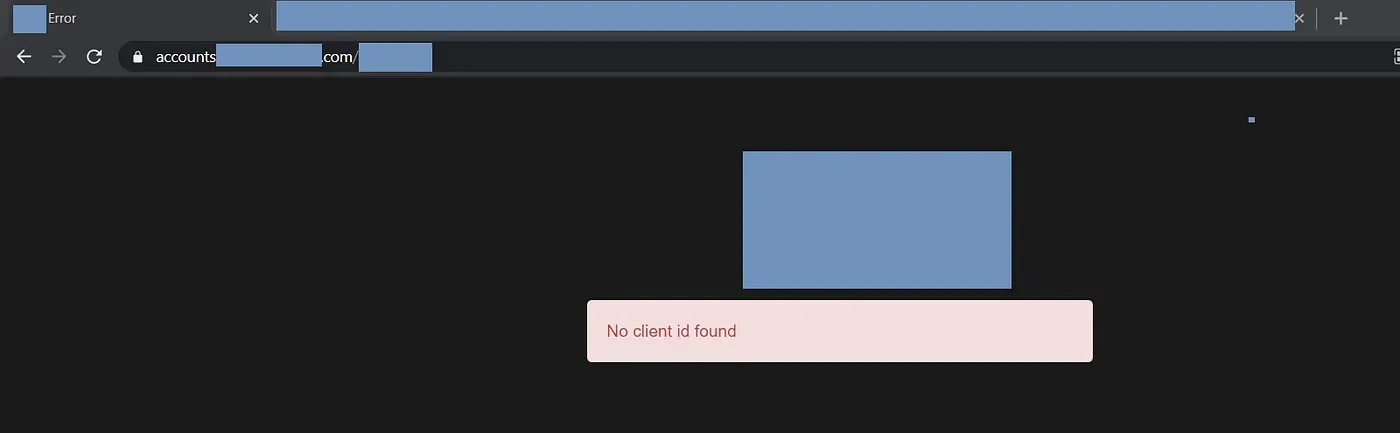
The screenshot shows the login page with no form and the No client id found error. That error is the whole lead: the application is telling the visitor that it expects a parameter called client_id (or clientid) before it will render anything. A page that refuses to work without an identifier is a page that was built for a specific client, not for anonymous visitors.
After some recon, the researcher found the login endpoint with a client id value in the URL, in this shape:
https://accounts.redacted.com/redacted/redacted?client_id=hashvalue
At that point a low severity bug was identified in the target URL and reported.
Exploitation
Step 1: read the error as a parameter hint
The error No client id found implies a parameter named client_id or clientid. That is the assumption the rest of the recon is built on.
Step 2: search for the parameter with a Google dork
The researcher used a simple Google dork to find pages on the host that carry the parameter:
site:accounts.redacted.com inurl:client_id
This restricts results to the accounts subdomain and to URLs containing client_id in the query string. The researcher used a Google dork to surface the endpoint.
Step 3: recover the endpoint and the client_id value
The dork returned the login endpoint together with a client_id value:
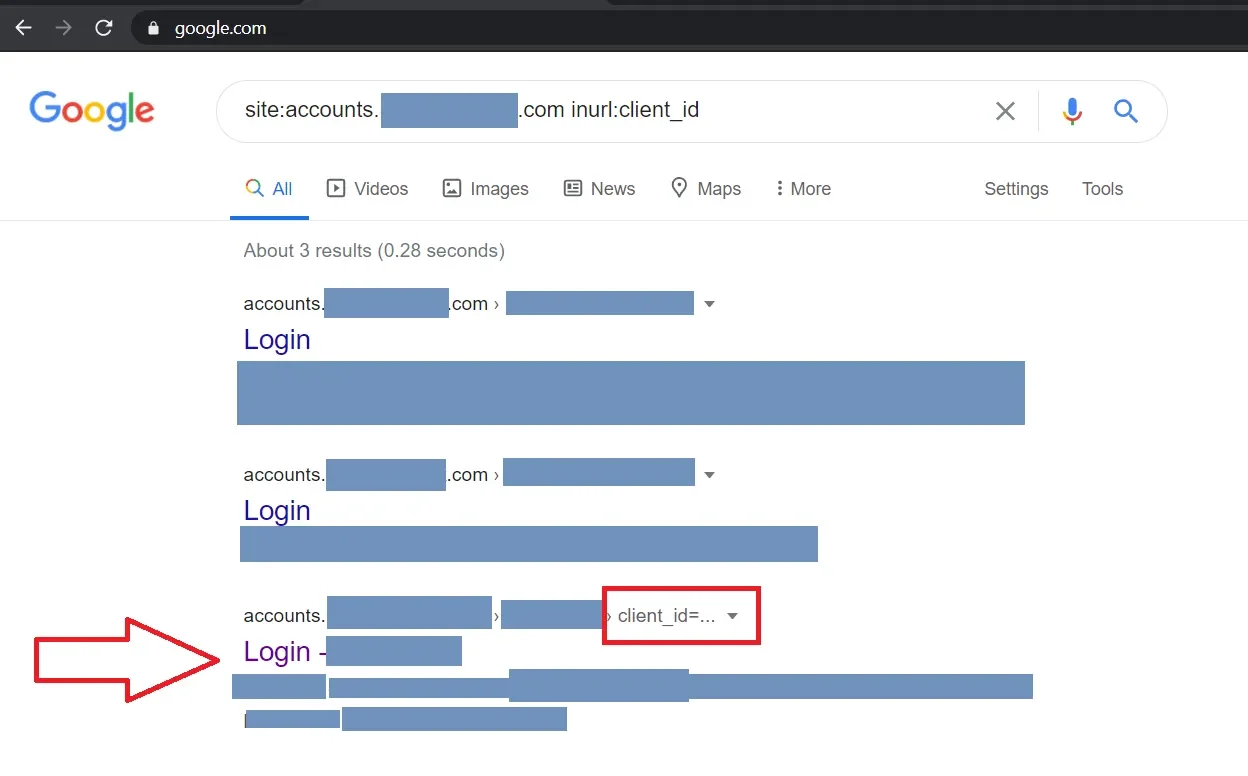
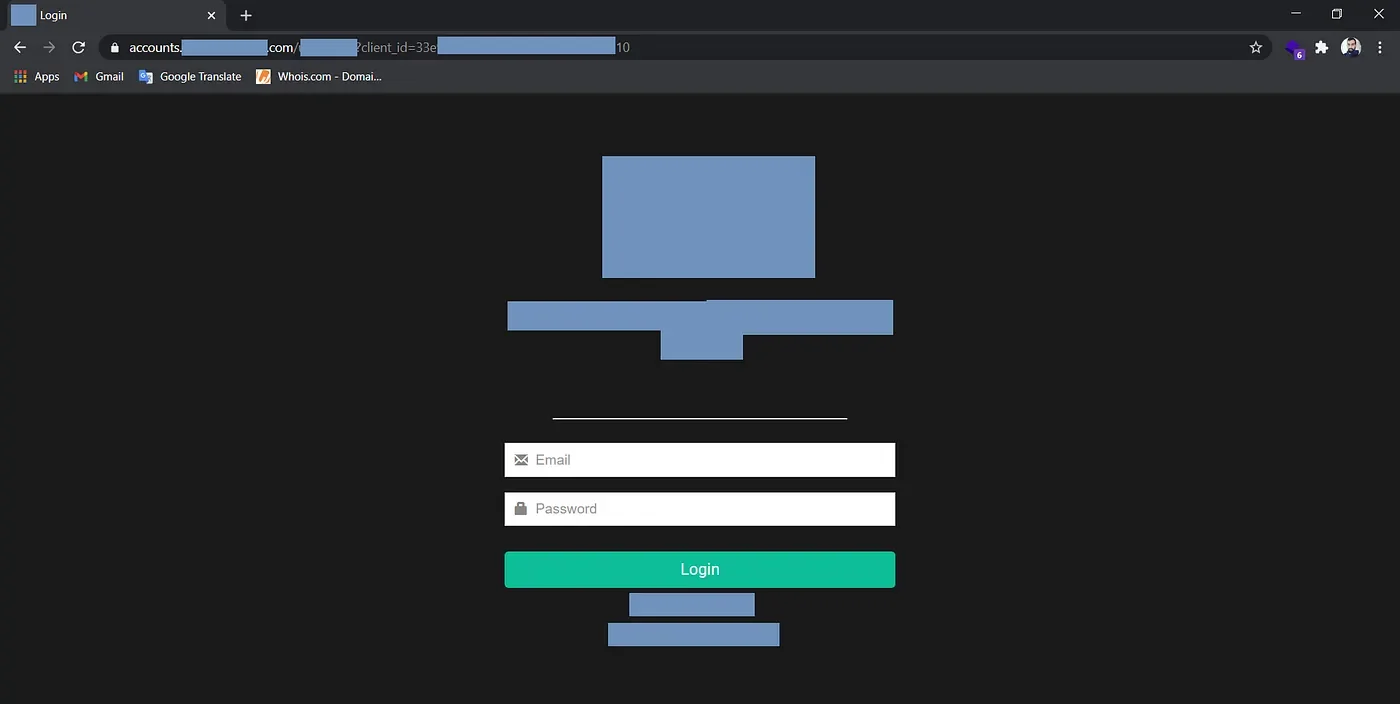
The screenshots show the dork results and the recovered URL with the client_id value. The point is that a client_id value was sitting in an indexed URL.
Step 4: chain the value with the earlier bug
With the client_id in hand, the researcher chained the previously reported low severity bug with this value. Doing so exposed multiple tokens that appeared to be secret as well. All of them were reported in the same report.
Timeline
The report gives the following dates:
| Date | Event |
|---|---|
| Feb 16, 2021 | Initial report submitted |
| Feb 18, 2021 | HackerOne triage team triaged the report |
| Feb 24, 2021 | Internal team reviewing the report and investigating the issue |
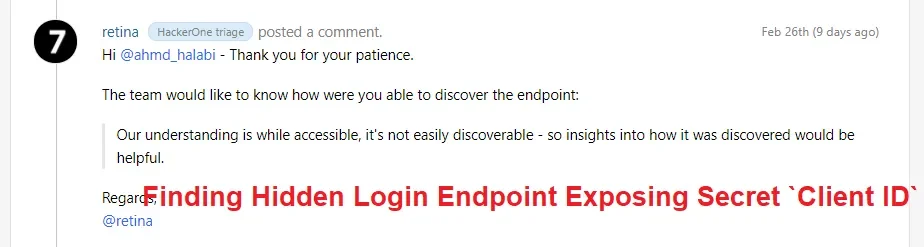
| Feb 26, 2021 | Internal team asked how the endpoint was discovered |
| Feb 26, 2021 | Researcher's methodology comment forwarded to the internal team |
| Mar 3, 2021 | Bounty awarded (700 USD) |
The triage team's comment was:
Our understanding is while accessible, it's not easily discoverable, so insights into how it was discovered would be helpful.
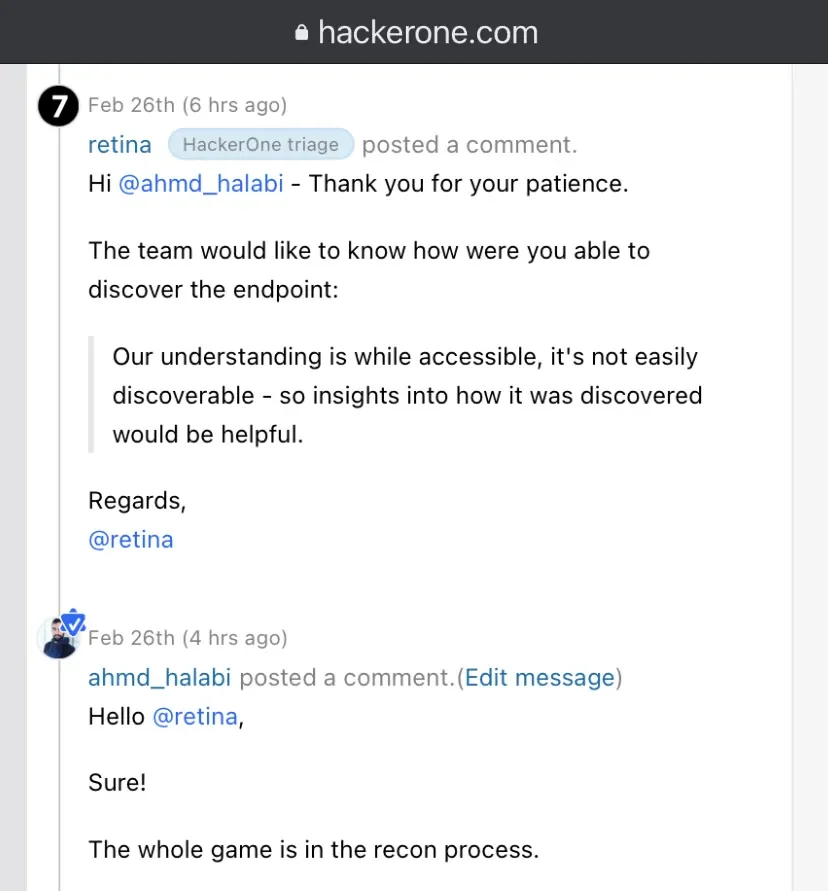
That comment is what changed the researcher's view of the finding. The internal team's phrasing told him the client_id was a secret value that should not be exposed to the public, since the login form is not meant for public users. The researcher's reply to the team was that the whole game is in the recon process, followed by the numbered methodology above.
Root cause
The login page is built to serve a specific client and requires a client_id to render. Without it, the page fails with No client id found. The identifier was treated by the internal team as a secret, but the URL carrying it was reachable and could be recovered with a Google dork. The report does not describe the server-side code, so the exact mistake (for example, whether the value was embedded in a link that got crawled, or whether the endpoint was simply left unauthenticated) is not stated. The page was not meant for public users, and the URL carrying the client_id could be found through a search engine.
Impact
An attacker who recovers the client_id can reach the hidden login form that is not meant for public users. In this case, chaining the value with the earlier low severity bug exposed multiple tokens that appeared to be secret. The report does not enumerate those tokens or describe what they grant, so the full blast radius is not stated. The severity depends on what the hidden login form and the exposed tokens allow, which the report leaves open.
Fix
Based on the finding, the value should not be reachable from public, crawlable URLs, and the hidden login endpoint should not be discoverable by search engines.
Variants to test
- Error messages that name a parameter. Visit login and authentication pages directly and look for errors such as
No client id found. A positive result is an error that names a parameter the page expects. - Dork for the named parameter. Run a search restricted to the target host and to the parameter in the URL, for example
site:accounts.example.com inurl:client_id. A positive result is an indexed URL that carries a real value. - Dork for related parameter names. Try
clientid,client_secret,redirect_uriand similar names ininurl:. A positive result is any indexed URL that leaks an identifier or secret. - Chain the recovered value with other findings. Use the recovered identifier against endpoints you already know are weak. A positive result is additional tokens or data that were not reachable before.
- Watch internal team comments. When a triager or internal team asks how you found something, treat that as a signal that the value is considered secret. A positive result is a severity increase after you explain the discovery path.

The final image is the closing section of the article, where the researcher promotes Cybit Sec's social media profiles.
What happened, in plain words
A security researcher was looking around a company's website. He found a page that looked like it should show a login form, but instead it showed an error message. That error message mentioned a name the page was looking for: client_id. He used Google to search for that name on the company's site, found a web address that contained a real value for it, and reported the problem. At first the company treated it as a small issue. Then they asked him how he had found the page, because they believed it was hard to discover. His answer showed that the value was meant to be secret, and the small issue turned into a bigger one. He was paid 700 USD.
This article walks through the whole story slowly, for someone who has never done security work before. You only need a browser and a computer to follow along.
Some words you will meet first
Before the story, a few ideas. Each one is explained from zero.
- Subdomain: a website's main address can have smaller addresses in front of it. If the main site is
example.com, thenaccounts.example.comis a subdomain. Think of a big building with a main entrance and a side door marked "accounts". The side door can lead to a different room with different rules. - Login form: the boxes on a page where you type your username and password and press a button. Without a form, there is nothing to type into.
- Endpoint: a specific address on a server that does one job. If a website is a building, an endpoint is a particular counter inside it, such as "the counter where you hand in your password".
- Parameter: extra information added to the end of a web address, after a question mark. In
https://example.com/page?colour=blue, the parameter is calledcolourand its value isblue. Parameters tell the page what you want. client_id: a name that some login systems use to identify which application or customer is asking for a login. Think of a hotel reception that will only hand you a key if you say which company booked the room. Theclient_idis the name of the company.- Token: a short piece of text that acts like a temporary key or ticket. If you have the token, the system treats you as allowed. Tokens are often secret, because anyone holding one can use it.
- Information disclosure: a security weakness where something that should be private is shown to people who should not see it. It is not about breaking in; it is about the system telling you something it should have kept quiet.
- Reconnaissance (recon): the information-gathering phase. Before trying anything, you look around: what pages exist, what they say, what they expect. Like walking around a building reading the signs before you open any doors.
- Google dork: a search on Google that uses special words to narrow results very precisely. For example,
site:limits results to one website, andinurl:limits results to addresses containing a certain word. It is just Google, used with more care. - Severity: how serious a security problem is judged to be. Low severity means limited harm; high severity means serious harm. The same finding can be judged differently depending on what it exposes.
- Triage: the first check a security team does on a report, to confirm it is real and decide how to handle it.
- Bounty: money paid to a researcher for reporting a valid security problem.
The starting point
The researcher was working on a private program on HackerOne. A private program is a company that invites selected researchers to test its systems and report problems, usually in exchange for a bounty. The company's name is hidden in the published report, and parts of the web addresses are replaced with the word redacted.
The address he came across was:
https://accounts.redacted.com/redacted/login
Reading it piece by piece: https:// means a secure web connection. accounts.redacted.com is the subdomain, the side door for account-related pages. /redacted/login is the path, the particular page inside that side door. The word login at the end suggests this page is where you sign in.
When he opened that address, something odd happened. There was no login form at all. Instead the page showed an error:
No client id found
The screenshot shows the page with no form and that error message. This is the key moment of the whole story. A normal login page shows boxes for a username and password. This one refused to show anything and told the visitor what it was missing: a client_id. The page is effectively saying, "I cannot work until you tell me which client you are." That means the page was built for a specific customer or application, not for the general public.
Why does that matter? Because a page that is not meant for the public is a page the public should not be able to reach. The error message itself is a small hint, like a locked door with a note saying "ask for the key at reception". The note tells you a key exists and what it is called.
Finding the hidden login address
After some more looking around, the researcher found the actual login endpoint, with a client id value in the address, in this shape:
https://accounts.redacted.com/redacted/redacted?client_id=hashvalue
Here the address has a question mark and then client_id=hashvalue. The part before the question mark is the page; the part after it is the parameter being handed to the page. hashvalue is a stand-in for a long string of characters that identifies the client.
At this point he had found a low severity bug in that address and reported it. Low severity means the team judged the immediate harm to be small. The story does not end there.
How the small bug became a big one
The report gives a timeline. Dates matter here because they show how the conversation with the company unfolded.
| Date | What happened |
|---|---|
| Feb 16, 2021 | The initial report was submitted |
| Feb 18, 2021 | The HackerOne triage team confirmed and categorised the report |
| Feb 24, 2021 | The company's internal team began reviewing and investigating |
| Feb 26, 2021 | The internal team asked how the endpoint had been discovered |
| Feb 26, 2021 | The researcher's explanation was passed on to the internal team |
| Mar 3, 2021 | A bounty of 700 USD was awarded |
The question from the triage team was:
Our understanding is while accessible, it's not easily discoverable, so insights into how it was discovered would be helpful.
Read that sentence carefully. The team is saying: yes, the page can be reached, but we did not think anyone would find it. They are asking for the method. For the researcher, this was the turning point. If the company believed the page was hard to find, then the client_id was probably meant to stay private. A value that is meant to stay private, but can be found, is a secret that has leaked.
The method, step by step
The researcher replied that the whole game is in the recon process, and then gave his method as a numbered list. Here it is, with the reasoning behind each step.
Step 1: read the error message as a clue
- If you navigate to
https://accounts.redacted.com/redacted/loginyou will get an error message statingNo client id found.
Why this step: the error message is free information from the server. It names the thing the page wants. Most people would close the tab; a researcher writes down the name.
Step 2: guess the parameter name
- From the above error I resulted that there should be a parameter named
client_idorclientid.
Why this step: the error said "client id" with a space. In web addresses, spaces are not allowed, so the real name is likely written with an underscore (client_id) or with no separator (clientid). This is a small deduction, but it gives you something concrete to search for.
Step 3: search Google for that parameter on the site
- Simple Google Dorking:
site:accounts.redacted.com inurl:client_id.
Why this step: the hidden login page is not linked from the public pages, so you cannot click your way to it. But search engines crawl the web and remember addresses. If the address was ever public, Google may have it. The dork has two parts:
site:accounts.redacted.comtells Google to return only results from that subdomain.inurl:client_idtells Google to return only addresses that containclient_idsomewhere in the URL.
Together they ask: "show me pages on this subdomain whose address contains client_id". That is a very narrow question, and narrow questions get useful answers.
Step 4: take the value from the result
- Found the login endpoint and the client_id value:
https://accounts.redacted.com/redacted/redacted/redacted?client_id=[redacted]
The screenshots show the search results and the recovered address with the client_id value. The point is not the exact characters but that a client_id value was sitting in an indexed address. The point is that a real identifier was sitting in an address that a search engine had indexed. Anyone who ran the same search could read it.
Step 5: combine the value with the earlier finding
With the client_id in hand, the researcher went back to the low severity bug he had already reported and used the value with it. Doing so exposed several tokens that also looked secret. He reported all of them in the same report.
Why this step: a single leaked value is often not the end. It is a key. The question is which doors it opens. By combining the new value with the earlier weakness, he could reach things that were not reachable before. That is what turned a low severity finding into something the company treated far more seriously.
Why the page behaved this way
The login page is built to serve one specific client and needs a client_id before it will draw the form. Without it, the page stops and shows No client id found. The company treated that identifier as a secret, but the address carrying it was reachable and a simple Google dork could recover it.
The report does not describe the server-side code, so the exact mistake is not stated. It may be that the value was placed in a link that got crawled, or that the endpoint was simply left open. What is clear is that the page could be found with a Google dork.
What someone could do with it
Someone who recovers the client_id can reach the hidden login form that was not meant for the public. In this case, combining the value with the earlier low severity bug exposed several tokens that appeared to be secret. The report does not list those tokens or say what they allow, so the full extent of the harm is not stated. How serious the issue is depends on what the hidden form and the exposed tokens let a person do.
What the fix would look like
The report does not say what the company changed. From the finding itself, the value should not be reachable from public addresses that search engines can crawl, and the hidden login endpoint should not be discoverable through search.
Things you can try yourself
These are the same ideas, written for someone starting out. Each one says what to look for.
- Error messages that name a parameter. Open login and account pages directly and read the errors. A useful result is an error that names something the page expects, such as
No client id found. - Search for the named parameter. Run a search limited to the site and to the parameter in the address, for example
site:accounts.example.com inurl:client_id. A useful result is an indexed address that carries a real value. - Try related names. Search for
clientid,client_secret,redirect_uriand similar names withinurl:. A useful result is any indexed address that leaks an identifier or a secret. - Combine what you find. Use a recovered identifier against places you already know are weak. A useful result is extra tokens or data that were not reachable before.
- Listen to the team's questions. When a triager or internal team asks how you found something, that is a signal the value is considered secret. A useful result is a higher severity once you explain your path.
The last image is the closing part of the article, where the researcher asks readers to follow his company Cybit Sec on social media.
Glossary
client_id: an identifier that tells a login system which application or customer is asking; often treated as a secret.- Endpoint: a specific address on a server that performs one job.
- Google dork: a Google search using special operators such as
site:andinurl:to narrow results precisely. - Information disclosure: a weakness where something meant to be private is shown to people who should not see it.
inurl:: a Google search operator that returns only addresses containing a given word.- Login form: the boxes on a page where you type a username and password and press a button.
- Parameter: extra information added to a web address after a question mark, in the form
name=value. - Private program: a company on a bug bounty platform that invites selected researchers to test its systems.
- Reconnaissance (recon): the information-gathering phase before attempting anything, such as reading pages and errors.
- Severity: how serious a security problem is judged to be, from low to high.
site:: a Google search operator that limits results to one website or subdomain.- Subdomain: a smaller address in front of a main domain, such as
accounts.example.comunderexample.com. - Token: a short piece of text that acts like a temporary key or ticket, often secret.





