Güvenlik Ürünü Kendini Koruyamazsa: Endpoint Central Ajanı ile Sorumlu İfşa Hikâyem
The Endpoint Central agent could be fully removed through changes to its MSI and registry components even when Self-Defense and Uninstall Password Protection were enabled. An attacker with local administrator rights could therefore strip the agent and with it the patching, application control, device control and browser policies it enforced.
 Published on medium.com
Cybersecurity
The full write-up lives on its author's site
It belongs to its author, so we link to it rather than copy it. The other two tabs are our own rewrites, checked against it.
Context
ManageEngine Endpoint Central is a unified endpoint management product. Its agent runs on managed machines and is the delivery channel for patch management, application control, device control and browser policies. The value of the agent depends on it staying installed and running: if the agent disappears, everything enforced through it disappears with it.
The product ships two features meant to prevent exactly that: Self-Defence and Uninstall Password Protection. The promise is that the agent cannot be removed. The finding in this write-up is that, on the tested version, that promise did not hold.
Setup
The testing was done against Endpoint Central Agent v11.4.2516.37.W. The precondition for the finding is that both Self-Defence and Uninstall Password Protection were active on the agent at the time of testing. The researcher does not publish the technical steps, because the issue is fixed in current versions but environments may still be running the old one.
Finding it
On that agent version, the researcher found that the agent could be removed completely by tampering with its MSI and registry components, even with Self-Defence and Uninstall Password Protection enabled. In other words, the product's claim that the agent cannot be uninstalled was not true under certain conditions. Once the agent is gone, the patch management, application control, device control and browser policies delivered through it are gone too.
Exploitation
The report deliberately omits the technical steps, so there is no request, payload or command to reproduce here. What the report does describe is the disclosure process and the argument over how the issue should be classified.
Step 1: report through the vendor programme
The finding was reported through Zoho's bug bounty programme as a responsible disclosure.
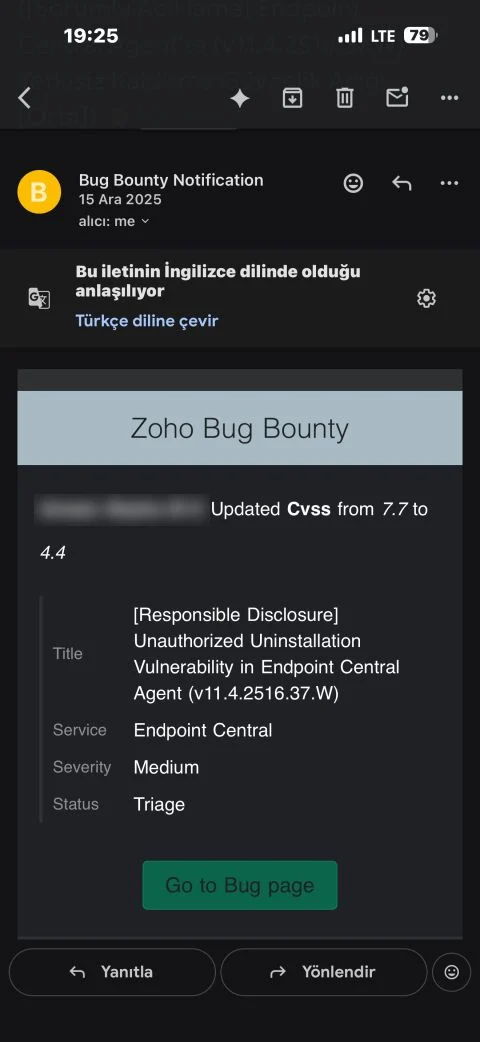
In December 2025 the report entered triage and the CVSS score was lowered from 7.7 to 4.4. What followed was the longest part of the process: agreeing on how the impact should be classified.
Step 2: the vendor's position
The vendor's view was that the behaviour requires SYSTEM/Administrator privileges, which places it outside the programme's scope. Microsoft's service criteria likewise do not treat the boundary between administrator and kernel as a security boundary.
Step 3: the researcher's counter-argument
The researcher's objection was that the issue is not about privilege escalation. It is about being able to disable entirely the protection mechanism on which the product's security guarantees rest. If the product promises malware protection, ransomware protection and DLP enforcement through this agent, an agent without tamper protection directly reduces the effectiveness of those controls. The researcher maps this to the MITRE ATT&CK techniques for impairing defences and indicator removal. Ransomware operators, the argument goes, typically start by shutting down security agents.
Outcome
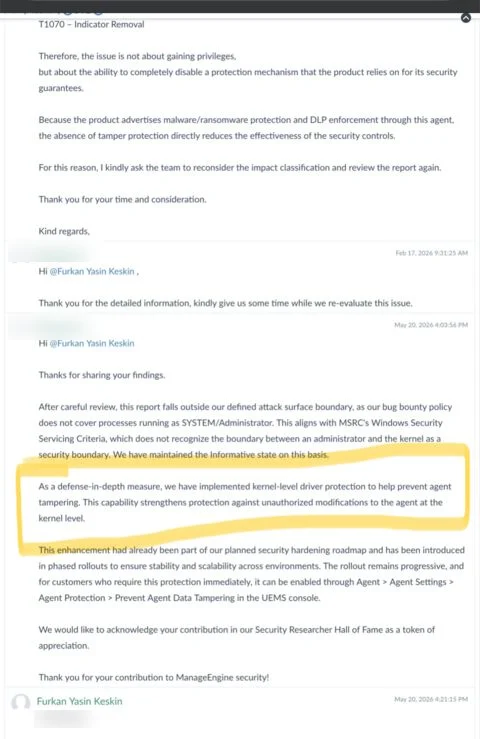
In the response received in May 2026 the report stayed Informative. The same response, however, carried important information: kernel-level driver protection against tampering with the agent had been added. The change was being rolled out gradually, and customers who wanted it could enable it immediately from the console.
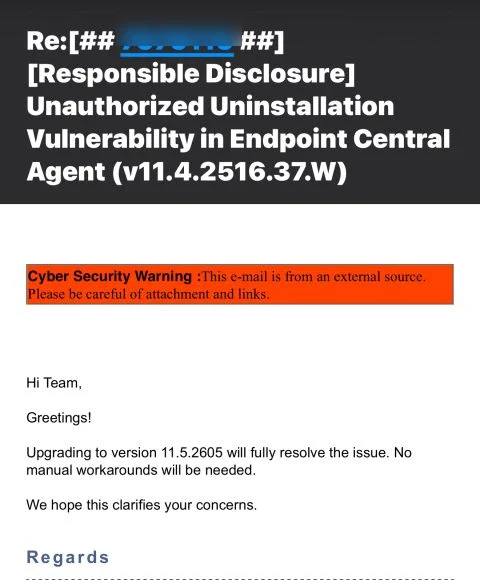
Support also stated that upgrading to version 11.5.2605 fully resolves the issue and that no additional manual action is needed.
Verification
Reporting is not enough; it has to be verified. The researcher repeated the same tests on agent version 11.5.2616.20.W: Agent Protection now behaved as expected against third-party removal and tampering attempts.
With one condition: the setting has to be turned on for the protection to be fully in effect.
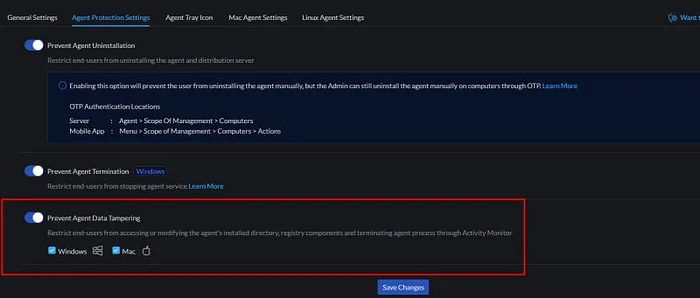
Agent Settings → Agent Protection Settings → Prevent Agent Data Tampering
Root cause
The report does not describe the implementation detail behind the behaviour, so the precise defect is not stated. What it does establish is the gap: an actor with SYSTEM/Administrator rights could tamper with the MSI and registry components and remove the agent despite Self-Defence and Uninstall Password Protection being enabled. The vendor's position is that this admin-to-kernel boundary is not a security boundary, and the report stayed Informative. The vendor added kernel-level driver protection against tampering with the agent.
Impact
Under the tested conditions, an actor with SYSTEM/Administrator privileges on a managed machine could remove the agent entirely, even with Self-Defence and Uninstall Password Protection active. The consequence is loss of every control delivered through the agent: patch management, application control, device control and browser policies. The report frames this as impairing defences and removing indicators, and notes that ransomware operators typically start by shutting down security agents. The vendor's counter-position is that the required privilege level puts this outside its programme scope.
Fix
The vendor added kernel-level driver protection against tampering with the agent, rolled out gradually and available for immediate activation from the console. Support stated that upgrading to 11.5.2605 fully resolves the issue with no additional manual action. The researcher verified on 11.5.2616.20.W that Agent Protection now works as expected against third-party removal and tampering attempts, provided the Prevent Agent Data Tampering setting is enabled.
What surprised the researcher
A self-protection improvement this significant was not clearly present in, and/or not emphasised in, the release notes. Many organisations running Endpoint Central may be unaware that the protection exists and that it has to be enabled.
Checklist for Endpoint Central users
-
Confirm your agent version is 11.5.2605 or later.
-
Check that Prevent Agent Uninstallation, Prevent Agent Termination and Prevent Agent Data Tampering are enabled.
-
Remove local administrator rights from users wherever possible. Kernel protection is a good layer, but it should not be the only one.
-
Set alarms for agents that lose contact with the console. An agent silently disappearing is an incident in itself.
-
Other UEM and EDR agents with a self-protection toggle. Repeat the removal attempt against the MSI and registry components with the protection feature enabled. A positive result is the agent being removed while the product still reports the protection as active.
-
Agents whose protection is user space only. Check whether the protection survives an actor with SYSTEM/Administrator rights. A positive result is the same gap: the protection can be disabled from the same privilege level it is meant to defend against.
-
Products that ship kernel protection but leave it off by default. Check the console defaults for the tamper-protection settings. A positive result is a protected build where the relevant setting is disabled out of the box.
-
Release notes coverage. Compare the shipped self-protection features against what the release notes mention. A positive result is a security-relevant protection that customers cannot discover from the documentation.
-
Console alerting for lost agents. Remove or silence an agent and watch the console. A positive result is an agent that stops reporting without generating an alarm.
What happened, in plain words
Imagine you hire a security guard to stand at the door of your building. You pay for the guard because you are not there all day. The guard checks who comes in, keeps troublemakers out and makes sure the rules you set are followed. Now imagine someone walks up to the guard, sends him home, and the building is left with no protection at all. That is roughly the story in this write-up.
ManageEngine Endpoint Central is a product that companies install on their computers to keep them safe and up to date. The part that actually sits on each computer is called an agent. The agent is a small program that runs quietly in the background. Through it, the company can push security patches, block certain applications, control which devices can be plugged in and enforce browser rules. All of that only works while the agent is installed and running. If the agent disappears, everything it was enforcing disappears with it.
The product has two features that are supposed to stop exactly that: Self-Defence and Uninstall Password Protection. In plain terms, the product promises: this agent cannot be removed. The researcher tested that promise and found it did not hold on the version he tested. He could remove the agent completely, even with both protections switched on.
He reported it responsibly to the vendor, Zoho, through their bug bounty programme. A bug bounty programme is a scheme where a company invites outside people to report security problems and, in return, may pay a reward and handle the report seriously. The report went through triage, the vendor and the researcher disagreed about how the impact should be classified, and in the end the vendor added a stronger layer of protection. The report itself was closed as Informative, which in bug bounty language means the vendor did not treat it as a valid security vulnerability, but the product still changed for the better.
This article walks through the whole story in the same order as the technical write-up, explaining every term along the way. No prior security knowledge is needed.
Context
What Endpoint Central is
ManageEngine Endpoint Central is what the industry calls a unified endpoint management product. "Endpoint" simply means a device at the edge of a company network: a laptop, a desktop, a server, a phone. "Unified" means one product manages all of them from one place. "Management" means the company can decide and enforce what happens on those devices.
The part that runs on each managed machine is the agent. Think of the agent as a resident caretaker in an apartment building. The building owner (the company's IT team) gives instructions from a central office (the console, a web page where administrators configure everything). The caretaker carries out those instructions locally.
Through the agent, the company delivers several kinds of control:
- Patch management: installing software updates that fix known security holes. A patch is like a repair kit for a broken lock.
- Application control: deciding which programs are allowed to run and which are blocked.
- Device control: deciding whether USB sticks, external drives and similar devices may be used.
- Browser policies: rules about how the web browser behaves, for example which sites can be visited or which extensions can be installed.
All of these depend on one simple condition: the agent must stay installed and running. If the agent is gone, the caretaker has left the building, and none of the instructions are carried out any more.
The two protections that are supposed to prevent removal
The product ships two features meant to keep the agent in place:
- Self-Defence: the agent watches over itself and resists attempts to stop it, modify it or remove it. The everyday comparison is a safe that locks itself if someone tries to pry it open.
- Uninstall Password Protection: removing the agent normally requires a password. Without the password, the uninstall should not proceed. The comparison is a door that only opens with the right key.
The promise, in short, is that the agent cannot be removed. The finding in this write-up is that, on the tested version, that promise did not hold.
Setup
The version tested
The testing was done against Endpoint Central Agent v11.4.2516.37.W. A version number is like the edition and printing of a book: it tells you exactly which build of the software is in front of you. Software changes over time, so a finding on one version may not apply to another.
The precondition
The precondition for the finding is that both Self-Defence and Uninstall Password Protection were active on the agent at the time of testing. This matters a lot. It is one thing to remove an agent when no protection is switched on; that is expected. It is a different thing to remove it while the product itself says the agent is protected. The whole point of the finding is that the protection was on and still did not stop the removal.
Why the technical steps are not published
The researcher does not publish the technical steps. His stated reason is that the issue is fixed in current versions, but environments may still be running the old one. An environment here means a company's actual set of installed machines. If the exact recipe for removing the agent were published, anyone could use it against a company that has not yet updated. This is a common and sensible choice in responsible disclosure: describe the problem and the fix, but hold back the recipe while old installations remain in the wild.
Finding it
What was found
On that agent version, the researcher found that the agent could be removed completely by tampering with its MSI and registry components, even with Self-Defence and Uninstall Password Protection enabled.
Two terms need explaining here:
- MSI stands for Microsoft Installer. It is the standard package format Windows uses to install, repair and remove software. Think of it as the box, the instruction leaflet and the list of parts that together tell Windows how a program is put together and taken apart. If you can tamper with the MSI, you can interfere with the installation itself.
- The registry is Windows' central configuration database. It stores settings for the operating system and for programs: where things live, which services start, what options are switched on. Think of it as the building's master ledger of settings. If you can edit the ledger, you can change how the building runs.
"Tampering" means deliberately modifying these components so that the software does something other than what it was designed to do. In this case, the tampering allowed the agent to be removed entirely.
Why that matters
In other words, the product's claim that the agent cannot be uninstalled was not true under certain conditions. Once the agent is gone, the patch management, application control, device control and browser policies delivered through it are gone too. The caretaker has left, and the building is now running on whatever rules were last written down, with nobody enforcing them.
The value of a security agent is that it keeps working when nobody is watching. An agent that can be switched off is only as good as the person who chooses not to switch it off.
Exploitation
Why there is no code here
The report deliberately omits the technical steps, so there is no request, payload or command to reproduce here. A payload is the piece of data or code that actually does the harmful thing when it is delivered; a request is a message one computer sends to another asking it to do something. Since the researcher chose not to publish the recipe, this article cannot show one either. What the report does describe is the disclosure process and the argument over how the issue should be classified.
Step 1: report through the vendor programme
The finding was reported through Zoho's bug bounty programme as a responsible disclosure.
The image shows the state of the report during triage in December 2025, when the CVSS score was lowered from 7.7 to 4.4.
Responsible disclosure is the practice of telling the vendor privately first, giving them time to fix the problem, and only then talking about it publicly. It is the difference between telling the building owner about a broken lock and posting the lock's weakness on the front door for everyone to read.
Triage is the first stage of handling a report. The vendor's team reads it, checks whether it is real, decides how serious it is and routes it to the right people. Think of it as the front desk of a hospital: before treatment, someone decides how urgent the case is.
CVSS stands for Common Vulnerability Scoring System. It is a standard way of giving a security issue a score from 0 to 10, where a higher number means more serious. The score is not a perfect measure of danger; it is a shared language so that everyone is talking about roughly the same thing. In December 2025 the report entered triage and the CVSS score was lowered from 7.7 to 4.4. That is a big drop: from "serious" territory towards "moderate". What followed was the longest part of the process: agreeing on how the impact should be classified.
Step 2: the vendor's position
The vendor's view was that the behaviour requires SYSTEM/Administrator privileges, which places it outside the programme's scope.
Two terms here:
- Administrator (often shortened to admin) is a user account with broad power over a computer. An admin can install software, change system settings and manage other users. Think of it as the building manager with a master key.
- SYSTEM is a special Windows account that the operating system itself uses. It is even more powerful than a normal administrator account and is not a person you log in as; it is the account under which core system services run.
Privilege means the level of permission an account has. A normal user can open their own files; an administrator can change the machine; SYSTEM can do things neither of them can. The vendor's argument is: to do this, you already need to be the building manager with the master key, so it is not a security problem in the sense the programme covers. In bug bounty terms, scope is the list of things a programme agrees to consider. If something is out of scope, the programme will not treat it as a valid report, even if it is real.
The vendor also pointed to Microsoft's service criteria, which likewise do not treat the boundary between administrator and kernel as a security boundary. The kernel is the core of the operating system: the part that talks directly to the hardware and enforces the most fundamental rules. It sits below all user programs. The boundary between "administrator" and "kernel" is the line between a very powerful user and the core itself. Microsoft's position, as cited in the report, is that crossing from admin to kernel is not considered a security boundary, because an administrator is already trusted with the machine.
Step 3: the researcher's counter-argument
The researcher's objection was that the issue is not about privilege escalation. Privilege escalation means going from a lower level of permission to a higher one, for example a normal user finding a way to become an administrator. The researcher agrees that this is not that. His point is different: it is about being able to disable entirely the protection mechanism on which the product's security guarantees rest.
His reasoning, in plain terms:
- If the product promises malware protection, ransomware protection and DLP enforcement through this agent, then an agent without tamper protection directly reduces the effectiveness of those controls.
- Malware is harmful software in general. Ransomware is a specific kind that locks or encrypts a victim's files and demands payment to unlock them. DLP stands for Data Loss Prevention: technology that watches for sensitive information leaving where it should not, for example customer records being copied to a USB stick or emailed outside the company.
- The researcher maps this to the MITRE ATT&CK techniques for impairing defences and indicator removal. MITRE ATT&CK is a public catalogue of techniques that attackers are known to use, organised so defenders can recognise them. "Impairing defences" means weakening or switching off the protections on a machine. "Indicator removal" means deleting traces, such as logs, so that the attack is harder to notice afterwards.
- Ransomware operators, the argument goes, typically start by shutting down security agents. This is the practical heart of the argument: the first move of many real attacks is to remove the very thing that would have stopped them.
So the disagreement is not about whether the behaviour is real. It is about what counts as a security problem. The vendor says: you already needed high privileges, so it is out of scope. The researcher says: the product's whole value is protecting the machine, and you can switch that protection off, so it matters.
Outcome
The report stays Informative
In the response received in May 2026 the report stayed Informative. In bug bounty platforms, "Informative" is a status meaning the report was read and acknowledged but not accepted as a valid vulnerability under the programme's rules. It is not the same as "invalid" or "spam"; it usually means "we understand, but we do not treat this as a security issue in our scope".
The important part of the same response
The same response, however, carried important information: kernel-level driver protection against tampering with the agent had been added. The change was being rolled out gradually, and customers who wanted it could enable it immediately from the console.
A driver is a piece of software that runs at a low level and lets the operating system control hardware or enforce deep rules. Because it sits at kernel level, it is much harder for ordinary programs, even administrator-level ones, to interfere with. The comparison is moving the safe from the lobby, where anyone with a master key can reach it, to a vault built into the building's foundation.
"Rolled out gradually" means the change is being released to customers in stages rather than all at once. This is common for changes that touch deep parts of the system, because it limits the damage if something goes wrong. Customers who did not want to wait could switch it on themselves from the console.
The image shows the vendor's response: the report remained Informative, but kernel-level protection was added.
Support's statement
Support also stated that upgrading to version 11.5.2605 fully resolves the issue and that no additional manual action is needed. "No additional manual action" means the customer does not have to run a special tool or edit settings by hand beyond the normal upgrade; the fix comes with the update.
The image shows the support team's message that version 11.5.2605 fully resolves the issue.
Verification
Why verification matters
Reporting is not enough; it has to be verified. A vendor saying "this is fixed" is a claim, not a proof. The researcher therefore repeated the same tests on agent version 11.5.2616.20.W. This is the difference between the shop saying the lock is repaired and you trying the door yourself.
What the retest showed
Agent Protection now behaved as expected against third-party removal and tampering attempts. "Third-party" here means something other than the agent itself: another program or a person trying to remove or modify it. The protection held.
The one condition
With one condition: the setting has to be turned on for the protection to be fully in effect. The path in the console is:
Agent Settings → Agent Protection Settings → Prevent Agent Data Tampering
Read that as a set of folders: open Agent Settings, then Agent Protection Settings, then find the option called Prevent Agent Data Tampering and make sure it is enabled. "Data tampering" means changing the agent's files or settings behind its back. This is the same idea as a house alarm that is installed but not armed: the hardware is there, but it only protects you once you switch it on.
The image shows the setting that has to be enabled for the protection to be fully active.
Root cause
What the report does and does not say
The report does not describe the implementation detail behind the behaviour, so the precise defect is not stated. "Implementation detail" means the exact lines of code or design choices that caused the problem. Without that, nobody outside the vendor can say precisely which piece of the agent failed.
The design gap it does establish
What it does establish is the gap: an actor with SYSTEM/Administrator rights could tamper with the MSI and registry components and remove the agent despite Self-Defence and Uninstall Password Protection being enabled.
User space is the part of the operating system where normal programs run, as opposed to kernel space, where the core runs. The comparison is the difference between the public areas of a building and the locked plant room in the basement. A program in user space can be stopped, modified or removed by someone with enough rights on the machine. A program in kernel space is much harder to touch.
The vendor's own position is that this admin-to-kernel boundary is not a security boundary, and the report stayed Informative. The vendor added kernel-level driver protection against tampering with the agent.
Impact
What an attacker could do
Under the tested conditions, an actor with SYSTEM/Administrator privileges on a managed machine could remove the agent entirely, even with Self-Defence and Uninstall Password Protection active. "Actor" is a neutral word for whoever is doing the action: it could be a malicious insider, a piece of malware running with high rights, or an attacker who has already taken over an admin account.
What is lost
The consequence is loss of every control delivered through the agent: patch management, application control, device control and browser policies. Each of these is a layer of defence. Removing the agent removes all of them at once, like pulling the main breaker in a building and finding that the lights, the alarm and the cameras all go out together.
How the report frames it
The report frames this as impairing defences and removing indicators, and notes that ransomware operators typically start by shutting down security agents. The vendor's counter-position is that the required privilege level puts this outside its programme scope. Both positions are in the report; the reader can weigh them.
Fix
What the vendor did
The vendor added kernel-level driver protection against tampering with the agent, rolled out gradually and available for immediate activation from the console. This is the substantive change: kernel-level driver protection against tampering with the agent.
What support said
Support stated that upgrading to 11.5.2605 fully resolves the issue with no additional manual action. Upgrading means replacing the old version with the new one through the normal update process.
What the researcher verified
The researcher verified on 11.5.2616.20.W that Agent Protection now works as expected against third-party removal and tampering attempts, provided the Prevent Agent Data Tampering setting is enabled. Note the two version numbers: 11.5.2605 is the version support named as the fix, and 11.5.2616.20.W is the version the researcher actually retested on. Both are later than the vulnerable 11.4.2516.37.W.
What surprised the researcher
A self-protection improvement this significant was not clearly present in, and/or not emphasised in, the release notes. Release notes are the document a vendor publishes with each new version, listing what changed. They are how customers find out what is new and what they need to do. If a security improvement is not mentioned there, customers have no easy way to learn that it exists or that they must switch it on.
Many organisations running Endpoint Central may be unaware that the protection exists and that it has to be enabled. This is the practical worry: a fix that nobody knows about protects nobody. It is like installing a new lock and not telling the tenants that the old key no longer works.
Checklist for Endpoint Central users
If you or your organisation use Endpoint Central, these are the concrete steps from the report:
- Confirm your agent version is 11.5.2605 or later. You can usually see the version in the console or in the agent's about screen. If it is older, upgrade.
- Check that Prevent Agent Uninstallation, Prevent Agent Termination and Prevent Agent Data Tampering are enabled. These are three separate switches: one stops removal, one stops the agent being killed, and one stops its data being changed. All three should be on.
- Remove local administrator rights from users wherever possible. Local administrator rights means the power to make deep changes on that particular machine. Kernel protection is a good layer, but it should not be the only one. This is the principle of defence in depth: several locks on the same door.
- Set alarms for agents that lose contact with the console. An agent silently disappearing is an incident in itself. If the caretaker stops reporting in, you want to know the same day, not next month.
The report suggests further testing for other researchers. These are ideas for where the same kind of problem might appear elsewhere. Each one is written as a test with a clear "positive result", meaning the outcome that would show a real problem.
- Other UEM and EDR agents with a self-protection toggle. Repeat the removal attempt against the MSI and registry components with the protection feature enabled. A positive result is the agent being removed while the product still reports the protection as active. EDR stands for Endpoint Detection and Response: security software that watches for suspicious behaviour on a device and responds to it. The test is the same shape as this story: does the promise survive contact with reality?
- Agents whose protection is user space only. Check whether the protection survives an actor with SYSTEM/Administrator rights. A positive result is the same gap: the protection can be disabled from the same privilege level it is meant to defend against. In plain terms: if the guard can be sent home by the very person the guard is supposed to watch, the guard is not much use.
- Products that ship kernel protection but leave it off by default. Check the console defaults for the tamper-protection settings. A positive result is a protected build where the relevant setting is disabled out of the box. "Out of the box" means as installed, before anyone changes anything. A protection that is off by default is a protection most customers will never have.
- Release notes coverage. Compare the shipped self-protection features against what the release notes mention. A positive result is a security-relevant protection that customers cannot discover from the documentation. This is exactly the surprise described earlier in the story, turned into a repeatable check.
- Console alerting for lost agents. Remove or silence an agent and watch the console. A positive result is an agent that stops reporting without generating an alarm. If the console stays quiet while an agent vanishes, the organisation has no way to notice the loss until something else goes wrong.
Glossary
- Administrator (admin): a user account with broad power over a computer, able to install software and change system settings.
- Agent: the small program installed on each managed machine that carries out the company's security instructions.
- Bug bounty programme: a scheme where a company invites outside people to report security problems, often with a reward.
- Console: the central web interface where administrators configure and monitor the product.
- CVSS: Common Vulnerability Scoring System, a standard 0 to 10 score for how serious a security issue is.
- Defence in depth: using several independent layers of protection so that one failure does not remove all safety.
- DLP (Data Loss Prevention): technology that watches for sensitive information leaving where it should not.
- Driver: low-level software that lets the operating system control hardware or enforce deep rules.
- EDR (Endpoint Detection and Response): security software that watches for suspicious behaviour on a device and responds to it.
- Endpoint: a device at the edge of a network, such as a laptop, desktop, server or phone.
- Environment: a company's actual set of installed machines and software.
- Implementation detail: the exact code or design choices that caused a behaviour.
- Informative: a bug bounty status meaning the report was read and acknowledged but not accepted as a valid vulnerability under the programme's rules.
- Kernel: the core of the operating system that talks directly to hardware and enforces fundamental rules.
- Kernel-level driver protection: protection implemented in a driver at kernel level, making it much harder for ordinary programs to interfere with.
- Local administrator rights: the power to make deep changes on a particular machine.
- Malware: harmful software in general.
- MITRE ATT&CK: a public catalogue of techniques attackers are known to use, used by defenders to recognise attacks.
- MSI (Microsoft Installer): the standard Windows package format used to install, repair and remove software.
- Payload: the piece of data or code that actually does the harmful thing when delivered.
- Privilege: the level of permission an account has.
- Privilege escalation: going from a lower level of permission to a higher one.
- Ransomware: harmful software that locks or encrypts files and demands payment to unlock them.
- Registry: Windows' central configuration database of settings for the operating system and programs.
- Release notes: the document published with each new version listing what changed.
- Request: a message one computer sends to another asking it to do something.
- Responsible disclosure: telling the vendor privately first, giving time to fix, then talking publicly.
- Scope: the list of things a bug bounty programme agrees to consider.
- Self-Defence: the product feature that makes the agent resist being stopped, modified or removed.
- SYSTEM: a special Windows account used by the operating system itself, more powerful than a normal administrator.
- Tampering: deliberately modifying software or its settings so it does something other than designed.
- Triage: the first stage of handling a report, where the vendor checks it and decides how serious it is.
- Unified endpoint management (UEM): one product that manages many devices from one place.
- Uninstall Password Protection: the product feature that requires a password before the agent can be removed.
- User space: the part of the operating system where normal programs run, as opposed to kernel space.
- Version number: the exact build of a piece of software, like the edition of a book.

