How I Got +1000$ by Clickjacking
The article describes clickjacking vulnerabilities where pages lack X-Frame-Options or CSP frame-ancestors headers, allowing attackers to embed them in iframes. The author claims to have reported five cases, including account deletion and self-XSS chained to account takeover, with two rewarded $1000.
 Published on medium.com
In this story I’m explaining a vulnerability that I reported to a programs and i got +1000$ also secure 5 company with it in Hackerone, my english is not perfect and its not my mother language so please never mind if I have some problems with the grammar, all I need is you to understand what I'm talking about exactly.
The full write-up lives on its author's site
It belongs to its author, so we link to it rather than copy it. The other two tabs are our own rewrites, checked against it.
Context
Clickjacking, also called user interface (UI) redressing, is an attack that fools users into thinking they are clicking on one thing when they are actually clicking on another. This write-up is about how I detect that weakness on real targets, how I turn it into something a triage team will accept, and the cases that paid. I reported five clickjacking cases to programmes on HackerOne, two of them were rewarded with 1000 USD in total, and the same technique helped secure five companies.
The report does not name the specific programmes or the affected endpoints. What it does give is the general method and the categories of functionality where clickjacking becomes a valid, payable issue rather than an out-of-scope header observation.
Setup
No special accounts or roles are needed to detect the weakness. The tools used are:
- Burp Suite, to inspect response headers.
- The browser's own DevTools (Chrome is used in the example), as an alternative to Burp.
- The online tool
clickjacker.ioas a quick check. - An HTML page with an
iframetag, hosted on your own server or on localhost, to build the proof of concept.
Finding it
The starting point is the response headers of the target. In Burp Suite you look for the absence of the header known as X-Frame. The same information can be read from the browser:
- Right-click on the page and select "Inspect." This will open the Chrome DevTools.
- Click on the "Network" tab.
- Refresh the page and look for a request to the website's main URL.
- Click on the request to inspect its details. Scroll down to the "Headers" section.
For both methods you look at the headers. The target may be vulnerable when:
- The
X-Frameheader is missing. - CSP is missing, or its value is not
noneorframe-ancestors.
If X-Frame and the CSP value are set to none or frame-ancestors, the website is protected and not vulnerable. The fast way to check is the online tool clickjacker.io. The last step of detection is to use the iframe HTML tag in your own code to embed the target on your server or localhost, which creates the proof of concept.
Exploitation
Step 1: confirm the headers
Inspect the target in Burp Suite or in the DevTools Network tab as described above. A missing X-Frame together with a missing or permissive CSP is the signal that the page can be framed.
Step 2: build the proof of concept
Embed the target in an iframe on a page you control, either on your own server or on localhost. The report does not include the exact HTML used; the PoC depends on your idea and on how you deal with it in HTML and CSS.
Step 3: add impact
A bare clickjacking PoC is often not triaged by programmes without any impact. The answer is to go deeply into the target and its functionalities, and to look for the cases below.
How the programmes triaged it
Some programmes do not triage clickjacking without impact, so the report describes the cases where it does count.
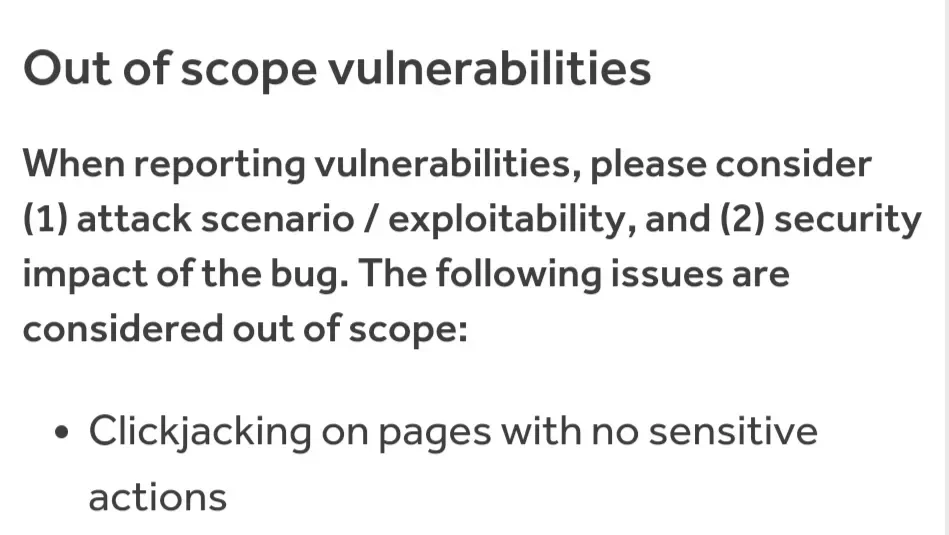
Photo by Alvaro Reyes on Unsplash
First case: delete account or update functionality
Look at the delete account or update functionality. Some programmes have this functionality and will triage clickjacking found there, provided you supply a good proof of concept.
Second case: chaining with another vulnerability
Chain clickjacking with another weakness such as Self-XSS or CSRF.
- Self-XSS on its own is out of scope. To deliver it to victims you can combine it with clickjacking and then report it as a valid issue.
- For CSRF, some programmes have an endpoint about the CSRF token. In that case an attacker can bypass the CSRF protection by chaining clickjacking with CSRF, which leads to updating the password or settings and similar actions.
Third case: sensitive information on an endpoint
When you find an endpoint that contains sensitive information such as credit cards, API tokens, access tokens or personal information, you can use clickjacking to steal it with JavaScript or with Burp Collaborator. If that happens and you report it, it is triaged as High or Critical.
For all of these, the PoC depends on your idea of how to deal with them in HTML and CSS. There are other cases too, but the point is to focus on the functionality and think like a hacker, so that even as a beginner or intermediate researcher you can get many triaged reports through hard work.
Results
I reported five cases containing the above patterns, including deleting an account, Self-XSS leading to account takeover, and stealing an API token. Two of them were rewarded with 1000 USD.
Root cause
The weakness is the classic one: the application allows its pages to be embedded in a frame by another origin. The report says that a missing X-Frame header and a missing CSP, or a CSP value that is not none or frame-ancestors, may mean the target is vulnerable. Because the page can be framed, an attacker can overlay it and make the victim's clicks land on the real application's controls. The report does not describe any server-side change that was made. It only says that setting the X-Frame header and a CSP value of none or frame-ancestors means the site is protected.
Impact
The report describes cases where clickjacking can count: delete account or update functionality, chaining with Self-XSS or CSRF, and stealing sensitive information. Where an endpoint exposes sensitive data such as credit cards, API tokens, access tokens or personal information, clickjacking can be used to steal it with JavaScript or Burp Collaborator, which the report says is triaged as High or Critical. The impact depends on the functionality that can be reached and on the programme accepting the chain; a bare clickjacking report without impact is often not triaged.
Variants to test
- Delete account or update functionality: a positive result is a framed page where a click on the overlay triggers the destructive or state-changing action.
- Self-XSS chained with clickjacking: a positive result is a framed page that delivers the Self-XSS to the victim.
- CSRF token endpoint chained with clickjacking: a positive result is a framed flow that bypasses the CSRF protection and updates the password or settings.
- Sensitive endpoint (credit cards, API tokens, access tokens, personal information): a positive result is data from the endpoint stolen with JavaScript or Burp Collaborator.
- Header check on any new target: a positive result is a missing
X-Frametogether with a missing CSP or a CSP withoutnoneorframe-ancestors.
What happened, in plain words
A security researcher named Aryan reported clickjacking cases to programmes on HackerOne, a platform where companies invite people to report security problems in exchange for rewards. Two of his reports were paid, 1000 USD in total, and the same technique helped him secure five companies.
Clickjacking is a trick. Imagine someone puts a transparent sheet of glass over a cash machine keypad, with fake buttons drawn on it. You think you are pressing "cancel", but your finger lands on the real "withdraw" button underneath. On a website the same thing happens with a hidden frame: the victim sees one page, but their clicks land on another page loaded invisibly underneath.
This article walks through how Aryan detects the weakness, how he builds a small demonstration page to prove it, and which kinds of website features make a clickjacking report worth money instead of being ignored. The report does not name the specific companies or the exact pages involved.
The words you need first
Before anything else, a few everyday ideas:
- A web page and its parts. When your browser asks a website for a page, the server sends back the page plus some extra information called headers. Headers are like the label on a parcel: they are not the contents, but they tell the browser how to treat what is inside.
- A frame (iframe). An
iframeis an HTML tag that lets one web page display another web page inside a rectangular window. It is like a picture frame on a wall: the frame belongs to your house, but the picture inside can come from anywhere. Websites use frames legitimately all the time, for adverts or embedded videos. - An origin. An origin is the combination of protocol, domain and port that a page comes from, roughly "which website". A page from one origin embedding a page from another origin is called cross-origin framing, and that is exactly what clickjacking abuses.
- A header called
X-Frame-Options. This is a header a server can send to say "my pages may not be put inside a frame". If it is missing, the browser is free to frame the page. - CSP (Content Security Policy). Another header, a longer list of rules a site sends to the browser about what it is allowed to load and do. One of its rules,
frame-ancestors, says which other sites are allowed to frame this one. If CSP is missing, or does not restrict framing, the page can be framed. - Burp Suite. A tool used by security testers that sits between your browser and the website and lets you read every request and response, including headers. Think of it as a transparent pipe you can look into.
- DevTools. The set of developer tools built into browsers such as Chrome. You open them with a right-click and "Inspect". They show you the page's code, its network requests and their headers.
- localhost. Your own computer, addressed as if it were a website. Hosting a test page on localhost means it runs only on your machine, which is handy for demonstrations.
- Proof of concept (PoC). A small, safe demonstration that shows a bug is real. For clickjacking, the PoC is a page you control that frames the target and shows that a click can be captured.
- Triage. The first review a report gets at a bug bounty programme. A triage team decides whether the report is valid, in scope and worth paying for. "Triaged" means accepted for handling.
- Out of scope (OOS). A rule in a programme saying certain bug types or certain parts of the site are not eligible for a reward. Many programmes put plain clickjacking out of scope.
- Impact. The real-world harm a bug can cause. A page that can be framed is a technical fact; a page that can be framed and used to delete your account is an impact. Programmes pay for impact.
- Self-XSS. A cross-site scripting bug that only fires when the victim pastes malicious code into their own browser. On its own it is usually out of scope, because the victim has to attack themselves.
- CSRF (Cross-Site Request Forgery). A trick where another website makes your browser send a request to a site you are logged into, using your existing login. Sites defend against it with a secret value called a CSRF token that the attacker is not supposed to know.
- Account takeover (ATO). When an attacker gains control of someone else's account.
- API token / access token. A long secret string, like a password, that a program uses to prove who it is when talking to a service. If it leaks, whoever holds it can act as that program.
- Burp Collaborator. A feature of Burp Suite that gives you a unique address you control, so you can see when a target server or browser contacts it. It is a way to catch data being sent out.
The tools Aryan used
No special accounts or permissions were needed to detect the weakness. The setup was:
- Burp Suite, to read the response headers.
- The browser's own DevTools (Chrome in the example), as an alternative to Burp.
- The online tool
clickjacker.ioas a quick check. - An HTML page with an
iframetag, hosted on his own server or on localhost, to build the proof of concept.
Finding it: the header check
The starting point is always the response headers of the target. In Burp Suite you look for the absence of the header known as X-Frame. The same information can be read straight from the browser:
- Right-click on the page and select "Inspect." This will open the Chrome DevTools.
- Click on the "Network" tab.
- Refresh the page and look for a request to the website's main URL.
- Click on the request to inspect its details. Scroll down to the "Headers" section.
Why these steps? The Network tab records every request the browser makes. Refreshing the page guarantees the main request is captured. Clicking that request shows its details, and the Headers section is where the server's instructions to the browser live. You are looking for one instruction in particular: whether the site told the browser not to frame it.
For both methods you look at the headers. The target may be vulnerable when:
- The
X-Frameheader is missing. - CSP is missing, or its value is not
noneorframe-ancestors.
If X-Frame and the CSP value are set to none or frame-ancestors, the website is protected and not vulnerable. In plain terms: the site has told the browser "do not let anyone frame me", and the browser will obey. If neither instruction is present, the browser has nothing stopping it from framing the page, and that is the opening clickjacking needs.
The fast way to check is the online tool clickjacker.io. The last step of detection is to use the iframe HTML tag in your own code to embed the target on your server or localhost, which creates the proof of concept.
Building the proof of concept
Step 1: confirm the headers
Inspect the target in Burp Suite or in the DevTools Network tab as described above. A missing X-Frame together with a missing or permissive CSP is the signal that the page can be framed. You do this first because there is no point building a demonstration for a page the browser will refuse to frame.
Step 2: build the proof of concept
Embed the target in an iframe on a page you control, either on your own server or on localhost. The report does not include the exact HTML used; the PoC depends on your idea and on how you deal with it in HTML and CSS. The idea is simple: your page loads the real site inside a frame, and you position your own fake buttons on top of it so that a click on your button actually lands on the real site's control underneath.
Step 3: add impact
A bare clickjacking PoC is often not triaged by programmes without any impact. In other words, showing "this page can be framed" is not enough; you have to show what a framed click can actually do. The answer is to go deeply into the target and its functionalities, and to look for the cases below.
How the programmes triaged it
Some programmes do not triage clickjacking without impact, so the report describes the cases where it does count.
Photo by Alvaro Reyes on Unsplash
First case: delete account or update functionality
Look at the delete account or update functionality. Some programmes have this functionality and will triage clickjacking found there, provided you supply a good proof of concept. The reasoning: if a framed click can delete an account or change a setting, the victim suffers real harm, and that harm is what makes the report worth paying for.
Second case: chaining with another vulnerability
Chain clickjacking with another weakness such as Self-XSS or CSRF. Chaining means using one bug to make another bug actually work in the real world.
- Self-XSS on its own is out of scope. To deliver it to victims you can combine it with clickjacking and then report it as a valid issue. The clickjacking supplies the missing piece: a way to make the victim perform the action that triggers the Self-XSS without realising it.
- For CSRF, some programmes have an endpoint about the CSRF token. In that case an attacker can bypass the CSRF protection by chaining clickjacking with CSRF, which leads to updating the password or settings and similar actions. The report says an attacker can bypass the CSRF protection by chaining clickjacking with CSRF, leading to updating the password or settings.
Third case: sensitive information on an endpoint
When you find an endpoint that contains sensitive information such as credit cards, API tokens, access tokens or personal information, you can use clickjacking to steal it with JavaScript or with Burp Collaborator. If that happens and you report it, it is triaged as High or Critical. The report says clickjacking can be used to steal such data with JavaScript or Burp Collaborator.
For all of these, the PoC depends on your idea of how to deal with them in HTML and CSS. There are other cases too, but the point is to focus on the functionality and think like a hacker, so that even as a beginner or intermediate researcher you can get many triaged reports through hard work.
Results
Aryan reported five cases containing the above patterns, including deleting an account, Self-XSS leading to account takeover, and stealing an API token. Two of them were rewarded with 1000 USD.
Why it works, and what the fix is
The weakness is the classic one: the application allows its pages to be embedded in a frame by another origin. The report says that a missing X-Frame header and a missing CSP, or a CSP value that is not none or frame-ancestors, may mean the target is vulnerable. Because the page can be framed, an attacker can overlay it and make the victim's clicks land on the real application's controls. The report does not describe any server-side change that was made. It only says that setting the X-Frame header and a CSP value of none or frame-ancestors means the site is protected.
What an attacker could do
The report describes cases where clickjacking can count: delete account or update functionality, chaining with Self-XSS or CSRF, and stealing sensitive information. Where an endpoint exposes sensitive data such as credit cards, API tokens, access tokens or personal information, clickjacking can be used to steal it with JavaScript or Burp Collaborator, which the report says is triaged as High or Critical. The impact depends on the functionality that can be reached and on the programme accepting the chain; a bare clickjacking report without impact is often not triaged.
Things to try on your own targets
- Delete account or update functionality: a positive result is a framed page where a click on the overlay triggers the destructive or state-changing action.
- Self-XSS chained with clickjacking: a positive result is a framed page that delivers the Self-XSS to the victim.
- CSRF token endpoint chained with clickjacking: a positive result is a framed flow that bypasses the CSRF protection and updates the password or settings.
- Sensitive endpoint (credit cards, API tokens, access tokens, personal information): a positive result is data from the endpoint stolen with JavaScript or Burp Collaborator.
- Header check on any new target: a positive result is a missing
X-Frametogether with a missing CSP or a CSP withoutnoneorframe-ancestors.
Glossary
- Burp Collaborator: a feature of Burp Suite that gives you a unique address you control, so you can see when a target contacts it.
- Burp Suite: a tool that sits between your browser and a website and lets you read every request and response.
- Clickjacking: an attack that fools users into thinking they are clicking on one thing when they are actually clicking on another; also called UI redressing.
- CSP (Content Security Policy): a header of rules a site sends to the browser about what it may load and do, including which sites may frame it via
frame-ancestors. - CSRF (Cross-Site Request Forgery): a trick where another website makes your browser send a request to a site you are logged into.
- CSRF token: a secret value a site uses to check that a request really came from its own pages.
- DevTools: the developer tools built into browsers such as Chrome, opened with right-click and "Inspect".
- Endpoint: a specific address on a website or API that performs a particular action or returns particular data.
- Headers: extra information a server sends with a page, telling the browser how to treat it.
- HackerOne: a platform where companies invite people to report security problems in exchange for rewards.
- iframe: an HTML tag that displays one web page inside another.
- Origin: the combination of protocol, domain and port a page comes from, roughly "which website".
- Out of scope (OOS): a rule saying certain bug types or parts of a site are not eligible for a reward.
- Triage: the first review of a report at a bug bounty programme, deciding whether it is valid and payable.
- X-Frame-Options: a header a server sends to say its pages may not be put inside a frame.