Public Disclosure: Anyone Can Send Email as OYO Rooms — Reported, Rejected, and Still Wide Open
Three OYO Rooms communication domains publish no SPF, DKIM or DMARC records and have no provider-side sender authentication, so anyone can send email that appears to come from the company. An attacker could use this for credential phishing or to send damaging content that appears to originate from OYO.
 Published on cyphernova1337.medium.com
Bug Bounty
The full write-up lives on its author's site
It belongs to its author, so we link to it rather than copy it. The other two tabs are our own rewrites, checked against it.
Context
Prism Life Ltd (prismlife.com) operates the OYO Rooms hospitality platform. OYO Rooms uses three domains for customer communication:
oyorooms.iooyoos.comleisure-partners.net
None of the three publishes SPF, DKIM or DMARC records. The author's argument is that this is not the usual best-practice nit, because there is also no mail provider in front of these domains enforcing sender authentication on its own infrastructure. The result is that a forged message sent from one of these domains has no layer anywhere between an attacker's server and a victim's inbox that can tell it apart from a genuine one.
Setup
The testing used a cheap cloud VPS, described as the standard attacker path because consumer ISPs block outbound port 25. Delivery was demonstrated against a public test inbox at mailinator.com. No customer data was involved and no real victim received anything; all testing used attacker-controlled infrastructure and a public test inbox.
The finding was reported to Prism Life Ltd through HackerOne on 19 September 2026, with full proof of concept, delivery logs and screenshots, and the same details were emailed directly to the company's security team the same day.
Finding it
The starting observation is DNS: none of the three domains publishes SPF, DKIM or DMARC. On its own that is common. What the author stresses is the second condition: these domains are not sitting behind Google Workspace or Microsoft 365, providers that enforce sender authentication on their own infrastructure. A company that forgets its SPF records but sends through such a provider is still effectively protected by the provider. These domains have neither records nor a provider in front of them, so nothing between a rented VPS and a victim's inbox can distinguish a forged message from a real one, because the domain publishes no basis for any server to even try.
The author frames three production domains with zero protection at any layer, in one company, as rare, and says this attack surface has never been looked at.
Exploitation
Step 1: open a raw SMTP conversation from a VPS
On 21 August 2026, from a cloud VPS, the author ran a raw SMTP conversation with a real public inbox:
EHLO mail.oyorooms.io -> 250 mail.mailinator.comMAIL FROM:<[redacted]> -> 250 OkRCPT TO:<[redacted]> -> 250 OkDATA -> 250 Ok
The session greets the receiving server as mail.oyorooms.io, sets the envelope sender to [redacted], addresses a Mailinator inbox, and the receiving server accepts every step: 250 for the EHLO, 250 Ok for the sender, 250 Ok for the recipient and 250 Ok for the data. Nothing in the exchange asks the sending side to prove it has any relationship with oyorooms.io.
Step 2: send a message that looks like account correspondence
The message carried these lines:
From: Support <[redacted]>Subject: Action required: verify your account
The display name is Support, the address is [redacted], and the subject is an account-verification prompt. The message was delivered and sat in a real inbox, sent from an address the recipient would reasonably trust, by a server with no relationship to the company whatsoever.
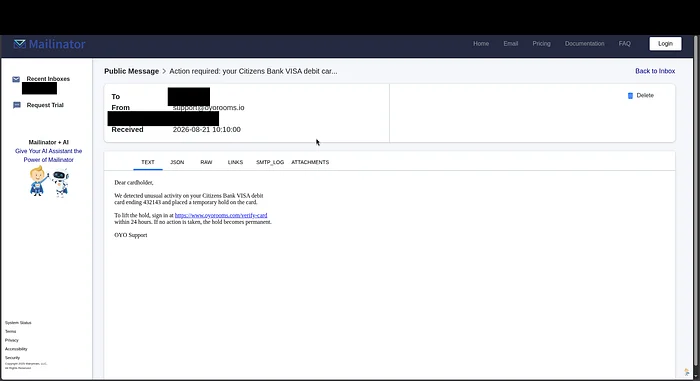
The screenshot shows the spoofed OYO support email as delivered to the public inbox.
Step 3: the Gmail control
The same message sent to Gmail was rejected:
550 5.7.26 Gmail requires all senders to authenticate with either SPF or DKIM
This is the instructive contrast. Google protects its own users by enforcing authentication on the receiving side for everyone, regardless of what the sender's domain publishes. That is Gmail's choice, not OYO's protection and not the internet's default. Every inbox that does not implement Gmail-style enforcement, including corporate systems, smaller providers, legacy appliances and much of the world's mail, has no basis to reject the forged message, and does not.
Root cause
The design mistake is the absence of any authentication basis for the three domains: no SPF, no DKIM and no DMARC. Because the domains are also not fronted by a provider that enforces sender authentication on its own infrastructure, there is no compensating control at any layer. Receiving servers have nothing to check the envelope sender or the message signature against, so a message claiming to come from [redacted] is accepted on the strength of the claim alone.
The defence that stopped the same message at Gmail, the 550 5.7.26 rejection, belongs to the receiver, not to the sending domain. It protects Gmail's users only and does not travel with the domain.
Impact
The obvious use is credential phishing from an address customers and employees already trust: password resets, HR surveys, payment updates. The subtler use is personalisation: a phish from the company's own domain can carry anything the attacker knows about the target, such as an order number, a masked card from a receipt or a name from a breach dump, and none of it has to look wrong, because the sender address is genuine and the inbox has no basis to doubt it.
The author also frames the issue as existential rather than merely a phishing helper: the sender is the company. Whatever is sent from these domains, including ransomware, illegal content or false statements to investors, lands in inboxes and in logs as mail from OYO. The company cannot disown it, and the domains cannot recover their reputation once that happens.
The impact applies to every inbox that does not enforce Gmail-style authentication. Gmail users are protected by Gmail's policy, not by anything the company did.
The report and its handling
The finding was submitted to the company's bug bounty program on HackerOne on 19 September 2026 with full PoC, delivery logs and screenshots. It was closed as Not Applicable two hours later, roughly a hundred minutes after it arrived, not by a human reviewer but by HackerOne's automated agent, citing the program's policy exclusion for SPF/DKIM/DMARC findings. The closure response engages the report's category and never its evidence; the delivery proof, the logs and the screenshots were never addressed. The same details were emailed directly to the company's security team the same day.
The author notes the consequences on the platform side: the Not Applicable sits on the researcher's record, and under HackerOne's Signal system a Not Applicable counts against a researcher's standing, the score that determines visibility, limits and in some cases whether a researcher can report at all. The platform offers no appeal path for a program's scope decision, even when the deciding party was an automated process that never read past the report's category.
Timeline as published:
| Date | Event |
|---|---|
| 21 August 2026 | Live delivery proof captured: spoofed message accepted by a real public inbox, Gmail control captured |
| 19 September 2026 | Finding submitted to the company's bug bounty program on HackerOne with full PoC, delivery logs and screenshots |
| 19 September 2026 | Closed two hours later as Not Applicable by HackerOne's automated agent, citing the program's policy exclusion for SPF/DKIM/DMARC findings |
| 19 September 2026 | Same details emailed directly to the company's security team |
| 29 October 2026 | Disclosure published. No fix, no response, no SPF/DKIM/DMARC on any of the three domains |
Fix
No fix was applied. At the time of publication there was no response and no SPF, DKIM or DMARC on any of the three domains. The report puts the fix at an afternoon of DNS work. The only mitigation available to everyone else in the meantime is knowledge: recipients of OYO mail should treat the sender address as meaningless as a trust signal, and mail administrators should treat these specific domains as unauthenticated until records exist.
The policy exclusion is the company's right, but as the author puts it, the risk does not get excluded along with the report: the spoofing capability remains in the hands of anyone with a VPS and a script.
Variants to test
- Other domains in the same corporate group. Enumerate every domain the organisation uses for customer or employee mail and check each for SPF, DKIM and DMARC. A positive result is a domain with no records that also has no authenticating provider in front of it, confirmed by a delivery test.
- Domains with records but no enforcement. Look for SPF records that end in
~allor?all, and DMARC policies ofp=none. A positive result is a forged message that is delivered despite the records existing. - Provider-fronted domains as a control. Repeat the delivery test against a domain known to send through a provider that enforces authentication. A positive result here would mean the provider is not enforcing as expected, which changes the severity of the whole class.
- Receiver-side variation. Send the same forged message to several receiving systems: a large consumer provider, a corporate mail gateway, a smaller regional provider and a legacy appliance. A positive result is delivery on any system that does not implement Gmail-style enforcement, which maps the real exposure rather than the best-defended receiver.
- Subdomain and lookalike coverage. Check whether SPF and DMARC are published at the organisational domain and inherited by subdomains, and whether DMARC
spandpctsettings leave gaps. A positive result is a subdomain from which a forged message is delivered even though the apex is protected.
What happened, in plain words
A security researcher found that anyone on the internet can send email that appears to come from OYO Rooms, the hotel booking company. OYO Rooms is run by a company called Prism Life Ltd (prismlife.com). The researcher proved it by sending a fake message from an OYO address to a public test inbox, and the message arrived looking completely genuine. When the same message was sent to Gmail, Gmail refused it. That difference is the heart of the story.
The researcher reported the problem through HackerOne, a well-known website where companies invite security researchers to report flaws in their systems (a "bug bounty program"). HackerOne closed the report as "Not Applicable" about two hours later. The closure was not made by a person reading the evidence; it was made by HackerOne's automated agent, a piece of software that sorts reports into categories. The agent matched the report to a rule in the program's policy that says findings about SPF, DKIM or DMARC are out of scope. The researcher also emailed the details directly to the company's security team the same day. Nothing was fixed. Months later the researcher published everything publicly so that people who receive OYO email know the sender address cannot be trusted.
This article walks through the whole thing from zero: what email authentication is, why its absence matters, exactly what the researcher typed and what came back, and what happened after the report was filed.
The finding
OYO Rooms uses three internet domains (a domain is the part of an address after the @ sign, like example.com) for talking to customers by email:
oyorooms.iooyoos.comleisure-partners.net
None of these three domains publishes any of the three standard records that let a receiving mail server check whether a message really came from the domain it claims to come from. Those records are called SPF, DKIM and DMARC. We will explain each one shortly. The short version: they are public notes in the domain's address book (DNS) that tell the world "here is how to verify mail from us". All three are missing on all three domains.
Missing records alone is common and usually not dramatic. What makes this case unusual, in the researcher's words, is that there is no protection at any other layer either. We will unpack that.
Why this is not an ordinary missing configuration
To understand why this matters, you need a little background on how email trust works.
When you send an email, your mail program hands it to a mail server, which looks up the recipient's domain in DNS (the internet's phone book) and delivers the message. The receiving server has no built-in way to know whether the message really came from the address written on the envelope. Anyone can write any sender address, just as anyone can write any return address on a paper envelope.
To fix that, the email world invented three checks:
- SPF (Sender Policy Framework): a public list, stored in DNS, of which servers are allowed to send mail for a domain. If a message arrives from a server not on the list, the receiver can flag or reject it. Think of it as a guest list at a door: the bouncer checks whether the person delivering the message is on the list.
- DKIM (DomainKeys Identified Mail): a cryptographic signature stamped onto each outgoing message by the sending server. The receiving server can verify the signature using a public key published in DNS. Think of it as a wax seal: if the seal is intact and matches the published stamp, the message is genuine and unaltered.
- DMARC (Domain-based Message Authentication, Reporting and Conformance): a policy that tells receiving servers what to do when SPF or DKIM fails (for example, reject the message or send it to spam), and where to send reports about failures. Think of it as the instruction sheet that says "if the guest list or the wax seal fails, here is what you should do".
Most companies that forget their SPF records are still hard to spoof, because their email flows through a big provider such as Google Workspace or Microsoft 365. Those providers enforce sender authentication on their own infrastructure: they check that outgoing mail really comes from their customer and they add signatures. So even with no DNS records, the provider acts as a bodyguard. That is why "missing SPF" is usually a best-practice nit rather than an emergency.
These three OYO domains have nothing. No records, and no provider in front of them that would stop a forged message from reaching real inboxes. There is no layer anywhere between an attacker on a rented server and a victim's inbox that can tell the forged message from a real one, because the domain publishes no basis for any server to even try.
You can almost never do this against a modern company, not because of SPF records but because of the infrastructure that sits in front of mail by default. Finding three production domains with zero protection at any layer, in one company, is rare. It means this attack surface has never been looked at.
The proof
On 21 August 2026, the researcher demonstrated delivery. The setup was a cheap cloud VPS. A VPS (virtual private server) is a rented computer in a data centre that you control completely, like renting a small office with its own front door. The researcher calls this the standard attacker path, because consumer internet providers block outbound port 25. Port 25 is the network door that email servers use to talk to each other; home internet providers usually lock it to stop spam, but a rented server in a data centre can use it freely.
From that server, the researcher ran a raw SMTP conversation with a real public inbox. SMTP (Simple Mail Transfer Protocol) is the language mail servers speak to each other. A "raw conversation" means typing the commands by hand instead of using a mail app, so you can see every step. The public inbox was at mailinator.com, a service that gives anyone a throwaway public email address for testing.
EHLO mail.oyorooms.io -> 250 mail.mailinator.comMAIL FROM:<[redacted]> -> 250 OkRCPT TO:<[redacted]> -> 250 OkDATA -> 250 Ok
Line by line, in plain words:
EHLO mail.oyorooms.iois the opening greeting. The sending server introduces itself to the receiving server and claims its name ismail.oyorooms.io. The reply250 mail.mailinator.commeans "hello, I am mail.mailinator.com and I accept your greeting". The number 250 is SMTP's code for "OK, fine".MAIL FROM:<[redacted]>sets the envelope sender, the return address written on the outside of the envelope. The reply250 Okmeans the receiving server accepted it without asking for any proof.RCPT TO:<[redacted]>names the recipient, a Mailinator inbox. The reply250 Okmeans the recipient is accepted.DATAannounces that the message body follows. The reply250 Okmeans "go ahead, send the content".
Nothing in the exchange asks the sending side to prove it has any relationship with oyorooms.io. The receiving server simply believed the claim.
Step 2: send a message that looks like account correspondence
The message carried these lines:
From: Support <[redacted]>Subject: Action required: verify your account
Line by line:
From: Support <[redacted]>is the visible sender line that a mail app shows the recipient. The display name isSupport, and the address is[redacted]. To a normal person reading their inbox, this looks exactly like a message from OYO's support team.Subject: Action required: verify your accountis the subject line, a routine account-verification prompt of the kind people see every day. It is a routine account-verification prompt of the kind people see every day.
The message was delivered and sat in a real inbox, sent from an address the recipient would reasonably trust, by a server with no relationship to the company whatsoever.
The screenshot shows the spoofed OYO support email as it appeared in the public inbox: a message that looks like genuine OYO correspondence, delivered by a server that has nothing to do with OYO.
Step 3: the Gmail control
The same message sent to Gmail was rejected:
550 5.7.26 Gmail requires all senders to authenticate with either SPF or DKIM
Line by line:
550is SMTP's code for a permanent failure: the message was refused, not queued.5.7.26is a more specific code Gmail uses for this kind of policy rejection.- The text after the code is Gmail's explanation: it requires every sender to authenticate with either SPF or DKIM. Because the OYO domains publish neither, Gmail had nothing to check and refused the message.
This is the instructive contrast. Google protects its own users by enforcing authentication on the receiving side for everyone, regardless of what the sender's domain publishes. That is Gmail's choice, not OYO's protection and not the internet's default. Every inbox that does not implement Gmail-style enforcement, including corporate systems, smaller providers, legacy appliances and much of the world's mail, has no basis to reject the forged message, and does not.
A useful comparison: Gmail is like a building with a strict doorman who checks every visitor's ID no matter what the visitor claims. Most other inboxes are like a building with no doorman at all. The strict doorman protects only his own building. The sender's lack of ID does not become safe just because one building happens to check.
What an attacker does with it
The obvious use is credential phishing from an address customers and employees already trust. Phishing is the practice of sending a fake message that tricks someone into handing over a password or other sensitive information. Because the sender address is real, the usual warning signs (a strange address, a lookalike domain) are absent. Examples the researcher gives: password resets, HR surveys, payment updates.
The subtler use is personalisation. A phish from the company's own domain can carry anything the attacker knows about the target, such as an order number, a masked card from a receipt or a name from a breach dump, and none of it has to look wrong, because the sender address is genuine and the inbox has no basis to doubt it. A breach dump is a leaked collection of data from a previous security incident, often sold or shared online.
The researcher also frames the issue as existential rather than merely a phishing helper: the sender is the company. Whatever is sent from these domains, including ransomware, illegal content or false statements to investors, lands in inboxes and in logs as mail from OYO. The company cannot disown it, and the domains cannot recover their reputation once that happens. Email reputation is like a credit score for a domain: once it is damaged, legitimate mail from that domain struggles to get delivered.
The impact applies to every inbox that does not enforce Gmail-style authentication. Gmail users are protected by Gmail's policy, not by anything the company did.
Timeline
The researcher published this timeline:
| Date | Event |
|---|---|
| 21 August 2026 | Live delivery proof captured: spoofed message accepted by a real public inbox, Gmail control captured |
| 19 September 2026 | Finding submitted to the company's bug bounty program on HackerOne with full PoC, delivery logs and screenshots |
| 19 September 2026 | Closed two hours later as Not Applicable by HackerOne's automated agent, citing the program's policy exclusion for SPF/DKIM/DMARC findings |
| 19 September 2026 | Same details emailed directly to the company's security team |
| 29 October 2026 | Disclosure published. No fix, no response, no SPF/DKIM/DMARC on any of the three domains |
A PoC, or proof of concept, is a small demonstration that proves a vulnerability is real rather than theoretical. Here the PoC was the live delivery test and its logs and screenshots.
The response, and what it cost
The way this report was handled deserves its own note, because it matters to anyone who reports this class of issue. The submission was closed roughly a hundred minutes after it arrived by HackerOne's automated triage agent, matched to a blanket policy exclusion. Triage is the first sorting step: deciding what a report is about and whether it is in scope. A blanket policy exclusion is a rule that says a whole category of findings is out of scope, regardless of the details of any individual report. The closure response engages the report's category and never its evidence. The delivery proof, the logs and the screenshots were never addressed at all.
That closure now sits on the researcher's platform record as a Not Applicable. Under HackerOne's Signal system, a Not Applicable counts against a researcher's standing. Signal is a reputation score that determines visibility, limits and in some cases whether a researcher can report at all. The platform offers no appeal path for a program's scope decision, even when the deciding party was an automated process that never read past the report's category.
The researcher is careful to say that this part of the story is not about OYO at all. When the gate between a demonstrated capability and a policy bucket is automated, the bucket wins, the researcher's record takes the hit, and the risk stays exactly where it was: in the wild, against a company that has been told twice.
Why this is public
The response to the report treated this as a category, "SPF, DKIM, or DMARC findings", rather than as what it is. A category is a checklist item. This is a live, demonstrated, fully open channel for impersonating the company to every inbox that does not enforce Google's policy, with the fix costing an afternoon of DNS work.
The policy exclusion is the company's right. But the risk does not get excluded along with the report. The spoofing capability remains in the hands of anyone with a VPS and a script, and the only people who were in a position to close it were told, in writing, twice, and have not.
Publishing the details is the responsible option now: the people who receive OYO mail deserve to know that the sender address is currently meaningless as a trust signal, and mail administrators deserve to know these specific domains should be treated as unauthenticated until records exist. That knowledge is the only mitigation available to the rest of us while the company decides whether to fix it.
The researcher adds a note on testing ethics: all testing used attacker-controlled infrastructure and a public test inbox; no customer data was involved and no real victim received anything.
Fix
No fix was applied. At the time of publication there was no response and no SPF, DKIM or DMARC on any of the three domains. The report puts the fix at an afternoon of DNS work. The only mitigation available to everyone else in the meantime is knowledge: recipients of OYO mail should treat the sender address as meaningless as a trust signal, and mail administrators should treat these specific domains as unauthenticated until records exist.
The policy exclusion is the company's right, but as the researcher puts it, the risk does not get excluded along with the report: the spoofing capability remains in the hands of anyone with a VPS and a script.
Variants to test
For other researchers who want to look for the same class of problem elsewhere, the write-up lists five directions:
- Other domains in the same corporate group. Enumerate every domain the organisation uses for customer or employee mail and check each for SPF, DKIM and DMARC. A positive result is a domain with no records that also has no authenticating provider in front of it, confirmed by a delivery test.
- Domains with records but no enforcement. Look for SPF records that end in
~allor?all, and DMARC policies ofp=none. These are weak settings: they tell receivers to check but not to reject. A positive result is a forged message that is delivered despite the records existing. - Provider-fronted domains as a control. Repeat the delivery test against a domain known to send through a provider that enforces authentication. A positive result here would mean the provider is not enforcing as expected, which changes the severity of the whole class.
- Receiver-side variation. Send the same forged message to several receiving systems: a large consumer provider, a corporate mail gateway, a smaller regional provider and a legacy appliance. A positive result is delivery on any system that does not implement Gmail-style enforcement, which maps the real exposure rather than the best-defended receiver.
- Subdomain and lookalike coverage. Check whether SPF and DMARC are published at the organisational domain and inherited by subdomains, and whether DMARC
spandpctsettings leave gaps. A subdomain is a smaller name under a main domain, likemail.example.comunderexample.com.spis the DMARC setting for subdomains, andpctis the percentage of messages the policy applies to. A positive result is a subdomain from which a forged message is delivered even though the apex is protected. The apex is the main domain itself.
Glossary
- SPF (Sender Policy Framework): a public DNS list of servers allowed to send email for a domain.
- DKIM (DomainKeys Identified Mail): a cryptographic signature added to outgoing mail so receivers can verify it came from the domain and was not altered.
- DMARC (Domain-based Message Authentication, Reporting and Conformance): a DNS policy telling receivers what to do when SPF or DKIM fails, and where to send reports.
- DNS (Domain Name System): the internet's phone book, translating names like
example.cominto the technical details needed to reach them. - Domain: the part of an email address or web address after the @ or before the path, such as
oyorooms.io. - SMTP (Simple Mail Transfer Protocol): the language mail servers use to send messages to each other.
- Raw SMTP conversation: typing SMTP commands by hand to a mail server, so every step is visible.
- EHLO: the SMTP greeting command where the sending server introduces itself.
- MAIL FROM: the SMTP command that sets the envelope sender, the return address on the outside of the message.
- RCPT TO: the SMTP command that names the recipient.
- DATA: the SMTP command that announces the message body follows.
- 250: SMTP's success code, meaning the command was accepted.
- 550: SMTP's permanent failure code, meaning the message was refused.
- VPS (virtual private server): a rented computer in a data centre that you control completely.
- Port 25: the network door mail servers use to talk to each other; consumer internet providers usually block it.
- Mailinator: a service that provides public throwaway email inboxes for testing.
- Header: the part of an email above the body that carries information such as sender, recipient and subject.
- Phishing: a fake message designed to trick someone into handing over credentials or other sensitive information.
- Credential: a username and password, or similar proof of identity.
- Breach dump: a leaked collection of data from a previous security incident.
- Ransomware: malicious software that locks or steals data and demands payment to restore it.
- Email reputation: a trust score for a domain that affects whether its mail is delivered.
- Bug bounty program: a scheme where a company invites researchers to report security flaws, often for a reward.
- HackerOne: a platform that hosts bug bounty programs and handles reports.
- PoC (proof of concept): a small demonstration that proves a vulnerability is real.
- Triage: the first sorting of a report to decide what it is about and whether it is in scope.
- Not Applicable: a report status meaning the program considers the finding out of scope or not a valid issue.
- Policy exclusion: a rule in a program's policy that puts a whole category of findings out of scope.
- Signal: HackerOne's reputation score for researchers, affecting visibility, limits and sometimes the ability to report.
- Subdomain: a smaller name under a main domain, such as
mail.example.comunderexample.com. - Apex domain: the main domain itself, without any subdomain prefix.
~alland?all: endings of an SPF record that tell receivers to treat unauthorised senders softly rather than reject them.p=none: a DMARC policy that asks receivers to take no action on failures, only to report them.sp: the DMARC setting that applies to subdomains.pct: the DMARC setting for the percentage of messages the policy applies to.- Mitigation: a step that reduces risk when a full fix is not available.




