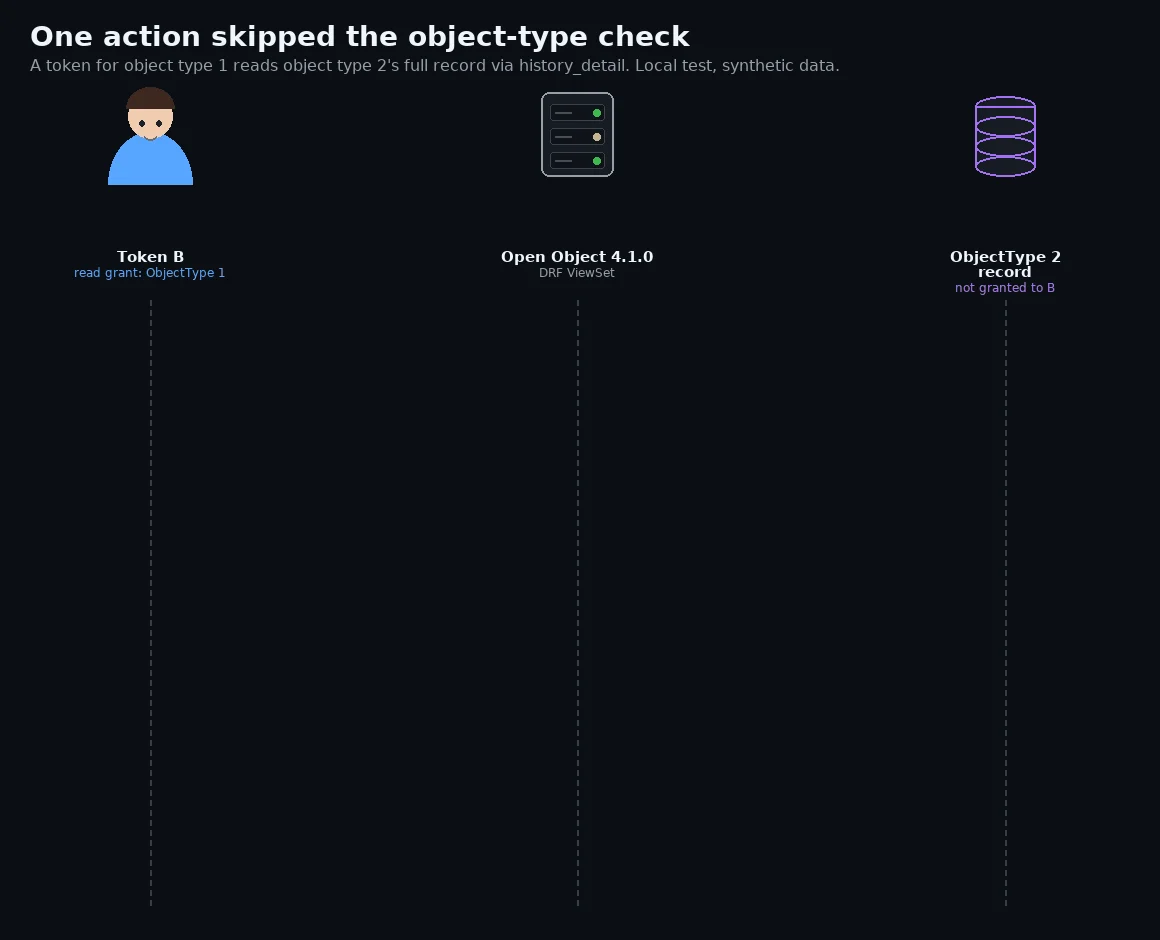
retrieve said 403. history_detail said 200. (Objects API, CVE-2026-82411)
The record-version detail endpoint of the Objects API returned a record without checking whether the token had a grant on that record's object type. A token with a read grant on one object type could read the full versioned data of a record of any other object type, given the object's UUID.
 Published on medium.com
Open Object stores “objects” for other applications. The docs’ examples include a parking permit, a tree and a complaint.
The full write-up lives on its author's site
It belongs to its author, so we link to it rather than copy it. The other two tabs are our own rewrites, checked against it.
Open Object, the project formerly called the Objects API, stores object registrations for other applications and hands out API tokens with read or write grants per object type. One action in its v2 API, the record-version detail endpoint history_detail, returned a record without ever running that per-type check. A token with a read grant on one object type could read the full versioned data of a record belonging to any other object type, provided the caller knew the object's UUID. This is the write-up of how I found it, reproduced it locally, and what the maintainers changed.
Context
Open Object is a Django and Django REST Framework (DRF) application. It was commissioned by the Municipality of Utrecht, is designed in line with the Common Ground model, and the documentation names municipalities as the organisations that want to store these objects. The documentation's examples include a parking permit, a tree and a complaint.
The access model is per object type: clients "have explicit access to objects based on their object types". A token can hold a read grant on trees and no grant at all on parking permits. The bug described here went around that limit. Authentication was never the problem, because the token was real. What went missing was the next question: does this token have a grant on this record's object type?
What the data field holds depends on the object type. The CVE record says it can include citizen or case records and sensitive identifiers in government deployments, and the project's own Vordering (debt claim) example schema has a required Burgerservicenummer field, the Dutch citizen service number (BSN). I have not looked at any real deployment; my run used synthetic data only.
In DRF, the conventional place for object-level authorisation is self.get_object(). It fetches the record and calls check_object_permissions(), which runs each permission class's has_object_permission(). In Open Object that class is ObjectTypeBasedPermission, and its object-level check asks whether the token has a grant on this record's object type.
Two other places matter:
- The view-level gate,
has_permission(), runs before the record is loaded, so it cannot know which object type you are about to touch. - The queryset can be scoped to the token's grants with the
filter_for_token()queryset method.listandsearchget that.
So a read is authorised in one of two ways. retrieve and history go through self.get_object(). list and search go through the queryset filter. An action that does neither gets no object-type check at all.
Setup
I found the issue by source review and reproduced it locally in Docker against the shipped maykinmedia/open-object:4.1.0 image, with Postgres and Redis. No hosted system was touched. The code quoted below is from tag 4.1.0, the version I tested.
I created two non-superuser tokens on the same instance, each with a read grant on a different object type:
- Token A: read on ObjectType 2
- Token B: read on ObjectType 1 only
I then seeded one object of ObjectType 2 with a marker payload: {"secret":"CROSS-TYPE-LEAK-CANARY","bsn":"123456789",...}. The BSN is made up.
Finding it
The history_detail action fetches the record with get_object_or_404 and returns it directly:
# src/objects/api/v2/views.py, tag 4.1.0, lines 493-498 (history_detail) def history_detail(self, request, uuid=None, index=None): """Retrieve a RECORD of an OBJECT.""" queryset = self.get_queryset() record = get_object_or_404(queryset, object__uuid=uuid, index=index) serializer = self.get_serializer(record) return Response(serializer.data)
The view-level gate lets any authenticated token through for every action except create:
# src/objects/token/permissions.py, tag 4.1.0, lines 9-22 (ObjectTypeBasedPermission) def has_permission(self, request, view): if bypass_permissions(request): return True
# request should be token authenticated if not request.auth: return False if request.auth.is_superuser: return True # detail actions are processed in has_object_permission method if view.action != "create": return True ...
That comment is the assumption: a detail action gets checked later, in has_object_permission. Nothing in history_detail makes that happen.
The token filter applies only to list and search:
# src/objects/api/v2/views.py, tag 4.1.0, lines 340-345 (end of get_queryset) if self.action not in ("list", "search"): return base
# show only allowed objects base = base.filter_for_token(token_auth) return base
So for history_detail, any valid token passes the view-level gate, the queryset is not filtered, and check_object_permissions() is never called, so has_object_permission() never runs. HistoryRecordSerializer is a plain ModelSerializer whose fields include data, so the record's whole payload goes back.
The history action directly above it in the same ViewSet does get the check, because it fetches with self.get_object():
# src/objects/api/v2/views.py, tag 4.1.0, line 459 (history) records = self.get_object().object.records.order_by("id")
# src/objects/api/v2/views.py, tag 4.1.0, lines 495-496 (history_detail) queryset = self.get_queryset() record = get_object_or_404(queryset, object__uuid=uuid, index=index)
Exploitation
Step 1: confirm the control case is denied
With Token B, which has no grant on ObjectType 2, I requested the seeded object through retrieve:
# Token B, control: retrieve is deniedGET /api/v2/objects/{uuid}-> HTTP 403 permission_denied
The 403 is the expected behaviour: retrieve goes through self.get_object() and the object-level check refuses the token.
Step 2: request the same object through history_detail
Same token, same object, but the record-version detail endpoint with index 1 (record indexes start at 1):
# Token B, the bug: history_detail on the same objectGET /api/v2/objects/{uuid}/1-> HTTP 200{"index":1,"typeVersion":1,"data":{"bsn":"123456789","note":"OType2 citizen record","secret":"CROSS-TYPE-LEAK-CANARY"},...}# Token A, control: it has the grant, so 200 is expectedGET /api/v2/objects/{uuid}/1-> HTTP 200# Token B, sanity check: the token is validGET /api/v2/objects-> HTTP 200
The response body is abridged where it shows .... The important part is the data object: the canary value CROSS-TYPE-LEAK-CANARY and the synthetic BSN come back to a token that has no grant on that object type. The second request in the block is Token A, which does hold the grant, so its 200 is expected. The third is a sanity check that Token B itself is valid, which it is.
Same token, same object: 403 through retrieve, 200 through history_detail. That split is the finding.
Honest boundary
The run reads one seeded canary record. There is no write, no code execution and no privilege change. It is a confidentiality bug (C:H, I:N, A:N). I tested one pair of object types. I already had the UUID because I seeded the object. Object UUIDs default to random uuid4 values, list and search are filtered by token, and I did not test any way of discovering another type's UUID. I also did not request history as Token B; that it enforces the grant comes from the source and from the project's test_history_no_object_permissions, which expects 403.
The advisory rates it Moderate with CVSS 6.5, and the CVE record carries the same score and vector as MEDIUM: CVSS:3.1/AV:N/AC:L/PR:L/UI:N/S:U/C:H/I:N/A:N, CWE-639.
Root cause
DRF only runs check_object_permissions() from self.get_object(). history_detail fetches with get_object_or_404 on self.get_queryset(), and get_queryset() deliberately returns the unfiltered base queryset for any action other than list and search. The view-level has_permission() returns True for every action except create on the stated assumption that detail actions are handled in has_object_permission(). Nothing in this action calls into that path, so the check is skipped silently, with no error.
The existing defences did not stop it because each one covers a different path. The view-level gate cannot know the object type before the record is loaded. The queryset filter only applies to list and search. The object-level check only runs when something calls self.get_object() or check_object_permissions(). history_detail fell between all three.
Impact
A token with a read grant on one object type could read the full versioned data of a record of any other object type, given the object's UUID. The impact is read-only. What that data contains depends on the deployment: the CVE record says it can include citizen or case records and sensitive identifiers in government deployments, and the project's own Vordering example schema has a required Burgerservicenummer field. The practical limit is the UUID requirement: object UUIDs default to random uuid4 values, and I did not test any way of discovering another type's UUID.
Fix
The fix shipped on 2026-07-16 in four release lines: 2.5.1, 3.6.2, 4.0.2 and 4.1.1. The 4.1.x commit makes two changes.
The first keeps the same fetch and adds one direct call on the fetched record:
# src/objects/api/v2/views.py, commit ce6b182 (history_detail) queryset = self.get_queryset() record = get_object_or_404(queryset, object__uuid=uuid, index=index)+ self.check_object_permissions(self.request, record) serializer = self.get_serializer(record) return Response(serializer.data)
It uses neither self.get_object() nor filter_for_token, the two options my report suggested. A token with no grant now gets 403: the commit adds test_history_detail_no_object_permissions, which asserts that. I did not re-run my PoC against the fixed releases.
The second change extends an existing rule. A read-only token using field-based permissions (the documentation's "Use fields" option) was already refused history. Now it is refused history_detail too, even with a grant on that object type:
# src/objects/token/permissions.py, commit ce6b182 (has_object_permission) # forbid showing history if there is field based auth if (- view.action == "history"+ view.action in ["history", "history_detail"] and object_permission.mode == PermissionModes.read_only and object_permission.use_fields ):
My run did not test field-restricted tokens. Both changes are also present at tags 2.5.1, 3.6.2 and 4.0.2.
If you run Open Object or the Objects API, you need 2.5.1, 3.6.2, 4.0.2, 4.1.1 or later. The project's versioning page lists 4.0.x and 4.1.x as past their support dates, so on 4.x move to 4.2.x or 4.3.x, which both carry the fix.
Variants to test
- Every custom
@actionthat fetches a record. Grep your DRF ViewSets forget_object_or_404and direct queryset fetches inside@actionmethods. A positive result is an action that returns a record to a token with no grant on that record's object type, while the matchingretrievereturns 403 for the same token and object. - Actions that rely on the view-level gate deferring to the object-level check. Look for a
has_permission()that returnsTruefor detail actions with a comment saying the object-level check handles them. A positive result is any detail action in that ViewSet that never reachescheck_object_permissions(). - Queryset filters scoped by action name. Where a filter is applied only for
listandsearch, test every other read action against a token with no grant. A positive result is a 200 with another type'sdatawhere a 403 is expected. - Test coverage of denials. Check whether the test suite has a no-permission test for each action, not just the neighbouring one. At 4.1.0,
test_auth.pyhadtest_history_no_object_permissionsand nothing forhistory_detail; a missing test next to a passing one is a useful signal. - Field-restricted and read-only tokens. After the fix,
history_detailis refused for read-only tokens using field-based permissions even with a grant. On other targets, check whether field-level restrictions are enforced on every history-style endpoint, not just the main one.
Disclosure timeline
- 2026-06-19: Found by source review and reproduced locally on the shipped
open-object:4.1.0image with a synthetic canary. - 2026-06-23: Reported privately through GitHub's private vulnerability reporting on
maykinmedia/open-object. - 2026-07-16: Advisory GHSA-55w6-rqp5-j5wx published by the maintainers, and the fix released in 2.5.1, 3.6.2, 4.0.2 and 4.1.1.
- 2026-10-28: CVE-2026-82411 record published.
The advisory credits two reporters: me and @raysabee. Comments and corrections welcome.
What happened, in plain words
Open Object is a piece of software that other applications use as a shared storage cupboard for records they call "objects". A parking permit, a tree, a complaint: each one is an object, and each object belongs to a category called an object type. To use the cupboard, an application gets a key called an API token. Each token is allowed to read or write only certain object types. A token for the parks department might be allowed to read trees and nothing else.
One of the ways to read from Open Object is a web address that returns the saved versions of a single record. That address is called history_detail. It had a flaw: it handed back the record without checking whether the token was allowed to see that record's object type. So a token that was only allowed to read trees could read a parking permit, as long as the caller knew the permit's unique identifier (its UUID).
Nothing was wrong with the login. The token was genuine. What was missing was the second question every request should answer: is this particular token allowed to see this particular kind of record? The answer was never asked on that one address.
The problem is read-only: the test run changed no data, ran no code and changed no privileges. It was rated Moderate, with a score of 6.5 on the CVSS scale (a standard way of scoring how serious a security flaw is), and classified as CWE-639, the catalogue entry for "authorization bypass through a user-controlled key". The public advisory is GHSA-55w6-rqp5-j5wx and the CVE identifier is CVE-2026-82411.
Why this matters
Open Object was commissioned by the Municipality of Utrecht and is designed in line with the Common Ground model, a Dutch approach to sharing government data. The documentation names municipalities as the organisations that want to store these objects, and its examples include a parking permit, a tree and a complaint.
The access model is per object type: clients "have explicit access to objects based on their object types". In everyday terms, the cupboard has separate locked sections, and each key opens only its own section. This bug let a key open a section it was never cut for.
What sits inside a record depends on the object type. The CVE record says it can include citizen or case records and sensitive identifiers in government deployments. The project's own Vordering (debt claim) example schema has a required Burgerservicenummer field, the Dutch citizen service number, usually shortened to BSN. That is the kind of number you would never want handed to the wrong application. The author of the report did not look at any real deployment; the test run used made-up data only.
The setup: how the software decides who may read what
Open Object is built with Django and Django REST Framework (DRF). Django is a popular framework for building web applications in the Python programming language; DRF is an add-on that makes it easy to build APIs, which are the machine-facing web addresses that applications call to fetch or send data. Think of an API as a service counter: you do not walk into the kitchen, you ask at the counter and get exactly what the counter decides to give you.
In DRF, the usual place to check whether a caller may see one specific record is a method called self.get_object(). A method is a named block of code that does one job. This one does two things: it fetches the record from the database, and it calls check_object_permissions(), which runs every permission rule's has_object_permission() (the rule that looks at one individual record). In Open Object that rule is ObjectTypeBasedPermission, and it asks whether the token has a grant on this record's object type.
Two other places matter:
- The view-level gate,
has_permission(), runs before the record is loaded, so it cannot know which object type you are about to touch. It is the bouncer at the door who checks you have a ticket at all, not which seat it is for. - The queryset can be narrowed to the token's grants with the
filter_for_token()queryset method. A queryset is the list of records a request is allowed to work with; filtering it means the database only ever returns rows the token may see.listandsearchget that filter.
So a read is authorised in one of two ways. retrieve and history go through self.get_object(), which runs the per-record check. list and search go through the queryset filter, which never even loads forbidden rows. An action that does neither gets no object-type check at all. That third case is where the bug lived.
Finding it
No hosted system was touched. The code quoted below is from tag 4.1.0, the version tested.
Two non-superuser tokens were created on the same instance, each with a read grant on a different object type:
- Token A: read on ObjectType 2
- Token B: read on ObjectType 1 only
One object of ObjectType 2 was then seeded (created on purpose for the test) with a marker payload: {"secret":"CROSS-TYPE-LEAK-CANARY","bsn":"123456789",...}. A canary here means a unique value planted so that if it ever appears somewhere it should not, you know for certain where it came from. The BSN is made up.
The history_detail action fetches the record with get_object_or_404 and returns it directly:
# src/objects/api/v2/views.py, tag 4.1.0, lines 493-498 (history_detail) def history_detail(self, request, uuid=None, index=None): """Retrieve a RECORD of an OBJECT.""" queryset = self.get_queryset() record = get_object_or_404(queryset, object__uuid=uuid, index=index) serializer = self.get_serializer(record) return Response(serializer.data)
Line by line:
def history_detail(self, request, uuid=None, index=None):defines the action. It receives the incoming request, the object's UUID (its unique identifier) and an index (which saved version of the record you want).queryset = self.get_queryset()asks the view for the list of records it may work with.record = get_object_or_404(queryset, object__uuid=uuid, index=index)looks up the one record matching that UUID and index inside that list.serializer = self.get_serializer(record)prepares the record for conversion into JSON, the text format APIs use to send data back.return Response(serializer.data)sends the converted record back to the caller.
Now the view-level gate, which lets any authenticated token through for every action except create:
# src/objects/token/permissions.py, tag 4.1.0, lines 9-22 (ObjectTypeBasedPermission) def has_permission(self, request, view): if bypass_permissions(request): return True
# request should be token authenticated if not request.auth: return False if request.auth.is_superuser: return True # detail actions are processed in has_object_permission method if view.action != "create": return True ...
Line by line:
def has_permission(self, request, view):is the door check that runs before any record is loaded.if bypass_permissions(request): return Trueis a bypass check that returns True.if not request.auth: return Falsereturns False when there is no token.if request.auth.is_superuser: return Truereturns True for a superuser token.# detail actions are processed in has_object_permission methodis a comment, a note to humans that the computer ignores. It states the assumption: actions that look at one record will be checked later, by the per-record rule.if view.action != "create": return Truelets every action except creating a new object through at this stage.
That comment is the assumption, and it is the heart of the bug: a detail action is supposed to get checked later, in has_object_permission. Nothing in history_detail makes that happen.
The token filter applies only to list and search:
# src/objects/api/v2/views.py, tag 4.1.0, lines 340-345 (end of get_queryset) if self.action not in ("list", "search"): return base
# show only allowed objects base = base.filter_for_token(token_auth) return base
Line by line:
# show only allowed objectsis a comment describing the next line.return basehands the narrowed list back.
Put together, for history_detail: any valid token passes the view-level gate, the queryset is not filtered, and check_object_permissions() is never called, so has_object_permission() never runs.
The history action directly above it in the same ViewSet does get the check, because it fetches with self.get_object(). A ViewSet is DRF's way of grouping related actions for one kind of thing into a single class.
# src/objects/api/v2/views.py, tag 4.1.0, line 459 (history) records = self.get_object().object.records.order_by("id")
# src/objects/api/v2/views.py, tag 4.1.0, lines 495-496 (history_detail) queryset = self.get_queryset() record = get_object_or_404(queryset, object__uuid=uuid, index=index)
Line by line:
- In
history_detail,self.get_queryset()returns the list, andget_object_or_404(...)picks the record out of it. No permission check is triggered anywhere in that path.
The image sits next to the comparison of the history and history_detail fetches.
The comparison is the whole finding: retrieve and history reach the record through self.get_object(), which runs the object-level check; list and search are scoped by filter_for_token; history_detail did neither, so nothing compared the token's grants with the record's object type.
Proving it, step by step
Step 1: confirm the control case is denied
With Token B, which has no grant on ObjectType 2, the seeded object was requested through retrieve:
# Token B, control: retrieve is deniedGET /api/v2/objects/{uuid}-> HTTP 403 permission_denied
Line by line:
# Token B, control: retrieve is deniedis a note saying which token is used and what is expected. A control is a test whose result you already know, used to prove the setup is sound.GET /api/v2/objects/{uuid}is the request:GETmeans "read this", and the address points at one object by its UUID. The curly braces are a placeholder for the real identifier.
The 403 is the expected behaviour: retrieve goes through self.get_object() and the object-level check refuses the token. This step matters because it proves the token really is not allowed to see this object, so any later success is a flaw and not a misconfiguration.
Step 2: request the same object through history_detail
Same token, same object, but the record-version detail endpoint with index 1 (record indexes start at 1):
# Token B, the bug: history_detail on the same objectGET /api/v2/objects/{uuid}/1-> HTTP 200{"index":1,"typeVersion":1,"data":{"bsn":"123456789","note":"OType2 citizen record","secret":"CROSS-TYPE-LEAK-CANARY"},...}# Token A, control: it has the grant, so 200 is expectedGET /api/v2/objects/{uuid}/1-> HTTP 200# Token B, sanity check: the token is validGET /api/v2/objects-> HTTP 200
Line by line:
# Token B, the bug: history_detail on the same objectmarks the request that should have been refused.GET /api/v2/objects/{uuid}/1asks for saved version 1 of that object.- The JSON body that follows is the record itself, including the canary value
CROSS-TYPE-LEAK-CANARYand the synthetic BSN indata. # Token A, control: it has the grant, so 200 is expectedis the second control: Token A is allowed on ObjectType 2, so a 200 here is correct and shows the endpoint works normally for permitted callers.# Token B, sanity check: the token is validis the third control: listing objects with Token B returns 200, proving the token itself is genuine and active.
The response body is abridged where it shows .... The important part is the data object: the canary value and the synthetic BSN come back to a token that has no grant on that object type. The second request in the block is Token A, which does hold the grant, so its 200 is expected. The third is a sanity check that Token B itself is valid, which it is.
Same token, same object: 403 through retrieve, 200 through history_detail. That split is the finding. One door says no, the door next to it says yes, and the only difference is which piece of code opened the record.
What the test does not show
The run reads one seeded canary record. There is no write, no code execution and no privilege change. It is a confidentiality bug: in CVSS terms C:H (confidentiality, high impact), I:N (integrity, none) and A:N (availability, none). One pair of object types was tested. The UUID was already known because the object was seeded. Object UUIDs default to random uuid4 values, which are long random strings that are impractical to guess, list and search are filtered by token, and no way of discovering another type's UUID was tested. history was also not requested as Token B; that it enforces the grant comes from the source and from the project's test_history_no_object_permissions, a test that expects 403.
The advisory rates it Moderate with CVSS 6.5, and the CVE record carries the same score and vector as MEDIUM: CVSS:3.1/AV:N/AC:L/PR:L/UI:N/S:U/C:H/I:N/A:N, CWE-639.
Why it happened
DRF only runs check_object_permissions() from self.get_object(). history_detail fetches with get_object_or_404 on self.get_queryset(), and get_queryset() deliberately returns the unfiltered base queryset for any action other than list and search. The view-level has_permission() returns True for every action except create on the stated assumption that detail actions are handled in has_object_permission(). Nothing in this action calls into that path, so the check is skipped silently, with no error.
The existing defences did not stop it because each one covers a different path. The view-level gate cannot know the object type before the record is loaded. The queryset filter only applies to list and search. The object-level check only runs when something calls self.get_object() or check_object_permissions(). history_detail fell between all three, like a visitor waved through the front door on the promise that someone inside will check the ticket, in a room where nobody does.
What an attacker could get
A token with a read grant on one object type could read the full versioned data of a record of any other object type, given the object's UUID. The impact is read-only. What that data contains depends on the deployment: the CVE record says it can include citizen or case records and sensitive identifiers in government deployments, and the project's own Vordering example schema has a required Burgerservicenummer field. The practical limit is the UUID requirement: object UUIDs default to random uuid4 values, and no way of discovering another type's UUID was tested.
The fix
The fix shipped on 2026-07-16 in four release lines: 2.5.1, 3.6.2, 4.0.2 and 4.1.1. The 4.1.x commit makes two changes.
The first keeps the same fetch and adds one direct call on the fetched record:
# src/objects/api/v2/views.py, commit ce6b182 (history_detail) queryset = self.get_queryset() record = get_object_or_404(queryset, object__uuid=uuid, index=index)+ self.check_object_permissions(self.request, record) serializer = self.get_serializer(record) return Response(serializer.data)
Line by line:
- The first two lines are unchanged: get the list, then pick the record out of it.
- The last two lines are unchanged: convert the record and return it. Now that the check runs first, a token without a grant never reaches them.
It uses neither self.get_object() nor filter_for_token, the two options the report suggested. A token with no grant now gets 403: the commit adds test_history_detail_no_object_permissions, which asserts that. The author did not re-run the proof of concept against the fixed releases.
The second change extends an existing rule. A read-only token using field-based permissions (the documentation's "Use fields" option, where a token may see only some fields of a record) was already refused history. Now it is refused history_detail too, even with a grant on that object type:
# src/objects/token/permissions.py, commit ce6b182 (has_object_permission) # forbid showing history if there is field based auth if (- view.action == "history"+ view.action in ["history", "history_detail"] and object_permission.mode == PermissionModes.read_only and object_permission.use_fields ):
Line by line:
# forbid showing history if there is field based authis the comment explaining the rule: if a token is restricted to certain fields, do not show it history at all.+ view.action in ["history", "history_detail"]is the new condition: the rule now covers both actions.- When all three hold, the rule refuses the request.
What to check in your own code
- Every custom
@actionthat fetches a record. Search your DRF ViewSets forget_object_or_404and direct queryset fetches inside@actionmethods (the decorator that marks a method as a custom API action). A positive result is an action that returns a record to a token with no grant on that record's object type, while the matchingretrievereturns 403 for the same token and object. - Actions that rely on the view-level gate deferring to the object-level check. Look for a
has_permission()that returnsTruefor detail actions with a comment saying the object-level check handles them. A positive result is any detail action in that ViewSet that never reachescheck_object_permissions(). - Queryset filters scoped by action name. Where a filter is applied only for
listandsearch, test every other read action against a token with no grant. A positive result is a 200 with another type'sdatawhere a 403 is expected. - Test coverage of denials. Check whether the test suite has a no-permission test for each action, not just the neighbouring one. At 4.1.0,
test_auth.pyhadtest_history_no_object_permissionsand nothing forhistory_detail; a missing test next to a passing one is a useful signal. - Field-restricted and read-only tokens. After the fix,
history_detailis refused for read-only tokens using field-based permissions even with a grant. On other targets, check whether field-level restrictions are enforced on every history-style endpoint, not just the main one.
Timeline
- 2026-06-19: Found by source review and reproduced locally on the shipped
open-object:4.1.0image with a synthetic canary. - 2026-06-23: Reported privately through GitHub's private vulnerability reporting on
maykinmedia/open-object. - 2026-07-16: Advisory GHSA-55w6-rqp5-j5wx published by the maintainers, and the fix released in 2.5.1, 3.6.2, 4.0.2 and 4.1.1.
- 2026-10-28: CVE-2026-82411 record published.
Comments and corrections welcome.

