The Logic Vulnerabilities is Always Worth it
A password-reset flow keyed its one-time code to a client-supplied request identifier rather than to the email address, so replaying the same identifier for a victim's email produced the same code and allowed a full account takeover. Separately, a comment voting guard could be defeated by concurrent requests, by removing the session value, or by corrupting the session signature, and an email-change flow reserved a target address at request time, locking the real owner out indefinitely.

medium.com
Published on medium.com
Bug Bounty
The full write-up lives on its author's site
It belongs to its author, so we link to it rather than copy it. The other two tabs are our own rewrites, checked against it.
Context
This write-up covers three findings from the same bug bounty program, all of them logic or access-control problems rather than memory-safety or injection bugs. The first is a race condition in a password-reset OTP flow that leads to full account takeover, triaged at CVSS 7.1 (High). The second is broken access control in a comment up/downvote system on an e-commerce target, exploitable in three independent ways. The third is a workflow bug in an email-change flow that lets an attacker lock an arbitrary email address out of the platform, with the lock outliving the confirmation token.
The author is Youssef, who goes by tomahawk0ctf. The report does not name the program or the target domains.

The features involved are ordinary ones: a password reset that sends a one-time code by email, a product comment voting widget with a one-vote-per-user guard, and a three-step email-change flow (request, verify, commit).
Setup
The report does not describe the accounts, roles or tool versions used. The testing was done with Burp Suite, since the author refers to Burp history when replaying earlier requests. For the first finding the attacker needs their own account to capture a request_id and OTP, plus the victim's email address. For the third, the attacker needs nothing beyond their own account and the victim's email address.
Finding it
Finding 1: OTP tied to a client-supplied request_id
The password reset endpoint accepted a simple JSON body:
{ "email": "[redacted]", "request_id": "UUID", "method": "CODE"}
A request_id (UUID) was generated per reset attempt and tied to an OTP delivered to the user's email.
The first experiment was the obvious one: fire two reset requests at two different emails simultaneously. Each request received a different request_id, and each email got its own distinct OTP. Nothing there, but worth pulling further.
While poking at the resend-code functionality, the author noticed that resending with the same request_id always returned the same OTP. The code was not rotating. That suggested the OTP was derived from, or stored against, the request_id rather than regenerated per request, and was not bound to the email or account itself.
That raised the real question: what happens if two different email addresses end up sharing the same request_id? Burp history from the parallel-request test confirmed that each request normally gets a unique request_id, so the collision had to be forced manually: replaying the reset request for two different emails using the same request_id instead of letting the server mint a new one each time.
Finding 2: a vote guard that can be bypassed three ways
On the e-commerce target, product comments supported upvote and downvote, with a "you already voted" guard meant to enforce one vote per user per comment. The author found three independent ways to defeat that guard, described under Exploitation.
Finding 3: an email reserved before it is verified
Most email-change flows follow the same three-step pattern: request, verify, commit. You ask to change your email, a confirmation link lands in the new inbox, you click it, and only then does the change take effect. The design assumes step three only happens after step two, so ownership is proven before anything is bound to the address.
On this target that assumption was wrong. The author went in expecting an IDOR on the confirmation token or a way to skip the click. Instead, the moment you submit a target email and hit "send confirmation link", the platform reserves that email address against your account, before the recipient has done anything.
To confirm this was not a UI illusion, the author checked their own attacker account's email after firing the request: still unchanged. The request gives the attacker nothing, no new email and no new access. The only thing that changes is on the victim's side: their address is now locked to someone else's pending, unconfirmed request. That made it a denial-of-access primitive rather than an ATO chain. The attacker does not need the victim to do anything, or even to know the attacker exists. They only need the victim's email address.
Exploitation
Finding 1, step 1: capture a valid request_id and OTP pair
The attacker initiates a reset for their own account and captures the request_id and the OTP that arrives by email.
Finding 1, step 2: replay with the victim's email
The attacker replays a reset request for the victim's email using that same request_id.
Finding 1, step 3: the server issues the same OTP
Both emails resolved to the identical OTP. The server issued the same code for the victim's account as for the attacker's.
Finding 1, step 4: reset the victim's password
The attacker submits the known OTP against the victim's email, the password is reset, and the account is taken over.
Finding 2, bypass 1: race condition
Firing concurrent vote requests (same comment, same session) before the server could commit the "already voted" state let multiple votes land before the check caught up. This is a classic TOCTOU on the vote-tracking logic.
Finding 2, bypass 2: session deletion
Stripping the session value entirely and replaying the vote request still resulted in a successfully processed vote. The endpoint did not fail closed when the session was absent. It fell back to an unauthenticated or untracked state and processed the action anyway, with no "already voted" tracking possible because there was nothing to key it against.
Finding 2, bypass 3: session tampering
This was the most interesting one. Modifying the session value itself, specifically truncating or altering the signature portion (session_one.signature to corrupted), and replaying produced the following sequence:
- Vote once normally: blocked correctly on a second attempt ("you already voted").
- Corrupt the session signature, vote again: succeeds.
- Corrupt it differently, vote again: succeeds again.
The backend was not validating session integrity before trusting it for authorisation or deduplication. The "already voted" check was apparently tied to the literal session value rather than a verified, tamper-proof user identity, so any mutation of the session string that still passed basic parsing was treated as a new identity for voting purposes, while still being accepted for the request overall.
Finding 3, step 1: reserve the victim's email
The attacker submits the victim's email address in the email-change form and triggers the confirmation link. The platform binds the address to the attacker's pending request immediately, before any confirmation.
Finding 3, step 2: confirm the lock
The author tried to use the victim's email themselves right after:
- Signup with it: rejected, "black listed" error.
- Login with it: fails.
- Password reset with it: fails.
Finding 3, step 3: check whether the lock expires
The author let the confirmation token sit unused past its own validity window (roughly 24 hours) and tried again. Same rejection. The lockout outlived the token that created it. There was no cleanup job and no release, so it became an indefinite denial of service against an email address the attacker does not own.
Root cause
Finding 1
The OTP was generated and validated against request_id as the primary key, with no server-side binding to the specific email or account the request was supposed to belong to. Since request_id was attacker-controllable, or at minimum reusable and predictable within a short window, this collapsed into a race-condition-adjacent IDOR on the OTP itself. No rate limit or binding stopped the collision.
Finding 2
Two separate failures stacked together:
- Fail-open on a missing or invalid session instead of rejecting the request outright.
- No session signature or integrity verification before using the session as the basis for per-user state (vote deduplication).
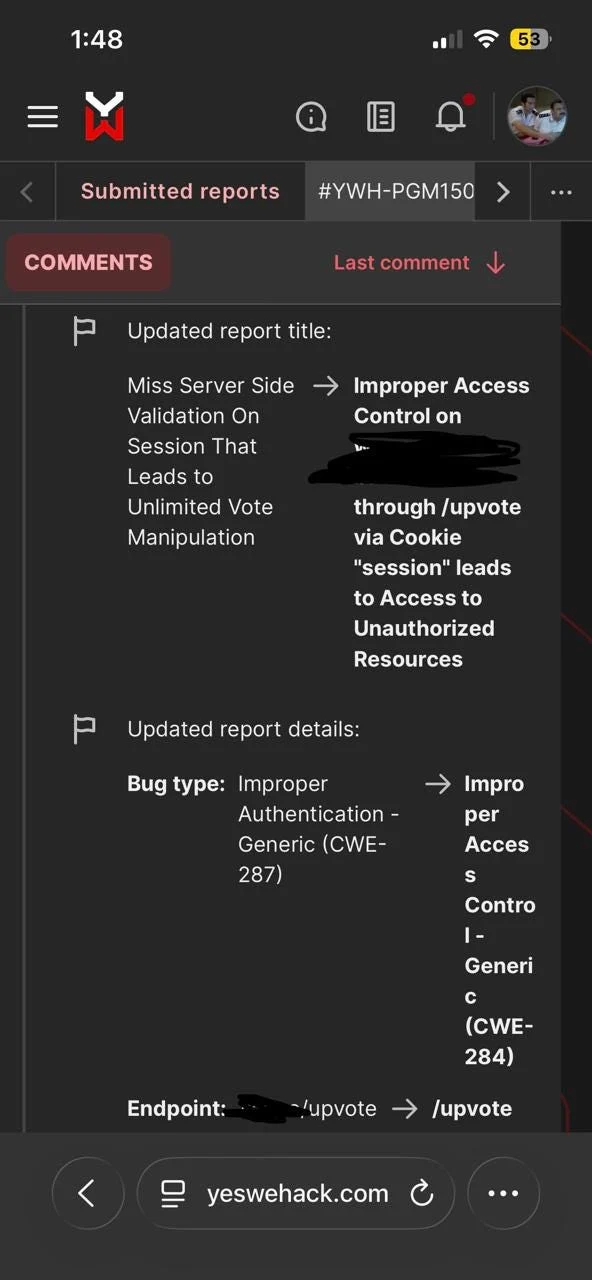
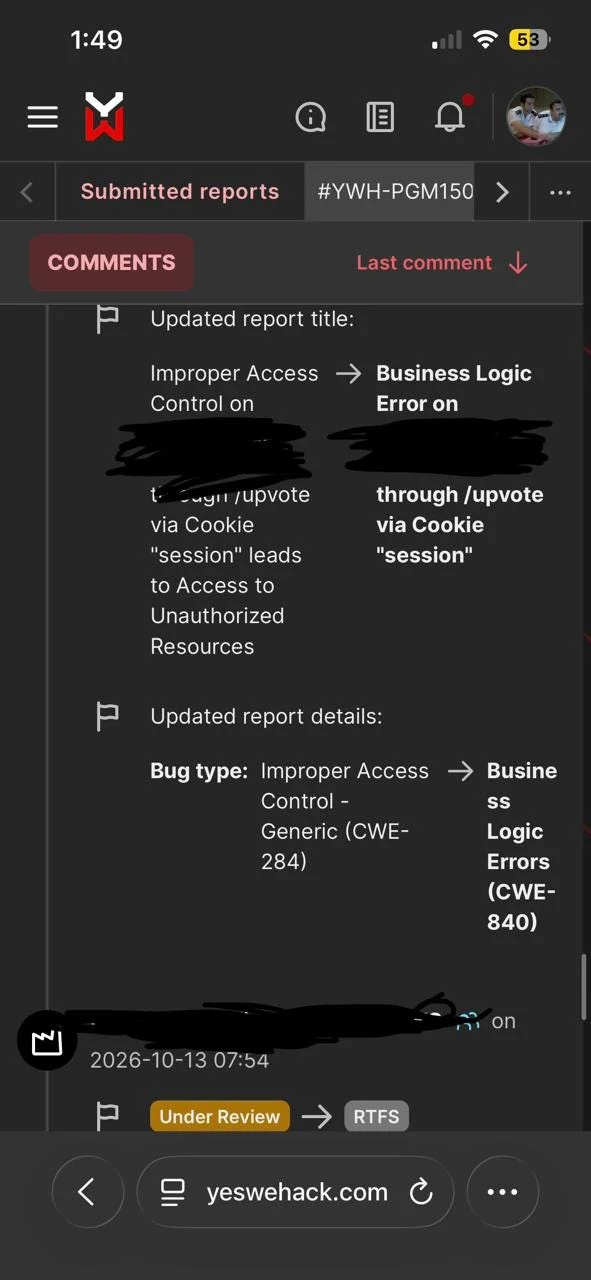
The author frames this as textbook Improper Access Control (CWE-284) and CWE-346 (Origin Validation Error), not a logic bug in the dismissive sense triage gave it. A logic bug is "the business rule is wrong". Here the business rule exists, and the enforcement mechanism can be trivially bypassed by corrupting attacker-controlled input that should never have been trusted in that state.
Finding 3
The platform conflates two states that should never be conflated: a change was requested, and ownership was confirmed. It binds the target email at request time instead of confirm time, and has no fallback to release that binding if confirmation never happens. In CWE terms this is CWE-841, Improper Enforcement of Behavioral Workflow: the system has the right steps defined, it just does not enforce that they happen in the right order before taking an action with real consequences.

Impact
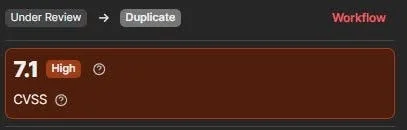
Finding 1 was flagged at CVSS 7.1 (High) during triage. No user interaction is required beyond knowing the target email, and the end state is complete account compromise.
Finding 2 lets an attacker cast more than one vote on the same comment, since the one-vote-per-user guard can be bypassed by racing, by removing the session, or by corrupting the session signature.
Finding 3 is a denial of access against an arbitrary email address. The victim cannot sign up, log in or reset their password with that address, and the lock persists after the confirmation token expires. The finding was out of scope.
Fix
The fixes implied by the root causes are:
- Bind the OTP to the email or account server-side, and treat
request_idas a lookup key rather than the identity of the reset. Regenerate the code per request, or reject arequest_idthat is reused for a different email. - For the vote guard, fail closed when the session is missing or invalid, and verify session integrity before using it for authorisation or deduplication.
- For the email-change flow, bind the target address only at confirmation time, and release any reservation when the confirmation token expires.
Variants to test
- Reused request identifiers in other OTP flows. Try replaying a reset, signup or MFA request with the same
request_id,flow_idor similar client-supplied value against a different email or phone number. A positive result is the same code being issued for the second identity. - Resend behaviour. Request a code, then resend with the same identifier. If the code does not rotate, the identifier is likely the storage key, which is worth pushing further.
- Concurrent vote or like requests. Fire parallel requests for the same object and session before the guard commits. A positive result is more than one vote counted.
- Missing session on state-changing endpoints. Strip the session cookie entirely and replay the request. A positive result is the action being processed rather than rejected.
- Session signature tampering. Truncate or alter the signature portion of the session value and replay a guarded action. A positive result is the guard treating the mutated value as a new identity while the request is still accepted.
- Request-time reservation in email-change flows. Submit a target address without confirming it, then try to sign up, log in or reset the password with that address. A positive result is rejection while the pending request exists, and again after the confirmation token expires.
Closing note
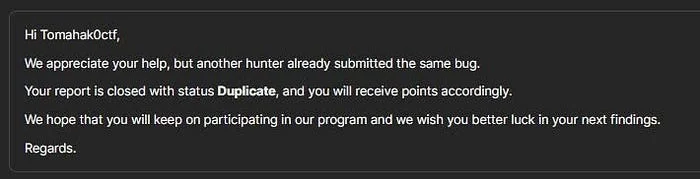
The author's summary of the outcomes: Finding 1 was closed as Duplicate, with points awarded but no CVSS-weighted bonus. Finding 2 got an "RTFS" response and was closed as RTFS / "logic", and the program closed down shortly after. Finding 3 was out of scope.
What happened, in plain words
A security researcher who goes by tomahawk0ctf (his name is Youssef) spent time testing a bug bounty program, which is a scheme where companies invite outside testers to look for weaknesses in their websites and pay or reward them for reporting what they find. He found three separate problems. None of them involved exotic programming tricks: all three came from the way the websites were designed to behave, which is why people call them logic bugs.
The first problem was in a password reset feature. When you forget your password, a site usually emails you a short code that you type in to prove the email address is yours. On this site, the code was tied to a reference number that the person making the request could reuse, and possibly control. By reusing one reference number for two different email addresses, the researcher could get the same code issued for someone else's account, then use it to reset that person's password and take over the account. It was flagged at 7.1 on a scoring scale called CVSS during triage, which puts it in the High band.
The second problem was in the upvote and downvote buttons on product comments at an online shop. The site tried to stop you voting twice on the same comment, but the researcher found three different ways around that guard: sending many votes at the same instant, removing the session value entirely, and corrupting part of the session value.
The third problem was in the feature that lets you change the email address on your account. The site reserved the new address the moment you asked for the change, before you had proved you owned it. That meant anyone could type in a stranger's email address and lock that address out of the site: the real owner could no longer sign up, log in or reset their password with it, and the lock did not go away when the confirmation link expired. This one was out of scope, meaning the program would not accept reports about that area.
The reports did not end the way the researcher hoped. The password reset one was closed as a duplicate, because someone else had reported it first. The voting one was closed with a short reply telling him to read the source code ("RTFS") and dismissed as "logic", and the program shut down soon afterwards.
The features involved
All three findings are about features you have almost certainly used yourself:
- A password reset that sends a one-time code by email. A one-time code (often shortened to OTP, for one-time password) is a short string of digits or letters that is meant to work once and then be useless.
- A comment voting widget on an online shop, with a rule of one vote per person per comment.
- A three-step email change flow: you ask for the change, you prove you own the new address, and then the change is saved.
A few words you will need
Before the findings, here are the basic ideas, explained from zero.
An API (application programming interface) is the part of a website that the page in your browser talks to behind the scenes. When you click a button, your browser does not usually reload a whole page; it sends a small message to the API and the API sends back an answer, often in a format called JSON, which is just text arranged as labelled values. Think of a restaurant: the menu and the waiter are the API, the kitchen is the server, and you never walk into the kitchen yourself.
A request is one of those messages. It has an address (the endpoint, the specific URL the message goes to), a method (roughly, the verb: fetch something, or submit something), and often a body, the content of the message.
A session is how a website remembers who you are between requests. Because the web is stateless, meaning each request arrives with no memory of the previous one, the site gives your browser a small piece of text called a session cookie or session token after you log in. Your browser sends it back with every request, like a wristband at a festival that lets staff recognise you without asking for your ID each time. A well-built session value is signed, meaning the server attaches a cryptographic stamp so it can tell whether the value was altered. If the server does not check that stamp, anyone can edit the value and the server will still believe it.
A race condition happens when two actions run at almost the same moment and the system's checks cannot keep up. Picture a turnstile that counts people: if two people squeeze through in the same instant, the counter may record one. In software, if a rule says "only one vote per person" but the check and the saving of the vote are two separate steps, firing many requests at once can slip several votes past the check before the first one is recorded. The formal name for this pattern is TOCTOU, time-of-check to time-of-use: the state changed between the moment it was checked and the moment it was used.
An IDOR (insecure direct object reference) is when a site lets you reach someone else's data by changing an identifier in a request, because it never checks that the identifier belongs to you. Think of a hotel where room numbers are on the keys and the doors do not check who is holding them.
Broken access control is the umbrella term for any case where the site fails to check whether you are allowed to do what you are asking. Fail-open means that when a check cannot be performed (for example, no session was supplied), the system lets the action through instead of refusing it. The safe behaviour is fail-closed: if in doubt, say no.
CWE is a public catalogue of weakness types, each with a number, used to label findings consistently. CVSS is a separate scoring system that rates how severe a finding is, from 0 to 10.
Burp Suite is a tool that sits between your browser and a website so you can see every request, edit it, and send it again. The researcher used its history feature, which keeps a log of everything already sent, to replay earlier requests.
Finding 1: a password reset code that follows the wrong owner
What the feature does
The password reset endpoint accepted a simple JSON body:
{ "email": "[redacted]", "request_id": "UUID", "method": "CODE"}
Line by line:
emailis the address whose password is to be reset. In the example it is the victim's address.request_idis a reference number for this particular reset attempt. A UUID is a long random-looking identifier, something like a very long serial number, meant to be unique each time.methodsays how the code should be delivered. Here the valueCODEmeans a one-time code by email.
The site generated a request_id for each reset attempt and tied it to a one-time code sent to the user's email. The intended logic is: this reference number belongs to this attempt, and this attempt belongs to this email address.
How the researcher found it
- The first experiment was the obvious one: send two reset requests for two different email addresses at the same time and watch what comes back. Each request got its own
request_id, and each address received its own distinct code. Nothing to report yet, but a thread worth pulling. - While poking at the "resend code" button, the researcher noticed something odd. Resending with the same
request_idalways produced the same code. The code was not rotating, meaning it was not being replaced with a fresh one. That suggested the code was derived from, or stored against, therequest_idrather than generated fresh for each request, and was not tied to the email address or account at all. - That raised the real question: what happens if two different email addresses end up sharing the same
request_id? The Burp history from the parallel test showed that each request normally gets a uniquerequest_id, so the collision had to be forced by hand: replaying the reset request for two different addresses using the samerequest_idinstead of letting the server create a new one each time.
How it was exploited
The attack has four steps:
- The attacker starts a reset for their own account and captures the
request_idand the code that arrives in their own inbox. - The attacker replays a reset request for the victim's email using that same
request_id. - The server issues the same code for the victim's account as for the attacker's. Both addresses resolved to the identical code.
- The attacker submits the code they already know against the victim's email. The password is reset, and the account is taken over.
Why it worked
The code was generated and checked against request_id as the primary key, with no server-side link to the specific email or account the request was supposed to belong to. Because request_id was under the attacker's control, or at least reusable within a short window, the whole thing collapsed into a race-condition-adjacent IDOR on the code itself. No rate limit and no binding stopped the collision.
Why it mattered
Triage rated it CVSS 7.1 (High). No user interaction is needed beyond knowing the target's email address, and the end result is complete account compromise.
What happened next
The report was closed as a Duplicate: someone else had reported the same problem first. Points were awarded, but no CVSS-weighted bonus. The researcher calls this the standard bug bounty tax, meaning the small loss you accept as part of the game.
Finding 2: a one-vote rule that can be dodged three ways
What the feature does
On the same online shop, product comments could be upvoted and downvoted. A guard was meant to enforce one vote per user per comment: try to vote a second time and you should see "you already voted". The researcher found three independent ways to defeat that guard.
Bypass 1: race condition
Firing concurrent vote requests, same comment and same session, before the server could record the "already voted" state, let multiple votes land before the check caught up. This is the classic TOCTOU pattern described earlier: the check and the recording are separate steps, and the gap between them is the opportunity.
Bypass 2: session deletion
Stripping the session value entirely and replaying the vote request still produced a successfully processed vote. The endpoint did not fail closed when the session was missing. Instead it fell back to an unauthenticated or untracked state and processed the action anyway. No "already voted" tracking was possible, because there was nothing to attach the record to.
Think of a club where the doorman checks your wristband. If you arrive with no wristband at all, a safe doorman turns you away. This one waved you in and simply did not write your name in the guest book.
Bypass 3: session tampering
This was the most interesting one. The researcher modified the session value itself, specifically truncating or altering the signature portion (session_one.signature to corrupted), and replayed the vote. The sequence was:
- Vote once normally: blocked correctly on a second attempt with "you already voted".
- Corrupt the session signature, vote again: succeeds.
- Corrupt it differently, vote again: succeeds again.
The backend was not validating session integrity before trusting it for authorisation or deduplication. The "already voted" check was apparently tied to the literal session value rather than to a verified, tamper-proof user identity. So any change to the session string that still passed basic parsing was treated as a new identity for voting purposes, while the request as a whole was still accepted.
Going back to the wristband comparison: the club was reading the name written on the wristband, but never checking the hologram that proves the club issued it. Scribble a new name on it and you are a new guest.
Why it worked
Two separate failures stacked together:
- Fail-open on a missing or invalid session instead of rejecting the request outright.
- No session signature or integrity verification before using the session as the basis for per-user state, here the vote deduplication.
The researcher frames this as textbook Improper Access Control (CWE-284) and CWE-346 (Origin Validation Error), not a logic bug in the dismissive sense triage gave it. A logic bug, in that dismissive sense, means the business rule itself is wrong. Here the business rule exists, and the enforcement mechanism can be trivially bypassed by corrupting attacker-controlled input that should never have been trusted in that state.
What happened next
The report got an "RTFS" response and was closed as RTFS and "logic". The program closed down shortly after.
Finding 3: an email address locked before anyone proves they own it
What the feature does
Most email-change flows follow the same three-step pattern: request, verify, commit. You ask to change your email, a confirmation link lands in the new inbox, you click it, and only then does the change take effect. The design assumes step three only happens after step two, so ownership is proven before anything is bound to the address. It is like a bank that only moves money into an account after you have shown ID, not when you merely fill in a form.
On this target, that assumption was wrong.
How the researcher found it
The researcher went in expecting the usual suspects: maybe an IDOR on the confirmation token, maybe a way to skip the click entirely. A token here is the random string inside the confirmation link that proves the link came from the site. Instead, something almost boring stood out. The moment you submit a target email and hit "send confirmation link", the platform does not wait for anything. It reserves that email address against your account right then, before the recipient has done a single thing.
To check this was not just a trick of the screen, the researcher looked at their own attacker account's email after sending the request. It was still unchanged. So the request gives the attacker nothing: no new email, no new access. The only thing that changes is on the victim's side. Their address is now locked to someone else's pending, unconfirmed request.
That is when it became clear this was not going to be an account takeover chain in the obvious sense. It was a denial-of-access primitive: a small building block that stops someone else from using something. The attacker does not need the victim to do anything, or even to know the attacker exists. They only need the victim's email address.
How it was exploited
- The attacker submits the victim's email address in the email-change form and triggers the confirmation link. The platform binds the address to the attacker's pending request immediately, before any confirmation.
- The researcher then tried to use the victim's email themselves, right after:
- Signup with it: rejected, with a "black listed" error.
- Login with it: fails.
- Password reset with it: fails.
- The researcher then checked whether the lock expires. The confirmation token was left unused past its own validity window, roughly 24 hours, and the attempt was repeated. Same rejection. The lockout outlived the token that created it. There was no cleanup job and no release, so it became an indefinite denial of service against an email address the attacker does not own.
Why it worked
The platform conflates two states that should never be conflated: a change was requested, and ownership was confirmed. It binds the target email at request time instead of confirm time, and has no fallback to release that binding if confirmation never happens. In CWE terms this is CWE-841, Improper Enforcement of Behavioral Workflow: the system has the right steps defined, it just does not enforce that they happen in the right order before taking an action with real consequences.
What happened next
The researcher notes the finding was out of scope, so the program would not accept it.
What each finding could do in the real world
- Finding 1 was rated CVSS 7.1 (High) during triage. No user interaction is required beyond knowing the target's email address, and the end state is complete account compromise.
- Finding 2 lets an attacker cast more than one vote on the same comment, because the one-vote-per-user guard can be bypassed by racing, by removing the session, or by corrupting the session signature. The report does not describe any further consequence beyond the vote manipulation itself.
- Finding 3 is a denial of access against an arbitrary email address. The victim cannot sign up, log in or reset their password with that address, and the lock persists after the confirmation token expires.
How the sites should have fixed it
The report does not say what the programs changed. The fixes implied by the root causes are:
- Bind the code to the email or account on the server side, and treat
request_idas a lookup key rather than the identity of the reset. Regenerate the code per request, or reject arequest_idthat is reused for a different email. - For the vote guard, fail closed when the session is missing or invalid, and verify session integrity before using it for authorisation or deduplication.
- For the email-change flow, bind the target address only at confirmation time, and release any reservation when the confirmation token expires.
Things worth trying on other sites
These are the same ideas generalised, so you can look for similar mistakes elsewhere. Only test on sites that invite it through a bug bounty program or that you own.
- Reused request identifiers in other code flows. Try replaying a reset, signup or two-factor request with the same
request_id,flow_idor similar client-supplied value against a different email or phone number. A positive result is the same code being issued for the second identity. - Resend behaviour. Request a code, then resend with the same identifier. If the code does not rotate, the identifier is likely the storage key, which is worth pushing further.
- Concurrent vote or like requests. Fire parallel requests for the same object and session before the guard records anything. A positive result is more than one vote counted.
- Missing session on state-changing endpoints. Strip the session cookie entirely and replay the request. A positive result is the action being processed rather than rejected.
- Session signature tampering. Truncate or alter the signature portion of the session value and replay a guarded action. A positive result is the guard treating the changed value as a new identity while the request is still accepted.
- Request-time reservation in email-change flows. Submit a target address without confirming it, then try to sign up, log in or reset the password with that address. A positive result is rejection while the pending request exists, and again after the confirmation token expires.
Closing note
The researcher's summary of the outcomes: Finding 1 was closed as Duplicate, with points awarded but no CVSS-weighted bonus. Finding 2 got an "RTFS" response and was closed as RTFS and "logic", and the program closed down shortly after. Finding 3 was out of scope. He ends by saying this is the side of bug bounty nobody really talks about, and that he is sure the accepted day is coming.
Glossary
- API: the part of a website that the browser talks to behind the scenes, receiving requests and sending back answers.
- Account takeover (ATO): when an attacker gains full control of someone else's account, usually by resetting their password.
- Body: the content of a request, such as the JSON values being submitted.
- Broken access control: any failure to check whether a user is allowed to perform an action.
- Bug bounty program: a scheme where a company invites outside testers to find weaknesses and rewards reports.
- Burp Suite: a tool that sits between browser and website so requests can be viewed, edited and replayed.
- Commit (in a workflow): the final step where a requested change is actually saved.
- Cookie: a small piece of text a site stores in your browser and receives back with each request, often used to remember who you are.
- CVSS: a public scoring system that rates the severity of a security finding from 0 to 10.
- CWE: a public catalogue of weakness types, each with a number, used to label findings consistently.
- CWE-284: the catalogue entry for Improper Access Control.
- CWE-346: the catalogue entry for Origin Validation Error, trusting input that has not been shown to come from a trusted source.
- CWE-841: the catalogue entry for Improper Enforcement of Behavioral Workflow, where the right steps exist but their order is not enforced.
- Denial of access / denial of service: stopping someone from using a service or resource they should be able to use.
- Duplicate: a report closed because the same problem was already reported by someone else.
- Endpoint: the specific URL that a request is sent to.
- Fail-closed: refusing an action when a check cannot be completed. The safe default.
- Fail-open: allowing an action when a check cannot be completed. The unsafe default.
- IDOR (insecure direct object reference): reaching someone else's data by changing an identifier in a request because the site never checks ownership.
- JSON: a text format for structured data, made of labelled values.
- Logic bug: a weakness in how a feature is designed to behave, rather than in low-level programming details.
- One-time code / OTP: a short code meant to be used once to prove you control an email address or phone number.
- Out of scope: an area a bug bounty program has decided in advance it will not accept reports about.
- Primary key: the main identifier a database uses to look up a record.
- Race condition: two actions happening so close together that a check cannot keep up, letting a rule be broken.
- Request: one message sent from a browser or tool to a website's API.
- Request ID: a reference number attached to one attempt at an action, meant to be unique per attempt.
- Resend code: the button that asks the site to send the one-time code again.
- RTFS: a blunt reply used here to dismiss a report.
- Session: how a site remembers who you are across separate requests, usually via a cookie or token.
- Session integrity: whether the session value can be trusted not to have been altered, usually proven by a signature.
- Signature (on a session): a cryptographic stamp the server attaches so it can tell whether the value was changed.
- State-changing endpoint: an endpoint that changes something on the server, such as casting a vote or resetting a password.
- Stateless: having no memory of previous requests; the web works this way, which is why sessions exist.
- TOCTOU (time-of-check to time-of-use): a race pattern where the state changes between the moment it is checked and the moment it is used.
- Token (confirmation): the random string inside a confirmation link that proves the link came from the site.
- Triage: the first review of a report by the program, where it is rated and routed.
- UUID: a long, random-looking identifier meant to be unique each time.
- Verify (in a workflow): the step where you prove you own the email address or phone number involved.



