Turning Vulnerability into Bounty: How CVE-2020–17453 XSS Earned Me a $500 Bounty
A WSO2 Carbon management console on one of the company's subdomains was affected by a known reflected cross-site scripting flaw, CVE-2020-17453. An attacker could trick a victim into opening a crafted link so that malicious script ran in the victim's browser, potentially stealing session data.
 Published on infosecwriteups.com
Hi there! As an avid bug bounty hunter, I always look forward to weekends to participate in different programs and discover vulnerabilities that can help make the internet a safer place.
The full write-up lives on its author's site
It belongs to its author, so we link to it rather than copy it. The other two tabs are our own rewrites, checked against it.
Context
This is a bug bounty story about a private program the author participates in regularly. One weekend an email arrived announcing that the company had updated its infrastructure. Infrastructure updates are a classic moment for hunters: new components, new versions and new paths appear, and the attack surface changes faster than the defenders' inventory. The author decided to start recon immediately, knowing that many other hunters were already working the same domain and that finding something unique would be the differentiator.

The author researched the /carbon/admin/ path and found the application was using the WSO2 Management Console. The console is the administrative web interface of WSO2 Carbon, and in this deployment it sat behind a redirect from /admin to /carbon/admin/login.jsp. The vulnerability in scope was CVE-2020-17453, a reflected cross-site scripting issue in WSO2 Carbon versions prior to 4.4.13, 4.5.0 to 4.5.7, 5.0.0 to 5.0.4, and 5.1.0 to 5.1.5. The author describes it as allowing an attacker to inject and execute malicious code in a victim's browser by tricking them into visiting a specially crafted URL, with consequences such as data theft or cookie hijacking.
Setup
The author had over 35 subdomains to test. No credentials, roles or accounts are described. The tooling used across the engagement was:
- assetfinder for subdomain enumeration.
- subsleuth, an npm package, for subdomain brute forcing and subdomain-of-subdomain discovery, used to get results beyond what other hunters running assetfinder would see.
- httpx to check which subdomains were live.
- burpflow to load all recon data into Burp through a proxy in a few seconds, so manual attacks could run in parallel with automation.
- Dirsearch for content discovery and directory brute forcing.
- A Node.js script written by the author to test every subdomain for CVE-2020-17453, later released as an open-source tool.
Finding it
Directory brute forcing surfaced an interesting redirect: requesting /admin returned a 301 to /carbon/admin/login.jsp, which looked like an admin panel login page. The author tried various login bypass and admin panel takeover techniques against it, and none worked.
Instead of continuing to attack the login, the author researched the /carbon/admin/ path and reasoned that the backend might be running a plugin, CMS or framework responsible for the redirect. Searching led to the identification of the WSO2 Management Console and to CVE-2020-17453, a reflected XSS in that product.
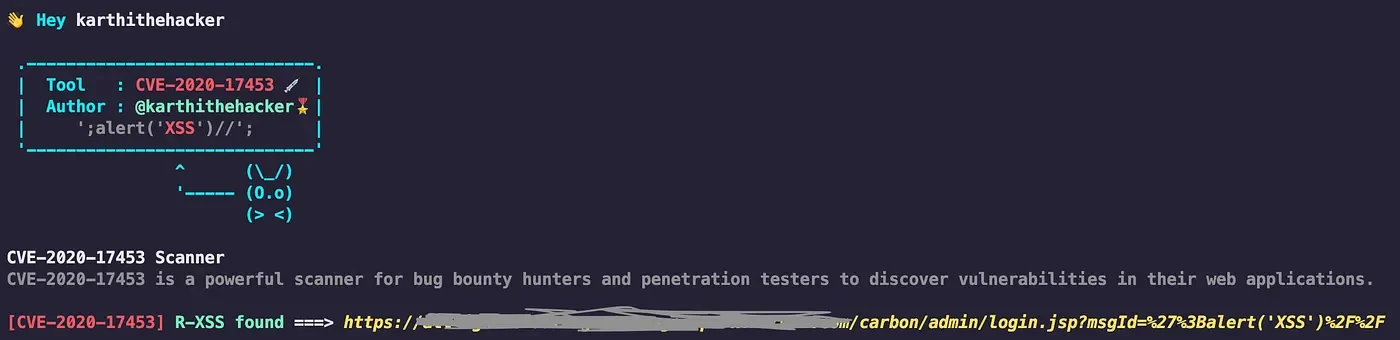
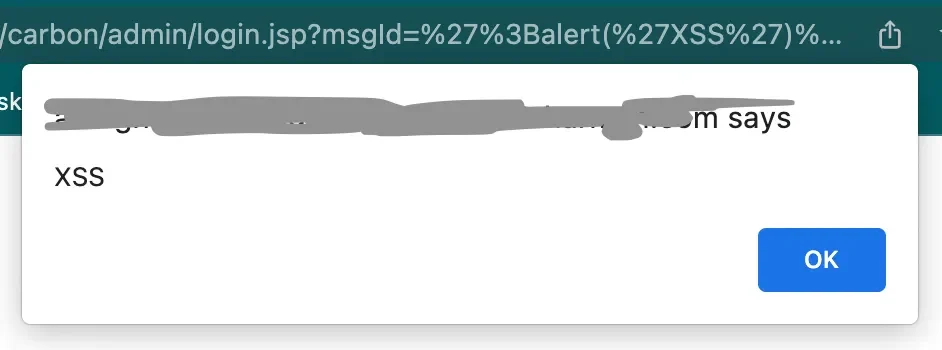
With over 35 subdomains in scope, manual testing of each one was not practical, so the author wrote a Node.js script to check every subdomain for the CVE automatically. The script flagged one subdomain as vulnerable and returned output containing the payload.
Exploitation
Step 1: enumerate subdomains and subdomains of subdomains
Use assetfinder for enumeration, then subsleuth for brute forcing to obtain additional, less commonly found results:
The point of the second tool is coverage: the most popular enumeration tool produces a list that many hunters share, so brute forcing adds names that are not on everyone's list.
Step 2: filter to live hosts
Feed the combined list to httpx to keep only active domains:
Step 3: load recon data into Burp
While automation runs, load all recon data into Burp with burpflow, which creates a proxy and imports the data in seconds. This lets manual testing proceed against the same host set without waiting for the automated scan.
Step 4: content discovery
Run Dirsearch against the hosts. This is where the redirect appeared: the URL /admin returns a 301 to /carbon/admin/login.jsp.
The redirect target is the WSO2 Carbon management console login. Login bypass and admin panel takeover attempts against it were all unsuccessful, so the author pivoted from authentication attacks to fingerprinting the product and looking for known issues in it.
Step 5: test every scoped domain for CVE-2020-17453
Rather than testing 35+ subdomains by hand, the author loaded all scoped domains into the CVE-2020-17453 testing tool. The script reported one subdomain as vulnerable and printed output containing the payload. The report does not include the exact payload string or the full HTTP response; the screenshots above show the tool output.
Root cause
CVE-2020-17453 is a reflected XSS in WSO2 Carbon, present in versions prior to 4.4.13, 4.5.0 to 4.5.7, 5.0.0 to 5.0.4, and 5.1.0 to 5.1.5. The author's explanation is that a crafted URL causes attacker-controlled script to be reflected back by the server and executed in the victim's browser in the context of the victim's session. The report does not describe the specific parameter or code path involved, so the precise reflection point is not stated here. The reason existing defences did not stop it is not described in the report.
Impact
Because the issue is reflected, exploitation requires a victim to follow a crafted link while authenticated to, or visiting, the vulnerable console. Under that condition the script runs in the victim's browser in the context of the console's origin, which the author frames as enabling theft of sensitive information such as session cookies, login credentials or personal data, and more generally cookie hijacking and data theft. The author does not demonstrate a specific post-exploitation chain, and the report does not state which user roles were exposed on the affected subdomain.
Fix
The author states that the vulnerability has since been patched in the affected versions of WSO2 Carbon, and that the episode is a reminder to keep software updated and patched. The author states the vulnerability has since been patched in the affected versions of WSO2 Carbon.
Variants to test
- Other Carbon consoles behind redirects. Any host where
/adminor a similar path redirects to/carbon/admin/login.jspis a candidate. A positive result is the testing tool flagging the host and returning output that contains the injected payload. - A positive result is a version banner or page artefact that falls inside the vulnerable ranges.
- Subdomain-of-subdomain discovery. Run brute forcing in addition to passive enumeration, since shared tooling produces shared lists. A positive result is a live host that does not appear in the passive output.
- Parallel manual and automated testing. Load recon data into Burp while the scanner runs, so that redirects and unusual paths found by content discovery can be examined by hand at the same time. A positive result is a redirect or path that the automated scan did not classify but that leads to a known product with known CVEs.
- Pivot from failed authentication attacks to product research. When login bypass attempts fail, fingerprint the product from the path structure and search for its CVEs. A positive result is a product identification that maps to a published vulnerability matching the observed version.
What happened, in plain words
A security researcher who takes part in bug bounty programmes received an email one weekend from a private company he works with regularly. The email said the company had updated its infrastructure. In bug bounty terms, "infrastructure" means the servers, web applications and supporting systems that run the company's online services. When a company changes that infrastructure, new software versions and new web addresses often appear, and some of them may contain bugs that were not there before. That makes an update a good moment to go looking.
The researcher started looking straight away. He knew that many other researchers were already testing the same company's web addresses, so finding something that nobody else had found would be the way to stand out and earn a reward. Bug bounty programmes pay a bounty, which is a cash reward, to people who find and report security problems responsibly.
During his search he found that one web address, /admin, automatically sent visitors to a different page, /carbon/admin/login.jsp. That second page looked like the login screen of an administration panel, the kind of page where staff sign in to manage a system. He tried several tricks to get past that login without a password, and none of them worked. So he changed approach: instead of attacking the login, he researched what software was behind that page. His research showed the application was using the WSO2 Management Console, and he came across information on a potential vulnerability, CVE-2020-17453. That flaw is a reflected cross-site scripting (XSS) bug.
He had more than 35 subdomains to check. A subdomain is a smaller address that belongs to a main domain, for example shop.example.com belongs to example.com. Testing each one by hand would have taken too long, so he wrote a small program in Node.js to test them all automatically. The program found one subdomain that was vulnerable and printed output containing the payload, which is the piece of code used to trigger the flaw. He then published the testing tool as open source so other people could use it.
What is XSS?
XSS stands for Cross-Site Scripting. It is a type of security flaw in web applications where an attacker can slip malicious code (usually JavaScript, the language browsers run) into a web page that other people will view. When a victim opens that page, the malicious code runs inside the victim's browser. Because the browser treats the code as if it came from the trusted website, the code can read things the browser holds for that site, such as session cookies (small pieces of data that keep you logged in), login credentials, or personal data.
A simple everyday comparison: imagine a noticeboard in an office where anyone can pin a message. If the board does not check what is pinned, someone could pin a note that says "hand your keys to the person at the door", and other staff might believe it because it is on the official board. XSS is similar: the website is the trusted board, and the attacker's script is the fake note.
The most common type is called Reflected XSS. In a reflected attack, the attacker sends a victim a link that contains a script. When the victim clicks the link, the server takes part of the link and sends it straight back into the page, so the script runs in the victim's browser as if the site itself had produced it. The script is "reflected" off the server, like a shout bouncing back from a wall.
What is CVE-2020-17453?
CVE stands for Common Vulnerabilities and Exposures. It is a public catalogue where each known security flaw gets a unique identifier, so that researchers, vendors and defenders can all refer to the same problem by the same name. CVE-2020-17453 is the identifier for a reflected XSS vulnerability found in WSO2 Carbon, the software platform that includes the WSO2 Management Console. The affected versions are those prior to 4.4.13, 4.5.0 to 4.5.7, 5.0.0 to 5.0.4, and 5.1.0 to 5.1.5.
The flaw lets an attacker inject and run malicious code in a victim's browser by tricking the victim into visiting a specially crafted URL. The consequences described are potential data theft, cookie hijacking (stealing the data that keeps a user logged in) and other malicious activity.
To automate the testing, the researcher wrote a script in Node.js, a runtime that lets JavaScript run outside a browser, to test each subdomain for this vulnerability. The script eventually found one vulnerable subdomain and produced output containing the payload.
The tactics I use for recon
Recon, short for reconnaissance, is the information-gathering phase before any testing. It is like casing a building before deciding which door to try. The researcher's process has five steps.
- Step one: Find subdomains, and subdomains of subdomains. He uses a tool called assetfinder for enumeration (listing names). Because many other researchers use the same tool, he also brute-forces subdomain names, meaning he tries a large list of common names to see which ones exist. For that he uses subsleuth, a tool designed for subdomain brute forcing and for discovering subdomains of subdomains.
- Step two: Check which of the discovered subdomains are actually alive and responding. He uses httpx for this.
- Step three: While the automated tools run, he also performs manual attacks. To make that easier, he loads all the recon data into Burp, a popular tool for inspecting and modifying web traffic, using a helper called burpflow. Burpflow creates a proxy (an intermediary that sits between the browser and the website) and loads the data into Burp in seconds.
- Step four: He performs content discovery and directory brute forcing with Dirsearch. This is how he found that the URL
/adminreturns a 301 redirect to/carbon/admin/login.jsp. - Step five: He uses his own CVE-2020-17453 testing tool and loads all the in-scope domains into it.
After confirming the vulnerability, he released the tool as an open-source resource so other security enthusiasts could use it to find similar issues on other websites and applications.
Tool Info
Github Link: https://github.com/karthi-the-hacker/CVE-2020-17453
Conclusion
The researcher notes that the vulnerability has since been patched in the affected versions of WSO2 Carbon. He uses the episode as a reminder of how important it is to keep software updated and patched, and says security professionals must stay vigilant to identify and reduce security risks.
The steps in detail
Step 1: enumerate subdomains and subdomains of subdomains
Enumeration means making a list of everything that exists in a given area. Here the area is the company's domain names. The researcher runs assetfinder to collect subdomains passively, then subsleuth to brute-force additional names.
Line by line:
assetfinder --subs-only example.comruns the assetfinder tool against the domainexample.com. The--subs-onlyoption tells it to print only subdomains, not the main domain or other findings. The tool gathers names from public sources, so it is quick but limited to what is already publicly known.subsleuth example.comruns the subsleuth tool against the same domain. It tries a large list of possible names to see which ones resolve, which can reveal subdomains that passive sources miss.
The reason for using both is coverage. The most popular enumeration tool produces a list that many researchers share, so brute forcing adds names that are not on everyone else's list. Finding a host that other people have not noticed is the whole point of recon.
Step 2: filter to live hosts
Not every name in the list will point to a working server. httpx checks each one and keeps only the ones that respond.
Line by line:
httpxruns the httpx tool, which sends a request to each host and reports whether it is alive and what it looks like.-l subdomains.txttells it to read the list of hosts from the filesubdomains.txt, one per line.
The reason for this step is to avoid wasting time on names that do not resolve or do not answer. Only live hosts are worth testing further.
Step 3: load recon data into Burp
While the automated tools run, the researcher loads all the recon data into Burp using burpflow. Burp is a tool that lets you watch and change the requests your browser sends and the responses it receives. Burpflow creates a proxy and imports the data in seconds. The reason is to let manual testing happen against the same set of hosts at the same time as the automated scan, so nothing is missed while waiting for the scanner to finish.
Step 4: content discovery
Content discovery means looking for pages, folders and files that are not linked from the main site. Dirsearch does this by trying a long list of common paths. This is where the interesting redirect appeared: the URL /admin returns a 301 redirect to /carbon/admin/login.jsp.
Line by line:
GET /admin HTTP/1.1is the request line.GETis the method used to ask for a page./adminis the path being requested.HTTP/1.1is the version of the web protocol being used.Host: [redacted]is a header that tells the server which website name the request is for. One server can host many sites, so the server needs to know which one you want. The actual host name is hidden here.- The blank line separates the request headers from the body. A
GETrequest normally has no body. HTTP/1.1 301 Moved Permanentlyis the status line of the response.301is a status code meaning the page has permanently moved to a new address.Location: /carbon/admin/login.jspis the header that gives the new address. The browser follows it automatically, which is why the visitor ends up on the login page.
The redirect target is the login page of the WSO2 Carbon management console. The researcher tried various login bypass and admin panel takeover techniques against it, and none succeeded. So he pivoted: instead of attacking the login, he identified the product from the path and looked for known issues in that product. This is a common and useful shift. When one door will not open, find out what kind of building you are standing in front of.
Step 5: test every scoped domain for CVE-2020-17453
Rather than testing more than 35 subdomains by hand, the researcher loaded all in-scope domains into his CVE-2020-17453 testing tool. The script reported one subdomain as vulnerable and printed output containing the payload. The report does not include the exact payload string or the full HTTP response; the screenshots above show the tool output.
Why the flaw exists
CVE-2020-17453 is a reflected XSS in WSO2 Carbon, present in versions prior to 4.4.13, 4.5.0 to 4.5.7, 5.0.0 to 5.0.4, and 5.1.0 to 5.1.5. The researcher's explanation is that a crafted URL causes attacker-controlled script to be reflected back by the server and executed in the victim's browser in the context of the victim's session. The report does not describe the specific parameter or code path involved, so the precise reflection point is not stated. The reason existing defences did not stop it is likewise not described. The report does not describe why existing defences did not stop it.
What the impact is
Because the issue is reflected, exploitation requires a victim to follow a crafted link while logged in to, or visiting, the vulnerable console. Under that condition the script runs in the victim's browser in the context of the console's origin, which the researcher frames as enabling theft of sensitive information such as session cookies, login credentials or personal data, and more generally cookie hijacking and data theft.
How to fix it
The researcher states that the vulnerability has since been patched in the affected versions of WSO2 Carbon, and that the episode is a reminder to keep software updated and patched. The researcher states the vulnerability has since been patched in the affected versions of WSO2 Carbon.
Variants to test
- Other Carbon consoles behind redirects. Any host where
/adminor a similar path redirects to/carbon/admin/login.jspis a candidate. A positive result is the testing tool flagging the host and returning output that contains the injected payload. - A positive result is a version banner or page artefact that falls inside the vulnerable ranges.
- Subdomain-of-subdomain discovery. Run brute forcing in addition to passive enumeration, since shared tooling produces shared lists. A positive result is a live host that does not appear in the passive output.
- Parallel manual and automated testing. Load recon data into Burp while the scanner runs, so that redirects and unusual paths found by content discovery can be examined by hand at the same time. A positive result is a redirect or path that the automated scan did not classify but that leads to a known product with known CVEs.
- Pivot from failed authentication attacks to product research. When login bypass attempts fail, fingerprint the product from the path structure and search for its CVEs. A positive result is a product identification that maps to a published vulnerability matching the observed version.
Glossary
- Bug bounty programme: A scheme run by a company that pays people a reward for finding and reporting security problems in its systems.
- Bounty: The cash reward paid for a valid security report.
- Infrastructure: The servers, applications and supporting systems that run a company's online services.
- Recon (reconnaissance): The information-gathering phase before testing, such as listing subdomains and finding live hosts.
- Subdomain: A smaller address that belongs to a main domain, for example
shop.example.comunderexample.com. - Enumeration: Making a list of everything that exists in a given area, such as all subdomains of a domain.
- Brute forcing: Trying a large list of possible names or values to see which ones exist or work.
- Live host: A server or web address that responds to requests.
- Proxy: An intermediary that sits between a browser and a website and can inspect or change the traffic.
- Redirect: A response that tells the browser to go to a different address instead.
- Status code 301: An HTTP response code meaning the page has permanently moved to a new address.
- HTTP header: A line of extra information sent with a request or response, such as the host name or the new location after a redirect.
- Admin panel: A web page where staff sign in to manage a system.
- Login bypass: An attempt to get into a system without valid credentials.
- WSO2 Carbon: A software platform that includes the WSO2 Management Console.
- WSO2 Management Console: The administrative web interface of WSO2 Carbon.
- CVE: Common Vulnerabilities and Exposures, a public catalogue where each known security flaw gets a unique identifier.
- XSS (Cross-Site Scripting): A flaw where an attacker can inject code into a web page that other people view, so the code runs in their browsers.
- Reflected XSS: A type of XSS where the attacker's script is sent back by the server through a crafted link and runs in the victim's browser.
- Payload: The piece of code or data used to trigger a vulnerability.
- JavaScript: The programming language that browsers run to make web pages interactive.
- Node.js: A runtime that lets JavaScript run outside a browser.
- Session cookie: A small piece of data stored by the browser that keeps a user logged in to a site.
- Cookie hijacking: Stealing a user's cookie so the attacker can act as that user.
- Patch: A software update that fixes a known problem.
- Open source: Software whose code is published so anyone can use or study it.
- assetfinder: A tool for listing subdomains from public sources.
- subsleuth: A tool for brute-forcing subdomain names and discovering subdomains of subdomains.
- httpx: A tool that checks which hosts are alive and reports what they look like.
- Burp: A tool for inspecting and changing web traffic between a browser and a website.
- burpflow: A helper that creates a proxy and loads recon data into Burp quickly.
- Dirsearch: A tool for content discovery and directory brute forcing.
- Content discovery: Looking for pages, folders and files that are not linked from the main site.
- Fingerprinting: Identifying what software and version a system is running from clues such as paths and page content.






