Unleashing the Power of Recon: How I Earned $2500 in 5 Minutes
The target application was running Apache Struts 2 and was vulnerable to CVE-2017-5638, an OGNL injection flaw. An attacker could exploit this to achieve remote code execution and take server-level control.
 Published on infosecwriteups.com
In this write-up, I’ll share the thrilling tale of how I earned $2500 within a mere 5 minutes of recon in a private bug bounty program. As a dedicated security researcher, my passion lies in breaking security barriers and ethically reporting my findings to organizations.
The full write-up lives on its author's site
It belongs to its author, so we link to it rather than copy it. The other two tabs are our own rewrites, checked against it.
Context
This is a write-up of a private bug bounty engagement in which the researcher earned $2500 after roughly five minutes of reconnaissance. The report does not name the target, the program or the application, and it does not describe what the application does for its users. What it does describe is the technology stack: during spidering, the researcher found files with the extensions .do, .action and .jsp, and Wappalyzer indicated that the backend was likely built on Apache Struts 2.
The researcher normally focuses on account takeover vulnerabilities, but this engagement offered no apparent authentication actions to attack, so the focus shifted to remote code execution. The specific weakness pursued was OGNL (Object-Graph Navigation Language) injection in Struts 2, tracked as CVE-2017-5638, which can give an attacker server-level control through RCE.
Setup
The report lists only a small set of tools and preconditions:
- Burp Suite, used for spidering and for automating the scan.
- The Wappalyzer browser extension, used to fingerprint the backend technology.
- A scope defined in Burp Suite, delimiting the target application.
- A private bug bounty program in which the target was in scope.
No versions of Burp Suite, Struts or any other component are given, and no account or role was needed for the steps shown.
Finding it
While spidering the application with Burp Suite, the researcher noticed files ending in .do, .action and .jsp. Those extensions are a strong hint of a Java web application, and in combination with the Wappalyzer result pointing at Apache Struts 2, they suggested that the OGNL injection of CVE-2017-5638 was worth testing for. The researcher then set out to look for that vulnerability specifically, with the goal of reaching RCE.
Exploitation
The approach was to automate the search rather than test by hand, so that a vulnerable endpoint would announce itself through a distinctive response header.
Step 1: define the scope in Burp Suite
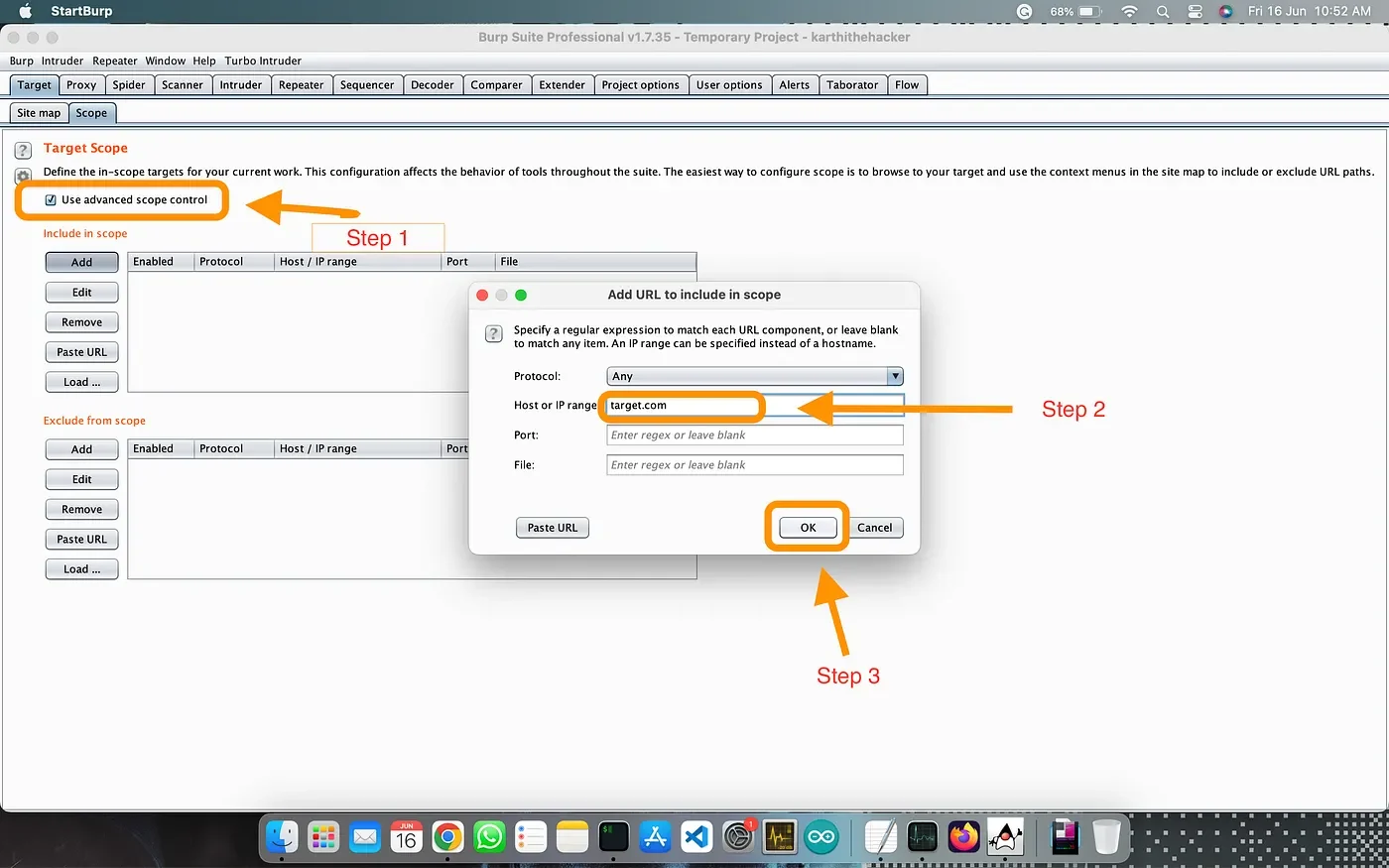
The first step was to set the scope in Burp Suite, clearly defining the boundaries of the target application. This keeps the spider and any automated checks inside the authorised surface.
Step 2: configure the Spider with OGNL payloads
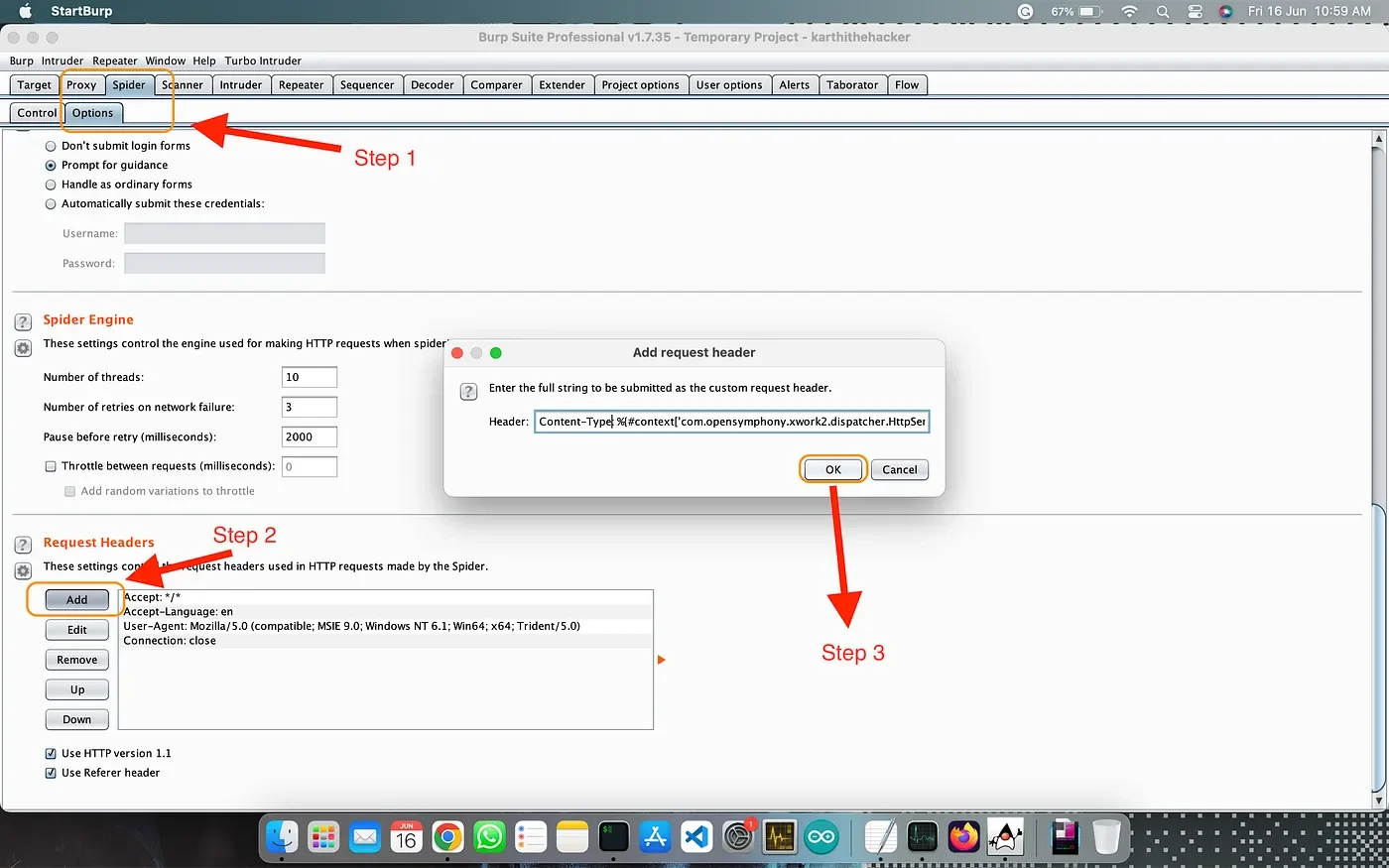
The next step was to navigate to the Spider tab and inject OGNL payloads into the specified content types. The report does not reproduce the payloads inline; it links to the researcher's payload collection, PayloadAllTheThings, on GitHub, as the source of the payloads used.
Step 3: run the spider
With the payloads configured, the researcher initiated the spidering process to systematically scan the target application.
Step 4: detect the vulnerable response
If the application is vulnerable, a distinctive response header is observed, featuring the value karthithehacker. That marker is how the automated scan distinguishes a hit from ordinary traffic: That marker is how the automated scan distinguishes a hit from ordinary traffic: a response carrying that value is the signal the report uses to identify the vulnerability..
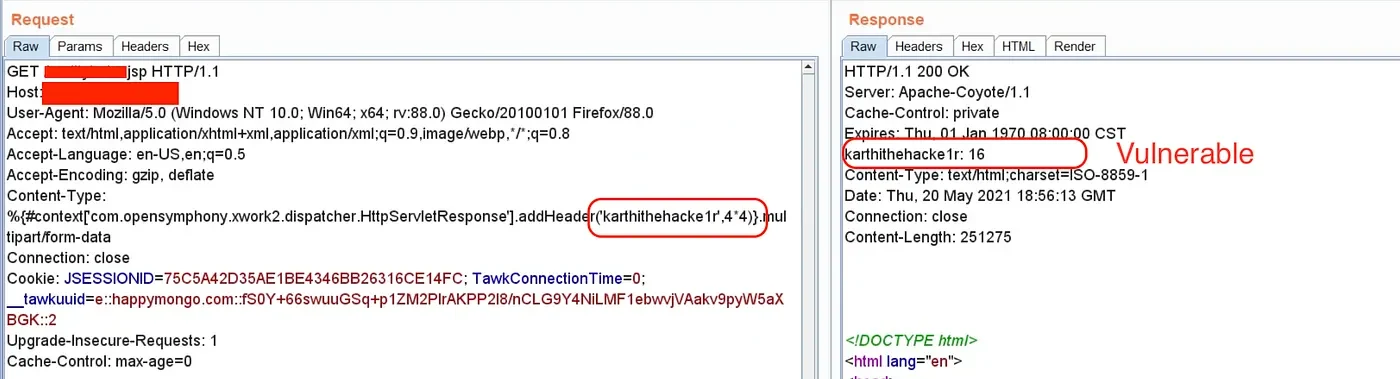
The report states that this automated procedure identified CVE-2017-5638 within about five minutes of reconnaissance, and that the finding was paid $2500. The report does not include the raw request or response that triggered the header, nor the exact payload string that produced it.
Root cause
CVE-2017-5638 is an OGNL injection in Apache Struts 2. The report does not analyse the vulnerable code path itself; it identifies the technology from file extensions and a Wappalyzer fingerprint, then confirms the vulnerability by observing the marker header in a response. The report does not state which Struts 2 version was in use or which patch level was missing.
Impact
The report frames the impact as server-level control through remote code execution: an attacker who can reach a vulnerable endpoint could execute code on the server rather than merely read or modify application data. The researcher's own demonstration stops at the marker header, which proves evaluation of the injected expression. The finding was paid $2500.
Fix
Its conclusion is general: organisations should adopt stringent security measures, prioritise patch management and foster a culture of proactive vulnerability management, because CVE-2017-5638 shows the consequences of leaving remote code execution flaws unaddressed.
Variants to test
- Other Struts 2 applications behind
.actionor.doendpoints. Fingerprint the stack with Wappalyzer or by inspecting URL extensions, then send OGNL payloads in the content types the Spider was configured for. A positive result is a response header carrying the value you injected. - Automated spidering with a marker value. Set a unique, harmless string as the OGNL expression result and spider the scoped application. Any response containing that string in a header is a candidate hit.
- Endpoints missed by the spider. The report's method depends on the spider reaching the vulnerable endpoint; manually replaying the same payloads against endpoints discovered by other means is a reasonable extension, with the same marker-header signal as the success criterion.
The payloads used are collected in the researcher's PayloadAllTheThings repository, linked from the report.
What happened, in plain words
A security researcher spent about five minutes looking around a website that was part of a private bug bounty program, and walked away with $2500. A bug bounty program is an arrangement where a company invites outside people to try to break its systems, and pays them when they report a real problem instead of exploiting it. "Private" means you can only take part if you have been invited.
The researcher did not find a way to log in as someone else, which is what they usually look for. Instead they found a remote code execution flaw in the company's server software. That kind of flaw is called remote code execution, or RCE: the attacker gets the server to execute code, which is far more serious than reading or changing data through the normal features of the site.
The report does not name the company, the program or the website, and it does not say what the website is for. It does say which building blocks the site was made of, and that is what made the attack possible.
The background you need first
Before the steps make sense, a few ideas need explaining from scratch.
What a web server and a web application are
When you open a website, your browser sends a request over the internet to a computer called a server, and the server sends back a response, usually a page of HTML (the language web pages are written in). A web application is a site where the server does more than hand over fixed files: it builds the page on the fly, based on what you asked for. A shop that shows your basket, or a site that shows your profile, is a web application.
A useful comparison: a static website is like a vending machine that always drops the same item for the same button. A web application is like a counter assistant who reads your order, checks the stock room and puts something together for you.
What a URL, an endpoint and a parameter are
A URL is the address you type in the browser, such as https://example.com/shop/item. An endpoint is a specific address on the server that does a specific job, like the counter you walk up to. A parameter is a piece of information you attach to the request, such as a search term or an item number, so the server knows what you want. In a URL, parameters often appear after a question mark, like ?id=42.
What file extensions tell you
A file extension is the part after the last dot in a filename, like .jpg for a photo or .pdf for a document. On the web, the extension in a URL often hints at what software produced the page. The researcher noticed pages ending in .do, .action and .jsp. Those three endings are typical of web applications written in the Java programming language. Seeing them is like noticing that a restaurant's menu is printed in a particular style: it does not prove which kitchen is behind it, but it narrows it down a lot.
What a backend and a framework are
Everything the server does behind the scenes is called the backend. A framework is a ready-made set of building blocks that developers use so they do not have to write everything from scratch. Apache Struts 2 is one such framework, used to build Java web applications. The researcher's evidence pointed at Struts 2 being the framework in use.
What Wappalyzer is
Wappalyzer is a browser extension, meaning a small add-on you install in your browser. It looks at the pages you visit and tries to guess which technologies the site is built with, such as which framework, which web server or which analytics service. It is a fingerprinting tool: it does not break anything, it just recognises clues. The researcher used it to gather further insight into the backend technology.
What a vulnerability and a CVE are
A vulnerability is a weakness in software that someone can abuse to make it behave in a way the developers did not intend. A CVE is a public catalogue number for a known vulnerability, so that everyone can refer to the same flaw unambiguously. CVE-2017-5638 is the number of a specific flaw in Apache Struts 2, published in 2017.
What OGNL injection means
OGNL stands for Object-Graph Navigation Language. It is a small expression language used inside Java applications, including Struts 2, to look up values and run simple expressions. Think of it as a formula the application evaluates, like a spreadsheet cell that says =2+2 and shows 4.
Injection means that an attacker manages to slip their own formula into a place where the application expected ordinary data. If the application takes something the attacker sent and evaluates it as an OGNL expression instead of treating it as plain text, the attacker's formula runs on the server. That is OGNL injection, and in the Struts 2 case of CVE-2017-5638 it can lead all the way to remote code execution.
What Burp Suite and spidering are
Burp Suite is a tool used by security testers. It sits between your browser and the website, so you can see and change every request and response. One of its features is a spider: a program that automatically crawls a website, following links from page to page, and builds a map of everything it can reach. The comparison is a librarian walking through every aisle and noting every book, instead of only reading the ones you hand them.
What a response header is
Every response from a server has two parts: the body, which is the page you see, and headers, which are small labelled lines of extra information about the response, such as what type of content it is. Headers are like the label on a parcel: not the contents, but information about them. The researcher's trick relies on getting a chosen word to appear in one of those labels.
The setup
The report lists only a few things that were needed:
- Burp Suite, used to crawl the site and to automate the scan.
- The Wappalyzer browser extension, used to identify the backend technology.
- A scope defined in Burp Suite, marking out which parts of the site were allowed to be touched.
- A private bug bounty program in which the target was in scope, meaning the company had authorised testing on it.
Scope matters: it is the difference between testing your own house and wandering into the neighbour's. Everything described here happened inside the authorised boundary. The report gives no version numbers for Burp Suite, Struts or anything else, and no login or account was needed for the steps shown.
Finding it
While crawling the application with Burp Suite, the researcher noticed files ending in .do, .action and .jsp. As explained above, those extensions point strongly at a Java web application. Combined with Wappalyzer's result suggesting Apache Struts 2, they made CVE-2017-5638 worth testing for. The researcher then went looking for that specific flaw, with the aim of reaching remote code execution.
Why this order? Because testing blindly is slow and noisy. Recognising the technology first turns a huge space of possible attacks into one specific, well-documented candidate.
Exploitation
The plan was to automate the search rather than test page by page by hand. The idea: send the OGNL payloads to many pages automatically, and have the server itself tell you when one of them worked, by putting a distinctive word into a response header.
Step 1: define the scope in Burp Suite
The first step was to set the scope in Burp Suite, clearly defining the boundaries of the target application. This keeps the spider and any automated checks inside the authorised surface, so the tool does not wander onto sites that are out of bounds.
Step 2: configure the Spider with OGNL payloads
The next step was to go to the Spider tab and inject OGNL payloads into the specified content types. A content type is the label a request carries saying what kind of data it holds, for example a form submission or a file upload. Putting the payload into the content types the Spider was configured for means the automated requests carry the formula where the vulnerable code might evaluate it.
The report does not reproduce the payloads inline. It links to the researcher's own collection of payloads, PayloadAllTheThings, on GitHub, as the source of the ones used.
Step 3: run the spider
With the payloads configured, the researcher started the spidering process, which systematically scanned the target application. In plain terms: the tool walked the site automatically, sending the prepared requests as it went, instead of the researcher clicking through pages one at a time.
Step 4: detect the vulnerable response
If the application is vulnerable, a distinctive response header is observed, carrying the value karthithehacker. That word is the researcher's chosen marker. The word is the researcher's chosen marker: if the application is vulnerable, a response header carries that value, which is how the automated scan spots a hit.
A comparison: instead of asking the server "are you vulnerable?" and trusting the answer, you ask it to write your name on the envelope. If the envelope comes back with your name on it, you know it did what you asked.
The report states that this automated procedure identified CVE-2017-5638 within about five minutes of reconnaissance, and that the finding was paid $2500. It does not include the raw request or response that produced the header, nor the exact payload string that triggered it.
Why it worked
CVE-2017-5638 is an OGNL injection in Apache Struts 2. The report does not analyse the vulnerable code path itself. It identifies the technology from file extensions and a Wappalyzer fingerprint, then confirms the flaw by seeing the marker header come back. The report does not say which Struts 2 version was in use or which patch was missing.
What the impact is
The report frames the impact as server-level control through remote code execution: someone who can reach a vulnerable endpoint could run code on the server, not merely read or change application data. The researcher's own demonstration stops at the marker header, which proves the injected expression was evaluated. The finding was paid $2500.
How it should be fixed
Its conclusion is general: organisations should adopt stringent security measures, prioritise patch management and foster a culture of proactive vulnerability management, because CVE-2017-5638 shows the consequences of leaving remote code execution flaws unaddressed. Patch management means keeping software up to date with the vendor's fixes.
Similar things worth testing
- Other Struts 2 applications behind
.actionor.doendpoints. Identify the technology with Wappalyzer or by looking at URL extensions, then send OGNL payloads in the content types the Spider was configured for. A positive result is a response header carrying the value you injected. - Automated spidering with a marker value. Choose a unique, harmless string as the result of the OGNL expression and spider the in-scope application. Any response containing that string in a header is a candidate hit.
- Endpoints the spider missed. This method depends on the spider reaching the vulnerable endpoint; replaying the same payloads against endpoints found another way is a reasonable extension, with the same marker-header signal as the success criterion.
The payloads used are collected in the researcher's PayloadAllTheThings repository, linked from the report.
Glossary
- Backend: everything the server does behind the scenes, as opposed to what you see in the browser.
- Bug bounty program: an arrangement where a company invites outside researchers to find and report security problems in exchange for payment.
- Burp Suite: a tool that sits between your browser and a website so you can view, change and automate requests and responses.
- Content type: a label on a request or response saying what kind of data it carries, such as a form submission or a file upload.
- CVE: a public catalogue number for a known vulnerability, so everyone can refer to the same flaw.
- Endpoint: a specific address on a server that performs a specific job.
- File extension: the part of a filename after the last dot, such as
.jpgor.jsp, often hinting at the software involved. - Framework: a ready-made set of building blocks developers use to build an application.
- Header: a small labelled line of extra information attached to a request or response, separate from the page content.
- HTML: the language web pages are written in.
- Java: a programming language commonly used for large web applications.
- OGNL (Object-Graph Navigation Language): a small expression language used inside Java applications, including Struts 2, to look up values and evaluate expressions.
- OGNL injection: slipping your own OGNL expression into data the application processes, so the server evaluates it as code.
- Parameter: a piece of information attached to a request, such as a search term or an item number.
- Patch management: keeping software up to date with the vendor's security fixes.
- Private bug bounty program: a bounty program you can only take part in if invited.
- Remote code execution (RCE): a flaw that lets an attacker make a server run code of their choosing.
- Response: what a server sends back to a browser after a request.
- Reverse shell: a way of getting an interactive command line back from a server you have compromised.
- Scope: the defined boundary of what you are authorised to test.
- Server: the computer that answers requests from browsers.
- Spider: a tool that automatically crawls a website, following links to map everything it can reach.
- Apache Struts 2: a framework for building Java web applications.
- URL: the address of a page or resource on the web.
- Vulnerability: a weakness in software that can be abused to make it behave unexpectedly.
- Wappalyzer: a browser extension that guesses which technologies a website is built with.



